


The payment clock starts with the invoice, not the photo shoot. With Net 30 terms, payment is due in full 30 days after the invoice date. Net 30 accounts for photography businesses can also support business credit building when the vendor reports account activity to business credit bureaus.
That timing matters when you’re balancing client payments with the cost of running your studio. A Net 30 supplier account gives your business time to pay for an order, but the terms don’t automatically mean the account will help build credit. The vendor’s reporting practices and your payment history matter.
Learn when the payment period begins, what information a vendor may request, and how an account moves from application to order, payment, and reporting. You’ll also see how to use supplier tradelines thoughtfully and what to keep in mind as your photography business establishes its business credit profile.
Key Takeaways
- Start the Net 30 countdown from the invoice date and use the stated due date to plan payment.
- Understand what business details a supplier may request before opening a terms account.
- Look beyond payment timing: a supplier account supports credit building only when account activity is reported.
- Compare account requirements, order minimums, and reporting practices before choosing a vendor.
- Use a numbered checklist to organize the application, first order, payment, and reporting steps.
Requirements vendors may ask for when opening accounts
Net 30 vendors set their own application criteria, so requirements can differ by seller. A photography business may be asked for its legal business name, EIN, business address, and contact details. The application may also request information about the owner or the business’s operating history. Read each field carefully and use consistent business details.
To apply, choose a vendor, complete its business application, provide the requested information, review the payment terms, and submit the application for a decision. If approved, follow the seller’s instructions to place an order and confirm when the invoice is due.
- Gather your business’s legal name, EIN, business address, and contact information.
- Review the application to see whether it asks for formation or ownership details.
- Read the account terms, including the invoice date and the date payment is due.
- Submit the application, then follow the vendor’s process for ordering and paying.
For example, a photography LLC should use its registered business name consistently instead of switching between that name and a studio brand. If the form asks for an EIN, enter the business identifier in the field provided. An application may also request owner information, even when the business applies as an LLC.
Some vendors may request supporting documents or payment details as part of their process. The application itself determines what to provide. Keep a copy of the submitted information and the account terms, so you can refer to the agreed due date after ordering. Net 30 means the invoice is due 30 days after its invoice date, not automatically 30 days after a client pays for a photo session.
Net 30 account options can vary across the United States because each seller sets its own eligibility and account rules. A vendor may also define which businesses or locations it serves. Review the application’s stated coverage and terms for your business address before submitting.
New businesses should pay close attention to questions about business age and credit history. If a field asks how long the company has operated, answer accurately; don’t substitute the owner’s photography experience for the LLC’s time in business. If the vendor asks about payment history, answer the question as written rather than assuming every account uses the same criteria.
Before submitting, check for mismatched details, incomplete fields, and unclear payment terms. A correct EIN paired with a different legal name can create avoidable confusion. Confirm that the invoice date starts the 30-day period and note how the seller delivers invoices. Clear records help you manage the account from application through payment.
How net-30 supplier accounts work
A supplier account follows a straightforward cycle: the business applies, places an order, receives an invoice, pays by the due date, and may build a payment record. The seller’s terms explain when billing begins and whether account activity is reported. Read them before ordering so you can plan for the due date.
After approval, the business places an order under the account’s conditions. The seller issues an invoice, and Net 30 generally makes the full balance due 30 days after the invoice date. The seller generally starts that period when the invoice is delivered. Net-30 deadlines typically use calendar days, so weekends and holidays count.
- Apply. Submit the requested business details and review the seller’s account terms.
- Order. Place an order within the account’s conditions and keep its confirmation.
- Review billing. Record the invoice date, amount due, and payment deadline.
- Pay. Pay the full invoice by its due date using the seller’s accepted method.
- Repeat. Keep records for each order and track whether the seller reports account activity.
For example, a photography studio that orders branded apparel should record the invoice when it arrives, not wait until a client pays for a portrait package. The Net 30 period runs from the invoice date, not from the day the studio’s customer pays. Use the invoice’s stated due date to plan payment.
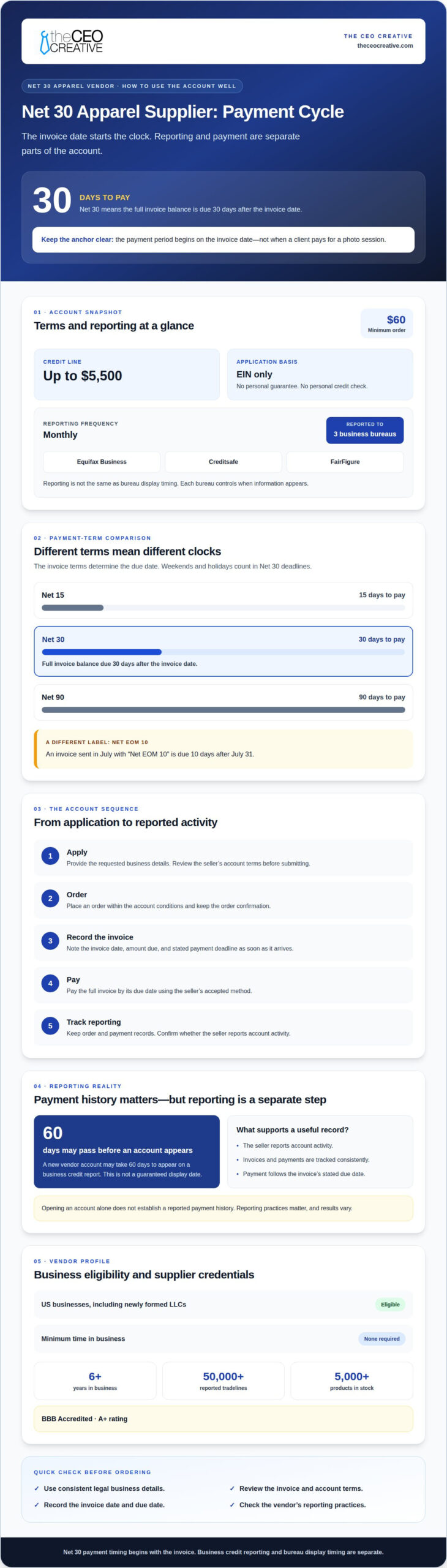
Terms can differ. Net 15 gives the customer 15 days to pay, while Net 90 gives 90 days. An end-of-month example works differently: an invoice sent in July with “Net EOM 10” is due 10 days after July 31. These labels affect the due date, so don’t assume every supplier’s billing cycle works the same way.
Paying on time matters to account management, but reporting is a separate step. A seller may report account activity to business credit bureaus, and each bureau controls when that information appears. A new vendor account may take 60 days to appear on a business credit report. Keep invoices and payment records so you can track orders while bureau records update.
Before opening an account, review the seller’s payment terms and reporting details together. A business Net 30 account can be considered as part of that supplier-account review.
Net-30 vendor accounts for business credit building
A Net 30 vendor account can support business credit building when the seller reports account activity to business credit bureaus. The account creates a record connected to a supplier purchase and its payment. Opening an account alone doesn’t establish a reported payment history; reporting practices matter.
For a photography business, a relevant purchase might be branded apparel for a studio team or printed materials for client presentations. The business places an actual supplier order through the account, then pays according to the invoice terms. This ties credit activity to a practical business expense.
Reporting is a separate part of the process. The seller sends account information to one or more bureaus, which maintain business credit files. A new vendor account may take 60 days to appear on a business credit report. That delay means a missing tradeline shortly after an order doesn’t necessarily show what will appear later.
Payment history can help build credit only if the account is reported and the business details match its credit profile. Differences in the legal business name or other identifying information can make records harder to match. Use the same business name and EIN on supplier applications, invoices, and payment records.
Net 30 vendor accounts differ from business credit cards and other financing. A vendor account is tied to purchases from that seller, with payment due under the supplier’s invoice terms. A card or financing arrangement follows its own agreement and purpose, rather than documenting a particular supplier purchase.
Some business owners find it helpful to begin with three to five Net 30 accounts that report to multiple bureaus. Treat that as a planning approach, not a required target. Choose accounts that fit real business needs, and consider the reporting destinations alongside the order terms. Several accounts that don’t fit the studio’s spending can add unnecessary purchasing and payment tasks.
For example, a portrait photographer could use one supplier account for printed business materials and another for branded team apparel, if those purchases serve the business. Track each account separately. The invoices may have different dates, balances, and reporting practices, even when both use Net 30 terms.
Build a routine around accurate records: retain invoices, record payment dates, and review business credit reports for account activity. Keep expectations measured. Reporting is monthly when a vendor’s terms say so, while bureau display timing is controlled by each bureau. A business Net 30 account is one supplier-account option to consider when the purchase and credit-building purpose align.
Which vendors offer Net 30 accounts for photography businesses?
Photography businesses can look for Net 30 terms from suppliers whose products support studio operations, client work, or business promotion. Relevant categories include apparel, office supplies, technology, printed materials, and promotional products. The key distinction is that a supplier must offer payment terms, not merely sell useful products.
Apparel and embroidery suppliers can fit studios that outfit staff or create branded clothing for events. A photographer ordering shirts for an assistant team should consider whether the order serves an actual business need. A Net 30 apparel vendor is one category to consider for planned branded clothing purchases. Printed materials and promotional-product suppliers can also suit studios that use branded items in client meetings or marketing campaigns.
Office and technology suppliers can serve different business needs. A studio might use a vendor account for office essentials, while a technology supplier may suit a business buying equipment-related products it already needs. The product category alone does not establish credit-building value. The seller’s account terms and reporting practices determine whether activity may contribute to a business credit file.
Compare potential vendors using a consistent process:
- Match the supplier’s product category to a planned business purchase.
- Read the Net 30 terms and identify the invoice date used to calculate the due date.
- Find out whether the seller reports account activity to business credit bureaus.
- Record any order minimums and application requirements before opening an account.
Reporting deserves particular attention. A supplier account can document a payment relationship only when the seller reports account activity. A new vendor account may take 60 days to appear on a business credit report, so a tradeline may not show immediately after an order. Keep invoices and payment records while the account history develops.
Some business owners find it useful to begin with three to five Net 30 accounts that report to multiple bureaus. That approach can help organize vendor selection, but each account should still match a real purchase. A portrait studio, for example, could consider a print supplier for client-facing materials and an apparel supplier for staff clothing. Avoid orders made only to create activity.
There is no single vendor category that fits every photography business. A wedding photographer, school portrait studio, and commercial studio can have different purchasing needs. Start with the expense the business already plans to make, then identify suppliers offering Net 30 terms in that category. Compare reporting and invoice rules alongside product fit. This keeps account selection tied to the studio’s operations rather than to credit-building alone.
What are typical fees, minimum orders, and payment terms for Net 30 vendor accounts?
Net 30 accounts don’t share one standard fee or order minimum. Each seller sets the account terms, so compare the fee structure, purchase threshold, and invoice deadline before ordering. Separate account charges from the cost of the goods. That distinction helps a photography business understand what it owes and when.
Review the agreement for application, membership, or late-payment charges. Don’t assume an account has no fee because the seller advertises Net 30. Likewise, an order minimum is not an account fee. Check that threshold against a planned business purchase before submitting an order.
Net 30 means the full invoice is due 30 days after its invoice date. The seller generally starts the payment period when the invoice is delivered. Net deadlines typically use calendar days, so weekends and holidays count. Record the invoice date and due date together, then plan payment around the written terms.
Some sellers offer early-payment discounts alongside a due date. With 2/10 net 30 terms, a buyer may receive a 2% discount by paying within 10 days; otherwise, the full invoice is due within 30 days. A 3/10 net 30 term offers a 3% discount for payment within the first 10 days, with the full balance due within 30 days otherwise.
Other labels set a different discount window or payment deadline. Under 2/10 net 45, a 2% discount applies when payment arrives within 10 days, and the full amount is due within 45 days. Under 3/20 net 60, a 3% discount applies within 20 days, with the full balance due within 60 days. Read both parts of the label before calculating payment.
Use this quick review before accepting terms:
- Identify every stated account or payment charge.
- Confirm the minimum order and whether it fits a planned purchase.
- Locate the invoice date that starts the payment period.
- Check whether an early-payment discount changes the amount or deadline.
- Record the full due date, including calendar days that fall on weekends or holidays.
A photography studio comparing two supplier offers should assess total account charges, minimum order, and payment timing together. A smaller minimum may suit occasional purchases, while a discount only helps if the studio can pay within its stated window. Use the written terms to make that decision, not the “Net 30” label alone, and review a business Net 30 account against your studio’s planned purchase.
The CEO Creative: business credit vendor
The CEO Creative is a business credit vendor for photographers seeking supplier purchases tied to business credit reporting. Its Net 30 apparel, T-shirt, and embroidery accounts can fit studios that already plan to order branded clothing or embroidered items. The account is based on an EIN, with no personal guarantee and no personal credit check. Reporting is monthly to Equifax Business, Creditsafe, and FairFigure.
Consider this option when a planned purchase fits the studio’s needs and you want a supplier account that reports business activity. Reporting does not guarantee a particular credit outcome, and bureau display timing varies. Contact The CEO Creative through its business Net 30 account page to discuss the account.
Make your next account decision with purpose
Choosing net 30 accounts for photography businesses is a business decision, not just a way to defer payment. Make the next step practical: connect any supplier account to a purchase your studio already needs, and keep the terms and reporting purpose clear. That approach helps your credit-building efforts stay grounded in normal business operations.
Before applying, consider whether the account fits your studio’s purchasing habits and payment routine. Reporting activity does not guarantee a particular credit outcome. Maintain clear records and choose accounts deliberately as you build your business systems.
Thoughtful business decisions can help build a stronger foundation for your photography company.
Frequently Asked Questions
How does net 30 work?
A seller invoices your business for an order, and the invoice’s Net 30 terms set the payment deadline. For example, if an invoice is dated August 4, payment is due 30 days after that date. The invoice and account agreement control the exact deadline. Keep the invoice with your studio’s records so you can match the purchase, billing date, and payment.
What Is Net 30?
Net 30 is an invoice payment term that gives a buyer 30 days to pay the full invoice amount. It describes the payment window, not a business credit score or a promise that the seller reports the account. A photographer should read the invoice and account agreement to understand the due date, payment method, and any other terms attached to the order.
What Is a Net-30 Account?
A Net-30 account is a supplier account that lets an approved business order from a seller and pay under Net 30 invoice terms. The account can create a record of purchases and payments if the seller reports its activity. For a photography studio, that might mean placing an eligible business order and managing its invoice through the supplier account.
What are the advantages and disadvantages of net 30?
Net 30 can give a business time to pay a supplier invoice and may support a business credit history when the seller reports account activity. The trade-off is a payment obligation with a fixed deadline. If a studio’s client payments arrive later, the invoice may still come due first. Plan purchases around available cash and track each invoice separately.
What does net 30 mean?
“Net 30” means the full amount owed is due within 30 days under the invoice’s terms. It doesn’t mean a buyer can wait until the next client payment or choose a different due date. For a photography business, use the seller’s invoice date and stated deadline to plan payment, even if the related photoshoot or event has not yet been paid.
What does Net 30 mean for a photography business?
For a photography business, Net 30 applies to purchases made from a supplier under an approved account. A studio might use terms for a planned business order, then manage the invoice alongside expenses for editing, studio operations, or client work. It can help with payment timing, but it doesn’t replace budgeting for the full invoice or guarantee that an account will build credit.
What business credit requirements are needed to open a Net 30 account?
Requirements vary by seller. The CEO Creative offers an EIN-based account with no personal guarantee and no personal credit check. U.S. businesses, including newly formed LLCs, are eligible, with no minimum time in business. Provide accurate application details and review the terms before placing an order.
How can photographers use Net 30 accounts to build business credit?
Photographers can use an account for a planned business purchase, pay the invoice on time, and choose a seller that reports account activity. Keep the business name and EIN consistent across account records, then review the relevant business credit files for reported activity. The CEO Creative reports monthly to Equifax Business, Creditsafe, and FairFigure; bureau display timing varies.