


A net 30 promotional products vendor account lets an eligible business order promotional products on terms and pay the invoice within 30 days, with the exact start date set by the agreed terms. For translation businesses choosing a vendor, the account’s terms and reporting practices are important to understand before placing an order.
A promotional products vendor account may contribute to a business credit history when the vendor reports payment activity. But terms, reporting practices, and late-payment charges differ, so it’s important to understand what you’re agreeing to before placing an order. This guide explains how vendor accounts work, what to look for when applying, and how to manage invoices so missed deadlines and unexpected fees are less likely. It also covers how to use reported payment history as part of a broader business credit-building plan.
Key Takeaways
- Choose net 30 vendor purchases that support your business operations, and review the order minimum before placing an order.
- Read the account terms to identify when the payment period starts and when each invoice is due.
- Keep invoices and payment dates organized so you can plan cash flow and avoid missed deadlines.
- Confirm that the vendor reports payment history to business credit bureaus, since reporting affects whether account activity can contribute to a business credit file.
- Use a simple routine to track each order, invoice, payment, and reporting cycle.
What Translation Businesses Can Order on Net 30
A Net 30 vendor account covers eligible purchases from that supplier, not the translation services your business sells to clients. For a translation agency or independent translator, a promotional products vendor can be relevant when you need branded materials for business visibility, client meetings, or events.
The CEO Creative offers a Net 30 promotional products account. Its promotional product offering connects business purchases with payment terms, so the order should have a clear operational purpose. For example, a company might use branded materials to support its own outreach or present a consistent identity at a business event. Choose purchases that fit your organization’s needs and budget rather than ordering solely to create account activity.
Before ordering, review which items are eligible under the account and whether the order meets the stated minimum. Keep the order confirmation and invoice together so each purchase can be matched to its balance and due date. That record also helps separate vendor purchases from translation project expenses, such as contractor payments or client-specific costs.
This distinction matters when choosing a vendor account. A tradeline reflects payment activity with the vendor, but it does not make every business expense eligible for that account. For a translation business, a practical fit could be branded apparel, drinkware, or office supplies that support business operations and can be paid for according to the agreed terms.
How the Net 30 Account Works
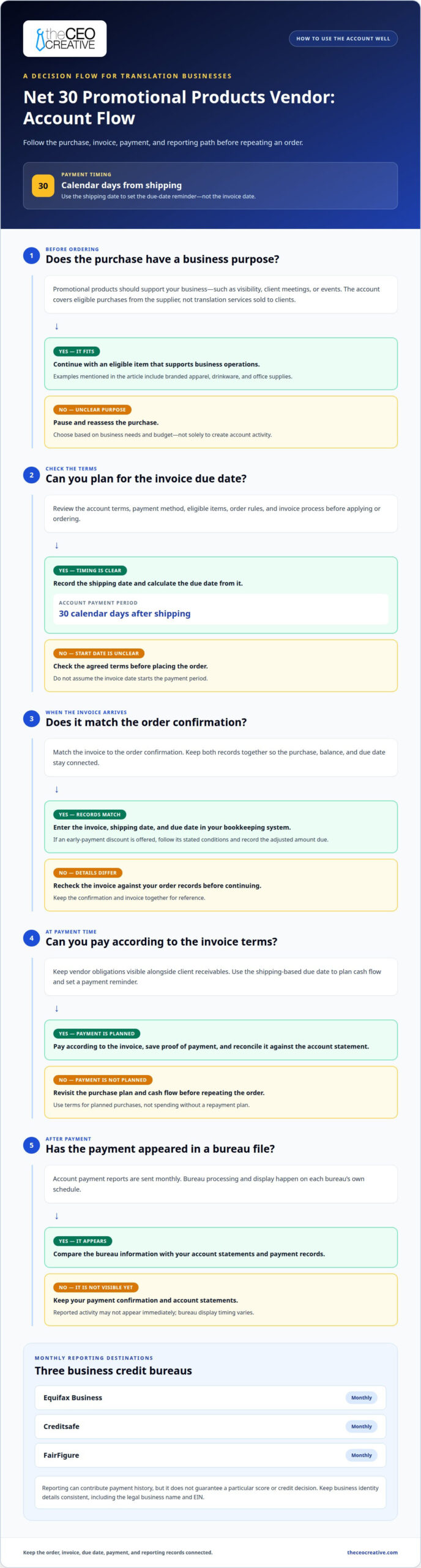
Net 30 accounts for translation businesses follow a sequence: apply, order, receive an invoice, pay, and repeat. Submit the business information requested in the application. Before ordering, review the account terms, payment method, and invoice process. These details help you plan how a vendor balance fits your cash flow.
After approval, place an eligible order and save its confirmation. The vendor issues an invoice showing the balance and payment terms. Under this account’s terms, the balance is due 30 calendar days from shipping. Use the shipping date to set your payment reminder, rather than assuming the invoice date starts the period.
Check the invoice against the order confirmation when it arrives. If an early-payment discount is offered, follow the stated conditions and record the adjusted amount due. Otherwise, plan to pay the invoiced balance by the shipping-based due date.
Record the shipping date, invoice details, and due date in your bookkeeping system. Pay according to the invoice, then save the payment confirmation. This creates a clear record for reconciling the purchase and monitoring outgoing cash.
The practical value of net 30 accounts for translation businesses depends on using terms for planned purchases, not spending without a repayment plan. Repeat the cycle when another purchase fits the budget. Keep vendor obligations visible alongside client receivables so both sides of cash flow are accounted for. A Net 30 payment period is easier to track when shipping and payment dates stay together.
Which Business Credit Bureaus Receive Reports
Reporting is monthly to Equifax Business, Creditsafe, and FairFigure. These are the three business credit bureaus that receive account payment reports. For owners comparing net 30 accounts for translation businesses, reporting destinations matter: account activity can support a business credit file only when the vendor reports it.
Payments are reported to the major credit bureaus, but they may not appear in a business credit file immediately. Each bureau processes and displays reported data on its own schedule. Keep payment confirmations and account statements so you can compare your records with the information eventually displayed. This paper trail also helps you identify which account or payment needs attention if a record appears inaccurate.
As you assess vendor accounts, consider whether the reporting aligns with the business credit files you monitor. Keep your business identity consistent across account records, including the legal business name and EIN. Consistent details help connect reported activity with the appropriate business file.
Use reporting as one part of a broader credit-building routine. Pay invoices according to their terms, retain proof of payment, and review business credit records periodically. Payments reported by a vendor can contribute payment history, but reporting does not guarantee a particular score or credit decision. Track account activity separately from its appearance on a bureau file, since those are distinct steps.
Checklist for Opening and Managing a Net 30 Account
Use this sequence to keep application details, purchases, and payments organized from the start.
- Prepare business details. Use your business’s legal name and EIN consistently. For an EIN-only Net 30 account, the EIN is the application basis.
- Read the terms before applying. Identify eligibility requirements, order rules, payment methods, and how the invoice period begins. Save a copy of the terms with your business records.
- Plan the first purchase. Choose an eligible item the translation business needs. Confirm the order total fits the available budget and leave room to pay the invoice by its due date.
- Save order records. Keep the confirmation, receipt, and invoice together. Match each document to the correct business account so purchases don’t get mixed with client-project expenses.
- Record payment dates. Enter the invoice date, period start, due date, and payment reminder in your bookkeeping system. If the terms use a different start date, record that date too.
- Pay and retain proof. Pay the invoice according to its terms, then file the payment confirmation. Reconcile it against the account statement before placing another order.
Keep your routine consistent. A clear record for each order helps you manage cash flow, spot an approaching deadline, and maintain accurate business records. Review account activity periodically, since reported payments and their appearance on a bureau file are separate steps.
Common Mistakes When Choosing a Net 30 Vendor
A Net 30 vendor account has a 30-day payment term, but check the vendor’s account terms to confirm when the period begins. This section covers vendor tradelines, not payment terms you offer to clients.
- Assuming the invoice date controls. Check the vendor’s account terms and invoice to confirm the due date.
- Tracking only by month. Record each invoice’s start date and due date so you can track the account accurately.
- Overlooking the account terms. Review the minimum order and payment terms before placing an order.
- Assuming a reporting date. Check the vendor’s stated reporting schedule; bureau display timing can vary.
- Assuming time alone confirms reporting. Do not treat 60 or 90 days as a substitute for checking the vendor’s reporting details.
If you are choosing a Net 30 vendor to build business credit, confirm the account terms before ordering and pay according to those terms. Results vary, and reporting does not guarantee a particular credit outcome. This article is not financial or legal advice.
Keep records of account terms, orders, invoices, and payments. They can help you review your vendor account and check that its activity is being reported as stated.
The CEO Creative: Business Credit Vendor
The CEO Creative is a business credit vendor for U.S. businesses seeking vendor payment activity that supports business credit building. A translation business can consider an account when it has a planned purchase that fits its operations and wants to establish a record of vendor payments. Using an account responsibly does not guarantee a particular credit result.
The account is based on the business EIN only, with no personal guarantee and no personal credit check. US businesses, including newly formed LLCs, are eligible, with no minimum time in business.
For a translation firm, branded apparel may support business identity at client meetings or professional events. Available options include a NET 30 apparel vendor, a NET 30 t-shirt supplier, and a NET 30 embroidery supplier. Select items for a clear business purpose, then include the invoice in your payment tracking routine.
This account may suit owners who want to establish business credit using an EIN and prefer an account without a personal guarantee. Review the terms and consider whether planned purchases and repayments fit your business’s cash flow.
Contact The CEO Creative to discuss the business credit account.
Frequently Asked Questions
What does NET 30 mean for a translation business?
NET 30 terms mean the balance is due 30 calendar days from shipping. For a translation business, that payment window applies to eligible vendor purchases, not invoices the business sends to its own clients. Keep supplier invoices separate from translation project billing. This makes it easier to see which balance follows vendor terms and which receivable depends on a client’s payment schedule.
How can a translation business apply for NET 30 vendor credit?
Apply using the business information requested by the vendor, including its EIN when the account is EIN-based. The CEO Creative accepts US businesses, including newly formed LLCs. Before submitting an application, make sure the business name and EIN are accurate and consistent with its records. After approval, review the purchase and payment terms, then use the account only for eligible business orders.
How can a new translation business build business credit with NET 30 accounts?
Choose a vendor that reports payment activity to business credit bureaus, make a purchase the business can afford, and pay according to the invoice terms. Keep the order record and payment confirmation with your bookkeeping documents. For example, match each vendor invoice to its payment entry rather than mixing it with client-project costs. Reported activity can contribute to a business credit file, but it doesn’t guarantee a particular score.