

Net 30 accounts for farms let a farm buy eligible business items from a vendor and pay later under stated terms. The invoice due date matters when farm income and expenses don’t align.
Compare net-15, net-30, and net-60 schedules to assess how net 30 accounts for farms may fit cash planning.
This guide explains vendor purchases, payment timing, and credit reporting so you can assess net 30 accounts for farms against your operation’s needs.
Key Takeaways
- Match invoice due dates to the timing of farm income and planned expenses to assess whether terms fit your cash flow.
- Separate profitability from cash availability: income statements and cash flow statements answer different questions.
- Review the vendor’s eligible order categories so purchases support farm business needs and fit the account’s terms.
- Understand how an account moves from application to purchase, payment, and monthly reporting before placing an order.
- Use a clear checklist to assess eligibility, reporting, and payment practices, then avoid common account-management mistakes.
How Net 30 Vendor Terms Can Fit Farm Cash-Flow Planning
Net 30 terms generally make an invoice payable in full 30 days after its date. That interval may help align a farm purchase with expected income, but it doesn’t create income or remove the payment obligation. For net 30 accounts for farms, compare each invoice due date with expected cash receipts and direct farming expenses. If crop-sale income is expected after an invoice comes due, the farm needs another way to cover that payment.
An income statement and a cash flow statement measure different things. A farm income statement typically covers an annual period and shows profitability; quarterly or monthly statements can support more frequent decisions. Net cash farm income is cash receipts from farming and related income, including government payments, minus cash expenses. A cash flow statement tracks money moving into and out of the operation. Review both to spot a profitable period that still has a short-term cash gap.
State-specific agricultural programs may have their own eligibility criteria; vendor payment terms are separate from program rules. Under USDA regulations, combined contributions of land, capital, or equipment need to account for at least 30% of a person or entity’s share of the farming operation’s total value, according to the U.S. Department of Agriculture. This contribution criterion concerns program eligibility, not approval for a vendor account.
The main cash-flow risk is owing payment before farm income arrives. Adding purchases without tracking invoices can also leave less cash for payroll, feed, seed, or other planned expenses. A farm evaluating net 30 accounts for farms should map invoice due dates against expected receipts and essential outflows. Use that schedule to decide whether the payment timing fits the operation’s cash position.
This information is not financial or legal advice.
What Farms Can Order on Net 30 Terms
Net 30 terms apply to purchases from a vendor, not automatically to every farm expense. An approved business orders eligible items from that vendor and receives an invoice with a payment due date. This is not a cash loan or general-purpose credit card. The account is tied to vendor purchases, so it can’t be used to pay any expense or buy from any seller.
Relevant categories for farm businesses can include office supplies for administration, apparel for branded staff clothing, tech and electronics for business operations, and promotional products for outreach. The vendor’s catalog determines which items are eligible. Don’t assume a vendor account covers seed, feed, fertilizer, livestock, or equipment unless those items are sold through that vendor. A net 30 office supplies vendor can support eligible administrative purchases. Apparel, tech and promotional products are other distinct purchase categories.
Choose orders that serve the farm business and fit the account’s permitted catalog. For example, office items may support recordkeeping, while branded apparel or promotional products may suit business outreach. These purchases aren’t substitutes for farm inputs or agricultural financing. Before ordering, match the item to its business purpose, confirm it falls within the vendor’s offerings, and note that its invoice will have a due date. This keeps the account focused on actual vendor purchases, rather than treating available terms as general spending money.
Which Suppliers Offer Net 30 Accounts to Farms in the United States?
In the United States, a farm can look for net-30 terms from vendors that sell business-use goods and report eligible purchases. The supplier’s catalog matters: an account may cover office items, apparel, technology, printed materials, or promotional products, rather than farm inputs. A vendor account applies to purchases from that supplier, not every expense in the operation.
Start by matching the farm’s need to a supplier category. An office supplier may suit administrative purchases, while an apparel or promotional-products vendor may serve staff identification or business outreach. A technology supplier may offer items used for business operations. These examples describe vendor categories, not a guarantee that every supplier offers net-30 terms or that every item qualifies.
Check the supplier’s stated payment terms before treating an account as net 30. Confirm when the invoice is dated, when full payment is due, which purchases qualify, and whether the supplier reports account activity to business credit bureaus. Those details determine how the account functions. Don’t assume that a retailer’s general checkout option is a reporting vendor account.
Farm-specific suppliers may sell agricultural inputs or equipment, but a purchase relationship alone doesn’t establish net-30 terms or bureau reporting. Separate those questions: first identify the supplier’s products, then review the account terms and reporting details. For example, a farm seeking office items for recordkeeping should evaluate an office vendor’s account, not assume it can use that account for seed or feed. This category-first approach helps distinguish trade credit from general financing and keeps the account aligned with actual business purchases.
What Are the Eligibility Requirements for a Farm Net 30 Account?
Farm businesses in the United States, including newly formed LLCs, can apply without a minimum time-in-business requirement. The account is based on an EIN and doesn’t require a personal guarantee or personal credit check. A farm’s legal structure or recent formation alone doesn’t rule it out under these eligibility terms.
Business credit history also matters. Eligibility requires no late payments on business credit during the previous six months. This is a payment-history criterion, not a requirement to have operated for a set number of years. Keep business obligations current and separate business records from personal activity so the application accurately reflects the business.
Before applying, gather the business’s EIN and use consistent information throughout the application. A newly formed farm LLC can apply using its business identity, even without an established operating history. Approval is still a decision on the application; meeting a listed eligibility condition doesn’t guarantee approval or a particular credit line.
Eligibility for a vendor account is separate from eligibility for agricultural programs. USDA program rules may assess a participant’s contributions or other program-specific criteria, while a vendor account has its own application requirements. Don’t treat qualification for a farm program as automatic approval for vendor terms, or assume a vendor account changes program eligibility. Review the account’s stated requirements and payment-history condition, then apply with accurate business details. These criteria help a farm assess whether its business profile fits before making purchases on terms.
For a net-30 account with The CEO Creative, the stated eligibility standard is no late payments on business credit during the previous six months. This condition concerns payment history; it does not itself set a minimum operating period or specify any other qualification. A farm assessing whether it meets this criterion can compare its business-credit payment record with that six-month window before applying. Keeping the scope of the requirement clear helps distinguish the stated payment-history test from other considerations that may apply to an account decision.
How a Net 30 Account Works: Apply, Order, Pay, Report, and Repeat
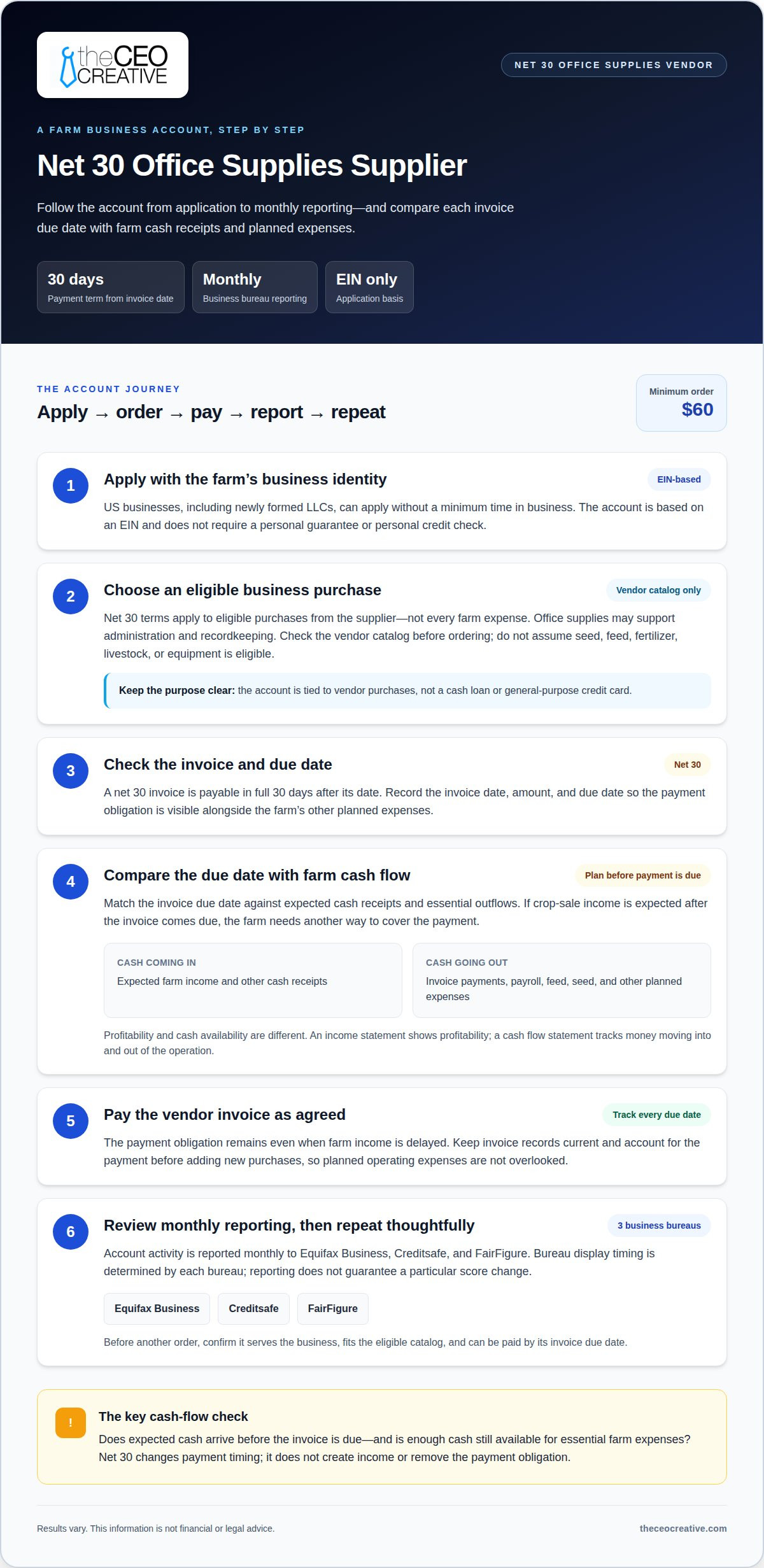
The process begins with an application identifying the farm business and its EIN. For an EIN-based account, the provider reviews the submitted business information and makes an approval decision. Meeting eligibility criteria doesn’t guarantee approval. If approved, the farm receives account terms explaining eligible purchases and payment obligations before ordering.
Next, choose eligible goods from the vendor’s catalog and place an order through the account. The purchase creates a balance for that vendor transaction, not general-purpose cash. Review the order details and keep the records with the farm’s business documents.
For this account, the balance is due 30 calendar days from shipping. Track the shipping date and payment due date in the farm’s payables records. Schedule payment with expected receipts and other obligations in view. Keeping purchase and payment records together helps the farm reconcile its account activity.
The provider reports account payments monthly to Equifax Business, Creditsafe, and FairFigure. Monthly reporting doesn’t determine when a bureau displays the information. After paying an order, the farm may make another eligible purchase, subject to its account terms. That begins the cycle again: apply, order, track shipping and the balance due, pay, and allow reporting to occur. The NET 30 account terms explain the account structure and purchase conditions.
Which Business Credit Bureaus Receive Reports?
Farm suppliers don’t all report Net 30 payments to business credit bureaus. Reporting depends on the supplier and account. For the account discussed here, reports are sent monthly to Equifax Business, Creditsafe, and FairFigure. Those are the three named business credit bureaus for this account.
Monthly reporting means account activity is submitted on a recurring monthly basis. It doesn’t mean every farm supplier reports, or that each purchase generates a separate report. The account’s eligible activity is the relevant record. Reporting doesn’t guarantee a particular credit score or outcome; bureaus manage their own reporting processes.
The time it takes for a report to appear varies. An entry may take time to show in a business credit file after submission, and the timing can differ by bureau. Distinguish the vendor’s monthly reporting schedule from the bureau’s processing and display time. A delay in visibility doesn’t, by itself, indicate a missed payment.
To understand a supplier’s reporting, identify the named bureaus and reporting frequency in its account terms. Then organize invoices and payment records by date. If an account reports to Equifax Business, Creditsafe, and FairFigure, those names indicate where activity is submitted. They don’t establish that another agricultural supplier reports to the same bureaus. Treat each vendor account separately and use the supplier’s stated reporting details to judge whether its terms fit your business-credit goals.
A Checklist for Choosing and Using a Farm Net 30 Vendor Account
Use this checklist to assess whether a vendor account fits your farm’s purchases, records, and payment schedule.
- Match the catalog to a business need. Identify the specific eligible category before applying. For example, decide whether the farm needs office items for administration or apparel for staff identification. Don’t assume a vendor sells agricultural inputs.
- Read the account terms. Note how the invoice date is set, when full payment is due, and which purchases qualify. Compare that due date with expected farm receipts and planned expenses.
- Review the application basis. Check what business information the provider uses, including whether the application relies on an EIN. Confirm whether a personal guarantee or personal credit check applies.
- Understand the account limits. Identify the minimum order and available credit line before planning a purchase. Keep the intended order within both the vendor’s eligible catalog and approved account terms.
- Confirm reporting details. Record the named business credit bureaus and reporting frequency. Keep expectations realistic: monthly submission doesn’t determine when a bureau displays account activity.
- Set up invoice tracking. Log each invoice date, amount, due date, and payment confirmation in the farm’s business records. Assign responsibility for reviewing bills so seasonal work doesn’t obscure an approaching deadline.
- Review before repeat orders. Check outstanding balances and expected cash receipts before placing another purchase. Repeat only when the next invoice fits the farm’s payables plan.
These steps help distinguish a useful vendor relationship from an account that adds pressure. Matching the purchase purpose, account terms, reporting, and payment capacity gives the farm a practical basis for deciding how to use trade credit.
Common Mistakes to Avoid with Farm Net 30 Accounts
A vendor account can support planned business purchases, but poor records or mismatched terms can strain farm finances. Avoid these common errors when choosing and managing an account:
- Treating trade credit as income. An approved purchase creates an invoice, not new revenue. Record the amount as a payable and include it in the farm’s cash planning, rather than counting available terms as money earned.
- Assuming every farm expense qualifies. A vendor account covers eligible purchases from that supplier. Don’t plan to use an office-products account for seed or feed unless those items are actually in the vendor’s eligible catalog.
- Mixing personal and business records. Keep farm purchases, invoices, and payment confirmations in business records. Combining them with household spending can make it harder to identify operating costs and reconcile what the business owes.
- Waiting until year-end to review finances. An annual income statement can show profitability but may miss short-term cash pressure. Review cash movements and upcoming invoices during the year, especially when receipts and farm expenses occur at different times.
- Expecting reporting to guarantee a credit result. Monthly submission doesn’t guarantee a score change or immediate bureau display. Track payments and account records, and distinguish the supplier’s reporting schedule from each bureau’s processing.
Use these checks before ordering and when reviewing the account. Consistent records connect each purchase to its business purpose, keep payables visible, and help you assess whether another order fits the farm’s cash position.
The CEO Creative
The CEO Creative offers reporting Net 30 vendor accounts for businesses building credit through eligible purchases. For a farm, this may be relevant when the operation needs business-use items from the vendor’s categories, rather than agricultural inputs such as seed, feed, or equipment. A vendor account covers purchases from that supplier; it isn’t general financing for farm expenses.
Available categories include apparel, T-shirts, embroidery, and office supplies. A farm might consider branded apparel for staff or office items for business administration, provided the products are in the account’s eligible catalog. Choose an order with a clear business purpose, then weigh the invoice due date against expected receipts and other obligations.
As a business credit vendor, The CEO Creative provides a way to make eligible vendor purchases on Net 30 terms. The account is intended for businesses using an EIN to establish business credit history. Reporting activity does not guarantee a particular credit outcome, and bureau display timing varies. Keep purchase and payment records so account activity can be tracked in the farm’s books.
This may be a useful option if your farm needs eligible items in these categories and wants a vendor relationship connected to business credit reporting. It may not fit if you need agricultural supplies outside the offered categories or if the invoice schedule doesn’t suit your cash flow. Review the account terms and eligible purchases before deciding whether to apply.
Contact The CEO Creative to discuss the Net 30 vendor account.
Frequently Asked Questions
What are net-30 accounts?
A NET 30 account is a vendor purchase arrangement. A business orders eligible goods or services from the supplier and pays under the account’s terms. It differs from a loan because it applies to purchases from that vendor, rather than providing cash for unrelated costs. For a farm, the useful first question is whether a planned business purchase fits the supplier’s catalog.
What does NET 30 mean for farm businesses?
For The CEO Creative’s account, the balance is due 30 calendar days from shipping. That date can differ from the invoice date, so use the shipping date and account terms when scheduling payment. A farm should consider whether cash will be available by the due date, including if expected crop or livestock receipts arrive later than planned.
Can a newly formed farm LLC apply?
Yes. Newly formed LLCs in the United States can apply, with no minimum time in business. The application is based on the business EIN and requires no personal guarantee or personal credit check. Approval isn’t guaranteed, so provide accurate business information and consider whether the purchase terms suit the farm’s current needs.
What can a farm purchase through a vendor account?
Eligible purchases depend on the supplier’s catalog. The CEO Creative offers apparel, T-shirts, embroidery, and office supplies. A farm might need apparel for business branding or office items for administrative work. These categories don’t mean the account can pay for every farm input; match each order to the vendor’s eligible offerings.
Which business credit bureaus receive monthly reports?
Account activity is reported monthly to Equifax Business, Creditsafe, and FairFigure. This identifies where reports are sent, not when an entry will appear in a business credit file. Each bureau controls its own processing and display timing. Keep order and payment records so you can compare your account history with information that later appears in a report.
Does using a NET 30 account guarantee a credit score increase?
No. Payment reporting doesn’t guarantee a particular score, credit outcome, or timing for a change. A vendor account creates a record of eligible purchases and payments, while business credit files and scores depend on bureau processes and other information in the file. Use the account for purchases the farm needs and can pay for on schedule.