
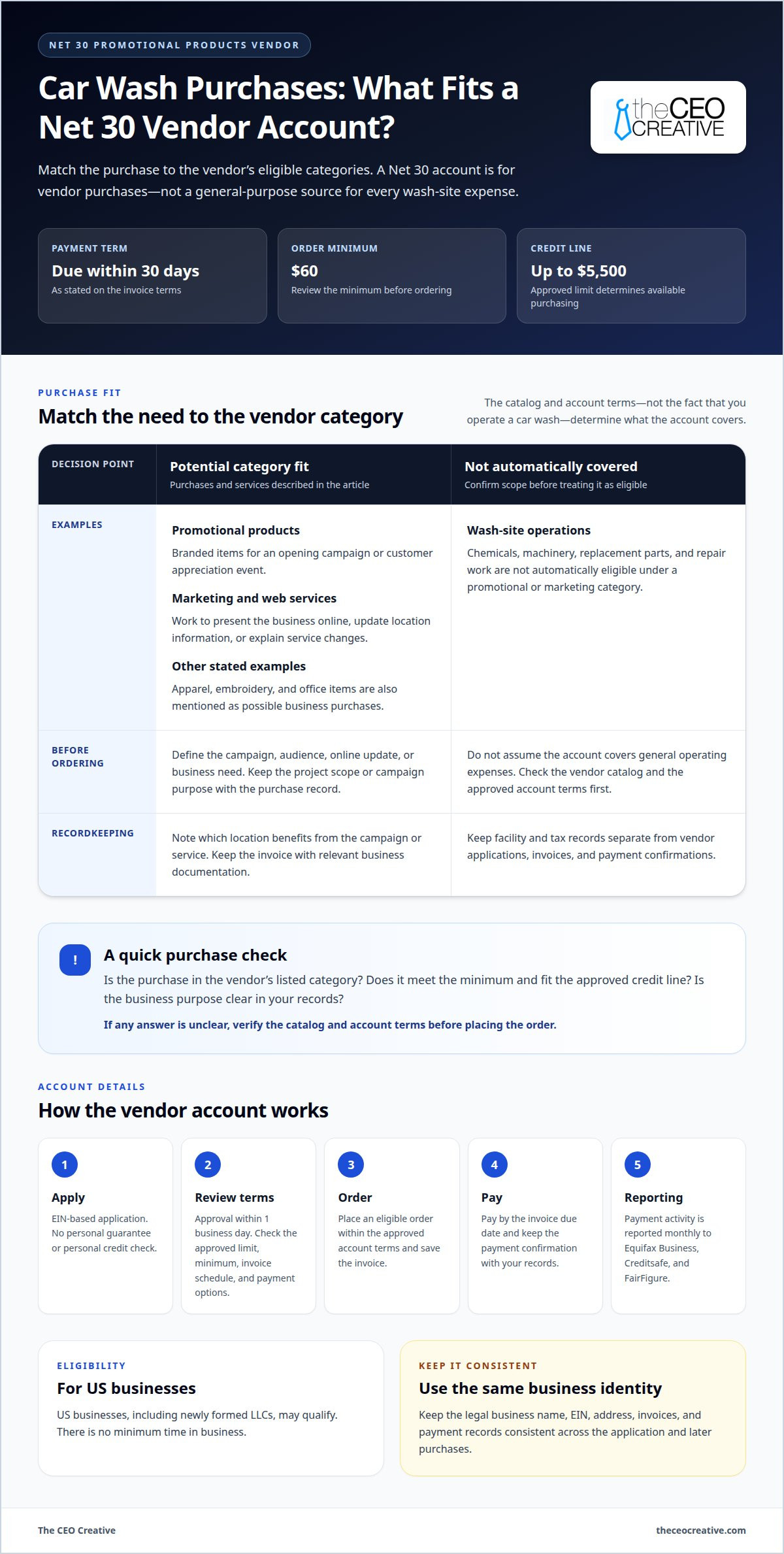
For an approved car wash business account, Net 30 means purchases are billed on an invoice and payment is due within 30 days. Net 30 accounts for car washes can support business purchasing while creating a record of payment activity through monthly reporting to Equifax Business, Creditsafe and FairFigure. Approval is based on the business’s EIN, with no personal guarantee or personal credit check.
The key is understanding what the terms apply to: this is a vendor account, not a business loan or credit card. Approval, eligible purchases and payment options all shape how the account works, so it helps to know the details before applying.
Read on to learn how invoice inquiries are handled, what to expect from the application and payment process, and how monthly reporting works. You’ll also find practical steps for managing an account responsibly and building a clear business credit history over time.
Key Takeaways
- Understand how approval works for a vendor account based on your business EIN, including the order minimum and available credit line.
- Match Net 30 purchases to eligible business needs, such as apparel, embroidery, or office supplies.
- Learn how invoice payment activity is reported monthly and which business credit bureaus receive reports.
- Use a consistent application, ordering, and payment process to support a clear business credit history.
- See what US eligibility means for newly formed LLCs and how to approach a vendor account from your state.
How can a car wash apply for a Net 30 vendor account?
Start by identifying a vendor account that accepts your business type and explains its invoice terms. Net 30 means payment is due within 30 days, according to the account’s stated terms. Before applying, determine what you plan to order and whether it meets the vendor’s minimum. For example, a new car wash may need branded apparel or office items rather than wash equipment. Match the application to an actual business purchase so the account supports both operations and payment history.
US businesses, including newly formed LLCs, can qualify for accounts that accept businesses without a minimum time in operation. Application requirements vary by vendor. Some accounts use an EIN-based application and do not require a personal guarantee or personal credit check. Read the account terms and application fields carefully. For a business account built around an EIN, review the details of EIN-only vendor accounts before submitting information.
Prepare consistent business details before applying. Use the legal business name, EIN, business address, and contact information associated with your company records. Keep spelling and formatting consistent throughout the application. Describe the operation accurately, such as a self-serve wash or an express exterior site, if asked. Provide the requested information and ensure the person submitting the form is authorized to apply for the business.
Then follow the account application and ordering steps in sequence:
- Review eligibility. Confirm that the vendor accepts US businesses and newly formed LLCs if your car wash is recently established.
- Complete the application. Enter the business identity and EIN details requested by the vendor.
- Review the approved terms. Check the credit line, minimum order, invoice schedule, and available payment methods before placing an order.
- Place an eligible order. Keep the order within the account’s terms and save the invoice with your business records.
- Pay by the invoice due date. Record the payment and retain its confirmation so your bookkeeping matches the vendor statement.
Approval is within 1 business day. Treat that stated period as an application detail, not a reason to delay planning. The approved limit determines how much eligible purchasing the account can support. A $60 order meets the minimum; an order above the available credit line does not fit the approved limit. Review each invoice’s due date and payment options because Net 30 describes the payment period, not a particular payment method.
Keep vendor-account records distinct from facility and tax records. The Internal Revenue Service states that most commercial buildings depreciate over 39 years. That building depreciation period is separate from a vendor’s application decision and invoice terms. For a car wash, retain property records with the appropriate accounting documents, and keep vendor applications, invoices, and payment confirmations together in the business’s credit and purchasing records.
After the first order, use the same business identity for later purchases and reconcile each invoice against its payment record. A consistent process helps avoid mismatched records when a car wash has several vendors or locations. The account’s terms, accepted order categories, and payment options, not the business’s wash format, determine how an application proceeds.
Which car wash products and services can be purchased on Net 30 terms?
A Net 30 vendor account covers purchases within that vendor’s eligible categories, not every expense a car wash may have. For this business, relevant categories can support branding, customer outreach, and online business information. The distinction matters: a promotional purchase or marketing service may fit an account, while equipment used to wash vehicles belongs to a different purchasing category. Match the need to the vendor’s catalog before placing an order.
Custom promotional products can support customer-facing activities. For example, a car wash planning an opening campaign could use branded items to introduce the business to potential customers. An established site might choose them for a customer appreciation event. Start with the campaign’s purpose and audience, then select items that fit. Keep the purchase record with the campaign documentation to show its business purpose.
Marketing and web services address different needs. A car wash might want to present its business clearly online, update information for a location, or explain a change in services. Before commissioning work, define the task and the result you want it to support. Keep the project scope and invoice with the business records.
Promotional products and marketing services are not the same as day-to-day wash operations. Chemicals, machinery, replacement parts, and repair work are not automatically eligible just because the buyer operates a car wash. Use the vendor’s catalog and account terms to guide purchases, rather than assuming the account covers general operating expenses.
Use this decision guide before choosing an order:
- For a campaign: Identify the event or customer outreach purpose, then select promotional products that support it.
- For an online update: Define which business information or web content needs attention before arranging marketing or web services.
- For multiple locations: Record which site benefits from the campaign or service so the expense is easy to track.
- For operating needs: Separate wash-site supplies and equipment from products or services covered by the vendor account.
Plan how each purchase will be used after it arrives or the service is completed. For promotional items, identify the campaign or business activity and the person responsible for distribution. For web work, decide who will provide accurate business details and review the finished materials. This keeps purchases connected to their intended business purpose.
Keep records linking each purchase to its business use. File promotional product details with campaign notes and retain the invoice. For marketing or web services, keep the project scope and invoice together. If the work benefits more than one location, note how it supports each site. Organized records help separate marketing activity from facility operations during bookkeeping reviews.
When a planned purchase fits an eligible category, review the business Net 30 account terms as part of deciding whether it suits your car wash’s needs.
How can a new car wash build business credit with Net 30 vendors
A new car wash builds its business credit file by establishing vendor tradelines tied to the business and managing those accounts responsibly. A Net 30 vendor may report account payment activity, giving the business a chance to develop a record separate from its owner’s personal credit. Reporting alone does not guarantee a particular credit outcome. The business’s account use and payment behavior matter.
Use a consistent business identity. Apply with the same LLC name and EIN for each vendor relationship, and keep separate legal entities distinct. If one company operates two wash sites, keep purchases under that company’s account. If another LLC owns a separate location, don’t mix its transactions with the first entity. Clear separation supports accurate business records.
Choose accounts around purchases the car wash genuinely needs. A new business may find one manageable vendor relationship easier to track than several accounts opened at once. Before applying, decide who will place orders, receive invoices, and approve payments. Assigning these responsibilities early helps keep activity organized as the business builds its credit profile.
Use a repeatable account routine:
- Set the business identity. Use the correct entity and EIN throughout the application and account activity.
- Assign account ownership. Name the staff member responsible for orders, invoice review, and payment scheduling.
- Review each statement. Match charges to authorized business purchases and resolve discrepancies through the vendor’s process.
- Plan payment. Schedule payment according to the invoice terms and the business’s cash-flow calendar.
- Review account activity. Track open balances and completed payments as part of routine business bookkeeping.
For a new wash, payment timing is both an operational and credit-management task. Compare invoice due dates with expected cash inflows and scheduled expenses. This doesn’t change the vendor’s terms, but it helps with cash planning and makes payables easier to track. Assign account notices to someone responsible for acting on them.
Common account-management mistakes
Small process gaps can make a vendor relationship harder to manage. Avoid these mistakes:
- Mixing entities: Don’t submit one LLC’s application details while another LLC makes the purchases.
- Ordering without authorization: Set an approval process so staff understand which purchases the business permits.
- Ignoring invoice notices: Route vendor statements to an active business contact, not an unattended inbox.
- Missing internal handoffs: Tell the person scheduling payment when an order or invoice changes.
- Opening accounts without a plan: Choose vendor relationships the business can actively manage instead of accumulating unused accounts.
Review the routine when the car wash adds staff or locations. A clear account owner, consistent business identity, and steady invoice management help keep vendor activity organized as the business develops its credit history.
Are Net 30 vendors available for car washes in my state or area?
Yes. US businesses can apply for Net 30 vendor accounts that accept businesses nationwide. Eligibility can include newly formed LLCs, depending on the account’s criteria. A car wash’s location within the United States does not by itself explain whether a planned purchase qualifies. The vendor’s business eligibility rules and approved purchase categories determine whether an account fits.
Start with the business entity that will hold the account. Use its legal name, EIN, and business address consistently in applications and vendor records. For example, a car wash LLC should apply using its own business details, rather than an owner’s personal information as the account identity. Consistent records connect orders and invoices to the correct business.
Separate geographic eligibility from product eligibility. A vendor can accept a car wash business while limiting Net 30 terms to certain catalog categories. Promotional products or office items may fit an account, while wash chemicals or machinery may fall outside its eligible catalog. Review the account’s terms and categories before planning an order. The business address alone does not make every product eligible.
If you operate multiple sites, identify which legal business will apply and which location will use each order. If one LLC operates several wash locations, keep orders and invoices tied to that LLC and note the site benefiting from each purchase. If separate LLCs operate different sites, keep applications and purchases under the appropriate business identities. This makes account activity easier to distinguish in internal records.
Use these steps to assess eligibility and keep location details organized:
- Identify the account holder. Select the US business entity that will make purchases and hold the vendor account.
- Use consistent business details. Enter the entity’s legal name, EIN, and business address accurately.
- Review geographic eligibility. Confirm the account accepts US businesses and the applicable business type.
- Match the intended order. Ensure the planned purchase belongs to an eligible catalog category.
- File by entity and site. Keep invoices connected to the correct business and location when multiple sites operate.
A car wash can use eligible purchases to support customer-facing work wherever it operates in the country. One business might order promotional items for an opening campaign; another might use them for ongoing customer outreach. In either case, the order must fit the vendor’s eligible categories and invoice terms. Tie each purchase to a genuine business need and keep its invoice with the relevant records.
Credit reporting is separate from geographic coverage. The CEO Creative reports account activity monthly to Equifax Business, Creditsafe, and FairFigure. Each bureau determines how and when it displays reported information. Keep invoices and payment confirmations so you can reconcile account activity, whether the car wash operates one site or several.
The CEO Creative: business credit vendor
The CEO Creative gives car wash businesses a way to pair eligible purchases with Net 30 vendor account activity. Turn to it when your business needs apparel, branded shirts, embroidery, or office supplies and wants those purchases connected to a vendor tradeline. Choose items that serve an actual operating or branding need, then follow the account’s invoice terms and keep the purchase records with your business bookkeeping.
For example, a car wash preparing staff apparel can consider a Net 30 apparel vendor. An office supply order may suit administrative needs. These purchases support business operations, but they are not car wash chemicals or wash equipment.
Contact The CEO Creative to discuss using a suitable Net 30 vendor account for your business.
Make your next account decision part of a clear plan
Choosing net 30 accounts for car washes works best when each account has a defined role in your purchasing plan. Before applying, decide which business need you’ll address first and how your team will track the order, invoice, and payment. That approach keeps vendor activity connected to real operations instead of turning credit-building into a separate task.
As your car wash grows, review the process when purchasing responsibilities change or you add a location. Keep account decisions aligned with eligible purchases and your ability to pay invoices on time. Results vary, and business credit reporting does not guarantee a particular outcome. This information is general and isn’t financial or legal advice.
If an eligible apparel, t-shirt, or embroidery purchase fits your business needs, The CEO Creative offers those Net 30 vendor categories. Review the account details and decide whether they fit your next step.
A consistent process gives your business a practical foundation for managing vendor relationships and moving forward.
Frequently Asked Questions
What does Net 30 mean for a car wash business account?
Net 30 means an approved business account has an invoice payment period of 30 days. The invoice sets the due date and shows the amount owed. For example, if your car wash orders eligible administrative items, record the invoice when it arrives and plan payment around its stated due date. Net 30 describes the payment period, not a promise of a particular credit result.
What are the eligibility requirements for Net 30 accounts for car washes?
Eligibility depends on the account criteria and the business information in the application. The CEO Creative accepts US businesses, including newly formed LLCs, and bases its account on the EIN without a personal guarantee or personal credit check. Apply using the legal identity of the entity that will make purchases and manage invoices.
Does every Net 30 vendor use the same terms?
No. Vendors set their own account terms, eligible purchase categories, invoice procedures, and payment options. One account may cover a particular type of business purchase, while another covers a different category. Read the terms for each account and keep its invoice instructions with your purchasing records. Approval or payment arrangements from one vendor do not automatically apply to another.
Can a Net 30 vendor account be used for any car wash expense?
No. The account applies to purchases included in the vendor’s eligible catalog and account terms. A car wash should distinguish those purchases from other operating expenses, such as specialized wash-site needs. An account for eligible office items, for example, doesn’t automatically apply to every item the business buys. Keep purchases within the stated categories and tied to genuine business needs.
Does opening a Net 30 account guarantee a particular business credit score?
No. Opening an account or having payment activity reported does not guarantee a particular score or credit outcome. Reporting is one part of a business credit file, and each bureau controls when it displays reported activity. Use the account for eligible business purchases and manage invoices according to their terms. Credit-building is an ongoing process, not a guaranteed result of opening an account.
What records should a car wash keep for a vendor account?
Keep the application details, order documents, invoices, payment confirmations, and vendor statements together. If a manager handles purchases, record who approved each order and its business purpose. For example, file a promotional order with the car wash’s campaign records. Organized files make it easier to reconcile account activity and answer bookkeeping questions without relying on memory.