


A missed Net 30 deadline can affect more than cash flow. If you’re asking what happens if you pay a Net 30 invoice late, payment is overdue when it hasn’t reached the vendor by the stated due date. Agreed late fees may apply, the vendor may limit future orders or send a severely overdue balance to collections, and reported payment history may affect your business creditworthiness. A missed Net 60 deadline also leaves the full invoice amount owed.
It’s reasonable to worry about the immediate cost and the longer-term effect on your business credit. A late payment won’t automatically appear on every business credit profile, but it can affect your record if the vendor reports payment history to business credit bureaus.
This article explains when Net 30 and Net 60 invoices become late, how contract terms shape fees and collection options, and how missed payments can affect vendor relationships and creditworthiness. You’ll also get practical ways to respond to an overdue invoice and protect your payment record going forward.
Key Takeaways
- Work out when the payment period starts and how the agreed due date accounts for calendar days.
- Review the written payment terms to understand when late fees or interest may apply.
- Address an overdue balance promptly and keep clear records of payment and vendor communications.
- Learn how late payment history can affect vendor terms and business creditworthiness.
- See which business credit bureaus receive monthly reports from the Net 30 account.
Net 30 vendor account order and payment dates
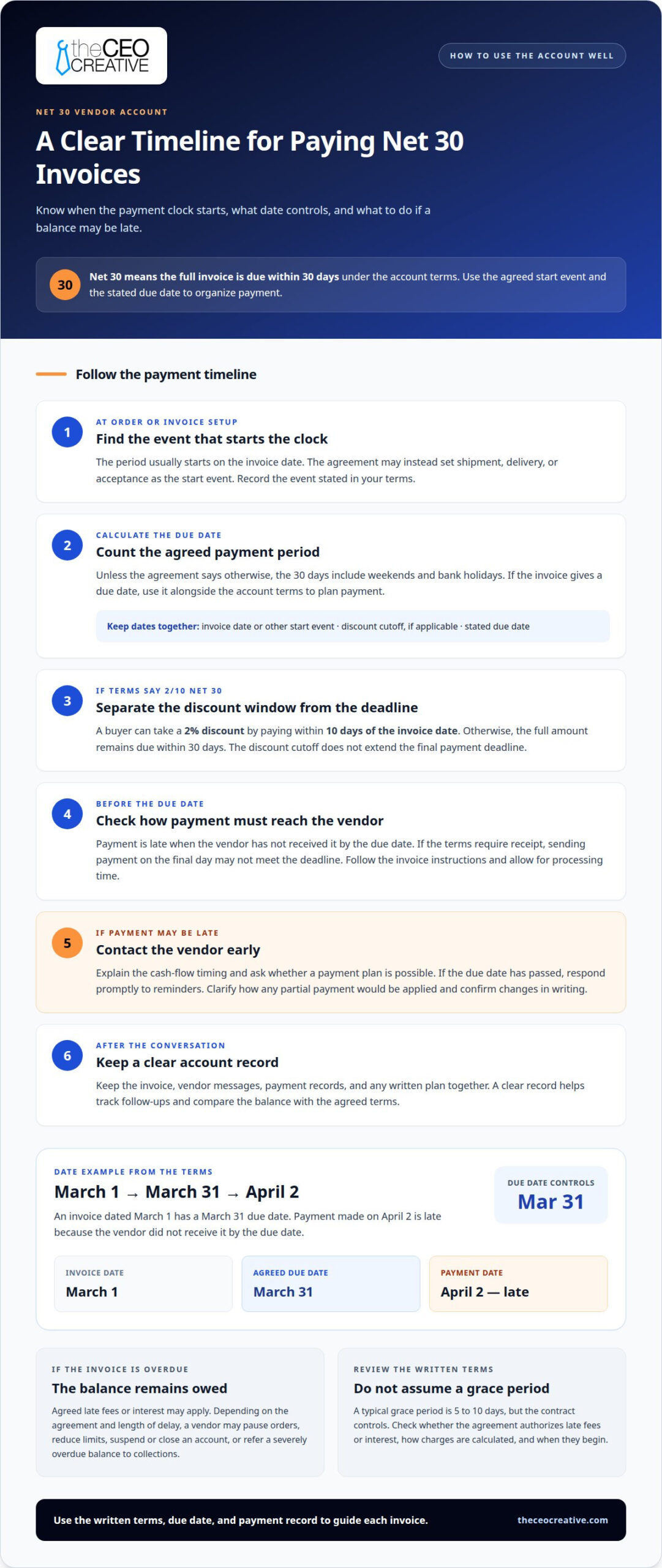
With a Net 30 category vendor account, the buyer has 30 days to pay the full invoice under the account’s terms. The period usually starts on the invoice date, but the agreement may set shipment, delivery, or acceptance as the starting event. Unless the agreement says otherwise, the 30 days include weekends and bank holidays. Use the agreed starting event to calculate the deadline for each order.
For example, if an order invoice is dated March 1 with a March 31 due date, payment made on April 2 is late. Payment is late when the vendor hasn’t received it by the due date. If the account terms require receipt, sending payment on the final day may not meet the deadline. Follow the invoice’s payment instructions and account for processing time.
If an account’s written terms state 2/10 net 30, a buyer can take a 2% discount by paying within 10 days of the invoice date. Otherwise, the full amount remains due within 30 days. Keep the discount cutoff separate from the final due date in your accounts payable records. Taking the discount doesn’t extend the payment deadline.
For each vendor account order, record the invoice date, agreed starting event, discount cutoff if applicable, and due date. A net terms calculator can help map the payment period. If the invoice states a due date, use that date alongside the account terms to organize payment and avoid confusing the discount window with the final deadline.
Consequences of missing a Net 30 or Net 60 deadline
Knowing what happens if you pay a net 30 invoice late starts with the due date. The balance remains owed after that date passes. If cash is short, contact the vendor before the deadline. Explain the timing and discuss a payment plan instead of ignoring reminders.
Effects of Missing the Deadline
Missing a deadline means the vendor hasn’t received payment by the agreed date. A Net 30 invoice paid 45 days after its due date is past its 30-day payment window. Net 60 terms allow 60 days from the invoice date. The full unpaid amount remains due. Agreed late fees or interest may also apply. A vendor may pause orders, reduce limits, suspend an account, or close it after an extended delay. The answer to what happens if you pay a net 30 invoice late depends partly on the agreement and the length of the delay.
Handling an Invoice You Cannot Pay
If you can’t pay an invoice on time, communicate early and propose a practical next step. Contact the vendor before the deadline, explain the cash-flow timing, and ask whether a payment plan is possible. Give a specific date for your next update, even if you can’t yet confirm full payment. If the deadline has passed, respond promptly to reminders. Clarify how any partial payment would be applied, confirm changes in writing, and keep the invoice, messages, and payment records together. This creates a clear account history and helps prevent missed follow-ups.
Late fee clauses in contracts
A late-fee clause explains what extra amount may apply after an invoice deadline. One commonly used percentage-based fee is 1.5% per month on the outstanding balance, equivalent to 18% annually. The contract should state the fee before work starts. Some states may cap the maximum rate, so location and contract wording can affect what applies.
To dispute an incorrect invoice or late fee, compare the charge with the contract, invoice, due date, and payment records. Write to the vendor, identify the specific error, and keep copies of your message and supporting documents.
A typical grace period is 5 to 10 days after the due date, but the contract controls the agreed terms. If it includes no authorization for late fees or interest, adding charges later may be harder. Don’t assume a grace period applies unless the agreement provides for one.
Clear payment terms can reduce strain on the business relationship by setting expectations before a payment is late. Review the clause for the fee amount, calculation method, start date, and any grace period. Check, for example, whether interest applies to the unpaid balance and whether the invoice matches the signed contract. Raising a discrepancy promptly can resolve a billing error faster than leaving it unaddressed. Keep the discussion focused on the written terms and payment record.
Collections and legal action
A vendor may begin with email or phone reminders about an unpaid invoice. If reminders don’t resolve the balance, the vendor may send a formal past-due notice and record your business’s payment history. A severely overdue account may be referred to collections. This can put pressure on cash flow and affect the vendor relationship, so respond to notices and keep copies of each exchange.
Legal action is a less common way to recover an unpaid balance. A business may claim breach of contract and request prejudgment interest. It may also request attorney fees if the contract allows them. The contract wording, amount owed, length of the delay, and applicable local rules can shape the available options. Any charge beyond the original invoice should be supported by the agreed terms.
If you receive a collections notice, compare the stated balance with the invoice, contract, and payment records. Write to the vendor or collection agency to identify any disputed amount, and retain proof of payments and messages. If you owe the balance but can’t pay it all at once, propose a payment plan and clearly document any agreement. A dated timeline helps organize the account facts if the dispute continues. The vendor’s next steps depend on the debt and agreement, so don’t ignore notices or assume a reminder has closed the matter.
Customer creditworthiness
For a business using Net 30 accounts, creditworthiness includes how reliably it pays vendors. When a vendor reports payment history to business credit bureaus, a late payment may be recorded and may lower a business credit score. The effect depends on whether the vendor reports and how the bureaus display the information. A missed due date can therefore matter beyond the unpaid balance.
That payment record can influence future vendor decisions. Late payments may make it harder to open another account, request a higher limit, or qualify for financing. A vendor may reduce a credit limit, pause orders, or set stricter payment terms. For a growing company, these changes can limit purchasing flexibility even after the original balance is paid.
Build a steadier record by matching payment dates to available cash, rather than relying on an early payment window. Under 2/10 net 30 terms, paying within 10 days earns a 2% discount; otherwise, the full invoice remains due within 30 days. Treat the discount as optional, not as a reason to stretch cash flow. Set reminders before each due date, keep enough funds for scheduled payments, and contact a vendor promptly if timing changes. Consistent on-time payments can demonstrate financial reliability and support a positive credit profile.
What can be ordered on terms
The CEO Creative offers Net 30 vendor accounts tied to eligible business purchases, giving owners a way to build payment history through routine company needs. Available categories include apparel, T-shirts, embroidery, and office supplies. Choose purchases that fit your business operations and budget, then manage each invoice against its stated due date. A vendor account is most useful when you can pay on time and use the items in your business.
For branded clothing and related business purchases, a Net 30 apparel vendor can connect a practical purchase with vendor-account activity. Office supplies offer another category for businesses that regularly need workplace materials. The right category depends on what your company uses, not on buying items solely to create account activity.
Match each order to planned business spending. For example, apparel may suit a company preparing branded clothing, while office supplies may support regular workplace needs. T-shirts and embroidery can also serve businesses with relevant apparel requirements. Choose products for their practical purpose, not just to create account activity. This keeps vendor-account use connected to ordinary operations and makes each invoice easier to plan within the business budget.
How the account works: apply, order, pay, report, and repeat
Apply using your business EIN. The account is EIN only, with no personal guarantee and no personal credit check. Approval is within 1 business day. Eligible applicants include US businesses and newly formed LLCs, with no minimum time in business. This EIN-only Net 30 account is designed for businesses building credit under their EIN.
Choose an order that fits your business needs and available credit.
Each order is billed under Net 30 payment terms. Record the invoice and its due date, then pay within the agreed period. Keep the invoice and payment record together so you can track each account transaction.
Payment activity is reported monthly. After paying an invoice, repeat the cycle with another eligible order that fits your budget and available credit. Monthly reporting doesn’t mean bureau displays update immediately; each bureau controls when information appears.
Which business credit bureaus receive monthly reports
The account’s payment activity is reported monthly to Equifax Business, Creditsafe, and FairFigure. These are the three business credit bureaus that receive reports. Monthly describes the reporting schedule, not when information appears in a bureau file. Each bureau controls when its file displays the information.
A vendor tradeline is one part of a business credit profile, not a guarantee of a score change. Reported payment history can show how the business manages its vendor account. For a new LLC, that record can contribute to a developing business credit file. Focus on consistent payment behavior rather than expecting an immediate change after one report.
Keep a simple record linking each invoice to its due date, payment date, and confirmation. Use the business name and EIN consistently in account records so activity is associated with the correct company. When reviewing a bureau profile, compare any account details shown with dated invoices and payment receipts. This makes it easier to spot mismatches and organize supporting records.
If an account detail differs from your records, note the bureau name, entry, relevant dates, and supporting payment evidence. Then follow that bureau’s process for reviewing business-file information. Equifax Business, Creditsafe, and FairFigure are separate destinations, so don’t assume they display identical information on the same dates. Monthly reporting sets the vendor’s reporting cycle, while each bureau controls when its file displays information.
A numbered checklist for handling a late invoice
Confirm the amount and due date, then address the balance directly with the vendor. Document each step in your accounts payable records.
- Review the invoice, contract, and payment terms. Confirm the amount due, the deadline, and any late-fee terms agreed in writing.
- Check your bank records and payment confirmations. Match each payment to the invoice, and identify any processing or posting issue.
- Contact the vendor promptly by email or phone. Explain the reason for the delay and ask for the current balance and payment instructions.
- If you dispute an amount, identify the specific line or charge. Send supporting records, such as receipts or prior messages, and keep a copy.
- If you owe the balance but can’t pay it in full, propose a realistic payment plan. Ask the vendor to confirm any revised arrangement in writing.
- Pay what you can under the agreed arrangement, then save the receipt and update your payment records. Follow up on any remaining balance.
If reminders continue, respond to each notice and retain the full communication history. Clear records help you track what was agreed, what remains unpaid, and which steps you’ve taken.
Common mistakes to avoid
Small invoice-handling errors can lead to missed deadlines, avoidable charges, or confused payment records. Watch for these five habits:
- Using the wrong start date. Don’t calculate the deadline automatically from the invoice date if the agreement starts the payment period at shipment, delivery, or acceptance. Use the event specified in the terms.
- Assuming a sent payment has arrived. A vendor may consider an invoice late if payment hasn’t been received by the due date. Allow for processing time and retain the confirmation showing when payment was made.
- Disputing a charge without details. Identify the specific invoice line or fee in writing. Include relevant contract terms, receipts, and prior messages so the vendor can understand the issue.
- Ignoring reminders. Silence leaves the vendor without an update and may allow an overdue account to escalate. Respond promptly, even if you’re still confirming the balance or arranging payment.
- Treating an early-payment discount as extra time. A discount window and the final due date serve different purposes. Missing the discount cutoff doesn’t extend the agreed payment deadline.
Keep invoices, agreements, vendor messages, and payment confirmations together. These records help you reconcile account activity and explain discrepancies if a payment or fee is questioned later.
Understanding what happens if you pay a Net 30 invoice late can shape how you approach new vendor relationships. Treat payment terms as part of your operating plan, not an afterthought. Before taking on an account, consider how its purchases fit your business needs and cash-flow schedule. A clear process for reviewing invoices and resolving issues helps you make deliberate decisions as your company grows.
The CEO Creative offers Net 30 apparel, T-shirt, and embroidery vendor options for businesses with relevant purchasing needs. These categories can connect routine company purchases with vendor-account activity. Choose terms that suit your operations, and make timely payment part of how you manage the relationship. This article provides general information, not financial or legal advice.
Build your business credit approach one considered decision at a time.
Frequently Asked Questions
What Counts as a Late Payment?
A payment is late when the vendor hasn’t received it by the agreed deadline. The date you submit a transfer may differ from the date it reaches the vendor. Keep the payment confirmation, including its submission date and transaction reference. If the vendor’s records still show an unpaid balance, share that information and ask them to reconcile the transaction with the invoice.
What are net 30 payment terms?
Net 30 terms give the buyer a 30-day payment period for the invoice balance. The agreement or invoice should clarify what event starts that period. For accounts payable, record that starting event alongside the invoice details. This helps prevent a team member from using a different date when scheduling payment or reconciling the account later.
How does a net 30 payment agreement work?
The agreement sets out the payment terms between buyer and vendor. Keep the signed terms, purchase records, invoices, and payment confirmations in one account file. If a purchase has several invoices, match each payment to its own invoice rather than recording only a combined total. This paper trail helps identify any open balance if the account statement and your ledger differ.
Can you charge fees or take further action?
A vendor’s options depend on the agreement and circumstances surrounding the unpaid balance. If you receive a notice, compare the claimed amount with your contract, invoice, and ledger before responding. Put any disagreement in writing and identify the specific entry you dispute. Keep copies of the notice and your reply. These records make it easier to explain the account history if the matter continues.
What does net 30 payment terms mean?
The phrase describes the payment period agreed between a buyer and vendor. It doesn’t, by itself, say which event starts the countdown or how a particular vendor handles payment receipt. Those details belong in the agreement or invoice. For clearer bookkeeping, save the document that establishes the terms with the related purchase and record the date your business uses to schedule payment.
When is a net 30 invoice considered late?
An invoice is late once the vendor’s stated deadline passes without receiving payment. If your records show that you sent funds before then, keep the confirmation and transaction reference available. Use them to clarify whether the payment is still processing, was applied to another invoice, or needs to be matched to the correct account entry.
What late fees can a business charge on an overdue net 30 invoice?
The applicable charge depends on the written agreement and rules that apply to the transaction. Before paying an added charge, compare the invoice with the contract and check how the clause describes its calculation and start date. If the documents conflict, point out the exact wording and request a corrected account statement. Keep the original and corrected records together.
Are there legal limits on late payment fees or interest in the United States?
Some states may limit late fees or interest rates, and the applicable rules can depend on the transaction and jurisdiction. The contract wording also matters. If a disputed charge could lead to a legal claim, preserve the agreement, invoices, notices, and payment records. This FAQ provides general information, not legal advice. Legal questions require advice based on the specific facts and applicable law.