


Net 30 accounts for dropshipping businesses are vendor accounts that defer payment for eligible purchases until the invoice is due. They may support cash-flow planning and help build business credit through reported payment history.
They don’t pay dropshipping suppliers or marketplace expenses. Each vendor sets its own application requirements, eligible purchases, and account terms.
This guide explains how the account process works, what to expect from bureau reporting, and how EIN and business bank account details fit into applying.
Key Takeaways
- Understand which business purchases may qualify for net 30 terms and why a vendor account is different from funding for dropshipping suppliers or marketplace expenses.
- Follow the account process from application and eligible order through payment and repeat purchases to build a consistent business payment history.
- Know which bureaus receive monthly reports and why bureau display timing can vary.
- Prepare your EIN and business details, and learn what eligibility and approval terms to expect as a new or established US business.
What You Can Order on Net 30 Terms
A net 30 vendor sets which purchases qualify for payment terms. Depending on its catalog, a vendor may offer office supplies, apparel, printed materials, promotional products, or technology and electronics. Dropshipping businesses can use eligible purchases for business operations, but a vendor tradeline does not pay a dropshipping supplier or marketplace expense.
Categories matter. A net 30 office supplies vendor may cover routine workplace purchases, while an apparel vendor may offer items such as T-shirts or embroidered apparel. Technology and electronics vendors serve another purchasing need. Check the eligible category and catalog before applying, so the account fits a planned business purchase.
For a first tradeline, choose a vendor whose catalog fits a genuine business need and whose reporting terms align with your credit-building goals. Before applying, review the minimum order, payment due date, reporting policy, and any stated fees. Keep each charge tied to an eligible purchase you can pay for by its due date.
U.S. businesses, including newly formed LLCs, can apply here using an EIN. There’s no minimum time in business, personal guarantee, or personal credit check. Requirements and fees vary by vendor, so read the application terms rather than assuming every account works the same way.
If a vendor declines an application, review it for mismatched business details or missing information, then correct what you can before applying again. Approval is separate from whether a vendor’s products and terms fit your business. A net 30 office supplies vendor is one example of a vendor-specific catalog and account.
How the Net 30 Account Works
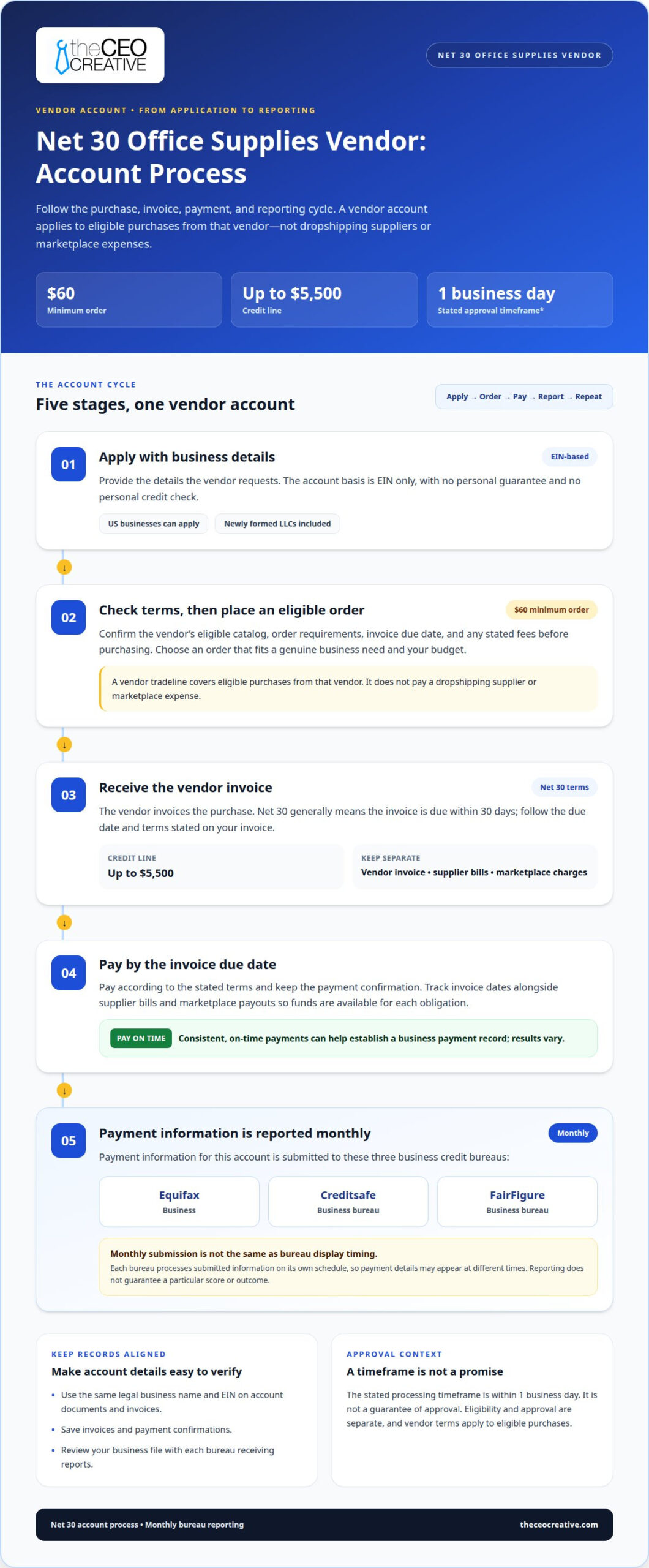
Start by applying with a vendor and providing the business details it requests. Approval gives your business access to eligible purchases under that vendor’s payment terms. Read the account terms before ordering, including the invoice due date, eligible supplies, and any charges. Net 30 generally means the invoice is due within 30 days.
After approval, place an order that meets the vendor’s requirements. The vendor invoices the purchase, and your business pays by the due date. The vendor may share payment information with business credit bureaus. Consistent, on-time payment history can help establish a business credit record, but reporting doesn’t guarantee a particular credit outcome. For net 30 accounts for dropshipping businesses, this vendor-specific reporting is distinct from funding inventory.
Net 30 differs from financing that provides funds for general use. A vendor account applies to purchases from that vendor, not every business expense. A business credit card may have different payment rules and uses; a net 30 invoice instead requires payment according to its stated terms. Owners comparing net 30 accounts for dropshipping businesses should also plan how each invoice fits around supplier bills and marketplace charges.
What are the risks of using net 30 accounts to finance dropshipping inventory? A vendor tradeline generally covers only eligible purchases from that vendor, so it may not pay a dropshipping supplier or marketplace charge. If inventory sells slowly, the invoice can still come due before sales generate enough cash.
Keep the process manageable: apply, make eligible purchases, pay each invoice on time, and order again only when the expense fits your budget. Before applying, review the vendor’s reporting policy and how it handles payment data. Track invoice and due dates separately from marketplace payouts so cash remains available for both obligations.
Which Business Credit Bureaus Receive Reports
Payment reporting is monthly to Equifax Business, Creditsafe, and FairFigure. These are the three bureaus that receive reports for this account. Reporting means payment information is submitted to these bureaus; it doesn’t mean a new payment appears on a business credit file immediately.
Bureau display timing varies. Each bureau processes submitted information on its own schedule, so the date a payment becomes visible can differ between Equifax Business, Creditsafe, and FairFigure. A monthly reporting cycle and a bureau’s display date are separate steps. Don’t treat the reporting frequency as a guaranteed posting date.
Keep your business records consistent when applying and ordering. Use the same legal business name and EIN on account documents and invoices, then save payment confirmations. These records help you identify the account and payment if you review a business credit file later. They can also help distinguish a reporting delay from a missed or misapplied payment.
Review your business file periodically at each bureau that receives reports, rather than checking only one. Look for the vendor account and payment information, and compare the details with your invoices and payment records. If an entry appears inaccurate, follow the bureau’s process for file questions and provide relevant documentation.
A reporting net 30 business account can contribute vendor payment history to business credit files, but reporting alone doesn’t guarantee a particular score or outcome. Keep paying invoices by their due dates and maintain clear records. Monthly reporting is the submission schedule; each bureau’s processing determines when information becomes visible. That distinction helps set realistic expectations while you build a consistent record of business payments.
Eligibility, EIN, and Approval
U.S. businesses, including newly formed LLCs, can apply using an EIN. There’s no minimum time in business, personal guarantee, or personal credit check. The Internal Revenue Service issues Employer Identification Numbers to businesses in the United States. Keep your EIN and business name consistent across the application and account records.
A business bank account helps separate company payments from personal spending and organize vendor invoices. The stated application basis is the EIN. Keep banking records accessible to manage business cash flow, but don’t confuse account-management practices with the stated credit qualification criteria.
The stated approval timeframe is within 1 business day. That is a processing timeframe, not a promise of approval. Eligibility and approval are different: an eligible US business can apply, while the application still goes through review. Provide accurate business details to support that review.
An EIN-based vendor account can help establish business payment history without relying on a personal credit check. That distinction matters to owners who want business activity considered separately from personal credit. A business credit score depends on information held by business credit bureaus, and reporting does not guarantee a particular score or result.
Review the credit limit and payment terms before making purchases. A smaller starting limit may affect which orders fit the account; larger purchases may require another payment method or separate planning. Pay invoices by their due dates and keep payment records. Consistent payment history can contribute to a business credit profile over time, while bureaus determine when submitted information appears. An EIN identifies the business for the account, but it does not make vendor terms interchangeable with financing or guarantee a higher limit.
Cash Flow and Dropshipping Expenses
Net 30 terms defer payment for eligible vendor purchases for 30 days. That gap may help a dropshipping business coordinate planned operating purchases with incoming sales revenue. It doesn’t erase the debt: the invoice remains due on its stated date, even if products sell slowly or marketplace payouts arrive later. Treat the due date as a fixed obligation when planning cash.
A vendor tradeline isn’t general-purpose financing. It covers eligible purchases from that vendor, not payments to a separate dropshipping supplier or marketplace charges. For example, inventory ordered from an outside supplier remains a separate expense. The cash-flow value of net 30 accounts for dropshipping businesses is therefore limited to the purchases covered by the vendor’s terms.
Map each invoice against expected cash coming in. Record the invoice date, due date, expected sales deposits, and recurring supplier obligations. If a payout is delayed, the invoice still needs payment. A net 30 account can shift the timing of eligible purchases, but it doesn’t guarantee improved business credit or a higher business credit score.
Don’t assume rewards or loyalty benefits are part of the payment arrangement. Net 30 terms describe when the invoice is due; any points, discounts, or other benefits depend on the separate terms offered. Likewise, a personal guarantee is a distinct account condition, not a cash-flow benefit. Read the terms so you understand the purchase coverage and repayment obligation before ordering.
For operators assessing net 30 accounts for dropshipping businesses, the key is matching each eligible purchase to a realistic repayment plan. Keep funds available for the invoice while budgeting separately for supplier and marketplace expenses. Reports of payment activity may contribute to a business credit file, but they don’t replace cash planning. Use vendor terms as a payment-timing tool, not extra revenue or working capital.
Net 30 Account Application Checklist
Use this sequence to keep application details, purchases, invoices, and payment records organized. Each step supports accurate account management and helps you track whether payment history appears in your business credit file.
- Prepare business details. Have your EIN and legal business name ready. Enter them consistently so the application and later account records identify the same business.
- Submit the application. Complete required fields accurately and review them before sending. An EIN-only account does not require a personal guarantee or personal credit check.
- Choose an eligible purchase. Select items covered by the vendor’s catalog and payment terms.
- Record the invoice and due date. Save the invoice when it arrives. Add its due date to your business payment calendar, separate from marketplace fees or supplier bills.
- Pay and retain proof. Pay the invoice according to its terms. Keep the payment confirmation with the invoice so you can reconcile the account if a question comes up.
- Review business credit records. Check the relevant business credit bureau files for the vendor account and payment information. Compare any displayed details with your invoice and payment records.
Repeat the purchase and payment cycle only when an order fits your business needs and available cash. Monthly reporting doesn’t mean a bureau will display an entry immediately. Monitor your file over time, and follow the bureau’s process if an entry differs from your records. A consistent routine makes invoices and reported history easier to track, without treating a tradeline as cash for dropshipping suppliers or marketplace expenses.
Common Mistakes to Avoid
Avoid these errors when choosing and managing a reporting vendor account. Reviewing the terms before applying can prevent mismatched expectations and unnecessary purchases.
- Check the eligible items and total before submitting an order, and don’t add products your business doesn’t need just to reach the threshold.
- Assuming an application guarantees approval. The stated approval timeframe is within 1 business day, but that isn’t a promise of approval. Submit accurate business information and understand that application review and eligibility are separate.
- Using inconsistent business details. A difference between the legal business name or EIN on the application and account records can make account management harder. Use consistent business details throughout the application and retain a copy for reference.
- Expecting a specific credit score result. A vendor-reported payment record may contribute to a business credit file, but it doesn’t guarantee a particular score or approval for other accounts. Treat reporting as a record of payment activity, not a promised outcome.
- Choosing a catalog that doesn’t fit. Don’t apply based only on the idea of adding a tradeline. Review the vendor’s eligible categories and choose an account only when its products serve a genuine business need.
- Skipping the account terms. Review applicable fees, payment conditions, and purchase eligibility before ordering. Don’t assume another vendor uses the same terms or account requirements.
These checks can help you choose a vendor account with clear expectations based on its written terms.
The CEO Creative as a Business Credit Vendor
The CEO Creative is a business credit vendor for US businesses seeking eligible purchases on net 30 terms and a vendor-reported business credit tradeline. Its role is specific: it connects business purchasing with payment terms and reporting, not cash for dropshipping supplier invoices or marketplace charges.
Its net 30 apparel vendor, net 30 T-shirt supplier, and net 30 embroidery supplier offerings cover categories tied to apparel and branded garments. For example, a business planning staff apparel or branded T-shirts can choose a relevant category instead of opening an account for unrelated purchases. Embroidery is another option for businesses that need embroidered apparel. Select items that fit real business needs and account terms.
That distinction matters for a dropshipping operation. The tradeline can reflect eligible purchases from the vendor, while inventory from a separate supplier remains a separate expense. Keep the account’s purpose clear: choose an eligible category for a planned purchase, review the invoice terms, and track payment against its due date. A vendor account records business payment activity but doesn’t guarantee a particular credit score or outcome.
Before applying, consider whether apparel, T-shirts, or embroidery suit your company’s actual operations. A relevant purchase is easier to budget and reconcile than an order made only to seek a tradeline. Keep application details consistent with business records, and save the invoice with its payment confirmation. These records provide a practical reference when reviewing account activity and business credit files.
Use this option when a vendor purchase fits your business and you want a reporting account for eligible purchases. To review the account and begin an application, apply with The CEO Creative.
Frequently Asked Questions
What Is Net 30 Business Credit?
NET 30 business credit is a vendor arrangement that lets an approved business buy eligible items and pay the invoice later. The vendor may report payment activity to business credit bureaus, giving the business a record of its transactions. It’s different from cash deposited into your account: the credit is tied to purchases from that vendor, and payment remains due under the account terms.
What Is a Net 30 Account and Why Is It Beneficial?
A NET 30 account is a vendor account with a delayed invoice payment date. Its practical benefit is timing: a business can receive eligible purchases before paying the balance. Under The CEO Creative’s terms, the balance is due 30 calendar days from shipping, and payments are reported to the major credit bureaus. The account can support purchase planning and business credit history, but doesn’t guarantee a score change.
What are net 30 accounts, and how do they work for dropshipping businesses?
NET 30 accounts for dropshipping businesses work like other vendor accounts: the business applies, makes eligible purchases, receives an invoice, then pays under its terms. For example, a seller might use an apparel vendor account for eligible business apparel while paying its dropshipping supplier separately. The vendor account doesn’t cover that supplier’s inventory or marketplace charges, so budget for those obligations independently.
Which vendors offer net 30 terms to U.S. dropshipping businesses?
The CEO Creative offers vendor accounts for eligible apparel, T-shirt, and embroidery purchases, as well as other business categories. A dropshipping owner can consider one when a catalog item serves a genuine business need and the payment terms fit the budget. This is vendor purchasing, not a way to pay a separate dropshipping supplier. Check that the intended purchase falls within the vendor’s eligible category.
What are the eligibility requirements for net 30 accounts for a new dropshipping business?
Newly formed U.S. businesses, including LLCs, may apply using an EIN only. Requirements vary by vendor, so applicants should check the account terms before applying. Approval is stated as within 1 business day, but that timeframe doesn’t guarantee approval. Keep the business name and EIN consistent across application records and invoices.
Do net 30 vendors report payment history to business credit bureaus?
Reporting depends on the vendor and account. The CEO Creative reports monthly to Equifax Business, Creditsafe, and FairFigure. Monthly reporting describes when payment information is submitted, not when it appears in a bureau file. Each bureau controls its own processing and display timing. Keep invoices and payment confirmations so you can compare your records with the account information shown in a business credit file.
What fees, minimum orders, and interest charges do net 30 accounts have?
Terms differ by vendor, so read the account details for any fees, interest charges, and order minimums. Don’t assume that every NET 30 account has identical costs or that the term itself means interest applies. Review the invoice and account terms before ordering, and plan to pay the full amount by its stated due date.
How do net 30 terms compare with business credit cards and other vendor credit?
NET 30 vendor credit is tied to eligible purchases from a specific supplier; it isn’t a general-purpose payment method. A business credit card has separate account terms and is not the same as a vendor tradeline. Compare the intended use, invoice due date, reporting policy, and any charges in each option’s terms. Choose based on the purchase and repayment plan, not an assumed credit score result.