


A sign company’s credit-building purchases should fit the way the business already operates. Net 30 accounts for sign companies let a business buy from a vendor on invoice and pay the balance within 30 days of the invoice date; credit-building value depends on whether the vendor reports payment history to business credit bureaus.
It makes sense to look beyond the payment window. The account’s reporting practices, purchase minimum, and fees all matter when you’re choosing terms for a growing sign business. This guide explains how vendor tradelines work, what to consider before applying, and how to manage an account from purchase through payment. You’ll also learn how to assess whether a vendor’s terms fit your cash flow and business-credit goals, without treating a reported account as a guaranteed result.
Key Takeaways
- Understand how a net 30 invoice works and plan payment around your sign business’s cash flow.
- Learn why a vendor’s reporting practices matter when you’re building a business credit history.
- See how to assess whether purchases and account terms fit your company’s regular needs.
- Use a simple checklist to manage an account from application through payment and reporting.
What Is a Net 30 Account and Why Is It Beneficial?
A net 30 account lets a business purchase from a vendor and pay the invoice within 30 days after its date. The invoice records the amount owed, the payment deadline, and the vendor’s terms. For a sign company, that window can help align purchases with incoming customer payments. It doesn’t remove the purchase cost or guarantee a business credit result.
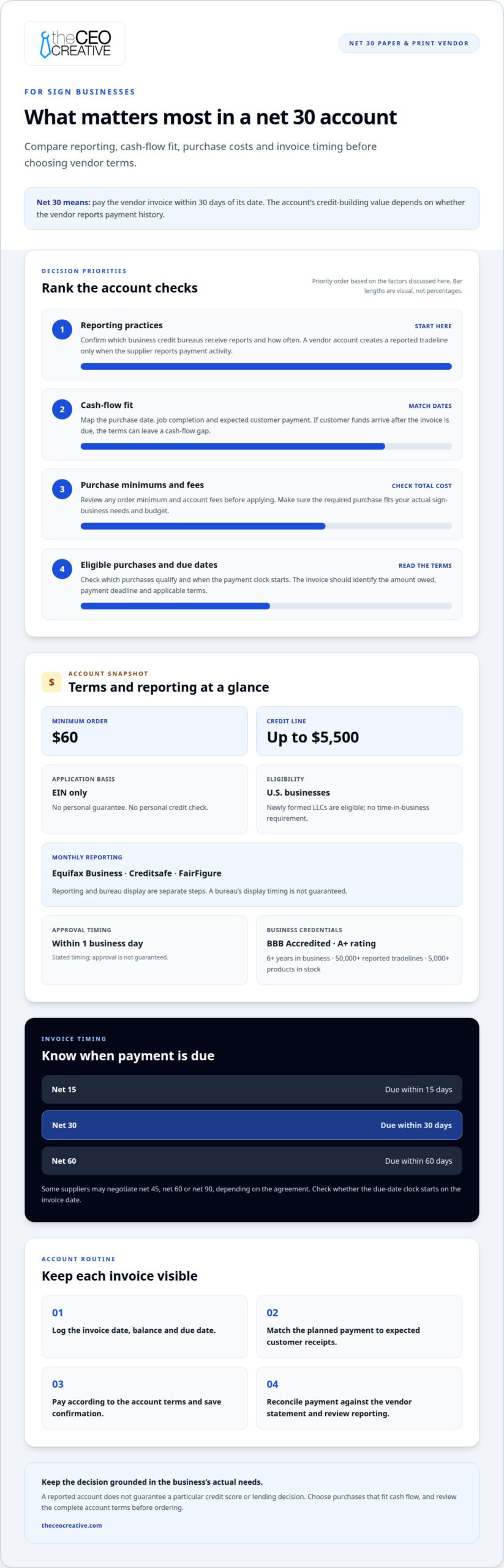
Payment terms set the period for settling an invoice. Net 15 generally means payment is due within 15 days; net 30 means 30 days; net 60 means 60 days. Some suppliers may negotiate net 45, net 60, or net 90 terms, depending on the agreement. Read the invoice and account terms before ordering, and note whether the due date starts from the invoice date.
Net 30 trade credit is different from a business credit card. A vendor account usually applies to purchases made from that vendor, while a card may be used across a wider range of sellers. Both create payment obligations. Track the due date and pay according to the terms. For a vendor tradeline, establish whether the vendor reports payment history to business credit bureaus.
Consider Uline’s product selection separately from its account terms. First, identify the specific item needed for a sign project and whether it fits the company’s budget and schedule. Then review the terms that apply to the account and order. Don’t assume an advertised payment option covers every purchase. Read the agreement for payment timing and eligible purchases.
Before applying for vendor credit, prepare accurate business details, including the legal business name, EIN, and physical business address. Review each application field and the payment terms before submitting. Approval conditions and offered terms can differ, so don’t plan cash flow around an assumed credit limit or due date. Apply when the account’s purchasing options fit the company’s actual needs.
Manage due dates with a simple routine. Record each invoice’s date, balance, and deadline as soon as it arrives. Match the planned payment date to expected customer receipts, allowing for collection delays. If a sign project has staged customer payments, link each supplier invoice to that project instead of treating all incoming revenue as available cash. This keeps upcoming obligations visible.
For sign companies considering net 30 accounts, compare the full agreement, not just the payment period. Check the purchase minimum, fees, eligible purchases, reporting practices, and payment-history policies. A longer term may leave cash available longer, but it doesn’t change the amount owed. Choose terms that suit the business’s work schedule and realistic payment plan.
Vendor accounts for establishing business credit
A vendor account can help establish business credit when the supplier reports payment activity to business credit bureaus. The account creates a record of purchases, invoices, and payments. Before applying, identify which bureaus receive reports and whether the vendor reports on-time and late payments. An account that doesn’t report payment history won’t create a reported tradeline through that supplier.
Business credit bureaus maintain separate files, so a vendor’s reporting may not appear everywhere. Dun & Bradstreet, Experian, and Equifax are commonly identified as major business credit bureaus. Creditsafe is another business information provider. Find out which bureaus receive a vendor’s reports, how often it reports, and which business details must match the account. Reporting and bureau display are separate steps.
Payment history reflects how an account is managed. Pay the invoice by its due date, retain the payment confirmation, and match it to the correct purchase. Consistent, on-time payments can support a business credit history when the vendor reports them. They don’t guarantee a particular score or lending decision. Keep purchases within cash flow rather than buying items solely to create account activity.
Vendor approval and credit checks depend on each supplier’s application process. A vendor may review business information, payment history, or other application details before setting a credit limit. Provide accurate information, including the legal business name and EIN where requested. Don’t assume every net 30 application uses the same approval criteria or checks personal credit.
If a vendor denies an application, read the decision notice and identify the stated reason. Correct inaccurate business information, complete missing fields, or address documentation gaps before applying again. Avoid repeated applications with inconsistent details. A denial from one supplier doesn’t automatically determine the outcome with another, because application requirements and approval decisions differ.
When assessing a business credit program, separate its stated purpose from its reporting policy. Look for clear terms on application requirements, purchase rules, credit limits, payment deadlines, and reporting bureaus. Don’t treat a business-credit label as proof that payment activity is reported. Keep a written record of each vendor’s terms so account obligations and reporting sources stay clear.
If a sign company pays a net 30 invoice late, the account becomes past due under its terms. The vendor may record or report that payment history, which can affect the business’s credit file if reporting applies.
Use a simple account routine: log the invoice date and due date, set a payment reminder, and reconcile the payment against the vendor statement. Review account activity regularly so a missed payment or reporting discrepancy can be addressed. To see account terms designed around business-credit reporting, explore this business net 30 account.
Net-30 accounts for a sign manufacturing business
A sign manufacturer can assess net 30 terms against the time between buying supplies, completing a job, and collecting customer payment. If a short cash conversion cycle lets the business receive sales proceeds before an invoice is due, those proceeds may cover the supplier payment. If customer payment arrives later, the same terms can create a cash-flow gap. Map the purchase and collection dates before relying on expected project revenue.
Start with a project-level purchase plan. For a storefront sign, list the supplies needed, the supplier, the invoice date, and the expected customer payment date. Then compare those dates with the 30-day payment window. This shows whether the project’s cash inflows can cover its supplier obligations without relying on an uncertain collection date. Repeat the calculation for each project with different billing milestones.
Track purchases by job. Record a materials invoice for one client’s sign against that project, rather than mixing it into general expenses. This helps the owner see which jobs create upcoming payment obligations and whether deposits or progress payments cover them. A spreadsheet can track the purchase, invoice, due date, customer receipt, and payment status. The record can also reveal overlapping supplier bills.
Timing matters because sign work has several stages. A customer may approve a design before production begins, while a supplier invoice may arrive earlier than the final customer payment. Map the order, production, installation, and collection steps for each project. If the supplier due date falls before expected receipts, plan cash for the invoice before placing the purchase. Choosing net 30 accounts for sign companies should include this project timing, not just the stated payment period.
Review each supplier agreement before using net 30 terms. Confirm when the payment period starts, which purchases qualify, how invoices are delivered, and whether the agreement includes fees or a personal guarantee. Keep the terms with the corresponding purchase record. This makes each obligation clear when an order has multiple invoices or project stages.
Credit-building and production planning are separate. An account may support business credit only if the supplier reports payment activity to business credit bureaus. Reporting doesn’t replace a cash-flow plan or guarantee a particular outcome. Treat the account first as a payment obligation, then assess whether its reporting policy supports your credit-building goals.
Set a payment routine for every active job. Enter each invoice and due date when it arrives, then schedule reminders before payment is due. Reconcile the supplier statement against the purchase record. If a customer delays payment, the supplier invoice remains due under its terms, so keep enough cash available to meet the obligation.
Evaluate each purchase against the sign company’s actual workload. A recurring supply purchase tied to confirmed jobs is easier to plan than an order based on possible future work. Compare the due date with expected customer receipts, available cash, and other invoices. For net 30 accounts for sign companies, a project-by-project cash-flow review helps determine whether the terms fit the business’s operating cycle.
Vendor account fees and purchase minimums
Review the order minimum and every account charge before applying. A purchase threshold is not an annual fee, nor does it mean every order will cost the same. Plan purchases around items the business needs, such as eligible office supplies, rather than buying unnecessary goods to reach a minimum.
Distinguish a purchase minimum from a membership fee. A minimum sets the lowest qualifying order amount. A membership fee, if an account has one, is a separate charge with its own timing and conditions. Also look for order-related charges, late-payment terms, and other fees listed in the agreement. Don’t assume a vendor charges a fee simply because another supplier does.
Before approval, read the application and account terms together. Note what starts the payment period, how invoices are delivered, and what happens if payment is late. Check whether the agreement requires a personal guarantee. A personal guarantee can make an individual responsible for specified business obligations, so understand the commitment before accepting it. Approval doesn’t replace the need to review those conditions.
For credit reporting, identify which business credit bureaus receive payment information and the vendor’s reporting schedule. A purchase minimum alone doesn’t establish that reporting occurs. Check whether the vendor reports payment activity and whether the terms explain how account activity is handled. Reporting may affect a business credit file, but it doesn’t guarantee a particular score or outcome.
Use a short comparison worksheet for each vendor. Record the purchase minimum, any membership charge, other stated fees, payment deadline, credit reporting details, and personal guarantee terms. For example, compare two office-supply accounts by listing each requirement in the same order. This makes differences visible without judging an account by one headline term.
Test the minimum against a real purchasing plan. List supplies needed for confirmed work, estimate the order total from the vendor’s catalog, and compare it with the threshold. If the planned order falls below the minimum, consider whether combining purchases makes operational sense. Don’t add items the business won’t use just to qualify.
As soon as you place an order, enter the invoice amount and due date in the cash-flow calendar. Track any separate membership charge on its own line. This prevents recurring account costs from being mistaken for purchase spending. A clear record also helps reconcile the vendor statement against the original order and identify unexpected charges.
Compare the full agreement, not just the payment period. A low purchase threshold may suit routine buying, while a fee or guarantee can change an account’s overall fit. Choose terms that match actual purchasing needs, cash flow, and credit-building plans.
Which vendors offer Net 30 accounts to sign companies?
Sign companies can look for vendor accounts in categories tied to regular business purchases. Examples include apparel, office supplies, promotional products, paper and print, and technology. A vendor’s product category doesn’t prove it offers net 30 terms. Confirm that its account agreement provides invoicing and a defined payment deadline before placing an order.
Start with the business’s purchase list. A sign shop ordering staff shirts might assess an apparel vendor with Net 30 terms. A company buying administrative items might consider an office-supplies vendor. Match each category to actual operating needs, then assess whether the vendor reports payment activity to business credit bureaus. This keeps the search focused on useful purchases and credit-building plans.
Uline and Grainger may come up during vendor research. Don’t assume their account availability, credit limits, fees, or reporting practices based on their names alone. Review each supplier’s published terms, including application requirements, qualifying purchases, minimums, payment deadlines, and bureau reporting. Terms can differ by account and may change, so compare the agreement relevant to your business.
Use a consistent comparison record for every option. Note the vendor name, product category, application requirements, purchase minimum, fees, payment terms, personal guarantee requirement, and reporting bureaus. For example, comparing an apparel account with an office-supplies account can show whether either fits planned spending and credit-building needs. Don’t rank vendors by payment period alone.
Separate a supplier’s ability to sell useful products from its role as a reporting vendor. A purchase can meet an operating need without creating a business tradeline. For credit-building purposes, the vendor must report payment activity, and the business must manage invoices according to the account terms. Reporting may support a credit file, but it doesn’t guarantee a specific score or financing decision.
Before applying, make sure the business information is consistent across the application and supporting records. Enter the legal business name, EIN, and address accurately. Review the final terms before accepting the account. If the agreement includes a personal guarantee, understand who is responsible for the covered debt. If the vendor reports to bureaus, record which ones and how often.
Competitor terms are based on publicly published reviews and are accurate to the best of our knowledge at the time of writing. Confirm current terms directly with any vendor.
Choose an account based on real purchases, clear payment terms, and stated reporting practices.
The CEO Creative
The CEO Creative offers Net 30 vendor accounts for businesses building credit through planned purchases. Sign companies can consider apparel, T-shirt, embroidery, and office-supplies options based on their operating needs. The account is based on the business EIN, without a personal guarantee or personal credit check.
Choose purchases that fit your company’s work and payment schedule. Keep orders connected to business needs, and manage invoices according to their terms. Account activity doesn’t guarantee a particular credit outcome.
If you’re considering a vendor account for your sign business, contact The CEO Creative to discuss the terms.
Make Your Next Account Decision Deliberate
Turn your research into a purchasing policy your team can follow. Decide which business purchases belong on vendor terms, who approves them, and how account activity fits your company’s credit-building goals. A clear process keeps supplier decisions connected to sign projects and avoids treating credit activity as a goal on its own.
Choosing net 30 accounts for sign companies should begin with operational fit, then consider reporting and account terms. Keep the decision tied to purchases the business already plans to make. Review the arrangement as your workload and cash-flow needs change, so vendor accounts remain useful to the company rather than becoming unnecessary obligations.
This article provides general information, not financial or legal advice. Credit outcomes vary, and a vendor tradeline doesn’t guarantee a particular result. Take a measured approach, keep account responsibilities clear, and make each purchase decision with your business’s plans in view.
With a thoughtful process in place, you can take your next step with greater clarity and confidence.
Frequently Asked Questions
What is a Net 30 Vendor?
A Net 30 vendor supplies goods or services to an approved business and invoices the purchase under payment terms. The business pays by the invoice’s due date. For example, a sign company might use a vendor account for business apparel, then record the invoice with its project expenses. Whether that purchase helps establish a reported tradeline depends on the vendor’s reporting practices.
What does Net 30 mean for a sign company?
Net 30 means the invoice balance is due within 30 days after the invoice date. The due date is tied to the supplier’s invoice, not the date a sign company collects from its customer. Record the invoice date and deadline when the bill arrives. That gives the business a clear payment obligation to include in its project and cash-flow records.
What are the requirements to open a Net 30 vendor account?
Requirements vary by vendor. For The CEO Creative’s account, applicants provide an EIN, and eligibility includes US businesses and newly formed LLCs. There’s no minimum time in business, personal guarantee, or personal credit check. Approval still depends on the application process. Use consistent legal business information, and review the account agreement before accepting terms or placing a purchase.
What products and services can sign companies buy on Net 30 terms?
Eligible purchases depend on the vendor’s catalog and account terms. A sign company could consider branded apparel for staff, embroidered items, or office supplies for administrative work. These purchases support business operations but may not be materials used to manufacture signs. Match the vendor category to planned spending, then check which items qualify for invoicing under the account.
Do sign supply vendors report Net 30 payments to business credit bureaus?
Some vendors report payment activity, while others don’t. The CEO Creative reports monthly to Equifax Business, Creditsafe, and FairFigure. Distinguish the vendor’s reporting schedule from the time a bureau takes to display an account. Keep invoices and payment records so you can review account activity if a reported tradeline appears differently than expected.
What fees, interest, and minimum orders apply to Net 30 accounts?
The Net 30 term is described as interest-free when payment is made within the stated period. Account or membership charges, if applicable, are separate from the purchase minimum and should be reviewed in the current terms before applying. Compare the full cost structure, payment deadline, and purchase rules rather than focusing only on the invoice term.
How can a new sign company qualify for Net 30 terms?
A newly formed US sign company can apply using its EIN, even without an established operating history. Complete the application with accurate business details and read the terms before accepting an account. Approval isn’t automatic, so don’t commit to a purchase based on an assumed limit. Plan to pay invoices from business cash flow, even if customer receipts arrive later.
How can sign companies build business credit with Net 30 accounts?
Choose accounts that report payment activity, use them for planned business purchases, and pay invoices according to their terms. Keep a record of each order, invoice, due date, and payment confirmation. For example, connect an apparel purchase to its invoice and receipt. Reported payment history may contribute to a business credit file, but it doesn’t guarantee a particular score or credit decision.