


A personal guarantee isn’t the only route into vendor credit. Starter vendor credit accounts can offer US businesses net 30 terms, with this account based on an EIN and no personal guarantee or personal credit check.
It’s reasonable to want clear terms before applying, especially when your business is new. Newly formed LLCs are eligible, with no minimum time in business. Invoices are due within 30 days, and payment activity is reported monthly to Equifax Business, Creditsafe and FairFigure.
This guide explains how invoice timing works, which application details matter, and how EIN-only eligibility differs from a personal guarantee. You’ll also learn what reporting can and can’t tell you, plus how to assess whether starter vendor credit accounts fit your business’s purchasing needs.
Key Takeaways
- Choose terms for purchases your business already needs, such as apparel, T-shirts, or embroidery.
- Have your business and EIN details ready so the application can be assessed using the stated eligibility criteria.
- Keep invoice due dates and payment records organized to support a consistent account history.
- Separate monthly bureau reporting from when a trade line appears in a bureau’s records; display timing can vary.
- Treat reporting as a record of payment activity, not a promise of approval or a particular credit outcome.
What You Can Order on NET 30 Terms
The CEO Creative is a business credit vendor with NET 30 apparel, T-shirt, and embroidery supplier categories. Choose a category that matches a purchase your business already plans to make. This keeps the decision connected to actual operations, such as preparing clothing for a team or arranging branded items for a business activity. An account should support a sensible purchase, not be the reason to buy something unnecessary.
For a company planning branded clothing, a NET 30 apparel vendor may fit its purchasing needs. Think about how the apparel will be used and whether it belongs in the business’s current plans. For example, a company preparing clothing for staff may find this category more relevant than a supplier focused on a different type of purchase. The category provides a way to align an order with a regular business purpose.
A NET 30 T-shirt supplier may be the closer fit when shirts are the specific items the business intends to purchase. Consider the purpose before ordering, such as clothing for a team or a planned brand activity. This distinction helps narrow the category choice without treating every apparel purchase as interchangeable. Keep the decision centered on what the company needs and can responsibly manage.
The NET 30 embroidery supplier category may suit a business planning apparel with embroidered branding. Apparel and embroidery are related, but the category choice should reflect the purchase being considered. A business looking for clothing generally may focus on apparel, while one seeking embroidered items may choose the embroidery supplier category. Matching the category to the intended order makes the purchasing rationale clear.
Before choosing an account, identify the planned purchase, its business purpose, and how it fits your priorities. Match the account category to an item your business actually needs, rather than choosing solely for a possible tradeline. Keep the purchase aligned with operational needs and a manageable payment plan. This makes the vendor relationship easier to include in routine business records.
If these categories fit your purchasing plans, contact The CEO Creative to learn about its business credit account.
How a Starter Vendor Account Works
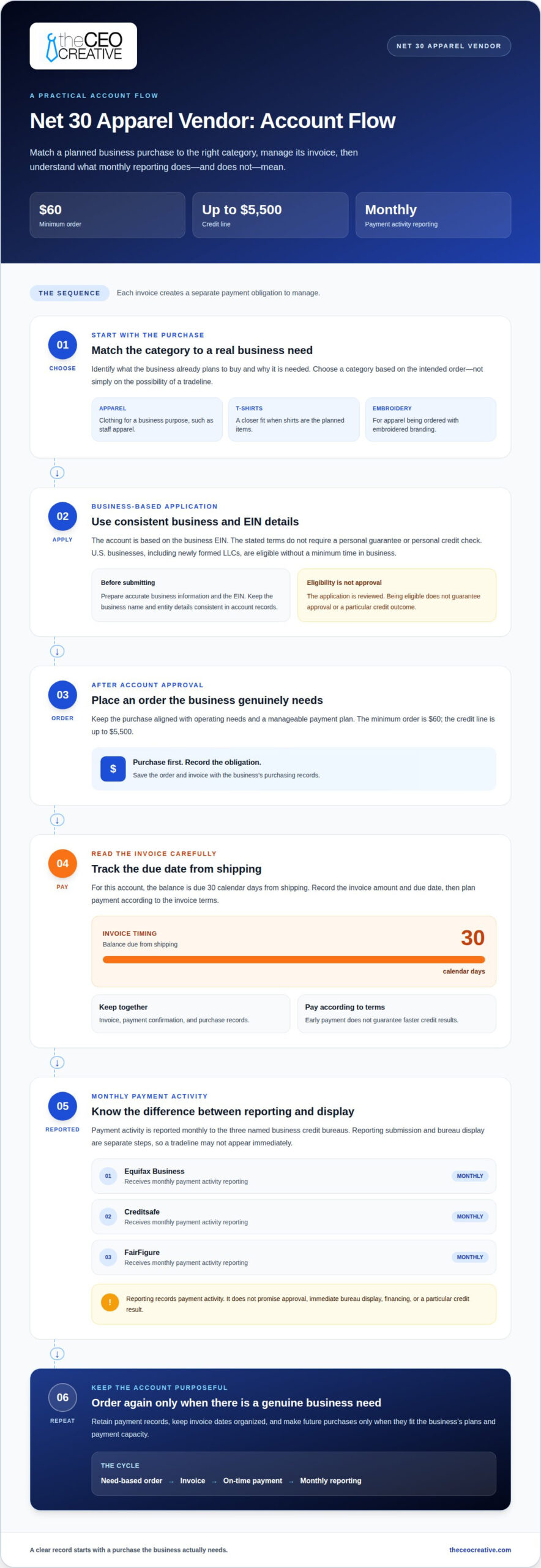
Start by submitting the business details requested in the application. The supplier reviews the application and decides whether to approve it. Once approved, place an order your business needs. The supplier issues an invoice with the payment terms and due date. Save it with your purchasing records to connect the purchase, payment obligation, and account history. When assessing starter vendor credit accounts, consider every step, not just the application.
Payment terms define when an invoice is due. Net 15 generally means payment is due within 15 days; NET 30 allows 30 days; net 60 allows 60 days. The due date on the invoice guides when payment must be made. A net 15 payment term gives less time to arrange payment than NET 30 or net 60. Check each supplier’s terms before placing an order.
When an invoice arrives, record its amount and due date, then plan payment. Paying on time meets the invoice obligation. Paying early may help keep your records current, but it doesn’t guarantee faster credit results. The supplier determines which payment activity it reports. Keep the business entity details consistent and save payment confirmation with the invoice. These records can help resolve questions about a transaction or payment date.
For The CEO Creative account, the balance is due 30 calendar days from shipping. Payments are reported monthly to Equifax Business, Creditsafe, and FairFigure. Reporting submission and bureau display are separate steps, so the tradeline may not appear immediately. After paying, retain the records and order again only when the business has a genuine need. Each invoice creates a separate payment obligation to manage. Starter vendor credit accounts can contribute payment history, but they don’t guarantee financing, approval, or a particular score.
Eligibility and Application Requirements
U.S. businesses, including newly formed LLCs, can apply without a minimum time in business. The account is based on the business’s EIN, with no personal guarantee or personal credit check. This may suit owners who want vendor payment activity associated with the business rather than a personal credit file. Approval still depends on application review, so eligibility does not guarantee approval.
Prepare accurate business details and your EIN before applying. Use the same business name and entity information throughout the application and account records. Review the terms before submitting, including the purchase threshold, invoice due date, and any applicable fees. A minimum purchase differs from a fee: one applies to the order, while the other is a separate account cost.
Purchase requirements and fees depend on the account terms. Review the stated order threshold and fee disclosures before applying. Don’t assume every starter account has the same costs or purchase rules.
This account’s reporting destinations and monthly frequency are described in the preceding section. Reporting practices vary by supplier, so consider both the named bureaus and reporting schedule when comparing programs. There is no fixed number of vendor accounts required to build business credit. Choose accounts that support genuine purchases and that your business can manage responsibly.
Key risks include taking on purchases the business doesn’t need, missing invoice payments, and expecting a particular credit outcome. Reduce these risks by matching orders to operating needs, recording due dates, and paying according to the account terms. The CEO Creative offers an EIN-only NET 30 account with no personal guarantee. As with any vendor account, that structure doesn’t guarantee approval, bureau display timing, or a specific credit result.
Which Business Credit Bureaus Receive Reports
Business account payment activity is reported monthly to Equifax Business, Creditsafe, and FairFigure. These are the three bureaus named for this reporting program. Monthly reporting means account information is sent on a recurring basis. It does not mean each bureau updates a business credit report on the same day or displays a new tradeline immediately.
Keep two events separate: the supplier submitting a report and the bureau displaying the information. The first concerns when payment activity is sent; the second depends on the bureau’s processing and display timing. For example, a paid invoice may be included in a monthly submission before appearing on a business credit report. Timing can vary among Equifax Business, Creditsafe, and FairFigure.
Reporting is not the same as a guaranteed score change. A tradeline can add account and payment information to a business credit profile, while each bureau maintains its own report and scoring approach. A reported account alone does not promise a particular score, approval, or financing result. Paying according to the invoice terms supports a clear payment record, but outcomes depend on how bureaus maintain and evaluate their records.
For practical tracking, keep the invoice, payment confirmation, and account details together. When reviewing a report, look for the supplier account and its payment information. Different display timing across the three bureaus doesn’t, by itself, show that a monthly submission was missed. Monthly reporting and bureau display are separate steps, so allow time for each bureau’s process.
When building credit with vendor accounts, ask not only whether a supplier reports, but also which bureaus receive reports and how often. This account reports monthly to Equifax Business, Creditsafe, and FairFigure. Keep payment records organized so you can track account activity while bureau records update on their own schedules.
Starter Vendor Account Checklist
Use this sequence to assess a reporting vendor account, organize purchase records, and track payment activity through the reporting process.
- Match the eligibility rules. Confirm that the business is based in the United States and fits the vendor’s stated criteria. Newly formed LLCs can be eligible, with no minimum time in business. Read the account terms closely so the business owner understands the approval basis, any order minimum, and payment deadline before applying.
- Prepare the application details. Have the EIN and accurate business identity details available. Enter them consistently wherever the application requests them. Before submitting, review the terms for whether the account uses an EIN only, requires a personal guarantee, or includes a personal credit check. These conditions differ by vendor and matter to how the business account is structured.
- Choose an order tied to a real need. Identify a planned business purchase, then make sure the order meets the vendor’s minimum and fits the business’s cash plan. Avoid buying items solely to create a tradeline. A purchase should make sense operationally even without a credit-building purpose.
- Record the invoice and pay by its due date. Save the invoice with its issue date, due date, amount, and payment terms. Set a reminder that gives the business enough time to process payment. Keep the payment confirmation with the invoice. This creates a useful record if the business later reviews its account activity.
- Track reporting and bureau display separately. Note the vendor’s stated reporting frequency and named bureau destinations. Reporting is monthly for the account described in this article, but bureau display timing varies. After payment, retain the relevant records and review business credit reports for the account’s appearance. Don’t treat a delay in display as proof that reporting was skipped.
Keep this checklist with your purchasing and payment records. Revisit it before opening another vendor account, especially if you have unpaid invoices. A manageable routine starts with necessary purchases, clear supplier terms, and records that track each order from purchase through payment and reporting.
Common Mistakes to Avoid
A vendor account works best when its terms, purchases, and payment records fit your business routine. Avoid these common errors when evaluating and managing an account.
- Assuming approval or credit results are guaranteed. Meeting basic eligibility criteria doesn’t ensure approval. A reported account also doesn’t guarantee a particular score, credit profile, or financing decision. Treat the account as one part of business credit history, and base purchasing decisions on business needs rather than an expected outcome.
- Expecting monthly reporting to mean immediate bureau display. Reporting describes when a supplier sends payment activity; bureau display follows its own process. Don’t assume an account is missing simply because it hasn’t appeared right away. Keep invoices and payment confirmations so you can track activity while bureau records update.
- Ordering only to create a tradeline. A purchase that doesn’t serve the business can strain cash flow and create another payment obligation. Before ordering, connect the items to an actual operational need. Keep the order within what the business can pay under the account’s terms, even if the supplier offers a larger credit line.
- Overlooking the invoice’s due date. Don’t rely on memory or assume every supplier uses identical payment terms. Record the due date shown on each invoice and plan payment accordingly. A calendar reminder and saved confirmation help the business keep a clear record of what was billed, when it was due, and when it was paid.
- Confusing account terms or reporting with other credit products. A vendor account is not automatically the same as a credit card or a loan. Review whether the agreement requires a personal guarantee, uses a personal credit check, and reports payment activity. Those details affect how the account relates to the business and its credit records.
Use these checks before applying and again before placing an order. Clear expectations help you manage invoices without relying on assumptions about approval, reporting, or credit outcomes.
The CEO Creative: Business Credit Vendor
The CEO Creative is a business credit vendor for companies that want a Net 30 vendor relationship tied to a business purchase. Its apparel, T-shirt, and embroidery supplier categories may fit businesses with planned purchases in those areas. Start with the item your company genuinely needs, then consider whether its payment terms work with your operating cash flow.
A company preparing apparel for its team may consider a net 30 apparel vendor. If the planned purchase is specifically shirts, a net 30 T-shirt supplier is a closer category fit. For apparel with embroidered branding, the net 30 embroidery supplier category may align better. The distinction helps connect the intended purchase to the right supplier category.
This account may suit an owner who wants vendor payment activity associated with business credit reporting, especially if the business expects to buy apparel or related items. It is less suitable if you would need to invent a purchase just to open an account. Base the decision on actual business use and a realistic invoice payment plan.
Before applying, review the account terms and confirm your business details are accurate. Consider how the invoice due date fits with expected cash receipts and other obligations. After ordering, retain the invoice and payment confirmation. These records help organize purchasing and payment activity, while bureau reporting and display follow their own processes.
Treat the account as one part of a broader business credit plan, not a promise of a particular score or future approval. A suitable vendor account connects useful purchases with clear payment terms and reporting. Your business remains responsible for choosing manageable orders and paying each invoice according to its terms.
Visit The CEO Creative’s business Net 30 account page to review the account details.
Frequently Asked Questions
Why Use a Net 30 Account for Your Business?
A NET 30 vendor account can help align a needed business purchase with a later invoice payment while creating a record of supplier payment activity. For example, a business planning branded shirts can choose a vendor category that matches that purchase. The account is most useful when the items serve an actual business purpose and the invoice fits the company’s cash flow plan.
Are net 30 accounts worth it?
Vendor accounts may be worthwhile when your business needs the products, can manage the invoice, and values the supplier’s reporting arrangement. They may not make sense if opening an account would lead to unnecessary spending or payments you can’t comfortably manage. Assess the purchase and terms together. A reported account can contribute payment information, but it doesn’t guarantee a score change or approval elsewhere.
Can Paying Early Help Build Business Credit Faster?
Paying early can help prevent an invoice from becoming late, but it doesn’t guarantee faster credit-building results. Suppliers report on their own schedules, and bureaus control when information appears in their records. For example, an early payment doesn’t necessarily appear before the supplier’s next monthly reporting cycle or change a business credit score immediately.
Do net 30 accounts require a personal credit check or guarantee?
Requirements vary by vendor and account. The CEO Creative’s account is EIN only, with no personal guarantee and no personal credit check. This lets a business apply using its business identification rather than relying on a personal guarantee. Before applying, read the account’s eligibility and payment terms to understand how the application is assessed.
How long does it take for net 30 payments to show on my credit report?
There is no fixed display interval. The account’s payment activity is reported monthly to Equifax Business, Creditsafe, and FairFigure, but each bureau controls its own processing and display timing. Keep the invoice and payment confirmation together. When reviewing a report, look for the supplier tradeline and its payment details rather than expecting every bureau to update at once.
What Is Vendor Credit?
Vendor credit is an arrangement where a supplier lets a business receive a purchase and pay its invoice later under agreed terms. The supplier’s payment reporting can create a record of the account in business credit files. For the business, the practical value depends on using the account for planned purchases and managing invoices as part of its normal payment process.
What Is a Net 30 Vendor Account?
A NET 30 vendor account lets a business buy from a supplier and pay under NET 30 terms. For The CEO Creative, the balance is due 30 calendar days from shipping, and payments are reported to the major credit bureaus. Before ordering, connect the purchase to a business need and make sure the invoice schedule fits the company’s cash management.
What are starter vendor credit accounts?
Starter vendor credit accounts are supplier accounts that can help a business establish payment history through purchases and invoices. The business applies, places an order, pays according to the invoice terms, and may have its payment activity reported. Compare the application requirements and reporting details with your purchasing needs. An account can support a credit profile, but it doesn’t guarantee a particular outcome.