

Business credit starts with separating business activity from personal finances and building a record of responsible payments. Learning how to get business credit as a young entrepreneur means establishing a business identity with an EIN, using accounts that report payment history, and paying on time while keeping balances manageable.
Starting young doesn’t mean you need years of credit history to take practical steps. Separate business income and expenses, then build credit through eligible business accounts and vendor terms that report to commercial credit bureaus. A young business can get started by establishing clear business details and consistent payment habits.
This guide explains how business credit works, why separating finances matters, and how an EIN supports a distinct business profile. You’ll learn how on-time payments and low credit utilization fit into the process, what to look for in vendor terms that report, and which common mistakes can make it harder to build a reliable credit history.
Key Takeaways
- Use an EIN and dedicated business bank account to create clearer separation between business and personal finances.
- Choose net 30 vendor terms that report payment activity, and plan orders around what your business can pay on time.
- Understand the account steps: apply, place an eligible order, pay the invoice, then repeat to build a payment record.
- Know which bureaus receive reports: Equifax Business, Creditsafe, and FairFigure. Reporting is monthly, but bureau display timing varies.
- Use a simple checklist to keep business records organized, make timely payments, and review reported account information.
What Is Business Credit and How Do You Build It?
Business credit records how a company handles financial obligations. For founders learning how to get business credit as a young entrepreneur, a practical first step is establishing a distinct business identity and a consistent payment record.
-
Choose a Business Entity
Choose a legal business structure, such as an LLC or corporation, and use its registered name consistently. A separate entity creates a distinct identity for banking and credit records. Gather your formation details and identify who can act for the business. If you operate as a sole proprietor, keep business details consistent across applications.
-
Open a Dedicated Business Account
Apply for an EIN through the IRS, then open a dedicated account in the business’s legal name. Keep business deposits and expenses separate from personal transactions. Have your EIN and entity details ready, and follow the bank’s application instructions. Set up a business phone number and use consistent contact details on account applications.
-
Set Up Vendor and Supplier Accounts
Choose vendor and supplier accounts with net-30 terms that report payment activity. Order items the business needs and can pay for by the due date. Keep invoices and payment records organized. A D-U-N-S number is a unique nine-digit identifier Dun & Bradstreet uses to track business credit. It differs from an EIN; EIN-only net-30 vendor accounts use the EIN as their application basis.
-
Understand Credit-Building Timelines and Scores
Establishing the foundation for a business credit profile can take 30 days, while meaningful history may take longer. No single score threshold is needed to begin building a profile; scoring models evaluate reported business information. Understanding how to get business credit as a young entrepreneur also means paying accounts on time and reviewing the information associated with the business as its credit history develops.
Why Keep Business Money Separate From Personal Money?
Separate records make business income, expenses, and payment activity easier to track. These steps help reduce financial mixing and clarify how personal and business records relate.
- Run business transactions through a dedicated business account. Deposit customer payments there, then pay business expenses from that account. For example, buy business materials with its debit card instead of a personal card. This creates a clearer bookkeeping trail and helps distinguish company activity from household spending.
- Record every transfer between personal and business accounts. Label it in your records rather than treating it as sales income or an ordinary expense. Reconcile statements with invoices and receipts regularly. Clear records show how the business is performing without mixing personal purchases into its operating history.
- Keep personal credit separate from business applications and accounts where possible. New businesses often lack an established financial history, so keeping business account activity organized can help clarify the company’s payment history. A personal credit card used for company expenses can also complicate bookkeeping. Track those transactions and follow the card issuer’s payment terms.
- Read account terms carefully before accepting a personal guarantee. A guarantee can make the individual responsible for a business obligation, so separate bank accounts alone don’t remove that commitment. Vendor accounts with terms that don’t require a personal guarantee provide another structure; review what the agreement says about repayment. See how net-30 accounts without a personal guarantee fit this distinction.
Some businesses use personal guarantees early on, even while establishing separate business credit. Keeping day-to-day transactions distinct and building business credit are related but different tasks. Clear records show how money moves through the business, while account terms may still make an owner personally responsible for an obligation. When reviewing a vendor account, check whether the agreement places responsibility on the business, the individual, or both.
The page recommends forming an LLC or corporation rather than operating as a sole proprietorship to help separate business and personal credit. Consider that choice alongside the way the business handles its accounts and credit applications, rather than treating a change in business structure as a substitute for reviewing account terms. The aim is to make the boundary between business activity and personal finances easier to maintain while recognizing that early credit arrangements may still involve personal guarantees. Reviewing both structure and vendor account terms can help owners understand where separation exists and where it does not.
What Can You Order on Net 30 Terms?
Net 30 terms can cover business purchases from an eligible vendor. For this account, the balance is due 30 calendar days from shipping. Choose items your business needs, rather than ordering solely to create account activity. Apparel, T-shirts, and embroidery may support staff clothing, branded wear, or other customer-facing business needs.
A net 30 apparel vendor can be relevant when your business needs apparel for its operations or brand. T-shirts are one option for coordinated branded clothing. Embroidery can add stitched branding to apparel, including hats where suitable. Match the order to a clear purpose, such as outfitting staff or preparing branded items for a business event.
- Apparel: Consider apparel your team can use during regular work or customer-facing activities. Choose an order size that fits the people and purpose it serves.
- T-shirts: Use T-shirts when your business needs coordinated branded clothing. Keep the design and quantity aligned with the intended use, not an imagined future need.
- Embroidery: Choose embroidered apparel when stitched branding suits the item and your business identity. Hats are one example of an apparel item that can carry embroidery.
Before ordering, plan for the balance to be due 30 calendar days from shipping. Keep the invoice and payment record with your business documents. Make sure the purchase fits an actual business need and your repayment plan. Apparel, T-shirts, or embroidery can serve as a business purchase while contributing to a consistent vendor-account routine, provided the business can meet the payment terms.
How the Net 30 Account Works
Track each account from application through payment and reporting. Keep order records, invoices, and payment confirmations with your business documents.
-
Apply With Business Details
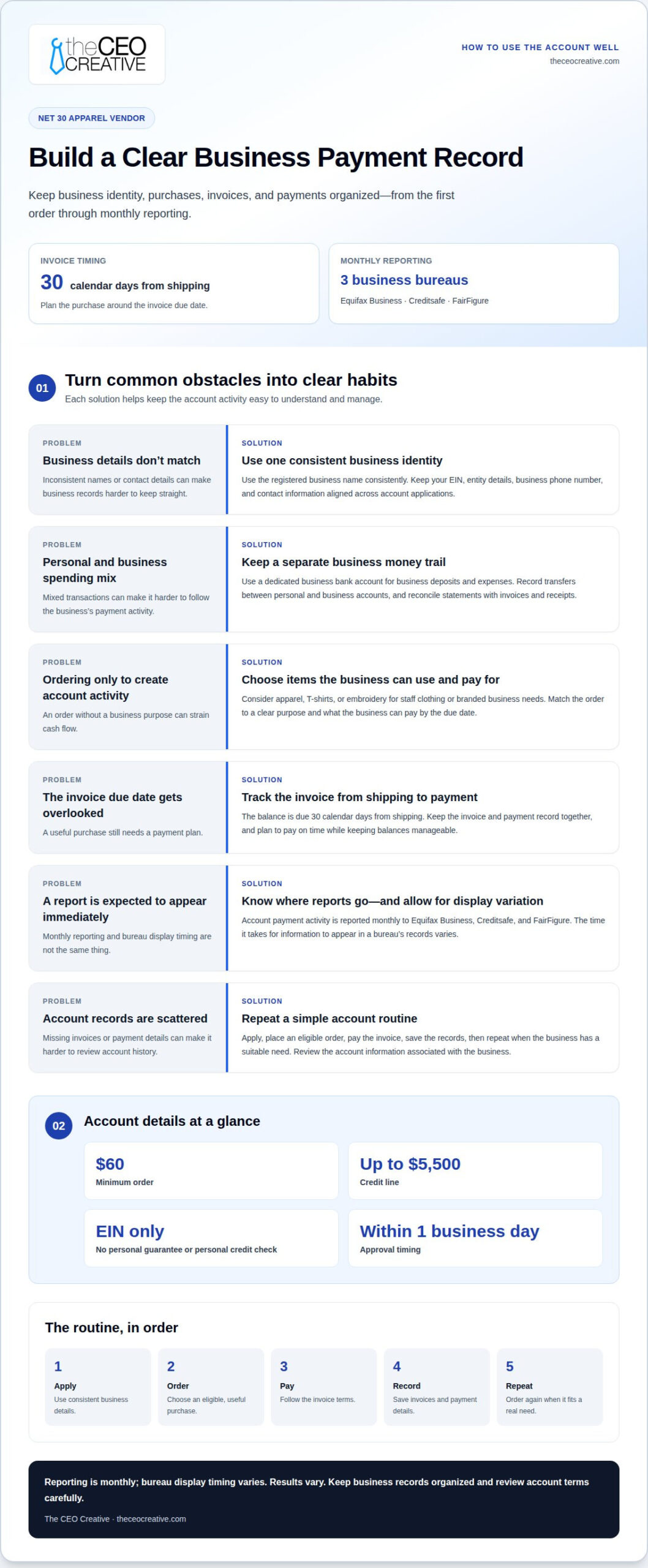
Submit the application using the business’s EIN and matching business information. The account is EIN-only, with no personal guarantee or personal credit check. Approval is within 1 business day. US businesses, including newly formed LLCs, are eligible, with no minimum time in business. Applicants under 18 may need adult involvement with account setup or payment services. Review the relevant service rules and fees before choosing a payment method.
-
Place an Order and Track the Invoice
After approval, order eligible items for a real business need. The account balance is due 30 calendar days from shipping. Save the order confirmation and invoice, then record the shipping date so you can track the payment deadline. Keep purchases within the available credit line and your repayment capacity.
-
Pay on Time and Repeat
Pay the balance by its due date and retain the confirmation with the matching invoice. Reporting is monthly to Equifax Business, Creditsafe, and FairFigure; bureau display timing varies. Repeat only with purchases the business can afford. Credit card accounts have separate terms: keeping balances below 30% of available credit and paying on time are recommended. Card transactions may not build company credit when the individual cardholder is responsible for payment.
Which Business Credit Bureaus Receive Reports?
Business credit reports can show payment behavior and other details lenders use to assess a profile. Commercial bureaus track business credit, but each account’s reporting destinations can differ. The CEO Creative reports payments monthly to Equifax Business, Creditsafe, and FairFigure. Bureau display timing varies.
-
Review Business Credit Profile Factors
Review the profile as a lender might. Payment history is a key factor, so compare reported activity with invoices and payment confirmations. Look for complete business identifiers and consistent records. Mismatches can make accounts harder to associate with the correct company. Dun & Bradstreet’s PAYDEX score uses a 1-to-100 scale, with 100 highest. Paying vendors on time can support a score up to 80; early payment is associated with reaching 100. These are D&B score details, not a claim that every vendor reports there.
-
Identify Business Credit Bureaus
Know which bureaus receive each vendor’s reports. The CEO Creative reports payments monthly to Equifax Business, Creditsafe, and FairFigure. Dun & Bradstreet is another major business credit bureau, but it is separate from these reporting destinations. Don’t assume every bureau receives the same account data. Bureau display timing varies, so a payment may not appear immediately. Review business reports a few times each year and compare listed accounts with your invoices.
- Keep invoice dates, payment confirmations, and account details on file. If a report contains incorrect information, follow that bureau’s process for correcting it. Comparing your records with bureau entries helps identify missing or inaccurate tradelines and shows more clearly what lenders may see.
A Numbered Checklist for Building Business Credit
- Establish the business identity first. Use the same legal business name, EIN, business address, and phone number across bank records, vendor applications, invoices, and credit accounts. Consistent details help connect business activity to the right profile and reduce mismatches.
- Route business income and expenses through a dedicated business bank account. Use it for customer deposits and company purchases, and keep personal transactions out. Save statements, receipts, and invoices together so you can trace each payment to its business purpose.
- Choose a reporting vendor account that matches a real operating need. Review the application basis, payment terms, reporting destinations, and any personal guarantee language before applying. For example, an EIN-based net 30 account can connect eligible business purchases with vendor payment reporting.
- Submit applications with business information that matches your records. Once approved, choose an order the business needs and can afford. Keep the order confirmation and invoice, and note the invoice due date in a calendar or bookkeeping system as soon as it arrives.
- Pay each invoice by its due date from the business account. Match the payment confirmation to the invoice, then save both records. Don’t order more than your cash flow can cover. Plan repeat purchases carefully so they don’t create a balance the business cannot repay.
- Review business credit reports and compare listed accounts with your records. Check that the business identity and payment details match your invoices and confirmations. If an entry is missing or inaccurate, follow the bureau’s process for resolving it and keep the related documents.
Common Mistakes to Avoid
Small process errors can weaken recordkeeping or make payment history harder to follow. Avoid these mistakes as you build business credit and use vendor tradelines.
- Mixing personal and business spending. Paying a company invoice from a personal account can make the transaction harder to match with business records. Keep a dedicated business account and save the invoice with its payment confirmation.
- Applying without checking reporting terms. A vendor account only helps create a bureau record if payment activity is reported. Before applying, identify the reporting bureaus and whether the account reports business payment history. Don’t assume every vendor reports to the same bureaus.
- Missing invoice due dates. A late vendor payment can undermine the consistent payment history you’re trying to establish. Record each due date when the invoice arrives, schedule payment from the business account, and retain proof of payment with the invoice.
- Ordering beyond the business’s repayment capacity. A purchase made only to create account activity can strain cash flow if the business doesn’t need the items. Choose an order tied to an actual business use, and plan payment before placing it.
- Using inconsistent business details. Different versions of a business name, address, or EIN across applications and records can make it harder to connect activity to the correct profile. Use the same business information on vendor applications, invoices, bank records, and credit accounts.
- Assuming every account affects company credit. Personal credit products and business vendor accounts have different terms and reporting practices. Read the account agreement, identify who is responsible for payment, and confirm which business bureaus receive reports before relying on the account to build a company history.
The CEO Creative: Business Credit Vendor
The CEO Creative is a business credit vendor offering net 30 apparel, T-shirt, and embroidery supplier options. These accounts may fit a business that needs those items and wants vendor payment activity reported as part of its business credit profile. Choose an order for a real business purpose, then manage its invoice through the company’s normal payment process.
A net 30 apparel vendor can suit a business that needs apparel for its team or brand. A net 30 T-shirt supplier offers a focused option when T-shirts match that need. A net 30 embroidery supplier may be relevant when embroidered items fit the business’s use. The right category depends on what the company will use, its budget, and its ability to pay the invoice on time.
Before applying, prepare the business information needed for credit accounts and review the payment terms. Consider whether the order meets an actual operating or branding need. Keep the invoice and payment record with your business documents. Clear records make it easier to track the purchase and its payment activity.
This vendor relationship can be a practical next step for a new business that is ready to establish a payment history through eligible purchases. It works best as part of a wider routine: keep business finances organized, follow invoice due dates, and review reported information as it becomes available. A vendor tradeline is one part of a business credit profile, not a substitute for sound financial management.
Contact The CEO Creative to discuss its business net 30 account.
Frequently Asked Questions
Should I register as an LLC or stay a sole proprietor?
An LLC creates a distinct business entity; a sole proprietorship does not create the same separation. Choose a structure based on your business needs, including administration and liability considerations, rather than credit alone. Use the chosen business name consistently on account applications and business records.
What is a D-U-N-S number and do I need one?
A D-U-N-S number is a unique nine-digit identifier Dun & Bradstreet uses to track a business credit profile. Some government contracts, grants, or loan applications may require one. Whether you need one depends on the application. It is separate from an EIN.
What are the steps to establish business credit in the U.S.?
Organize your business identifiers and financial records, then use accounts that report business payment activity. Track invoices, pay by their due dates, and retain payment records. Compare business credit reports with those records, and follow the relevant bureau’s process if information appears inaccurate.
Can entrepreneurs under 18 open a business and build business credit?
Entrepreneurs under 18 may need adult involvement with contracts, account setup, payment services, or business formation. Requirements can depend on the activity and location. Identify who can enter agreements and manage payments, and keep the business’s transactions organized separately.
What legal business structures help establish business credit?
LLCs and corporations can establish a distinct business identity for records and accounts. Sole proprietors can also operate a business, but their structure does not create the same separate entity. Credit reporting depends on business accounts and reported payment activity, not structure alone.
How do vendors and net-30 accounts help build business credit?
A net-30 vendor account lets a business purchase eligible items and pay under its account terms. If the vendor reports payment activity to business credit bureaus, that history may contribute to the business profile. Choose purchases the company needs and can repay on time.
What business credit cards are available to startups with little or no credit history?
Card eligibility and application requirements vary by issuer. Some applications consider the owner’s personal credit, and card activity may not appear on the company’s credit profile. If your goal is to establish vendor payment history, focus on accounts that report business activity.
Do lenders require a personal guarantee or personal credit check for business credit?
Requirements depend on the lender and account. Some applications may use an owner’s personal credit, particularly when the business has limited financial history. The CEO Creative’s EIN-only net-30 account does not require a personal guarantee or personal credit check. Read the specific agreement to understand responsibility for payment.
Results vary. This information is educational and is not financial or legal advice.