


A NET 30 vendor account lets a pharmacy buy business goods or services and pay the full invoice within 30 days of the invoice date. The account can help build a business credit profile when the vendor reports payment activity, but reporting isn’t automatic for every vendor.
Choosing an account involves more than getting approved. You’ll want to understand what the vendor sells on terms, what the application requires, how payments work, and which business credit bureaus receive reports.
This guide explains what to expect when applying for NET 30 accounts for pharmacies, including how the account cycle works and what reporting can and can’t do for your credit history. It also covers a practical checklist for reviewing account terms, common application and payment mistakes, and answers to frequently asked questions. Use these details to decide whether a vendor account fits your pharmacy’s purchasing needs and business credit plans.
Key Takeaways
- Assess a supplier’s business identity and terms separately from any pharmacy regulatory requirements. A NET 30 account does not establish regulatory compliance.
- Review the vendor’s product categories and order minimum before applying; don’t assume a supplier carries pharmacy-specific products.
- Reporting is monthly to Equifax Business, Creditsafe, and FairFigure, but bureau display timing varies and reporting doesn’t guarantee a credit outcome.
- Check eligibility and payment terms before ordering, then plan to pay invoices on time and track reporting as part of your business credit process.
How to Check a NET 30 Supplier’s Legitimacy
Start by checking the supplier’s legal business name. Search the relevant state business registry and compare the entity listed there with the name on the application, invoice, and payment instructions. Resolve any differences before ordering. A matching name helps confirm that the documents refer to the same business, but it does not establish that the supplier meets every requirement for your pharmacy.
Next, review the account terms in writing. Confirm the due date, accepted payment methods, any order minimum, credit limit, and whether payments are reported. Make sure the invoice identifies the supplier and clearly states when the payment period begins.
- Check that the supplier’s business identity is consistent across its application and invoices.
- Read account terms before submitting an application or placing an order.
- Keep the application, approval notice, invoices, and payment records together.
Assess regulatory compliance separately. A NET 30 account establishes a payment arrangement, not pharmacy compliance or product approval. Review the requirements that apply to your pharmacy and the specific goods you intend to buy. If a supplier claims a product meets a particular standard, request documentation identifying that product and claim. Treat clear records and written terms as practical checks, not as a substitute for your pharmacy’s compliance review.
What Can Pharmacies Order on Net 30 Terms?
A Net 30 vendor account covers eligible goods or services in that supplier’s catalog. The available order depends on what the vendor sells, not on the buyer’s pharmacy license or business type. Categories may include office supplies, apparel, printed materials, drinkware, or promotional products. These are examples of business-vendor categories, not a claim that every supplier carries each one.
For pharmacies assessing net 30 accounts for pharmacies, separate routine business purchases from pharmacy inventory needs. A pharmacy might use office materials for administration or printed items for business communications. Don’t assume a general vendor carries prescription medicines, clinical supplies, or dedicated management tools like Datascan Pharmacy Software. Check that the exact item appears in the catalog and fits its intended use before ordering.
Review the account terms alongside the product list. Net 30 generally means the invoice balance is due within 30 days, with the countdown usually starting on the invoice date. A pharmacy comparing net 30 accounts for pharmacies should consider whether the order minimum and account limit fit its planned purchase. Choose goods that serve a genuine business need. A vendor account supports purchases from its catalog; it doesn’t make every item suitable for pharmacy operations.
How the Net 30 Account Works
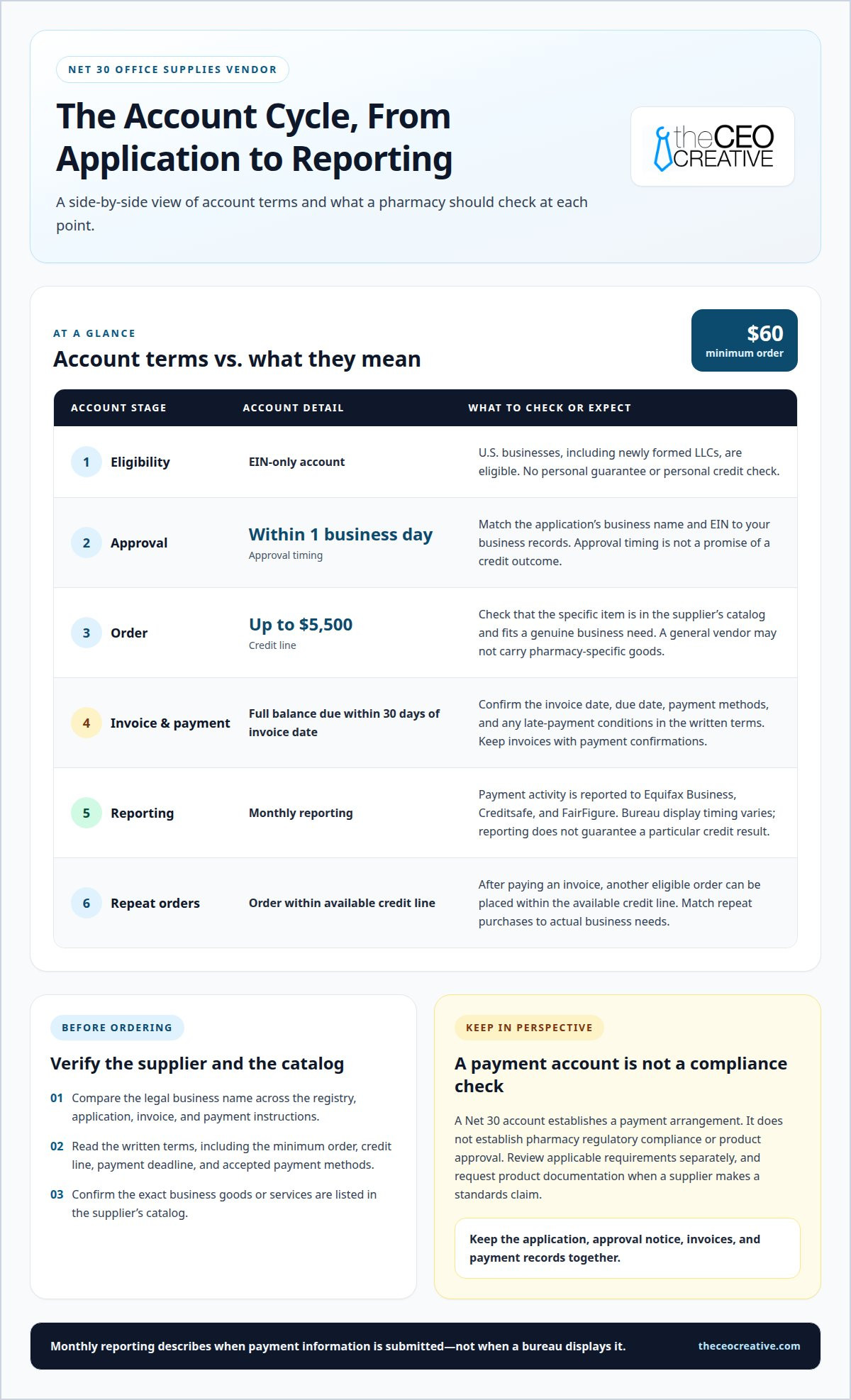
The application process for net 30 accounts for pharmacies starts with the business’s EIN. The account is EIN-only, with no personal guarantee and no personal credit check. U.S. businesses, including newly formed LLCs, are eligible, with no minimum time in business.
The supplier issues an invoice, and the full balance is due within 30 days of the invoice date. Keep the invoice and payment confirmation together. Those records show the purchase amount, due date, and payment history. Paying on time helps keep the account process organized.
For pharmacies evaluating net 30 accounts for pharmacies, reporting is another part of the process: payment activity is reported monthly to Equifax Business, Creditsafe, and FairFigure. Bureau display timing varies, and reporting doesn’t promise a particular credit result. After paying an invoice, a business can place another eligible order within its available credit line. EIN-only Net 30 accounts use the business’s EIN for the account. Match repeat orders to actual business needs and track each invoice through payment.
Which Business Credit Bureaus Receive Reports?
Payment activity is reported monthly to Equifax Business, Creditsafe, and FairFigure. These are the three business credit bureaus that receive reports for this account. Monthly reporting describes when account information is submitted. It doesn’t mean a new payment will appear in a bureau file immediately. Each bureau controls its own processing and display timing.
Keep your account records organized while waiting for bureau files to update. Save the business name and EIN used on the application, along with invoices and payment confirmations. If you review a business credit file, use these records to identify the account and compare any displayed details. Consistent documentation makes missing or mismatched entries easier to spot.
Reporting is one part of a business credit profile, not a promise of a particular score or lending decision. A supplier can submit payment information, but how a bureau displays it and how it affects a profile are separate matters. When evaluating vendor accounts for a pharmacy, focus on the reporting details and named bureaus, then pay invoices by their due dates. Track records over time rather than expecting one submitted payment to produce an immediate change.
A Checklist for Choosing and Using a Net 30 Vendor
Use this checklist to assess whether an account fits your purchasing needs and to keep each order organized.
- Review eligibility. Confirm the application’s business details match your pharmacy’s legal business name and tax identification information.
- Read the terms. Identify the order minimum, available credit line, invoice date, payment deadline, accepted payment methods, and any late-payment conditions.
- Match the catalog to a real need. Check that the supplier offers the specific business goods or services you plan to purchase. Don’t assume a general vendor carries pharmacy inventory.
- Plan each order. Keep the purchase within the approved limit and make sure the invoice reflects the correct business information and items ordered.
- Schedule payment. Record each invoice’s due date in your accounting system, assign responsibility for payment, and retain proof after paying.
- Understand reporting. Confirm which business credit bureaus receive account updates and how often the supplier submits them. Keep invoices and payment records available if you review your business credit file.
Review the checklist before repeat orders. A consistent process connects purchasing, invoice tracking, and payment records.
Common Mistakes to Avoid
Avoid these common errors when opening or managing a vendor account. They can complicate purchasing records or create unrealistic expectations about business credit.
- Assuming reporting guarantees a credit result. A vendor may report account activity, but that doesn’t promise a particular score, credit decision, or profile change. Treat reporting as one part of credit building.
- Expecting an immediate bureau update. Monthly reporting and bureau display are different steps. Don’t assume a payment will appear as soon as it clears. Keep invoices and payment confirmations for your records.
- Missing the invoice due date. Net 30 terms don’t mean payment can wait beyond the stated deadline. Record each due date when the invoice arrives, then assign someone to manage payment.
- Ordering without reviewing the terms. Skipping the minimum, credit limit, payment method, or invoice details can lead to a purchase that doesn’t fit the account. Read the terms before submitting an order.
- Buying goods that don’t fit pharmacy needs. A general business vendor may not sell pharmacy-specific inventory. Confirm the exact catalog item and its intended use before purchasing.
Keep clear records linking every order to its invoice and payment. This makes account activity easier to track over time.
The CEO Creative and Its Net 30 Account
The CEO Creative is a business credit vendor offering a Net 30 account for businesses that want vendor purchases tied to business credit reporting. For a pharmacy, this can fit when you need a reporting vendor for regular business needs, rather than a source of prescription drugs or pharmacy-specific inventory. A vendor tradeline does not establish pharmacy regulatory compliance.
Available categories include apparel, T-shirts, embroidery, and office supplies. A pharmacy might consider these for staff apparel, embroidered business clothing, or administrative materials, depending on its purchasing needs. The useful question is whether a listed item is a genuine business purchase the pharmacy already plans to make. Avoid ordering solely to create account activity. Keep invoices connected to the purchased items and their business purpose. That helps organize the account alongside regular purchasing records.
The CEO Creative is BBB Accredited with an A+ rating. It has 6+ years in business and 50,000+ reported tradelines. Consider these details alongside the account terms and whether its catalog fits your business needs. Visit the Net 30 account page for The CEO Creative to review the account information.
Frequently Asked Questions
What does net 30 payment terms mean for a pharmacy?
NET 30 terms mean the pharmacy can order eligible business items and pay later, with the balance due within 30 days of the invoice date. For example, if a pharmacy orders office materials, it should schedule payment based on the invoice deadline. Payment activity is reported monthly to Equifax Business, Creditsafe, and FairFigure. Reporting does not guarantee a specific credit score or lending result.
What are the eligibility requirements for opening a net 30 pharmacy account?
U.S. businesses, including newly formed LLCs, can apply, and there is no minimum time in business. The account is based on the business EIN only, with no personal guarantee or personal credit check. Approval is within 1 business day. Eligibility does not mean every pharmacy-specific purchase is available; the account applies to goods and services in the vendor’s catalog.
What documents and licenses should a pharmacy provide when a Net 30 vendor helps set up an account?
Start with the business information needed to complete the vendor application, including the legal business name and EIN. The account is EIN-based. Don’t assume a vendor account replaces pharmacy licenses or other operational credentials. The account facts do not establish a specific license requirement for opening this vendor account. Keep your application details consistent with the business records used for purchasing and invoicing.
How does a Net 30 vendor guide a pharmacy through applying for a supplier account?
A vendor account process typically begins with submitting business details and an EIN-based application. For this account, the stated approval timeframe is within 1 business day. After approval, the business can order eligible catalog items, receive an invoice, and pay according to its terms. Keep the application, order confirmation, invoice, and payment record together to help track the account activity.
What credit limits, fees, or minimum orders apply to pharmacy net 30 accounts?
Review any applicable fees in the account terms before ordering, and plan purchases within the approved limit. A vendor purchasing limit is not a promise of a particular credit outcome. Choose items your pharmacy needs and schedule payment so the balance is paid by the invoice deadline.
Which pharmacy wholesalers and suppliers offer net 30 accounts?
CEO Creative offers a Net 30 account. The available information does not identify any pharmacy wholesalers offering these terms.