

Net 30 vendor accounts let boutiques purchase eligible business goods and pay later under the supplier’s terms. For net 30 accounts for boutiques, compare what each vendor reports and whether its requirements fit your business stage.
This guide covers purchase categories, application considerations, bureau reporting, and practical steps for managing invoices.
Key Takeaways
- Choose Net 30 vendor purchases that fit your boutique’s actual business needs, such as apparel, office supplies, or promotional products.
- Plan for invoice payment as part of cash flow management, and understand how the invoice date affects when payment is due.
- Reporting is monthly to Equifax Business, Creditsafe, and FairFigure; bureau display timing can vary.
- If an application is declined, identify what may need attention before applying again, and keep records of orders, invoices, payments, and reporting activity.
What Boutiques Can Order on Net 30 Terms
Net 30 purchasing can cover business goods a boutique already needs, rather than unrelated personal shopping. One example is branded promotional merchandise for a store event, customer gift, or launch. Match each order to a clear business use. That keeps the purchase tied to operations and makes its cost easier to plan around.
Order categories vary by vendor. A boutique might consider promotional products for a seasonal event, then choose items that suit its audience and brand. Before applying, review the product category, ordering process, and payment terms together. A useful way to compare net 30 accounts for boutiques is to ask whether the items fit a real business need and the invoice can be paid on time.
Terms can differ for a new LLC and an established shop. Some wholesale sellers ask applicants for at least 6 months of operating history or trade references. A newly formed business can focus on vendors whose application criteria allow newer companies to apply using an EIN. An established boutique may have business history or references available, but those details don’t replace reviewing the actual account terms.
- For a new boutique: Confirm which business details the application uses and whether the vendor accepts newly formed LLCs.
- For an established boutique: Have relevant business and trade-reference information ready if the application requests it.
- For either stage: Choose a useful order and plan for the full invoice before charging it to the account.
Net 30 describes a payment window, not a promise that every vendor will approve every applicant. Read the agreement to see when the invoice period begins and when the full balance is due. Those details affect cash flow: an order can arrive before the boutique has earned revenue from the related event or sales. Build the due date into the operating budget, then schedule payment accordingly.
For a boutique comparing net 30 accounts for boutiques, the practical takeaway is to select an order that serves the business, then assess eligibility and payment terms against its stage and cash flow. That approach makes the account decision about fit, not just access to credit.
How a Net 30 Account Works
Start by submitting the supplier’s application with the requested business details. If approved, place an order for eligible business goods. The supplier issues an invoice, and the invoice date usually starts the 30-day payment period. Read the account terms for the specific due-date rule before ordering.
Net 30 differs from a credit card because it applies to a supplier’s invoice, not a card balance. Net 60 gives 60 days after the invoice date; prepaid wholesale orders require payment before the order is fulfilled. Each option affects cash flow differently, so match the payment schedule to the boutique’s expected sales and available funds.
Plan around the invoice date, not just the order date. Record each invoice when it arrives, add its due date to your business calendar, and set aside funds for the full balance. A sale or event may happen after payment is due, so don’t rely on future revenue without a backup plan.
If a boutique pays late, the account terms determine what happens next. A late payment may trigger a fee or affect future purchasing terms, and reported account activity may reflect payment history.
- Apply: Provide accurate business information and review the payment terms before submitting the application.
- Order: Choose goods the boutique needs, then keep the order confirmation and invoice together.
- Pay: Schedule the full invoice balance by its stated due date and retain payment records.
After payment, a supplier may report eligible account activity to business credit bureaus, though the timing of its appearance can vary. Keep invoices and payment confirmations to track the account, and place another order only when it fits your budget.
For a closer look at the business account terms and application process, review the account details before placing an order.
Which Business Credit Bureaus Receive Reports
Wholesale options include Net 30 apparel, t-shirt, embroidery, and office supplies vendors. Risks include taking on invoices the boutique can’t repay or assuming reporting guarantees a credit outcome.
Industry Fit and Credit Reporting
Choose a supplier whose category fits planned business purchases. A boutique needing branded staff clothing might consider a Net 30 apparel vendor; custom apparel can include t-shirts and embroidery. Reporting is monthly to Equifax Business, Creditsafe, and FairFigure. Bureau display timing varies, so separate the supplier’s reporting schedule from when an account appears in a bureau file.
Credit Checks and Account Approval
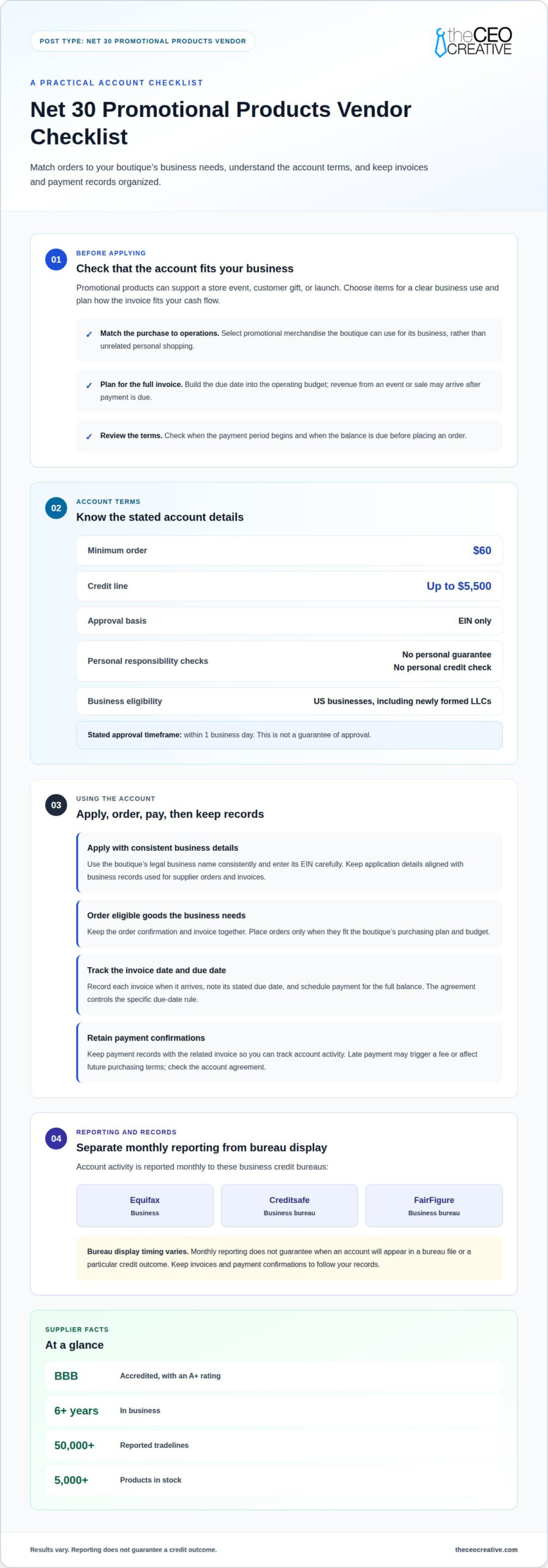
Vendor application reviews and personal credit checks are different matters. An application may ask for business information to assess account eligibility and set terms. For this account, approval is based on the EIN only, and the stated approval timeframe is within 1 business day. Approval doesn’t establish that a bureau has displayed a tradeline or predict a particular business credit result.
Personal Guarantees and Credit Checks
A personal guarantee makes an owner personally responsible for a business debt under the agreement. A personal credit check reviews an owner’s personal credit file. This account has no personal guarantee and no personal credit check. Read the agreement’s responsibility and payment language before ordering, especially if comparing vendor applications with different terms. Learn more about Net 30 accounts with no personal guarantee.
Starting Credit Lines and Tradelines
A tradeline records an account relationship and its reported activity; it does not promise a score change. Keep orders within the boutique’s cash flow, pay by the due date, and check the terms for interest or other charges. Consider a business credit vendor when its products and reporting fit your purchasing plan.
Requirements and Terms for Boutique Accounts
Prepare your business information before starting an application. Use the boutique’s legal business name consistently and enter its EIN carefully. Keep application details aligned with business records used for supplier orders and invoices. Accurate, consistent entries make it easier to spot mistakes before submission and keep account records organized after approval.
A resale certificate serves a different purpose from an EIN. The EIN identifies the business for account purposes, while resale paperwork relates to a purchase’s tax treatment. A vendor may have separate requirements for these processes. Don’t treat one document as a substitute for the other; review the application to see what information it requests.
Application requirements vary among wholesale vendors. Review the specific application to see what information it requests, and gather those details rather than assuming every vendor uses the same checklist. If a field does not apply, follow the form’s instructions instead of entering unrelated or inaccurate information.
Review the account agreement before ordering. Check how the invoice is issued, what starts the payment period, how the due date is shown, and what happens if payment is late. Keep the agreement with order confirmations and invoices so the boutique has one organized record set for understanding the terms and reconciling purchases.
For boutiques assessing EIN-only Net 30 vendors, focus on the application’s stated requirements and the agreement’s payment language. Separate application documents from resale paperwork, provide accurate business details, and organize records as the account is used. This approach helps owners assess whether the process and obligations fit their business operations, without assuming that every wholesale supplier applies identical criteria.
A Numbered Checklist for Applying and Using an Account
Use this checklist to manage a wholesale account from application through reporting. A 30-day payment period requires planning before an order, not after the invoice arrives.
- Prepare the application. Enter the business name, EIN, and address consistently. Review each required field before submission. The stated approval timeframe is within 1 business day.
- Plan the purchase. Select goods that serve the boutique, then compare the expected payment date with available cash and expected revenue. Don’t rely on sales that may arrive after the invoice is due.
- Review the invoice. When the supplier issues it, note the invoice date, balance, and due date. Save the invoice with the order record so the payment obligation is easy to track.
- Schedule payment. Set a calendar reminder ahead of the due date and reserve funds for the full balance. After paying, keep the confirmation with the invoice as evidence of the transaction.
- Track reporting. Keep the account and payment records together. Reporting is monthly to Equifax Business, Creditsafe, and FairFigure, but bureau display timing varies. Review the relevant business credit files for the tradeline.
- Repeat with purpose. Before another order, confirm the boutique needs the goods and can cover the next invoice. Consistent records make it easier to follow order history and payment activity.
If a vendor declines an application, pause before applying again. Review the notice and application for missing fields, inconsistent business details, or information that needs correction. Update relevant records, then reapply only when the details are accurate. One vendor’s decision does not determine how another will assess the application, since requirements and review processes differ.
Keep the process orderly: submit accurate application details, make a useful purchase, record the due date, pay on time, and later review business credit files. This sequence helps a boutique manage its account and track whether reported activity appears.
Common Mistakes to Avoid
A Net 30 account needs active management after approval. Avoid these six errors to keep boutique purchases, invoices, and payment records organized.
- Ordering without a business purpose. Don’t charge a purchase simply to create account activity. Choose goods the boutique can use, such as apparel for staff, and keep the order tied to an operating need.
- Spending up to the available limit. A credit line is a ceiling, not a recommended budget. Before placing an order, compare the invoice with available cash and expected revenue. Leave room for regular expenses and other bills.
- Assuming approval guarantees a tradeline. Account approval and bureau reporting are separate steps. Reporting may occur on a set schedule, while a bureau’s display timing varies. Don’t treat an approval notice as proof that a tradeline already appears.
- Tracking the order but not the invoice. The order date and invoice date may differ. Record the invoice date, balance, and due date as soon as the invoice arrives. A calendar reminder helps prevent the due date from getting lost among inventory tasks.
- Submitting inconsistent business details. A different business name or EIN across account records can complicate application review. Use the boutique’s business information consistently, and correct mistakes before submitting an application or updating an account.
- Ignoring the account agreement. Don’t assume every vendor handles late payments or future orders the same way. Read the payment and late-payment terms before ordering. Save the agreement with invoices and payment confirmations for reference.
These practices keep purchasing decisions separate from assumptions about credit outcomes. Review the terms, buy for a clear business need, and maintain reliable records of invoices and payments. Results can vary, and a reported tradeline does not guarantee a particular credit profile or score.
The CEO Creative
The CEO Creative gives boutiques a reporting Net 30 vendor option for business purchases that fit their operations. A boutique can consider apparel, t-shirts, embroidery, or office supplies based on what the business actually needs. The account decision should start with the purchase, then the payment terms and reporting process, rather than credit-building expectations alone.
For example, a boutique preparing staff apparel could consider a Net 30 apparel vendor or t-shirt supplier. A shop updating embroidered garments could consider a Net 30 embroidery supplier. For routine business purchases, a Net 30 office supplies vendor may fit better. These options let an owner connect vendor purchases with identifiable business uses.
Before applying, define the intended purchase and its role in the business. Consider whether the items support staffing, store operations, or planned promotions. Review the account terms and make sure the invoice can be paid from available business cash flow. A reported tradeline may add account information to a business credit file, but it does not guarantee a particular score or lending decision.
Match the account to the boutique’s stage and purchasing plan. A newly formed LLC may value an EIN-based application, while an established boutique may prioritize categories that meet recurring business needs. Either way, keep applications, order records, invoices, and payment confirmations organized to track account activity and manage future purchases.
Approach Net 30 as a supplier relationship with defined payment obligations, not as a substitute for budgeting. Choose useful items, understand the due date, and make each purchase in a way the business can manage. The CEO Creative’s vendor categories give boutiques options across apparel and office needs while keeping the account decision centered on business use.
Choose a Vendor That Fits Your Next Step
Make the next decision based on what your boutique needs to purchase and how the invoice fits its cash flow. A vendor relationship should support ordinary business operations, not add pressure to spend or create expectations about a particular credit result. As you compare net 30 accounts for boutiques, keep your purchase plan, payment capacity, and reporting goals in view.
The CEO Creative offers Net 30 apparel, t-shirt, and embroidery vendor options. These categories can suit boutiques planning staff apparel or branded garments. Choose the category that matches a real business need, then review the account terms and application details before placing an order. Timely payment and organized records help you manage the account; credit outcomes can vary.
When you’re ready, review The CEO Creative’s account details and decide whether its terms and business products fit your boutique.
Build your business credit plan carefully, one practical purchasing decision at a time.
Frequently Asked Questions
What Is a Net 30 Account and Why Is It Beneficial?
A NET 30 account lets an approved business buy from a supplier and pay according to the invoice terms. For a boutique, it can help coordinate a planned purchase with the timing of business funds. If the vendor reports the account, its activity may be included in a business credit file. Reporting does not guarantee a particular score or credit decision.
What does net 30 mean for boutique wholesale accounts?
For this account, the balance is due 30 calendar days from shipping. Use the shipping date and invoice to plan the payment date, rather than relying only on the day the order was placed. Wholesale agreements can define terms differently, so a boutique should read the specific invoice and agreement before making a purchase.
What are the eligibility requirements for a boutique to get net 30 terms?
U.S. businesses, including newly formed LLCs, can apply using an EIN, with no minimum time in business. The account does not require a personal guarantee or personal credit check. Have the business’s identifying information ready and enter it consistently. Approval is not guaranteed, and account terms apply to purchases made after approval.
How can a new boutique apply for net 30 vendor accounts?
Choose a vendor whose business purchase categories fit the boutique, then complete its application with accurate business information. Review the agreement before ordering, and keep the order confirmation and invoice together. If declined, review the application for errors or incomplete details, correct what needs attention, and consider whether the vendor’s criteria fit the business before applying again.
Do net 30 vendors charge fees, interest, or minimum order amounts?
Fees, interest, and order requirements depend on the vendor and account terms. Read the agreement for any charges, how balances are calculated, and what happens if payment is late. Include the full invoice obligation in the boutique’s budget before ordering; payment terms do not mean a purchase has no additional costs.
How do net 30 terms affect boutique cash flow and credit?
NET 30 terms change when payment is due, but they don’t remove the obligation to pay. A boutique can compare the invoice due date with expected revenue and other scheduled expenses before ordering. Reported payment activity may contribute information to a business credit file, but bureau display timing varies and results differ. This information is general and not financial or legal advice.
Do net 30 vendors report payment history to business credit bureaus?
Reporting policies differ by vendor, so identify the bureaus named in the account terms. This account reports monthly to Equifax Business, Creditsafe, and FairFigure. Payments are reported to the major credit bureaus, but bureau display timing varies. Keep payment confirmations and invoices so you can compare your records with the account information that appears in business credit files.