

A supplier bill can come due before your pool-service customers pay. Net 30 accounts for pool service companies give a business 30 days from the invoice date to pay for a purchase, so the due date matters as much as the order itself.
That timing can help you plan purchases, but it doesn’t erase the bill or the risk of paying late. Look beyond the payment window: the vendor’s terms, eligible purchases, and consequences of a missed due date all affect whether an account suits your operation.
This guide explains how net 30 accounts work, what pool service businesses may use them to purchase, and how to keep invoices on schedule. It also covers reported late-payment charges and the details to weigh when comparing vendors, so you can make a clear decision about whether trade terms belong in your business credit plan.
Key Takeaways
- Compare each supplier’s invoice due date, late-payment terms, and credit-reporting practices before placing an order.
- Late charges can add up: some net 30 terms use monthly interest, so review the agreement and plan payment dates carefully.
- Check whether a vendor accepts newly formed businesses; some suppliers require a business to have operated for 3-6 months.
- Choose purchases that fit your pool service operation and your ability to pay on time, rather than opening accounts just to build credit.
- Use the article’s checklist to assess vendor eligibility, reporting details, and payment terms before applying.
Late fees and consequences of missed payments
A missed net-30 payment can create more than a late charge. It can tighten cash flow, complicate supplier relationships, and weaken the payment history a pool service business is trying to establish. Treat each supplier invoice as a scheduled obligation, not as a bill to handle after customer payments arrive.
Late charges depend on the supplier’s written terms. One sample set of net-30 sale terms charges 1.75% interest per month on invoices unpaid within 30 days, equivalent to a 21% annual percentage rate. Late fees and interest are often around 1.5-2% monthly. These are examples of terms, not a universal rate. Read the agreement for the rate, when it begins, and whether other charges apply.
For example, a supplier invoice dated March 1 with net-30 terms is due March 31. Record the due date when the invoice arrives, then schedule the payment before that date. If you dispute a charge, contact the supplier promptly and keep the invoice, message, and resolution together. Don’t assume a dispute automatically pauses payment obligations.
Put payment terms in writing
Use a written service contract and matching invoice for each pool-service client. Specify the services covered, billing frequency, due date, accepted payment methods, and any late-payment terms. If a client pays by credit card, make the amount due and payment instructions clear. Explain when each charge applies instead of leaving clients to infer it from a reminder.
Set payment terms before the first visit and explain them during onboarding, then include them in the signed agreement. A pool service business might bill monthly for recurring visits, while a one-time cleanup can have a separate invoice tied to the job. Keep the schedule consistent: if the agreement says monthly, send invoices on the same billing cycle.
Set a clear process for overdue customer invoices. Send each invoice promptly, then use software to flag upcoming due dates and track reminders. Keep unpaid customers visible in your accounts. Review open invoices each week, record any promised payment date, and follow up using the same documented process.
Track subcontractors and tax records
Keep separate records for subcontractor payments. Save each invoice, payment date, amount, business purpose, and payment method. Match the invoice to completed work, such as a documented repair or route coverage. Maintain records in one organized system rather than relying only on card statements or text messages.
A pool service business generally needs to issue Form 1099-NEC by January 31 of the following year for a non-corporate individual or LLC paid at least $600 during the year for services. Track each contractor’s payments through the year, including payments made by check or electronic transfer. Keep payment records and supporting invoices available for tax preparation or an audit. This section is operational information, not tax or legal advice.
Keep customer receipts, supplier invoices, subcontractor payments, and credit card charges organized separately. Reconcile them against bank and card statements each month. If a supplier reports payment activity, retain proof of the transaction and its invoice reference. This makes it easier to resolve a posting mismatch and determine whether an unpaid balance reflects a missed payment or a processing issue.
Before closing each month, review invoices due soon, overdue customer balances, and payments already sent. Compare the supplier statement with your ledger and investigate differences while the details are fresh. A repeatable monthly review helps protect working cash and keep tax records clear. Set aside funds for supplier payments before treating customer receipts as available operating cash.
Complete the recordkeeping routine by matching receipts and account activity to invoices, then checking that overdue balances and upcoming bills are visible together. Cash-flow planning matters because pool cleaning businesses with employees in the United States have net profit margins of 15-25%, and businesses with employees spend 30-37% of revenue on labor.
Upfront terms can also reduce the gap between service and collection: pool service businesses can request an upfront payment of 25%-50% of the pool cleaning cost. A solo operator with 50 pools charging $150 per month per pool generates $7,500 in monthly revenue; a solo operator with 50-80 pools can earn $75K-$120K in annual net income. Account for card costs too, since fees typically range from 1.43% to 3.5% of the purchase price.
Vendors offering net 30 accounts
Net 30 vendors serve different business purchasing categories, so the best fit depends on what your pool service company actually buys. Office supplies may support scheduling, customer records, and bookkeeping. Apparel or printing may be relevant when the business has planned staff clothing or branded materials. Choose an account for a real purchasing need first, then assess its reporting terms as a separate factor.
Vendor requirements differ. Some suppliers may not work with startups until they have been in business for 3-6 months. A new business owner should review eligibility before applying, rather than treating approval by one supplier as evidence that another will approve the account. Applications commonly ask for business identity and billing details. Enter consistent information and keep a copy of what you submit.
Also distinguish a supplier’s product category from its credit terms. A vendor may sell items your business needs but offer different payment arrangements, or it may provide net 30 terms only for eligible purchases. Read the agreement for the purchase categories covered, invoice process, payment methods, and reporting practices. Reporting claims should identify which bureaus receive information; don’t assume every net 30 account reports.
Use this checklist to compare options and keep account records clear:
- Write down the recurring purchases your company already makes, such as office materials for route administration.
- Match each planned purchase to a vendor category and remove items that don’t support current operations.
- Review the application criteria, including business-age requirements, before entering company information.
- Save the vendor agreement and note eligible purchases, invoice procedures, payment methods, and due-date rules.
- After approval, create a supplier record in your bookkeeping system and attach each invoice to its order.
- Reconcile the supplier statement against your ledger, then save payment evidence with the related transaction.
For a pool service operator, this checklist helps distinguish useful purchasing access from accounts that add administrative work. A vendor account can support a business credit plan when purchases are relevant and payments are recorded consistently. It doesn’t replace budgeting for the invoice or managing customer receivables. Review the agreement before ordering, and keep any changes to the terms with the account documents.
A consistent review routine can help prevent common mistakes:
- Applying before checking whether the supplier accepts businesses at the company’s stage.
- Choosing a vendor by product category alone, without reviewing whether purchases qualify for its terms.
- Assuming a vendor reports to business credit bureaus without reading its reporting statement.
- Buying items the business doesn’t need simply to create account activity.
- Mixing supplier invoices with customer invoices, which can obscure the business’s actual obligations.
Keep the application, agreement, order record, invoice, and payment confirmation together for each supplier. That record makes it easier to review account activity and resolve discrepancies. To assess an account structure for your purchasing plan, review the business net 30 account details alongside the vendor criteria.
Cash-flow planning should include the invoice date, the due date, and any early-payment offer. Some vendors offer a 2% discount when a business pays within 10 days. Some vendors offer early payment discounts such as 2/10 net 30. Confirm how the vendor applies the discount and whether the business can pay early without straining funds needed for regular operations. For a $1,000 supply order made on March 1st with net-30 terms, the due date is March 31st. Treat that date as a planning point: enter it in the bookkeeping system, keep the invoice with the order, and allow time for payment processing. An invoice example sets payment for a $2,000 office-furniture purchase made on March 1st as due on March 31st. These examples illustrate why the invoice and the account agreement should be checked rather than relying on an assumed billing cycle.
Also verify how a vendor handles business-credit reporting, since reporting is not guaranteed across suppliers. Dun & Bradstreet, Experian Business, and Equifax Business are business credit bureaus that some Net 30 vendors report to. Ask which bureau receives information and what account activity is reported, then retain invoices and proof of payment in case records need to be reviewed. A three-chair beauty salon owner in the example orders $2,000 in supplies monthly using net-30 accounts. The broader lesson for a pool service business is to connect any account to planned purchases and a realistic payment routine. Compare the purchase value with cash available for the invoice, check terms before placing an order, and update the bookkeeping record if the vendor changes its payment or reporting practices. These steps can help keep supplier accounts useful without allowing them to become an unmanaged balance.
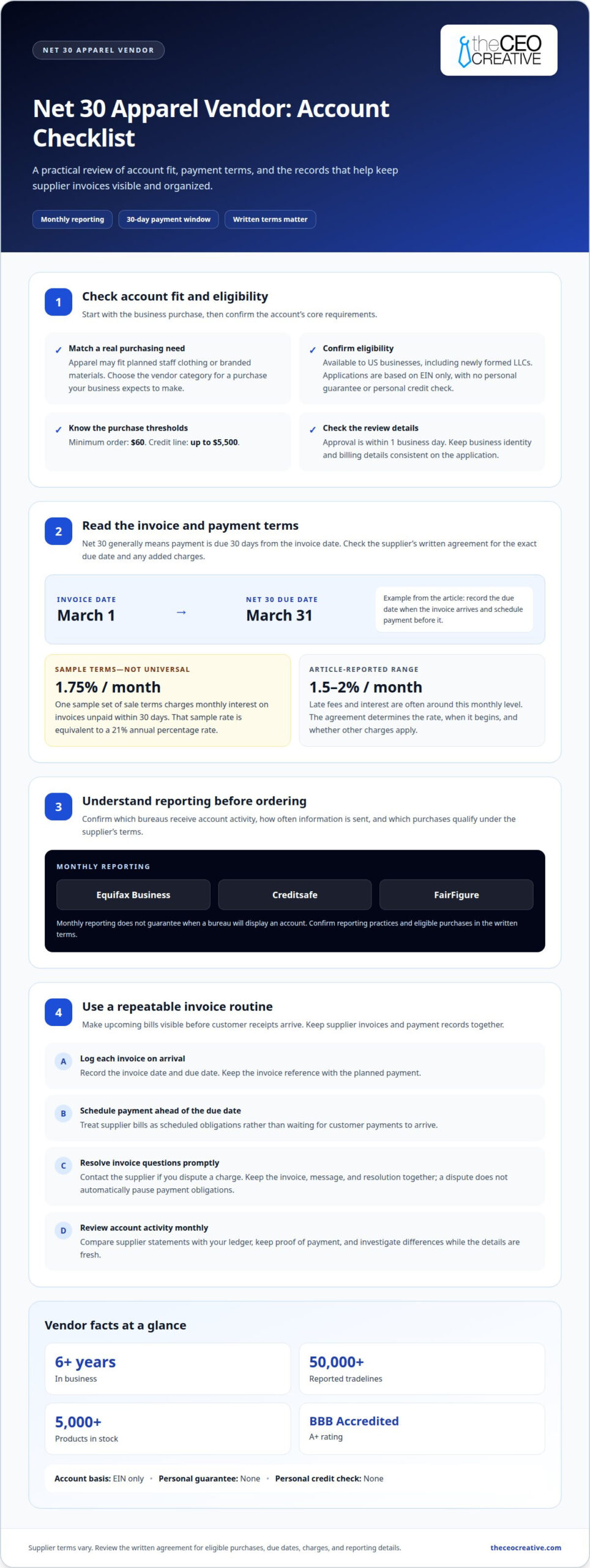
The CEO Creative: net 30 apparel vendor
The CEO Creative offers a net 30 apparel vendor account for businesses with planned workwear or branded clothing purchases. Its net 30 terms use an EIN, with no personal guarantee or personal credit check. Reporting is monthly to Equifax Business, Creditsafe, and FairFigure; bureau display timing varies.
Pool service companies may also consider its net 30 t-shirt supplier and net 30 embroidery supplier options when those purchases fit their business needs. The net 30 office supplies vendor account may suit administrative purchases.
Choose a vendor that fits your next business step
Use your next purchasing decision to build a process you can maintain. Choose an account only when its products fit planned business needs and its payment schedule fits your cash flow. The right net 30 accounts for pool service companies should support operations first, with reporting as an additional consideration. Keep the invoice, due date, and payment record together from the first order.
If branded workwear is already part of your plans, The CEO Creative offers net 30 apparel, t-shirt, and embroidery supplier options. These categories can make sense when you have a genuine business use for the items, rather than an order made only to open an account. Results vary, and bureau display timing depends on the bureau. This information is educational, not financial or legal advice.
Review the account details and decide whether the terms fit your purchasing plan.
Build your credit process through considered purchases and on-time payments.
Frequently Asked Questions
What does net 30 mean for pool service companies?
Net 30 means supplier payment is due 30 days after the invoice date. For pool operators, that deadline applies to the vendor purchase, not the customer’s service agreement. Keep supplier bills separate from customer receivables so expected revenue from scheduled cleaning isn’t mistaken for money already collected. This distinction helps you plan purchases around actual cash available.
Which vendors offer net 30 accounts to pool service businesses?
Net 30 accounts are available from suppliers in different business purchasing categories. The CEO Creative is one vendor option covered in this article. Compare each supplier’s eligible purchases, reporting practices, and payment terms against your business needs. A vendor account is most useful when its purchases fit a real operating or administrative purpose, rather than creating extra inventory or unused items.
How can a new pool service company qualify for vendor credit?
Start by reviewing the vendor’s application requirements and preparing accurate business information. Use your business’s consistent legal name and contact details. Review the eligibility criteria, eligible purchase categories, and required application fields. Assess each supplier separately: one vendor’s approval process does not establish another vendor’s requirements or show whether its account suits your business.
What fees, interest, or minimum orders come with net 30 accounts?
The net 30 label alone doesn’t tell you whether interest, late charges, or an order threshold applies. Read the supplier agreement for charge triggers, how charges are calculated, and any minimum purchase condition. Before ordering, compare the full invoice amount with available operating cash. Don’t assume that one supplier’s payment or fee terms apply to another vendor.
What steps should a pool service company take to open and manage net 30 accounts?
When comparing net 30 accounts for pool service companies, build a separate record for each supplier. Save the application, agreement, invoices, statements, and payment confirmations together. Categorize each purchase in your bookkeeping system, then reconcile the supplier balance against your records. This makes it easier to trace a charge, spot a mismatch, and keep purchasing activity distinct from customer billing.