


Net 30 can help a moving company manage planned business purchases and build payment history, but it doesn’t create extra cash or guarantee stronger credit. Net 30 accounts for moving companies require the full invoice to be paid 30 days after its date; the account can support a credit profile only when the vendor reports payment history to business credit bureaus.
For a mover, the appeal is practical: buy something the business already needs, then pay later under the agreed terms. The trade-off is just as important. If customer payments arrive after vendor invoices are due, the delayed payment window can add pressure rather than ease it.
This article explains how Net 30 works for moving businesses, what purchases may fit, and how reporting connects vendor payments to business credit. It also covers the potential benefits and drawbacks for both buyers and vendors, so you can understand when trade credit may fit your business and what to consider before relying on it.
Key Takeaways
- Use Net 30 terms for business purchases you already plan to make, and track invoice due dates against expected cash flow.
- Check whether a vendor reports payment history to business credit bureaus before relying on an account to support your credit profile.
- Compare the items a moving company needs with the vendor’s eligible categories, so purchases serve an operational purpose as well as a credit-building goal.
- Understand that payment history may take time to appear on a business credit report, and on-time payment does not guarantee a particular credit outcome.
- Weigh the delayed payment window against the risk of a bill coming due before customer revenue arrives.
What products and services can moving companies buy on Net 30 terms?
A moving company can use net 30 accounts for moving companies to finance eligible business purchases, including office supplies, branded apparel, promotional products, and marketing services. The vendor decides which categories qualify. Before ordering, match each purchase to an operating need, then confirm the invoice date and payment deadline in the account terms.
Office supplies can support dispatch, scheduling, billing, and customer records. A company might order printer paper, folders, pens, or desk supplies for its office team. These routine purchases may fit a vendor’s catalog, but an item’s availability does not establish that every vendor offers it on terms. Review the eligible categories and keep each order tied to normal business use.
Branded apparel can give crews and office staff a consistent appearance. For example, a mover could purchase logo shirts for employees who meet customers at pickup or delivery locations. Apparel purchases are most useful when the business already plans to outfit staff. Net 30 changes when an approved invoice is paid; it does not make an unplanned purchase affordable.
Promotional products can support marketing and customer outreach. A moving company might use branded apparel or other promotional items at a community event or in a referral campaign. Choose products that fit a clear outreach plan, rather than buying solely to create an invoice.
Marketing and web services may also be available through business vendors that offer those categories. A mover could use a web service to maintain its online presence or support a defined promotional campaign. Service terms differ from product orders: the invoice should identify the work purchased, its billing date, and the amount due. Keep the invoice and related business records together.
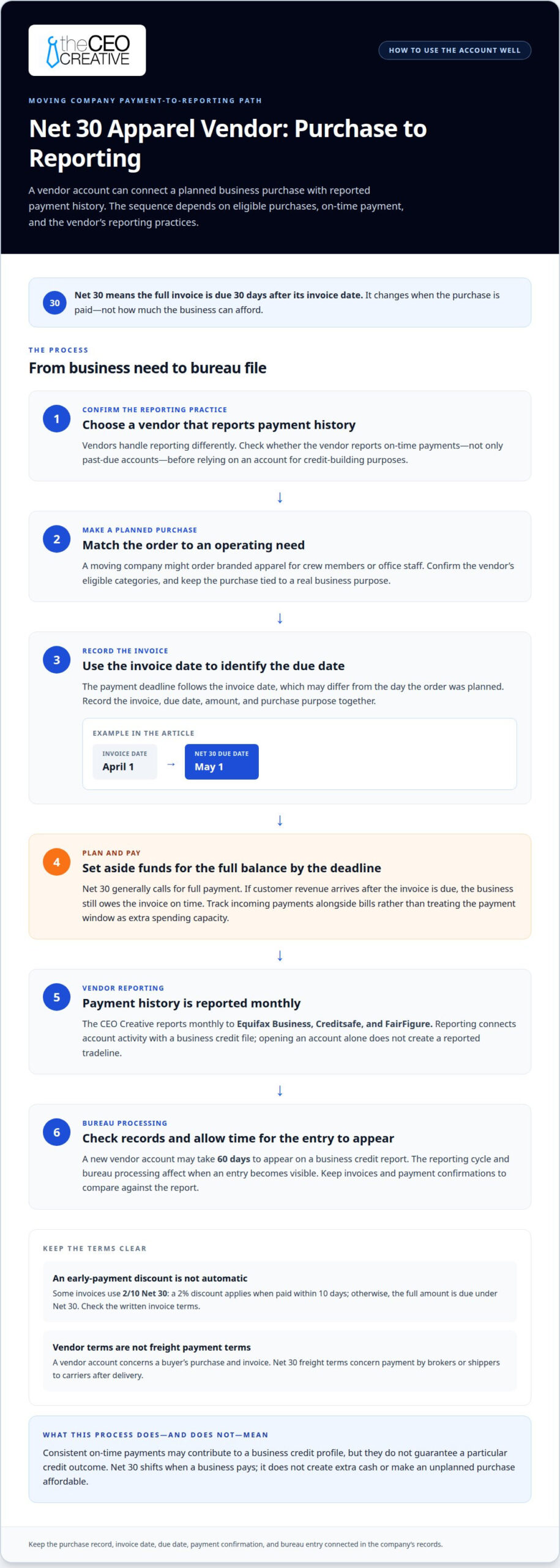
Net 30 means the full invoice is due 30 days after its invoice date. For example, goods invoiced on April 1 under Net 30 terms are due May 1. The due date follows the invoice date, not necessarily the day the company planned its budget. Record both dates when placing an order, then schedule payment to arrive by the deadline.
Some invoices use 2/10 Net 30 terms. The buyer receives a 2% discount for paying within 10 days; otherwise, the full amount is due under Net 30. That early-payment option matters only if the invoice includes it. Check the written terms rather than assuming every Net 30 purchase includes a discount or interest-free period.
A moving company should distinguish vendor trade terms from freight payment arrangements. Net 30 freight terms give brokers and shippers 30 days to pay carriers after delivery. For a load delivered on January 1, payment under those terms can be sent by January 31. That arrangement concerns payment for transportation services, while a vendor account concerns the buyer’s purchase and invoice.
The payment window can help a buyer coordinate a planned purchase with incoming revenue, but it can also create a cash-flow gap. If a customer pays after the vendor invoice is due, the company still owes the full invoice on time. Net 30 generally calls for full payment, not an assumed series of partial payments. Set aside funds as soon as the purchase is made.
For vendors, clear terms define when payment is expected and which transaction the invoice covers. For buyers, accurate records help connect each order to its due date and business purpose. A practical check is to confirm the eligible category, review the invoice date, note any early-payment discount, and plan for the full balance before ordering.
A moving company should also judge the payment window against expected cash flow. Net 30 terms shift when a U.S. business pays for a purchase but do not increase how much it can afford to spend. For a carrier hauling a $2,000 load delivered on January 1, payment may not arrive until early February under Net 30 terms. That timing can matter when a moving company has costs to cover before customer or carrier payments arrive.
Some business customers may have extended payment terms, described as Net 45 and Net 60. Payment history can also affect terms: a Net 30 customer who pays at 45 days for three consecutive cycles should have their terms tightened. By contrast, a Net 15 customer who pays within five days for a year has earned Net 30 terms. Track invoices and incoming payments together so purchasing decisions reflect the actual payment schedule, rather than treating a longer term as extra spending capacity.
How do Net 30 accounts help build business credit for a moving company?
A moving company can build business credit through a Net 30 account when its vendor reports payment history to business credit bureaus. Opening an account by itself doesn’t create a reported tradeline. The vendor’s reporting practice connects the account’s payment record with the company’s business credit file.
Reporting matters because vendors handle it differently. Some report account activity, while others report only past-due accounts. A moving company choosing an account for credit-building purposes needs to know whether on-time payments are reported. Without that information, the company can’t rely on its payments to contribute to a bureau file.
The CEO Creative reports monthly to Equifax Business, Creditsafe, and FairFigure. A new vendor account may take 60 days to appear on a business credit report. The reporting cycle and bureau processing affect when an entry becomes visible. Keep invoices and payment confirmations so you can compare the report entry with the company’s own records.
A tradeline records a business’s experience managing vendor payments. Consistent on-time payments may contribute to its credit profile, but they do not guarantee a particular score, credit decision, or financing outcome. Bureaus maintain their own reports, so information can differ. Treat a vendor account as one part of a broader business credit history.
Keep the application, account terms, invoices, and payment confirmations together to connect purchases with account activity. Use the company’s legal name and EIN consistently. If a bureau entry shows a different spelling or business identity, these records can help identify the mismatch.
Common mistakes can reduce an account’s usefulness or make recordkeeping harder:
- Assuming every vendor reports paid accounts. Confirm the vendor’s reporting practice before counting on payment activity to build a file.
- Paying late. Track the due date when the invoice arrives, instead of relying on a reminder after it passes.
- Ordering only to create activity. Keep purchases tied to real business needs and the company’s available cash.
- Using inconsistent business details. Match the legal name and EIN on applications and account records to help avoid identity mismatches.
- Expecting an immediate report entry. Allow for monthly reporting and bureau processing before treating an account as missing.
Payment planning is especially relevant when a mover’s customer receipts and vendor bills fall on different dates. List upcoming invoice deadlines alongside expected customer payments. If a customer payment is due after a vendor bill, plan how the business will cover the bill in full. Net 30 shifts the purchase’s payment date; it doesn’t increase what the company can afford.
Vendors also rely on accurate account records to document a buyer’s payment experience. For the moving company, saved invoices and confirmations provide a transaction trail. If a report shows a status that conflicts with those records, identify the account and payment at issue before raising a correction request. Specific documents make the discrepancy easier to explain.
For companies using an EIN to establish business credit, an EIN-based Net 30 account is one account type to consider. Compare its reporting practice and eligible purchases with your operating needs, then build payment tracking into your regular bookkeeping routine.
Payment planning matters because trade credit can be a substantial part of small-business financing. The Consumer Financial Protection Bureau estimates that U.S. small businesses with under $1 million in annual revenue used more than $50 billion in trade credit in 2019. That scale makes it important to understand the account’s terms before placing orders. No U.S. federal law caps trade credit terms between businesses; federal agency payment deadlines are an exception governed by the Prompt Payment Act. A common late fee for business credit terms is 1% to 1.5% per month on outstanding balances, so a missed due date can add to a moving company’s costs.
A modest limit can still support purchases the company needs, but it should not encourage ordering beyond its budget. Review high-exposure business credit accounts quarterly and mid-tier business credit accounts semi-annually. These reviews can help a mover check balances, due dates, fees, and whether account use still matches operating needs. If cash flow changes, reassess upcoming purchases and payment timing rather than relying on credit to cover obligations the business cannot comfortably meet. Keeping account use deliberate supports a more reliable payment record while reducing the risk that fees or overdue invoices undermine the value of the tradeline.
The CEO Creative: net 30 apparel vendor
The CEO Creative offers a net 30 apparel vendor option for moving companies buying workwear for their crews. If your business already needs staff shirts, a net 30 t-shirt supplier or embroidery supplier can align a planned purchase with a vendor account. The company also offers a net 30 office supplies vendor for routine business needs. These purchases make sense when they serve an actual operating purpose, rather than being ordered only to create account activity.
As you compare vendor terms, consider whether apparel or office supplies fit your company’s current purchasing plans and payment schedule. Explore the net 30 apparel vendor details, or visit The CEO Creative to learn more.
Choose a credit-building step that fits your next move
Choosing among net 30 accounts for moving companies starts with a clear business purpose. Decide which planned purchase fits your operation, then make payment tracking part of your regular bookkeeping. That approach keeps credit-building activity connected to the way your company actually runs.
The CEO Creative offers net 30 apparel, t-shirt, and embroidery vendor options. Consider them when branded workwear is already part of your purchasing plans. Results vary, and a vendor account does not guarantee a particular credit profile or outcome. This article is for general information, not financial or legal advice.
Review the account details and decide whether the terms fit your moving company’s purchasing and cash-flow needs.
Build your business credit strategy one planned purchase and well-managed payment at a time.
Frequently Asked Questions
How can a moving company apply for a Net 30 account?
Submit the vendor’s business application using your company’s EIN and accurate business details. The CEO Creative offers an EIN-only account with no personal guarantee or personal credit check. Keep a copy of the application to compare its details with future invoices and account records.
What should a moving company check before choosing a Net 30 vendor?
Review eligible purchase categories, payment terms, reporting practices, and any minimum order requirement. The CEO Creative reports monthly to Equifax Business, Creditsafe, and FairFigure. Choose categories that match purchases your company genuinely plans to make, and ensure the payment schedule fits your bookkeeping process.
Can a newly formed LLC apply?
Yes. Newly formed LLCs in the United States are eligible, with no minimum time in business. Use the LLC’s correct legal name and EIN consistently in its application and purchase records to keep them linked to the same business identity.
Does applying guarantee approval or a particular credit result?
No. Applying does not guarantee approval, a specific credit limit, or a particular business credit outcome. A reporting account can contribute payment history when the vendor reports it, but bureaus and other businesses make their own assessments. Treat account use as one part of business credit management, not a guaranteed result.
What should the company retain after applying?
Keep the application confirmation, account terms, order confirmations, invoices, and payment records together. If a business credit report shows an unfamiliar or inaccurate entry, these documents can help identify the transaction and provide details when addressing the issue with the relevant bureau or vendor.
What if a business credit report shows mismatched account details?
Compare the report entry with the business name and account records on the application. Note the exact discrepancy, such as a misspelled company name or unfamiliar payment status, and gather supporting invoices or payment confirmations. Clear records help you explain the issue when seeking a correction.