


A supplier’s payment deadline can support cash flow, but it contributes to business credit only when the vendor reports the account. Net 30 accounts for pressure washing businesses provide 30 days to pay, while net 60 terms provide 60 days. The reporting relationship matters as much as the payment window.
It makes sense to look for terms that help manage recurring business expenses while building a separate credit profile. But supplier terms are only one part of the financial picture: business banking and payment processing also affect how you track income, expenses, and due dates.
This article explains how reported supplier accounts work, what to consider before using net 30 or net 60 terms, and how to manage payments responsibly. You’ll also see how banking and payment processing fit into a pressure washing business’s finances, so you can build a practical system for purchases and payments.
Key Takeaways
- Compare net 30 and net 60 terms by the payment deadline and whether the supplier reports account activity.
- Separate suppliers that support daily pressure washing operations from vendors whose accounts can contribute to a business credit history.
- Use business banking and payment processing records to keep incoming payments, purchases, and bill due dates organized.
- Build a repeatable payment routine so supplier invoices fit your cash flow and are paid on time.
- Consider a net 30 apparel, t-shirt, embroidery, or office supplies vendor when those purchases fit your business needs.
Building business credit with supplier net-30 or net-60 terms
Supplier payment terms can give a pressure washing business more control over when purchases are paid. Net 30 accounts for pressure washing businesses may also support business credit when the supplier reports account activity. Treat these as two separate functions: managing invoice timing and establishing payment history. Before choosing an account, identify which outcome matters and how the purchase fits ordinary operations.
Start with a simple account worksheet. Record the supplier’s name, the purchase purpose, application details, invoice date, due date, and reporting policy. Add the business name and EIN used on the account. This helps you catch mismatches between an application, invoice, and bookkeeping record before they become harder to trace.
Next, compare invoice dates with expected cash needs. A pressure washing business may receive customer deposits and payments for completed jobs while also covering recurring operating expenses. List expected receipts and scheduled obligations by date. If a supplier invoice falls near another large expense, plan to pay it from available business cash rather than relying on a customer payment that has not arrived.
Keep account records together. Store the application confirmation, supplier terms, invoices, payment confirmations, and reporting correspondence in one digital folder or bookkeeping system. Use the same supplier name consistently. That makes it easier to match payments to invoices and review which accounts are intended to contribute to business payment history. If a discrepancy appears, your records provide a clear starting point for resolving it.
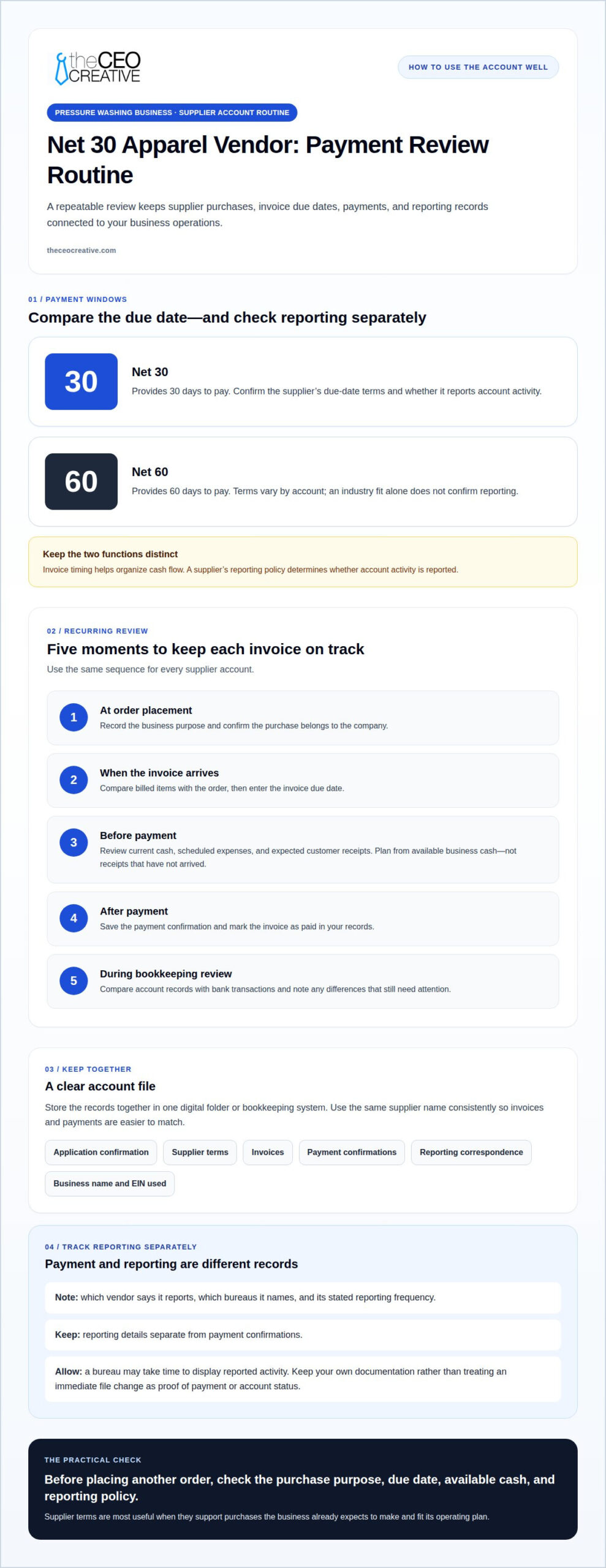
Use a recurring review routine to manage each account:
- At order placement, record the business purpose and confirm the purchase belongs to the company.
- When the invoice arrives, compare the billed items with the order and enter its due date.
- Before payment, review current cash, scheduled expenses, and expected customer receipts.
- After payment, save confirmation and mark the invoice as paid in your records.
- During bookkeeping review, compare account records with bank transactions and note unresolved differences.
This routine is more useful than opening accounts without a purchasing plan. For example, if two suppliers invoice during the same period, a calendar can show whether both payments fit alongside fuel, payroll, and other scheduled costs. The goal is not to wait until the last possible moment to pay. It is to know which obligations are coming and set aside cash before placing additional orders.
Track reporting separately. Note which vendor says it reports, the bureaus it names, and the stated reporting frequency. Keep this information separate from payment confirmations because paying an invoice and reporting its history are different actions. A bureau may take time to display reported activity. Maintain your own documentation rather than treating an immediate change in a credit file as proof of payment or account status.
When assessing net 30 accounts for pressure washing businesses, compare the business need, account identity, payment process, and reporting policy together. A supplier account is only one part of a broader credit-building approach. Keep purchases within the company’s operating plan, review records regularly, and use payment history as a reason to maintain accurate administration, not as a promise of a particular credit outcome.
Supplier terms are most useful when they support purchases the business already expects to make, rather than creating a reason to buy. Put planned equipment and required operating costs on the same cash calendar as supplier invoices, then decide whether each purchase can be paid by its due date without depending on receipts that have not arrived. A pressure washing machine with at least 3000 PSI is recommended as a starting point for quality equipment. If that kind of equipment is under consideration, record its purpose and expected payment timing before applying for supplier terms. Keep the purchase documentation with the account records so the invoice can be matched to the original business need and payment plan.
Include licensing and permit obligations in the same review. Pressure washing business licenses and permits may require annual renewal, and renewal fees are typically lower than the initial licensing budget. Plan for these costs instead of treating supplier credit as a substitute for available cash. When reviewing an account, make sure the purchase fits current business needs, the due date is visible, and the planned payment does not conflict with other scheduled expenses. If a purchase or renewal changes your cash plan, update the calendar and records promptly. Consistent documentation helps you see which obligations are pending, which invoices have been paid, and whether supplier terms remain manageable.
Which vendors offer net 30 accounts to pressure washing businesses?
Pressure washing owners can look at two broad vendor groups: suppliers whose products support jobs, and vendors whose products support general business operations. Pressure washing suppliers may offer net 30 or net 60 terms, giving businesses 30 or 60 days to pay. The terms vary by account, so a supplier’s industry fit alone doesn’t tell you whether it offers credit terms or reports payment activity.
Start with vendors whose products support day-to-day operations. Separate suppliers you already use from those you are considering. For each, record the items purchased, how often orders recur, and whether the business needs a payment account or simply a standard purchase. This helps keep your search focused on genuine operating needs.
General business vendors are another category to consider. A pressure washing company may purchase staff apparel, office materials, or promotional items for routine business use. These purchases don’t replace job supplies, but they can be relevant if they fit the company’s actual needs. A net 30 account in a suitable category may support purchasing and business credit efforts when the vendor reports account activity.
Keep three questions separate as you assess a vendor: Does it sell something the business needs? Does it offer net 30 or net 60 terms? Does it report the account’s payment history? A “yes” to one doesn’t establish the others. A supplier might offer terms without reporting, while a vendor’s reporting arrangement may apply only to a particular account type. Use the supplier’s stated account details to distinguish these conditions.
Compare vendors using a consistent record rather than relying on memory. Note the supplier’s business name, product category, terms, stated reporting policy, application details, and invoice process. Track whether an account supports recurring orders or a specific one-time business need. This gives you a practical basis for comparing options without assuming every supplier uses the same terms.
A forum participant sought a commercial account for purchases recurring once or twice per month. The example suggests a useful selection test: look for a purchase pattern that already exists in your business. If orders recur, note their timing and how invoices would align with incoming customer payments. If a purchase is occasional, decide whether it belongs in your operating plan before opening an account for it.
Use this checklist when assessing a supplier:
- Match the catalog to a real need. Identify the business purchase the vendor would support.
- Read the account terms. Record whether payment is due on net 30 or net 60 terms.
- Review reporting details. Write down whether the supplier reports payment activity and the bureaus it names.
- Map the invoice routine. Note how invoices arrive, how you’ll record due dates, and how payments will be tracked.
- Check the fit over time. Compare expected purchases with your actual order pattern before making the account part of routine operations.
Banking and payment processing records can help you assess whether an account fits. Keep supplier invoices distinct from customer receipts, then review both against the company’s cash plan. For instance, consider a recurring vendor invoice alongside expected deposits and other scheduled expenses. This makes it easier to choose a payment arrangement you can manage without treating a longer payment window as extra income.
Choose an account for its practical value: purchases relevant to your work, terms that fit your schedule, and clear reporting information. A pressure washing supplier may suit job-related purchases, while a general business vendor may suit recurring office or branding needs. Comparing these roles helps you decide which type of vendor account belongs in your business plan.
The CEO Creative: net 30 apparel vendor
The CEO Creative offers a net 30 apparel vendor option for pressure washing businesses that need branded work apparel and want a reporting supplier account. Its offerings include a net 30 t-shirt supplier, net 30 embroidery supplier, and net 30 office supplies vendor. These categories may fit businesses purchasing team apparel or routine office materials alongside their regular operations.
The account is based on the business EIN, with no personal guarantee or personal credit check. Reporting is monthly to Equifax Business, Creditsafe, and FairFigure. Bureau display timing varies, and business credit results aren’t guaranteed.
Review the net 30 apparel vendor account if these purchases fit your needs, and visit The CEO Creative’s website to learn more.
Make your next account decision with a clear plan
Use your purchasing records to decide which supplier relationship makes sense next. For pressure washing owners, net 30 accounts can fit business credit goals when the vendor’s reporting terms and the company’s real purchasing needs align. A planned account should have a clear business purpose, a manageable invoice schedule, and a payment routine that works alongside customer receipts.
Before opening another account, choose a category that supports your operations, then keep supplier details, invoices, and payment records together. This creates a consistent process as your business grows and makes each new account easier to manage. Focus on steady administration rather than opening accounts simply to increase activity.
This information is for general purposes and isn’t financial or legal advice. Business credit outcomes vary, and bureau display timing is determined by the bureaus.
Build your credit process one considered decision at a time. A clear system can help you manage supplier relationships with confidence as your pressure washing business grows.
Frequently Asked Questions
What does net 30 mean for a pressure washing business?
Net 30 means the invoice is due within 30 days, according to the supplier’s terms. For a pressure washing business, the practical step is to check when that period begins and enter the due date in your records. For example, don’t assume the invoice date and delivery date are interchangeable. Use the date specified by the vendor to plan payment and reconcile the bill.
What business credit requirements are needed to qualify for net 30 terms?
Requirements depend on the vendor and account. Vendors may consider the business’s identity, application details, and intended account use. Before applying, gather consistent business information and use the company’s legal name and EIN where requested. If you have a newly formed LLC, review the vendor’s criteria rather than assuming every supplier uses the same approval process or requires the same documents.
How can a new pressure washing business apply for net 30 vendor credit?
Choose a vendor whose products match a real business need, then complete its application with accurate information. Review the account terms before ordering, including the invoice process and due date. Save the application confirmation and order records together. When the invoice arrives, compare it with the order, enter the due date in your bookkeeping system, and retain payment documentation for your files.
What are the risks and benefits of using net 30 accounts to build business credit?
A vendor account may help manage purchase timing and contribute to payment history when the supplier reports account activity. The risk is taking on an invoice the business can’t comfortably pay by its due date, putting pressure on cash available for other obligations. Consider the purchase, expected customer receipts, and scheduled expenses together. Reporting doesn’t guarantee a particular credit score or future financing decision.
Does every net 30 vendor report payments to business credit bureaus?
No. Net 30 describes payment terms, not a promise that the supplier reports the account. Before relying on an account for credit-building, identify whether the vendor reports payment history, which bureaus it names, and how often it reports. Keep the vendor’s stated reporting details with your account records. A purchase can still serve an operating need even if it doesn’t generate a reported tradeline.
Should a pressure washing business choose net 30 or net 60 terms?
Choose a payment period that fits your cash plan and invoice schedule. Compare the due date with expected customer receipts and other scheduled costs, then decide whether the purchase is necessary. A longer payment window doesn’t make an order more affordable by itself; the balance remains due under the vendor’s terms. Use an account that fits your purchasing needs and payment routine.
Common Mistakes to Avoid
- Assuming net 30 terms automatically mean the vendor reports payment activity.
- Placing an order without recording its invoice due date.
- Using inconsistent business details across applications and account records.
- Ordering items solely to create account activity instead of meeting a business need.
- Planning payment around customer funds that haven’t arrived.