


Net 30 accounts for roofing companies set payment for 30 days after the invoice date, with the full invoice balance due then. The supplier’s stated terms determine how that date is recorded and applied. For a contractor, the payment deadline is a planning point for the business, not a measure of when a roofing job is finished.
That distinction matters when a roofing company is juggling job schedules, customer billing, and supplier obligations. Track each supplier invoice separately in accounts payable, noting whether the purchase supports a job or routine operations. This guide explains supplier options, application preparation, and how reported account activity may contribute to a business credit file. It also outlines practical ways to assess vendor terms and choose an account that fits your purchasing needs and payment process. Make a deliberate choice, then keep account records organized as the business grows.
Key Takeaways
- Net 30 means the invoice is due 30 days after its invoice date, so record that date to plan payment.
- Compare supplier terms, eligible purchases, and reporting practices before opening an account.
- Prepare your business details and EIN before applying, then review the approved terms before placing an order.
- On-time payments may contribute to business credit history when the vendor reports account activity, but results vary.
- Build a repeatable routine: track each invoice, pay by its due date, and monitor the reporting bureaus for account updates.
Which suppliers offer net 30 accounts to roofing contractors?
Roofing contractors can look for Net 30 terms from building-material distributors, lumberyards, manufacturers, and business vendors that report payment activity. These are different supplier types, and an account’s purpose matters. A materials distributor may offer terms for job-related purchases, while a reporting vendor may provide a separate account for eligible business purchases and report its payment history.
Start with suppliers tied directly to roofing work. Building-material distributors and roofing product manufacturers may offer contractor accounts, depending on their policies and your application. Find out which products qualify, how invoices are issued, and whether the account reports to business credit bureaus. Trade terms do not necessarily include tradeline reporting, so treat reporting as a separate feature to verify.
Lumberyards and broader building-supply wholesalers are another category to investigate. A roofing company might already buy related materials through these suppliers, so an account can fit existing purchasing habits. Review whether Net 30 applies to every order or only approved purchases. Also identify the invoice date and payment method in the account terms. Those details help you align supplier bills with project receipts.
Roofing businesses can also consider reporting vendors for business-use items beyond roofing materials. These accounts may support credit-building when the vendor reports payment activity, but they do not replace a roofing materials supplier. Choose items the company can use, understand the vendor’s order requirements, and pay by the invoice due date. Record operating purchases separately from credit-building goals.
Supplier categories to compare include:
- Roofing manufacturers: Ask whether contractor purchases qualify for invoice terms and whether payments are reported.
- Building-material distributors: Review the application process, approved purchasing categories, and invoice schedule.
- Lumberyards: Check whether account terms cover the materials your roofing jobs require.
- Reporting vendors: Confirm the eligible order type and which business credit bureaus receive reports.
Reporting details deserve particular attention. A vendor account may take 60 days to appear on a business credit report, so an immediate bureau entry shouldn’t be assumed. Ask which bureaus receive reports and whether the vendor reports monthly. Compare that information with the account’s payment terms before choosing a supplier. A reporting vendor should be evaluated on the account terms and the reporting practice, not just the product category.
For context, U.S. small businesses with under $1 million in annual revenue used more than $50 billion in trade credit in 2019. That figure describes small-business trade credit broadly, not roofing suppliers or credit-reporting results. For a roofing contractor, the practical step is to identify the supplier’s role first: materials for jobs, routine business purchases, or a reporting account. Then compare the written terms and reporting details for that specific account.
Keep a separate record for each supplier. Save the application approval, invoices, payment confirmations, and reporting details. An account log can track the supplier, invoice and due dates, purchase purpose, and payment status. This helps distinguish a materials account from a reporting tradeline and makes it easier to follow up if an expected account entry does not appear.
Before applying, list the suppliers your business already uses and the purchases each account would cover. Then identify which accounts offer Net 30 terms and report payment activity. That comparison helps roofing contractors choose accounts that support operations while building a clear, manageable payment record.
How can a roofing company apply for a net 30 supplier account?
Prepare a consistent business profile before applying. Enter the roofing company’s legal name, business address, EIN, and contact details as they appear in its records. If the company is an LLC, use its full legal name rather than a shortened trade name. Consistent information helps match the application and invoices to the business credit file.
Choose an account based on the purchase it will support. A roofing-material distributor may assess a contractor account differently from a vendor selling routine business items. Note the supplier, the account’s purpose, and the purchases you expect to make. For example, keep job materials distinct from ordinary business purchases intended for a reporting account.
Before applying, gather the details you may need: business registration information, EIN, billing and delivery addresses, and an authorized contact. Check spelling and suite numbers against existing records. If the form asks for a trade name, enter it separately from the legal business name. Use an owner’s personal details only when the application specifically requests them.
Use this preparation sequence:
- Identify the supplier. Record its legal business name and the materials or purchases the account covers.
- Match your records. Compare the application name and address with the roofing company’s business documents.
- Prepare the EIN. Enter the business identifier carefully wherever the form requests it.
- Review the terms. Locate the invoice date, due-date rule, accepted payment methods, and any order requirements.
- Save the submission. Keep a copy of the completed application and any confirmation for your files.
Read the account terms before signing or placing an order. Confirm how the supplier defines the invoice date and calculates the due date. Net 30 terms require full payment 30 days after the invoice date. For example, if an invoice is dated on the fifth, use the supplier’s stated terms to determine the due date rather than counting from delivery or job completion.
Review reporting details as a separate step. Ask whether the supplier reports account activity, which business credit bureaus receive reports, and how often it reports. Reporting arrangements differ from payment terms. Save the information with the account documents so your records show both the payment schedule and reporting practice.
After approval, compare the first order confirmation with the application. Check the business name, billing address, eligible purchase, and invoice terms before accepting the order. Record the invoice date and due date in a calendar or accounts-payable system, and keep the invoice with its payment confirmation under the supplier’s name.
Use the same process for each new account, rather than relying on memory. A simple spreadsheet can track supplier, application date, account purpose, invoice number, invoice date, due date, and payment status. For an EIN-based account, review the business Net 30 account details as one reference when comparing application terms and reporting information.
How do net 30 accounts affect a roofing company’s business credit?
A Net 30 account can contribute payment history to a roofing company’s business credit file when the supplier reports account activity. The account itself doesn’t guarantee a score change. Its effect depends on reporting, the bureau’s records, and how the business manages the balance.
Start by separating two steps: the supplier sends data, then a bureau processes and displays it. A vendor that reports monthly to Equifax Business, Creditsafe, and FairFigure provides account information to those bureaus. The bureau’s display timing is separate from the vendor’s reporting schedule. A new account may take 60 days to appear on a business credit report.
A reported tradeline can document a supplier relationship and payment history. For example, a roofing LLC might make an eligible business purchase, receive an invoice, and pay according to its terms. If the supplier reports the account, that payment information may become part of the company’s business credit file. The purchase alone does not create a reported record; supplier reporting is essential.
Payment habits matter because an invoice creates a clear obligation. Track the invoice date, due date, amount owed, and payment confirmation for each account. If an invoice is dated on the fifth, use its stated Net 30 terms to calculate the due date. Paying by the due date helps maintain an accurate payment record with the supplier. Late payment can create a negative supplier history and may affect future account decisions.
Business credit files are separate from personal credit files. Use the roofing company’s legal business name and EIN consistently on supplier applications and invoices. If the supplier reports a different name or identifier, the bureau may have difficulty matching the account to the company’s file. Keep application records to compare account details with bureau entries.
Use this review process after opening an account:
- Save the terms. Keep the supplier agreement and identify the invoice date and payment deadline.
- Document each bill. Record the invoice number, amount, due date, and payment confirmation.
- Note the reporting schedule. Record whether the supplier reports monthly and name the listed bureaus.
- Review the business file. Look for the supplier account after allowing time for bureau processing.
- Compare account details. Check that the business name and identifying details match your records.
If a tradeline doesn’t appear after 60 days, first compare the supplier’s reporting schedule with the bureau’s display. Then review the business name and identifying details used on the account. Keep the invoice and payment record available when addressing a mismatch. Don’t assume that an absent entry means a payment was late; reporting and bureau display are separate steps.
For a roofing company, the practical value is a documented supplier relationship, not a promised score increase. Net 30 accounts for roofing companies can support credit-file development only when the vendor reports and the business maintains the account responsibly. Results vary, and business credit information is not financial or legal advice.
Vendor accounts
A vendor account lets a business buy eligible goods or services and pay under agreed invoice terms. For a roofing contractor, it could be with a roofing supplier or a business vendor. One account supports job purchasing; another may help establish a reported payment record.
Net 30 terms require full payment 30 days after the invoice date. The invoice date starts the payment period, not the date a roofing project ends. For example, if a supplier issues an invoice before a customer pays the roofing company, the contractor still needs to plan for the supplier’s stated due date.
Terms can also differ by supplier and account history. New businesses may initially receive Net 10 or Net 15 terms. A longer payment period may become available after the supplier sees a record of on-time payments. Don’t treat an advertised term as automatic approval; the approved account agreement sets the terms for that business.
Assess an account’s purchasing function separately from its credit-reporting function. A roofing-material supplier may offer invoice terms without reporting the account. A reporting vendor may sell other eligible items and send account activity to business credit bureaus. Before opening an account, decide which function matters and review both the purchase and reporting terms.
A practical account review should cover:
- Eligible purchases: Identify which materials or business items the account covers.
- Payment terms: Record the term length and how the invoice date is established.
- Order requirements: Note any minimum purchase requirement or ordering condition.
- Reporting practice: Confirm whether the vendor reports payment activity and the bureaus involved.
- Account administration: Identify how invoices, payments, and account notices are managed.
Some guidance recommends starting with three to five Net 30 accounts that report to multiple bureaus. Treat that number as a planning reference, not a required target. Each account adds invoices and payment dates to manage. A roofing business with one well-tracked account may find that easier to administer than several accounts opened at once.
Choose accounts around genuine business needs. For example, compare an account for regular supplier purchases with a reporting account for recurring business-use items. Avoid buying unnecessary goods just to create account activity. Each purchase should suit the company’s operations and its ability to pay by the due date.
Maintain a separate record for each vendor. Capture the supplier, account purpose, invoice number, invoice and due dates, amount, and payment confirmation. A spreadsheet or bookkeeping system can flag upcoming obligations. Reconcile statements against invoices so credits, returns, or corrections do not throw payment records off.
Review accounts periodically. If a supplier changes terms, update the payment calendar before the next invoice. If the business receives Net 10 or Net 15 terms, schedule payment using that shorter period rather than assuming Net 30. A contractor comparing account requirements can use these business Net 30 account details as part of its review. Consistent records help the owner manage vendor relationships and understand which accounts serve purchasing needs, reporting goals, or both.
The CEO Creative: net 30 apparel vendor
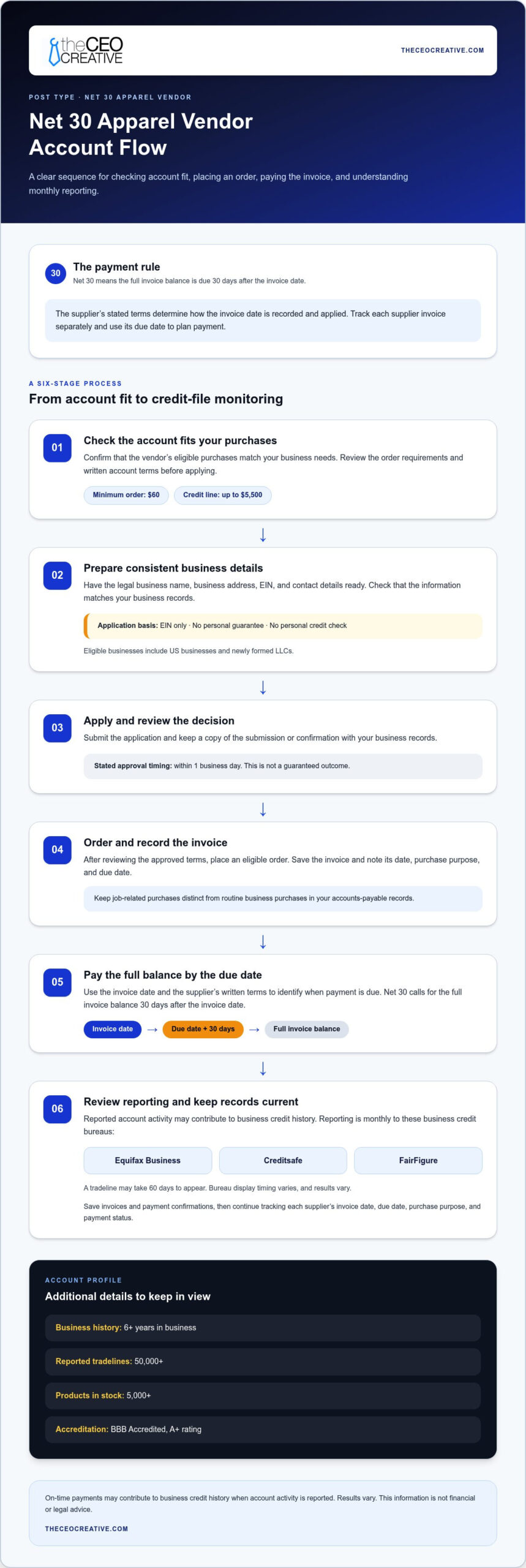
The CEO Creative offers a reporting Net 30 apparel vendor account for roofing businesses that also need eligible company apparel. It may fit contractors ordering shirts or embroidered apparel for crews, rather than businesses seeking roofing materials. The account uses the EIN only, with no personal guarantee or personal credit check.
Eligible U.S. businesses, including newly formed LLCs, can apply without a minimum time in business. The account reports monthly to Equifax Business, Creditsafe, and FairFigure. Roofing owners can also consider its Net 30 office supplies vendor for eligible business purchases. Reporting may support a business credit file, but outcomes vary and bureau display timing is separate.
Visit The CEO Creative’s Net 30 apparel vendor page to review the account.
Set up your next account with a clear plan
Before opening another supplier account, assign someone to manage its records. That person should review invoices, update the payment calendar, and organize purchase documents. The role can belong to the owner or the person handling bookkeeping. Clear responsibility helps keep accounts from being overlooked during a busy roofing season.
When evaluating net 30 accounts for roofing companies, connect each account to a defined business purpose. Decide what the company expects to purchase, how those purchases fit its operating budget, and who will approve orders. A written process can help the owner assess whether a new account supports the business instead of adding avoidable administrative work.
Use each new application to reinforce your record-keeping process. Store supplier records in one place and review them as the business changes. A consistent system provides a practical foundation for managing new vendor relationships.
Take the next step at a pace that fits your business, and build your supplier relationships with intention.
Frequently Asked Questions
Can a roofing company use a vendor account for purchases outside roofing materials?
Yes. A roofing business can consider a reporting vendor for eligible business-use purchases beyond job materials. Crew apparel or office supplies, for example, may support daily operations. Record their purpose clearly so they are not confused with materials assigned to a roofing project. The vendor’s eligible order categories and terms determine which purchases the account can cover.
What should a roofing company include in an internal account policy?
Define who can apply, approve purchases, and manage invoices. Explain how staff should document each purchase’s business purpose and route supplier statements for review. For example, the owner could approve new accounts while the bookkeeper enters invoices. Clear roles reduce confusion as the company adds suppliers or changes who handles accounts payable.
How can a roofing contractor connect vendor purchases to jobs?
Use a consistent bookkeeping method to separate job costs from general business expenses. Code a roofing-material order to its project, for example, and record crew shirts or office items as operating purchases. This helps owners assess job profitability without treating every vendor invoice as a direct project cost. Apply the same coding method to invoices across accounting periods.
What if a supplier application asks for owner information?
Complete each application field according to its wording and the account structure. A form may request business details and an authorized representative. Keep the company’s legal name and business identifiers consistent with its records. Before submitting, check that a trade name, billing address, or contact detail has not replaced the roofing company’s legal information.
Can Net 30 terms replace cash-flow planning?
No. Supplier terms create a payment obligation; they do not replace a roofing company’s budget or ensure that customer payments arrive first. Include each supplier invoice in cash-flow planning alongside payroll, job expenses, and expected customer receipts. If project payments are delayed, the business still needs a plan to meet the account’s agreed terms.
Does opening a vendor account guarantee a change to business credit?
No. Opening an account alone does not guarantee a change to a credit file or a particular result. The vendor’s reporting practice, the information it submits, and bureau processing all matter. Treat reported account activity as one part of the company’s credit profile, not as a promised score increase. Keep payment records and review business credit files as part of ongoing account management.