


Net 30 accounts for HVAC companies can defer eligible supplier payments for 30 days. Residential and commercial customer payment practices differ, so compare supplier due dates with expected collections before ordering.
This article explains supplier options, application requirements, personal guarantees, and payment risks, then shows how a reporting vendor may fit.
Key Takeaways
- Separate distributor terms for HVAC equipment from vendor accounts that report payment history to business credit bureaus.
- Compare residential and commercial payment cycles to understand when supplier bills may come due relative to customer payments.
- Prepare your business details before applying, and understand whether an account relies on an EIN or a personal guarantee.
- Use manageable orders and pay on time to build a consistent account history without treating credit as a substitute for cash-flow planning.
- Review the risks of delayed customer payments before relying on supplier terms to cover HVAC purchases.
3. Which suppliers offer Net 30 accounts to HVAC contractors?
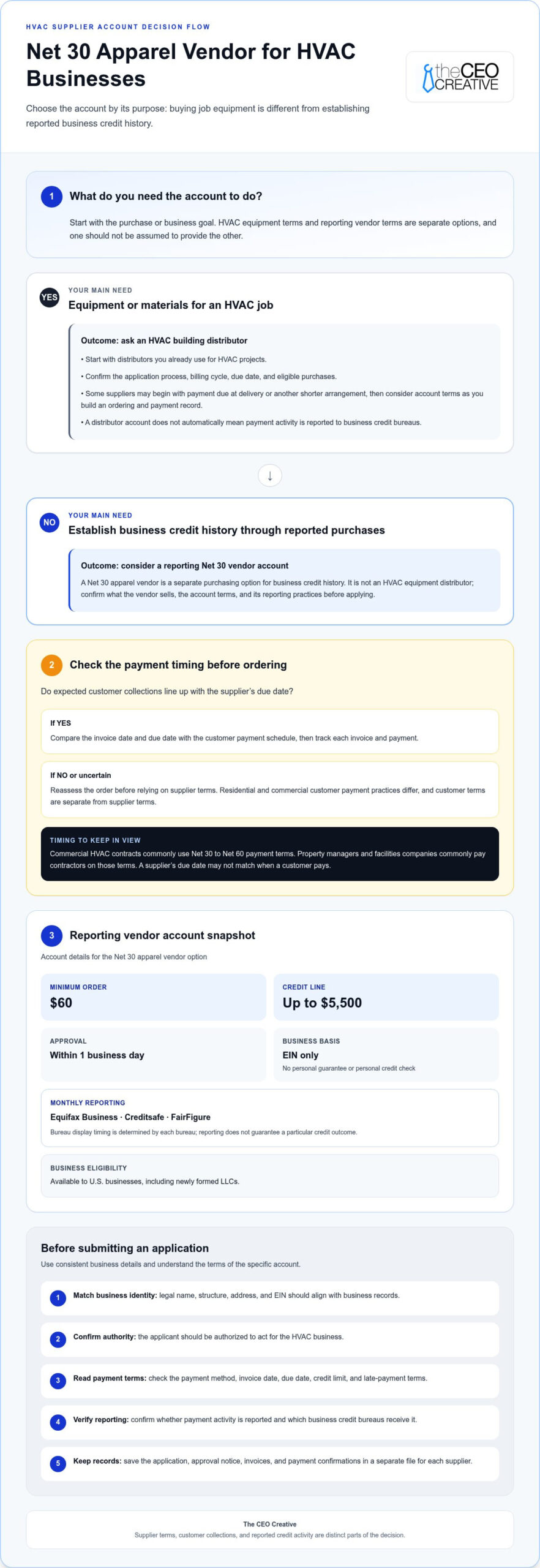
HVAC contractors encounter two kinds of supplier credit. Building distributors sell equipment and job materials, while reporting vendors offer purchases that may establish a business credit tradeline. These accounts serve different purposes. Before applying, identify whether you need job inventory, more time to pay, or reported payment history.
For equipment and materials, start with the distributors you already use for HVAC projects. Ask about their account application, billing cycle, due date, and whether they offer terms to your business. Commercial HVAC contracts commonly use net-30 to net-60 payment terms, and property managers and facilities companies commonly pay contractors on those terms. That timing can make distributor terms relevant, but a supplier’s payment terms and your customer’s terms are separate agreements.
Some building distributors start with payment due at delivery or another short-term arrangement, then consider account terms as the contractor develops an ordering and payment record. Keep invoices, receipts, and payment confirmations organized. Match each statement to the related job, especially when equipment costs depend on progress billing or retainage. A distributor account supports purchasing, but it does not automatically mean the supplier reports payment activity to business credit bureaus.
Reporting Net 30 vendors are a separate option for businesses building credit history through purchases. Before opening an account, confirm what can be ordered, how the due date is calculated, which business identity details are used, and whether the vendor reports payment activity. Do not assume every HVAC equipment supplier reports tradelines, or that every reporting vendor sells HVAC equipment.
Tax planning is another separate consideration, not a supplier credit feature. According to the Internal Revenue Service, the Section 179 deduction limit is $2,560,000. The Internal Revenue Service states that the Qualified Business Income deduction allows pass-through entities to deduct up to 20 percent of qualified business income, subject to income limits. The Internal Revenue Service also states that self-employed HVAC business owners may pay a 15.3% self-employment tax on business profit. These tax details do not determine a vendor’s approval or payment terms.
Compare suppliers based on the expense you need to cover. For example, use an HVAC building distributor account for equipment purchases, then evaluate a reporting vendor account separately if you also want to establish business credit history. Read the terms before ordering, track each due date, and pay invoices as agreed. This keeps purchasing, customer collections, and credit-building activity distinct.
Start with the building distributors you already use for HVAC projects and ask whether they offer business accounts with Net 30 terms. Confirm the application process, billing cycle, and due date; some suppliers may begin with shorter terms and consider account terms as you build an ordering and payment record.
4. HVAC Business Net 30 Account Requirements
Eligibility depends on whether you’re applying to an HVAC distributor or a reporting vendor. A distributor may assess your purchase history and ability to pay for equipment. A reporting vendor may focus on your business identity and account terms. Identify the account type first, since the application criteria and purpose can differ.
Before applying for net 30 accounts for HVAC companies, prepare a consistent business profile. Use the legal name shown on your formation documents, and enter the matching business address and tax identification details. For an LLC, keep the spelling and punctuation consistent across the application and supporting records. A mismatch can slow processing or make it harder to connect the account with the correct business.
Review the application for these details before submitting it:
- Business identity: Have your legal business name, structure, address, and EIN ready.
- Authorized applicant: Confirm that the person applying can act for the HVAC business.
- Payment information: Understand the accepted payment method, invoice date, due date, and any late-payment terms.
- Reporting terms: Determine whether the account reports payment activity, and which business credit bureaus receive it.
New LLCs should distinguish time in business from other underwriting factors. A supplier may consider business identity, requested purchasing terms, and payment history rather than relying on operating age alone. For distributor terms, consistent ordering volume and on-time payments can help an HVAC company build toward net-30 terms. Start with orders that match routine business needs, then maintain a clear record of each invoice and payment.
When comparing net 30 accounts for HVAC companies, ask what each account requires before relying on it for a project schedule. A distributor account tied to equipment purchases may assess the order and payment relationship differently from a vendor account designed to report business credit activity. Read the agreement for the credit limit, eligible purchases, billing cycle, due date, and consequences of late payment. Treat each term as part of the application decision.
Keep a separate account file for each supplier. Save the application, approval notice, invoices, and proof of payment together under the supplier’s name. If your HVAC business operates under a trade name, document how it connects to the legal entity. Organized records make it easier to resolve billing questions and keep account details accurate over time.
For an EIN-based business account, use the business Net 30 account details as one reference when comparing supplier requirements. Review the application against your business records before placing an order.
5. How do HVAC companies apply for supplier credit accounts?
Choose an account based on the purchase you need to make. An HVAC distributor account may cover job equipment, while a reporting vendor account may help establish business credit history. Keep those goals separate as you compare applications: supplier terms, eligible purchases, and reporting practices are not interchangeable.
Before applying, gather the information that identifies your business. Use the legal name on your formation records, the business address, and the company’s EIN. If your HVAC firm uses a trade name, distinguish it from the legal entity name. Consistent details help avoid mismatches across applications, invoices, and payment records.
Read the application and account terms before submitting them. Find the payment due date, billing cycle, credit limit, eligible purchases, and late-payment conditions. If the form asks for an owner or authorized applicant, provide the information requested for that role. Approval criteria and application requirements vary by supplier.
Use this sequence to keep the process organized:
- Choose the supplier: Match the account to the need, such as HVAC equipment from a building distributor or a separate vendor tradeline.
- Prepare business information: Enter the legal name, address, EIN, and authorized applicant details consistently.
- Review the terms: Identify the invoice date, payment due date, purchase limits, and reporting policy.
- Submit the application: Save a copy of the completed form and any decision notice with your business records.
- Manage the first order: Match the invoice to the job or operating expense, record its due date, and schedule payment.
For example, if a distributor account supports an upcoming installation, file its invoice with that project’s purchase documents. If a separate vendor account is intended to report payment activity, document its terms and reporting details independently. This makes each account’s purpose clear and prevents an equipment purchase from being mistaken for proof of credit reporting.
After submitting, monitor the account through its first billing cycle. Compare the supplier’s invoice with your order, note any discrepancy promptly, and retain payment confirmation. A spreadsheet or bookkeeping system can track supplier name, invoice date, due date, amount, and payment status. Keep the record current as you apply to additional suppliers.
To review an EIN-based application path, use the business Net 30 account application details as one reference when comparing supplier account requirements.
Once the account is active, consider whether its payment timing fits the job’s cash flow. U.S. businesses can negotiate supplier payment terms of net 45 days or net 90 days to retain cash longer. Ask about these options before placing an order, and record any agreed terms so the invoice can be scheduled against the correct due date.
If your U.S. business uses a credit card to defer supplier payments, pay the balance in full by the statement due date to avoid interest charges. Track the card statement separately from supplier invoices, and check available cash before relying on either payment method.
4. Do New HVAC Firms Need Personal Guarantees?
There is no single personal-guarantee rule for every Net 30 supplier. Each supplier sets its own application terms, so a new HVAC business should read the agreement before accepting credit. A personal guarantee means an owner agrees to be personally responsible for specified business debt if the business does not pay.
That differs from applying with business information alone. A supplier may request the company’s legal name and EIN, then ask an owner to sign a guarantee. Review the application and agreement for terms such as “personal guaranty,” “individual guarantor,” or a personal-liability clause. Signing beside those terms may create obligations beyond the business account.
Before signing, identify who is responsible and which debts the guarantee covers. Check whether it applies to one order, the account balance, or future purchases. Review how the agreement addresses late payment, default, and cancellation. If a clause is unclear, get qualified legal advice before agreeing. This article is not legal advice.
Compare supplier applications using the same questions:
- Is a personal guarantee required? Look for a direct requirement in the application or agreement.
- Who signs? Distinguish an authorized business representative from an individual guarantor.
- What does it cover? Read the scope, duration, and conditions tied to personal responsibility.
- How is the business evaluated? Identify whether the supplier considers business identity, payment history, or other application details.
For example, an HVAC LLC applying to a distributor for equipment terms may encounter a guarantee clause in the credit agreement. A separate vendor account may have different underwriting terms. Approval from one supplier does not determine another’s requirements. Keep signed agreements with the related account records and note any guarantee terms before placing orders.
New firms may build a business payment record through supplier accounts that assess the business using EIN-based terms. That does not mean every supplier account is free of guarantees. Read the agreement to confirm whether the owner signs only as the LLC’s authorized representative or also accepts personal responsibility.
Compare the Net 30 account terms without a personal guarantee with the distributor agreement you’re considering. Read each document before ordering, and keep the signed terms accessible for whoever manages HVAC purchasing and accounts payable.
5. What are the risks of using Net 30 accounts for HVAC purchases
Net 30 terms shift the payment date, but they don’t remove the cost of an HVAC purchase. The main risk is timing: a supplier invoice may come due before the customer pays. A $40K commercial HVAC installation can require the contractor to front labor and equipment for one to two months before payment clears. If several jobs overlap, each invoice adds another claim on operating cash.
Residential and commercial work can have different collection patterns. A residential customer may pay in stages, while commercial work may involve progress billing, retainage, or payment after approval. If a contractor orders equipment before confirming the customer’s payment milestones, the supplier’s due date may arrive before the customer’s funds. Match the supplier invoice to the job schedule before ordering.
Credit can also make it easier to commit to purchases without checking whether the work is profitable. Compare the order with the signed scope, approved change orders, and expected collections. For example, if the equipment order exceeds the amount due in the customer’s next scheduled payment, the business must cover the difference with available cash. Don’t treat payment terms as a reason to buy beyond the project’s needs.
Late payment is another risk. Review the supplier agreement for due-date rules, late charges, account restrictions, and the effect of disputes on payment obligations. Document billing errors promptly, but don’t assume a dispute automatically pauses the invoice deadline. Keep the purchase order, delivery record, invoice, and written communication together to support any correction.
Several supplier accounts can complicate cash planning because invoices may have different billing dates, due dates, and purchase limits. Track every supplier in one calendar or accounting system, and assign each order to a job or operating expense. Before accepting another order, compare unpaid invoices with expected collections, payroll, and upcoming operating costs.
Credit reporting is not the same as immediate access to cash. A reporting account may contribute payment history, but it cannot collect a late customer invoice or cover a project shortfall. Keep customer receivables and supplier payables visible in the same cash-flow review. If commercial terms include net-60 payment, retainage, or progress billing, account for those conditions before relying on supplier credit.
Before ordering, confirm the job need, verify the supplier’s due date, compare it with the customer’s payment schedule, and assign someone to monitor the invoice. This simple check can help HVAC owners spot timing gaps before committing to equipment purchases.
U.S. businesses can require a minimum deposit with every purchase to improve receivables. Consider whether deposits can be built into customer agreements before taking on supplier obligations, and keep expected deposits distinct from money already collected. The page estimates that an HVAC business with $300,000 in net profit could save $15,000-$25,000 annually by using an S-Corporation structure. Treat that estimate as a separate planning consideration, not as cash available to settle a supplier invoice; review business structure alongside cash-flow needs.
The CEO Creative: net 30 apparel vendor
The CEO Creative offers a Net 30 apparel vendor option for HVAC businesses with apparel purchasing needs. Its Net 30 t-shirt supplier and Net 30 embroidery supplier can support branded workwear orders, separate from HVAC equipment purchases.
The account reports monthly to Equifax Business, Creditsafe, and FairFigure. Review its terms and choose purchases that fit your business needs. Visit the Net 30 apparel vendor page or theceocreative.com to explore the account.
FAQs
Do supplier terms and credit reporting mean the same thing?
No. Payment terms specify when an invoice is due. Reporting specifies whether a supplier sends payment activity to business credit bureaus.
Can a Net 30 vendor account pay an HVAC customer invoice?
No. It sets payment terms for purchases from that vendor. It does not collect customer receivables or cover unrelated project costs.
What should I track after placing an order?
Record the supplier, invoice date, due date, purchase purpose, and payment status. Keep the invoice and payment confirmation with your business records.
Does monthly reporting mean a bureau will display activity immediately?
No. The timing of when submitted information appears can vary.
Can an HVAC business use a vendor account for routine purchases?
Yes, if the purchase is eligible under the vendor’s terms and meets a genuine business need. Check the account agreement before ordering.
What should I compare before opening an account?
Review eligible purchases, payment due dates, reporting practices, and any personal guarantee language in the agreement.