

The easiest net 30 account to find may not be the right fit for your electrical business. Net 30 accounts for electrical contractors are vendor accounts that let an eligible business purchase goods or services and pay the invoice within 30 days of its date.
It’s reasonable to focus on the payment window, but eligibility and credit requirements matter too. Vendors can differ in the business information they request and the factors they consider, such as business identity, time in operation, and credit history. Knowing what an application asks for can help you compare accounts and avoid applying without a clear reason.
This guide explains which vendor categories may offer net 30 terms to electrical contractors and what eligibility and credit requirements may apply. You’ll also learn how the account process works, what to consider before opening accounts, and how to assess whether a vendor tradeline fits your business-building plans.
Key Takeaways
- Compare each vendor’s fees, payment terms, and late-payment rules before opening an account.
- Prepare your business details and understand what the vendor considers when reviewing an application.
- Learn how vendor reporting can contribute to a business credit profile and why bureau updates may take time.
- Use a manageable approach to multiple accounts, with a clear system for tracking invoices and due dates.
- See how a net 30 apparel, t-shirt, embroidery, or office supplies vendor may fit your business needs.
Are there fees, interest charges, or late-payment penalties on net 30 supplier accounts?
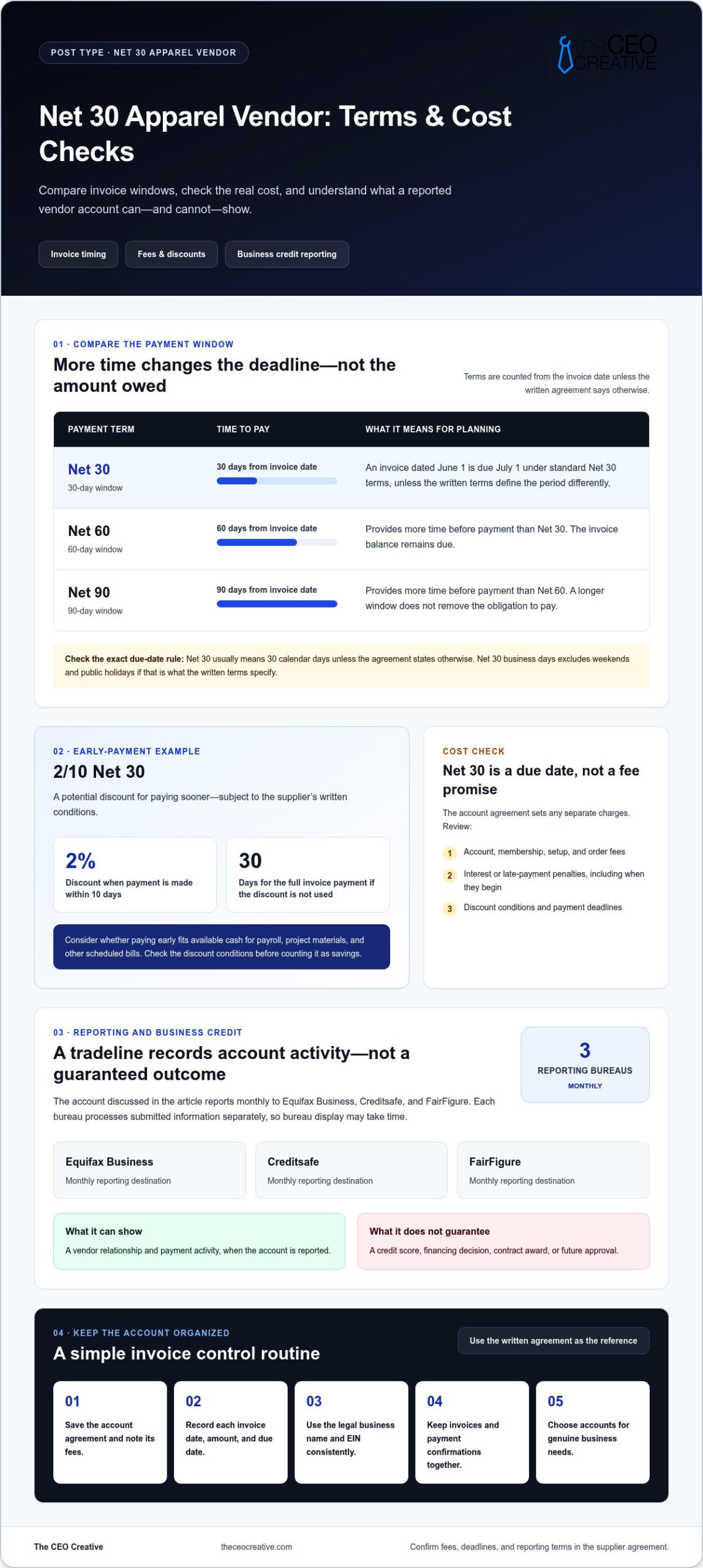
Net 30 describes when an invoice is due, not whether an account is free of added charges. The full invoice amount is generally due within 30 days of the invoice date. A supplier’s account agreement sets any separate fees, interest, discounts, or late-payment penalties. Read those terms before placing an order, and save the version that applies to your account.
Check for charges that apply before or after a purchase. An account could have a membership or setup fee, while an overdue invoice could trigger interest or a late fee under the agreement. These are separate from the price of the goods or services ordered. Don’t assume that “net 30” means no fees, or that every supplier uses the same fee structure. Look for the charge type, when it applies, and how the supplier calculates it.
Next, confirm the exact due-date rule. Net 30 usually means 30 calendar days unless the written terms say otherwise. For example, an invoice dated June 1 with Net 30 terms is due July 1. If the agreement says Net 30 business days, weekends and public holidays are excluded. Mark the due date shown on the invoice, then compare it with the account agreement if the dates differ.
Some suppliers offer an early-payment discount instead of reducing the payment window. Under 2/10 Net 30 terms, the buyer receives a 2% discount for paying within 10 days. Without that discount, the full invoice remains due within 30 days. For an electrical contractor, decide whether paying early fits the cash available for payroll, project materials, and other scheduled bills. Don’t count the discount as savings until you’ve checked its conditions and calculated the invoice total.
Before applying, use this review sequence to identify the real cost of an account:
- Read the fee section. Identify account, membership, order, and payment-related charges.
- Find the late-payment terms. Note when a charge begins and how the agreement calculates it.
- Confirm the invoice clock. Check whether the due date runs from the invoice date or follows another written rule.
- Record discount conditions. For 2/10 Net 30, compare the 10-day discount deadline with expected cash needs.
- Keep the paperwork. Save the agreement and each invoice so you can resolve a difference using the same terms.
A due-date calendar makes the review practical. Enter each invoice’s date, amount, and deadline when it arrives. If an invoice is dated June 1, for example, record July 1 as the Net 30 due date, unless its written terms define the period differently. This simple step helps prevent a forgotten invoice from becoming an overdue balance.
Payment timing also affects cash-flow planning. Net 30, Net 60, and Net 90 specify 30, 60, and 90 days from the invoice date, respectively. Longer terms provide more time before payment, but they don’t erase the amount owed. A net terms calculator can help organize due dates and compare payment windows. Use the agreement’s stated charges and deadlines when deciding what the account will cost.
How do net 30 accounts help electrical contractors build business credit?
A vendor-reported account can add payment history to an electrical contractor’s business credit file. It documents how the company manages supplier obligations, but it does not build a strong profile on its own. Its value depends on whether the vendor reports the account and whether the business keeps accurate records tied to its legal identity.
Reporting details matter when comparing accounts. The account discussed here reports monthly to Equifax Business, Creditsafe, and FairFigure. These are the reporting destinations, but each bureau processes submitted information separately. The contractor’s own records and the information that appears on a bureau file are distinct parts of the process.
A reported tradeline records an account relationship and payment activity. For an electrical contractor, it can show that the business used vendor terms and made payments. This is separate from project revenue, customer invoices, and retainage. A tradeline does not guarantee a credit score, financing decision, contract award, or future approval.
When a contractor purchases business items through a vendor account, it should keep the application, invoices, and payment records under the same legal name and EIN. If the vendor reports the account, the submitted information may be associated with the company’s business credit file. Consistent records make it easier to identify the account and address discrepancies between reported information and the company’s own files.
Use these checks to decide whether a vendor account fits your credit-building plan:
- Confirm reporting: Determine whether the vendor reports payment activity, rather than only offering deferred payment terms.
- Identify the bureaus: Record which business credit bureaus receive information from the account.
- Match business details: Use the company’s legal name and EIN consistently on the application and account records.
- Keep documentation: Retain invoices and payment confirmations so account activity can be reviewed against company records.
- Choose relevant purchases: Use an account for genuine business needs, not solely to add a tradeline.
Accurate business identification is especially useful for a newly formed LLC. Use the LLC’s legal details consistently, and distinguish any trade name where the application asks for it. If the business changes its address or legal name, update the vendor account information. Clear records help you track what was reported and which business file should reflect the account.
Follow a steady process instead of opening accounts just to increase your tradeline count. Review vendor statements and payment records as part of regular bookkeeping. This keeps account history organized and helps you catch missing invoices or incorrect details. Results vary, and reported activity is only one part of a business credit profile.
Contractors considering an EIN-based vendor tradeline can review the business net 30 account details as one option. Compare its reporting terms and account requirements with the company’s purchasing needs. Choose a vendor relationship the business can manage consistently.
How can an electrical contractor apply for and manage a net 30 account?
Managing net 30 accounts for electrical contractors starts with accurate records and clear purchasing controls. Before applying, collect the business details the vendor requests, including the legal company name and EIN. Keep those details consistent with the company’s bookkeeping records. If the contractor uses a trade name, distinguish it from the legal name when the application asks for both.
Use this sequence to organize an application and account:
- Review the application. Identify required business details, eligible purchases, and account conditions before entering information.
- Prepare supporting records. Gather company information and keep a copy of any submitted application or approval notice.
- Set purchasing authority. Decide who may place orders and who reviews purchases before they are submitted.
- File each transaction. Save the order confirmation and invoice together in the company’s accounting system.
- Reconcile the account. Match statements and payment records to the company ledger, then resolve any differences.
Assign clear roles to keep purchasing organized. For example, a project manager can request a purchase while an owner or bookkeeper checks it against the job budget. Record the business purpose and relevant project for each order. This gives the accounting team context when reviewing invoices and helps distinguish job-related purchases from general operating expenses.
Keep a central file for each vendor account. Save the application, account terms, order confirmations, invoices, statements, and payment confirmations. Use consistent file names, such as the vendor name followed by the invoice reference. If an invoice differs from the order confirmation, note the discrepancy and keep related messages with the records.
Build regular reconciliation into your bookkeeping. Compare vendor statements with the company ledger and flag unfamiliar charges, duplicate entries, or missing documents. If the business address or legal name changes, update the vendor account information and save confirmation of the change. Organized records make it easier to review account history and keep vendor files aligned with current company details.
If your company has several active jobs, tag purchases by project or operating category. Record office administration purchases separately from job material costs. Clear categories help owners review project budgets and operating expenses independently, and create more useful records for internal reports or discussions with a bookkeeper.
Finally, review account activity as part of the company’s regular financial review. Check that the business identity is accurate, transactions have supporting documents, and internal purchasing approvals were followed. An EIN-only vendor account is one option to consider when organizing vendor accounts under the company’s EIN. A consistent process keeps applications, purchases, and accounting records connected.
For contractors serving property management companies, ask how their payment schedule fits with the account’s due date. Property management companies often issue checks twice a month, which can affect whether Net 15 or Net 30 aligns with their accounts-payable cycle. Keep expected customer receipts and vendor payment dates visible in the same cash-flow review, and follow up promptly when an invoice or payment timing is unclear. This helps the business plan purchases without assuming that a customer’s check run will match a vendor’s terms.
Review account use alongside project budgets and overall business performance. Well-managed electrical contracting businesses may occasionally reach net profit margins of 20%, so protecting margins calls for attention to costs, purchasing approvals, and timely collection of customer payments. Faster receivables—supported by card and merchant payment solutions such as Dojo—can also help maintain healthy cash flow to settle supplier invoices on time. Compare material spending with estimates, investigate recurring discrepancies, and adjust purchasing practices when the records show avoidable cost overruns. A consistent review routine can help owners make informed decisions about which account purchases support active work and which need closer scrutiny.
What risks should electrical contractors consider before opening multiple net 30 accounts
Each net 30 account adds another invoice deadline, balance, and set of terms to manage. For an electrical contractor, several due dates can overlap with payroll, project costs, and customer payment delays. Opening accounts faster than the business can track them can create missed payments. Business credit reports may include payments that are one day late, so a short delay can matter.
Cash flow is a central risk on commercial jobs. A $280,000 electrical contract example includes $28,000 in retainage held until completion and punch-list resolution. That retainage may not be released until 60-90 days after substantial completion. Supplier invoices still come due under their own terms, regardless of when the customer releases retainage.
Multiple projects can compound the gap. An electrical contractor running five commercial projects simultaneously could have $80,000 to $150,000 locked in retainage. Adding supplier obligations without accounting for those receivables can leave less cash available for bills. Track retainage separately as a receivable, rather than combining it with regular accounts receivable.
Review each proposed account against these risks before applying:
- Overlapping deadlines: Put every invoice date and due date on one calendar, rather than relying on separate reminders.
- Uneven project cash flow: Compare upcoming supplier bills with expected customer payments and retainage releases.
- Unused purchasing: Avoid opening an account if it does not support a real business purchase or operating need.
- Different account terms: Record each supplier’s payment rules and late-payment provisions alongside its invoices.
- Reporting exposure: Remember that a late payment can be included in a business credit report, even when it is only one day late.
The number of accounts alone does not show whether a credit-building plan is manageable. Consider monthly payment capacity, active job commitments, and how invoices are tracked. If a customer payment is delayed, the contractor still needs a plan for invoices already due. Base cash-flow forecasts on actual project billing and collection schedules, not only on the expected contract value.
Use a short review before adding another supplier account. List current balances, due dates, and expected incoming payments. Then check whether the business can pay the new invoice without depending on a retainage release. If several bills fall due while a project payment remains outstanding, delay adding another obligation until the payment schedule is workable.
For example, a contractor with retainage held across multiple jobs should compare those receivables with bills due during the same period. Treating retainage as cash already available can distort the payment plan. Keep a separate receivables record to show which funds remain tied to project completion and punch-list resolution, alongside an accounts-payable schedule showing what the contractor must pay.
Choose vendor accounts for relevant purchases and manageable terms, not simply to add tradelines. A clear invoice process, realistic cash-flow plan, and consistent payment tracking help reduce avoidable account risk.
The CEO Creative: net 30 apparel vendor
The CEO Creative offers net 30 vendor accounts for electrical contractors seeking business purchases that fit their operations and credit-building plans. Its options include a net 30 apparel vendor, t-shirt supplier, embroidery supplier, and office supplies vendor. These categories may suit contractors purchasing apparel for their business or office essentials, while keeping the account focused on relevant company needs.
Consider this option if you want a vendor account that uses your EIN and doesn’t require a personal guarantee. Review the account terms and make sure the payment schedule works with your existing obligations before applying. For details on the apparel account, visit The CEO Creative’s net 30 apparel vendor page.
Choose the next step that fits your business
Use your next account decision to build a repeatable purchasing process, not simply to add another tradeline. For your electrical business, compare each vendor account against actual company needs, your invoice workflow, and the cash available to meet payment deadlines. That gives you a practical way to decide whether net 30 accounts for electrical contractors fit your credit-building plan.
The CEO Creative may suit contractors whose business purchases align with its vendor categories. Credit outcomes vary, and a reported account does not guarantee a particular bureau result. Choose terms you can manage, keep records consistent, and make each account part of a deliberate business-credit plan.
Take the next step at a pace that supports your company’s operations and long-term goals.
Frequently Asked Questions
What does net 30 mean for electrical contractors?
Net 30 is an invoice payment term: the buyer pays the full balance within the period set by the vendor, generally counted from the invoice date. Check the invoice and account agreement for the exact due date and any different counting rule. For an electrical contractor, recording that date alongside project expenses helps separate supplier payment obligations from customer billing milestones.
What are the requirements to open a net 30 account with electrical supply companies?
Requirements vary by supplier and account type. An application may ask for the company’s legal name, business contact details, and other information needed to identify the applicant. Review the written terms for eligibility criteria, purchasing rules, and payment conditions. Keep business information consistent across the application and account records so invoices are tracked to the correct company.
Do electrical contractors need an EIN, business credit, or trade references to qualify for net 30?
There isn’t one requirement that applies to every vendor. The CEO Creative’s EIN-only net 30 account uses the business’s EIN and does not require a personal guarantee or personal credit check. Requirements for business credit history or trade references depend on the vendor’s application criteria. Read the specific account terms to understand what information that supplier uses when evaluating an application.
Can a newly formed LLC apply for a vendor account?
Yes. Newly formed LLCs are eligible for an account with The CEO Creative, and there is no minimum time in business. Use the LLC’s legal name and EIN consistently when applying. Prepare the requested business details and consider whether the account’s purchase categories and payment schedule fit the LLC’s actual operating needs.
How soon can a new vendor account appear on a business credit report?
A new vendor account may take 60 days to appear on a business credit report. The vendor’s reporting activity and the bureau’s processing are separate steps, so an account can be open before it appears in a file. Keep the application and payment records while the bureau processes the information. Review the business report later for accurate account details.
Should an electrical contractor open several net 30 accounts at once?
Base your decision on genuine purchasing needs and the company’s ability to manage each account. Every additional supplier can mean another invoice, due date, and set of terms to track. Compare proposed payment dates with existing supplier bills and expected customer receipts before adding an account. A manageable routine is more useful than opening accounts solely to increase tradeline count.