


A supplier invoice can do more than settle a purchase. Net 30 accounts for plumbing companies give a business 30 days to pay after receiving an invoice. When a vendor reports payment activity, paying on time may help build the company’s business credit history.
For a plumbing business managing materials, operating costs, and customer invoices, payment timing matters. Net 30 terms can provide time to pay a vendor, but the terms alone don’t guarantee that an account will be reported or affect a credit profile.
Learn how Net 30 payment terms work, what reporting means, and what to consider when choosing a vendor account. The sections ahead explain the account lifecycle and how plumbing companies can use reported vendor payments as part of a practical business-credit strategy.
Key Takeaways
- Learn how a new plumbing business can use vendor payment history as one part of building its business credit profile.
- See why reporting practices matter when comparing Net 30 vendor accounts.
- Understand how to manage account applications, purchases, invoices, and payments as a repeatable process.
- Explore when a Net 30 apparel, T-shirt, embroidery, or office supplies vendor may fit your business needs.
How can a new plumbing business build business credit with Net 30 accounts?
A Net 30 account gives a plumbing business 30 days to pay after receiving an invoice. The vendor supplies goods or services, then records the purchase as a business obligation. For example, a new plumbing LLC might use a reporting vendor for a planned business purchase, pay its invoice by the due date, and build a record of payment activity. This is trade credit, not a loan. The useful outcome is a documented vendor relationship tied to the business rather than an undocumented purchase.
Start by preparing consistent business details. Use the company’s legal name, business address, and employer identification number, or EIN, consistently on applications and invoices. A legal business structure and a DUNS Number are also advised when applying for vendor accounts. Treat these details as application preparation, not a guarantee of approval. Mismatches between an application and business records can make it harder to connect an account with the correct company profile.
Choose accounts based on reporting, not just payment timing. Before applying, find out whether the vendor reports payment data to business credit bureaus. Some vendors report to Dun & Bradstreet, Experian Business, or Equifax Small Business, while others may not report at all. Reporting to one bureau does not mean reporting to every bureau. Match the vendor’s reporting practices to the business credit profile you want to establish, and keep a record of the bureau names and reporting frequency.
Build a manageable routine rather than opening accounts without a plan. A commonly recommended starting range is three to five Net 30 accounts that report to multiple bureaus. For a plumbing company, the key is choosing accounts for purchases the business can use and pay for from available cash. One account could support routine business needs, while another fits a separate planned purchase. Avoid ordering solely to create activity. An invoice is still an obligation, even when the purchase is intended to support credit building.
- Prepare the business profile. Gather the EIN, legal business name, business address, and entity details before submitting applications. Use matching information across each account.
- Confirm reporting. Identify whether the vendor reports payment history, which bureau receives it, and how often the vendor sends data.
- Apply selectively. Start with accounts that suit actual business purchases. Keep a record of application dates, account terms, and approval details.
- Track every invoice. Record the invoice date, due date, amount, and payment status in bookkeeping software or a calendar. A written process helps prevent missed due dates.
- Pay on time and retain records. Save invoices and payment confirmations. Review account activity and business credit reports for the reported tradeline.
Payment timing affects the account record. Pay the full amount by the invoice due date, and don’t assume that an early payment changes the reporting schedule. A new vendor account may take 60 days to appear on a business credit report. On-time payments to Net 30 vendors may appear in a business credit score in about 90 days. These are distinct timing points: an account’s appearance and the visibility of payment activity may not happen together.
After the account has been used, review the business credit profile for the vendor tradeline. Check that the business identity matches and that the reported account reflects the payment record. If an account does not appear, first compare the account’s reporting terms with the bureau where you looked. For plumbing companies, repeat only the process the business can sustain: choose relevant vendor accounts, monitor invoice dates, pay on time, and keep records. Net 30 accounts for plumbing companies can contribute to a business credit history, but vendor reporting and bureau updates determine what becomes visible.
The Consumer Financial Protection Bureau estimates that U.S. small businesses with under $1 million in annual revenue used more than $50 billion in trade credit in 2019. That preference can inform preparation, but it does not replace checking each vendor’s reporting practices and account requirements.
As the business grows, sound payment practices can support its own receivables, too. For plumbing contractors looking to expand into full bathroom installations through intensive trade courses like those from YTA Training, balancing higher material costs with dependable trade credit is essential. Businesses can extend credit terms to customers who pass their credit approval process, require a minimum deposit with every purchase to improve receivables, and encourage early payment by offering discounts. If the business uses a credit card to pay supplier invoices, it should pay the balance in full when the statement is due to avoid interest charges.
Vendor accounts
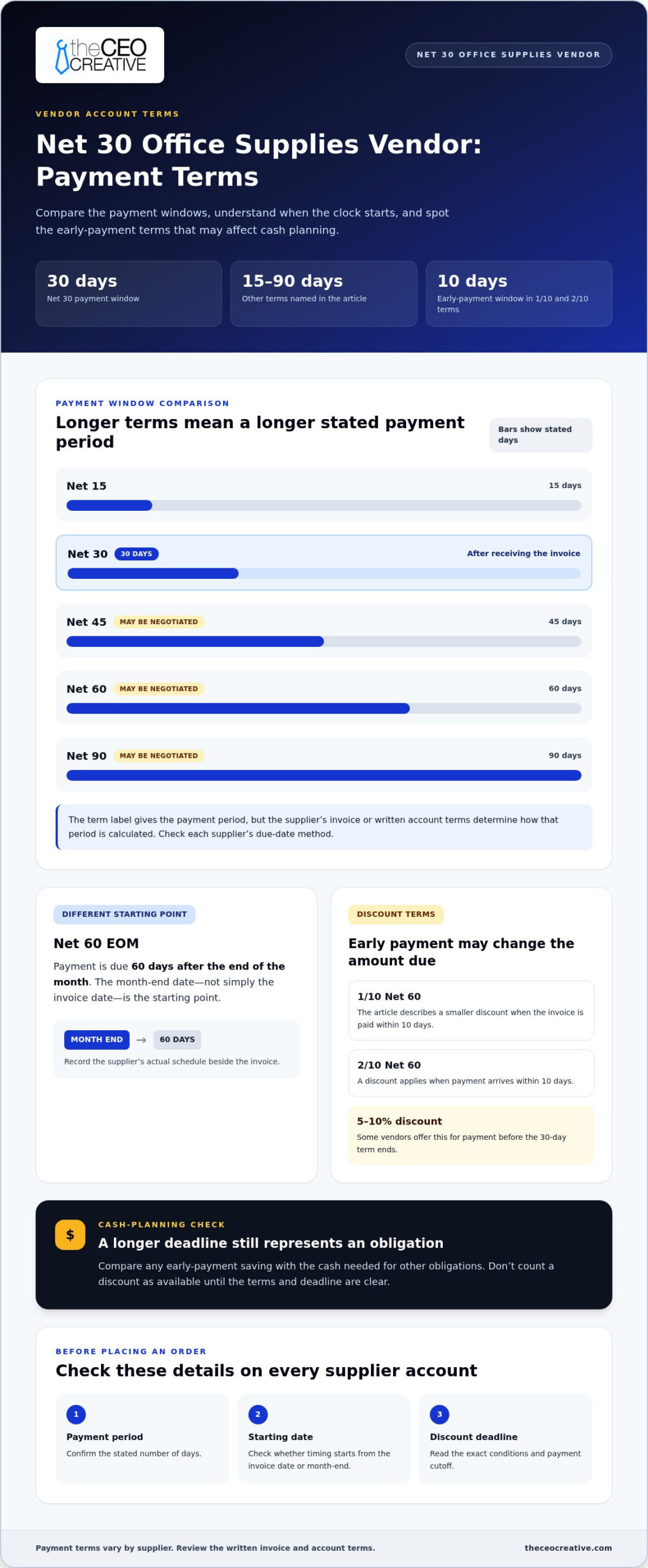
Vendor accounts can use different payment schedules, so read each supplier’s written terms before placing an order. Net 30 provides 30 days to pay after receiving an invoice. Other vendors may offer Net 15, Net 60, or Net 90 terms. The number identifies the payment period, but the invoice or account terms determine how the period is calculated. Record each supplier’s specific due-date method instead of applying one rule to every payable.
Net 60 terms give a buyer 60 calendar days from the invoice date to pay the full amount owed. Net 60 EOM uses a different starting point: payment is due 60 days after the end of the month. For example, an invoice issued during a month with EOM terms follows the month-end date, not simply its invoice date. Keep the term label beside the invoice so the bookkeeping entry reflects the supplier’s actual schedule.
Some offers combine a payment deadline with an early-payment discount. Under 1/10 Net 60, a buyer receives a smaller discount if the invoice is paid within 10 days. Under 2/10 Net 60, a discount applies when payment arrives within 10 days. Some vendors also offer a 5-10% discount for payment before the 30-day term ends. Compare the saving with the cash the business needs for other obligations. Don’t count a discount as available cash until the terms and deadline are clear.
Plumbing companies may also discuss alternative terms with existing suppliers. Businesses can negotiate net 45, net 60, or net 90 days to keep cash on hand longer. That can help align a payable with the company’s operating cycle, but a longer term still creates an obligation. Write down any agreed change and make sure the supplier’s invoice reflects it. A verbal understanding that differs from the written invoice can lead to a missed deadline or a disputed balance.
Consignment is another vendor arrangement, but it works differently from invoice terms. A supplier may deliver products and require payment only after those products sell. That timing is distinct from Net 30, Net 60, or other terms with a set payment deadline. Keep consignment records separate from ordinary supplier invoices. For each arrangement, track what was received, what was sold, what remains, and when payment becomes due under the agreement.
Use an accounts-payable calendar to see vendor obligations together. Enter the supplier name, invoice reference, amount, applicable term, and due date. Then compare those dates with expected customer receipts. Fewer than four in 10 construction businesses report getting paid within 30 days on average, based on construction payment data. That context makes receivables timing relevant to plumbing businesses, but customer delays don’t automatically change a supplier’s stated due date.
Watch for these common vendor-account mistakes:
- Assuming every supplier starts its payment period on the same date.
- Confusing Net 60 EOM with Net 60 calculated from the invoice date.
- Accepting a discount without recording its early-payment deadline.
- Treating a consignment balance like an ordinary invoice payable.
- Planning payment around customer receipts without tracking the supplier deadline.
- Relying on a changed term that isn’t reflected in the written account terms.
A plumbing company comparing account structures can consider an EIN-based Net 30 business account alongside its supplier terms and purchasing plan. Choose terms the business can track and meet, then keep the invoice and payment records together for clear bookkeeping.
When opening a vendor account, ask what information the supplier needs and which written terms will govern the account. Most vendors do not check an applicant’s personal credit unless the business is brand new. That distinction can help an established company prepare its application, but it does not guarantee approval or a particular payment schedule. Confirm the supplier’s requirements directly, and keep any account documents with the related invoices. If the business is brand new, clarify what the vendor will review before relying on a proposed term or placing an order.
Businesses can ask existing vendors whether they offer net-30 terms. A direct request can open a discussion about payment timing with suppliers already familiar with the business. If a vendor agrees, confirm the terms in writing and check that invoices use the agreed schedule. Record the due-date method in the payable calendar, and update the entry when the supplier’s written terms change. Clear records help distinguish a confirmed account arrangement from a request that has not yet been accepted. They also give the person managing payments a consistent reference when reviewing invoices and planning cash needs.
The CEO Creative: net 30 apparel vendor
The CEO Creative offers a Net 30 apparel vendor option for plumbing businesses with planned apparel purchases. Its offerings include a Net 30 T-shirt supplier, embroidery supplier, and office supplies vendor. A plumbing company might consider these categories when it has a business use for branded apparel or needs office supplies. The account is based on an EIN, with no personal guarantee or personal credit check. Reporting is monthly to Equifax Business, Creditsafe, and FairFigure; bureau display timing varies.
Review the Net 30 apparel vendor account details to see whether the category and terms fit your purchasing plan. Visit The CEO Creative’s website to explore the account.
Make your next account fit your business plan
Choose a vendor account as part of your plumbing company’s operating routine, not as a standalone credit-building shortcut. Before applying, identify a business purchase you already expect to make, decide how you’ll record the invoice, and connect its due date to your cash-flow planning. That way, each account has a clear business purpose and a place in your bookkeeping process.
As you compare net 30 accounts for plumbing companies, focus on whether the vendor’s terms and reporting practices fit your goals. Keep your records organized, pay according to the invoice terms, and review your business credit profile as activity develops. Credit outcomes vary, and bureau display timing is outside a vendor’s control.
Build your credit process one considered business decision at a time. Consistent records and thoughtful account use can help you manage payments with greater confidence.
Frequently Asked Questions
What does Net 30 mean for a plumbing company?
It gives the plumbing company 30 days to pay after receiving the vendor’s invoice. Record when the invoice arrives, then schedule payment within that window. For example, if an invoice arrives while the owner is handling customer billing and supplier orders, adding it to the payable calendar helps keep it visible. The customer payment schedule and the vendor’s terms remain separate obligations.
Do all vendor accounts report payments to business credit bureaus?
No. Reporting depends on the vendor’s practices, and having Net 30 terms alone doesn’t establish that payment activity will be reported. Before relying on an account for credit-building purposes, identify whether the vendor furnishes data and which bureau receives it. Keep a note of the reporting details with the account records so you can distinguish a reporting tradeline from a supplier account that doesn’t report.
How should a plumbing company manage vendor invoices when customers pay late?
Keep customer receivables separate from supplier payables. A late customer payment doesn’t change the vendor’s agreed terms, so use a payable calendar to flag upcoming invoice dates. Review expected receipts alongside required payments before committing available cash. This gives the owner a clearer view of timing and helps prevent a customer’s delay from being mistaken for an extension on a supplier invoice.
How is Net 60 different from Net 30?
Net 60 allows 60 calendar days from the invoice date to pay the full balance, while Net 30 provides 30 days after receiving an invoice. Net 60 EOM uses another starting point: the payment period runs from the end of the month. Check the exact term on each invoice because the label and calculation method affect how the due date should be recorded.
What records should a plumbing business keep for a vendor account?
Keep the vendor agreement, invoices, payment confirmations, and any written changes to account terms together. For each invoice, record its reference number, receipt date, amount, due date, and payment status. These records help the owner reconcile bookkeeping entries against supplier statements. They also make it easier to spot a missing payment entry or a discrepancy between the invoice and the business’s payable records.
Can a newly formed LLC apply for a vendor account?
Yes. Newly formed U.S. LLCs can be eligible for The CEO Creative’s business credit account, and there’s no minimum time in business. The application is based on the EIN, without a personal guarantee or personal credit check. Enter the company’s legal name and EIN consistently so account information is associated with the business rather than recorded under differing business details.