


Net 30 accounts for general contractors can defer payment for planned business purchases. The terms may help align vendor bills with project cash flow, but each invoice still needs a payment plan.
Compare the due date with expected receipts and other job costs. A customer payment that arrives later does not change the supplier’s deadline.
This guide explains how to assess suppliers, account charges, and payment risks, then choose terms that fit your purchasing workflow.
Key Takeaways
- Compare vendors by the account terms that affect your purchasing workflow, not just by the payment window.
- Review minimum orders, possible charges, and reporting details before placing a purchase on terms.
- Match invoice due dates to your project cash flow and set reminders to help prevent late payments.
- Use vendor accounts for planned business purchases, and avoid relying on payment terms to cover costs you can’t repay on time.
- Choose a supplier category that fits a real business need so purchasing and credit-building efforts work together.
Which suppliers offer net 30 terms to general contractors?
General contractors may find Net 30 terms through trade suppliers, business vendors, and service providers that invoice commercial customers. Net 30 generally gives the buyer 30 days to pay an invoice. The right supplier depends on what the business regularly purchases, whether the vendor offers terms, and whether the account reports payment activity to business credit bureaus.
Start with purchases tied directly to jobs. Building-material suppliers, lumberyards, and electrical, plumbing, or HVAC wholesalers may invoice contractors for eligible business orders. For example, a contractor buying lumber for a scheduled project can compare the supplier’s payment terms with the expected timing of customer draws. The invoice due date still applies, even if the project payment arrives later.
Equipment rental companies and subcontractors are other places to review invoicing arrangements. A contractor may receive an invoice for a rental period or completed trade work, with terms set by the provider. These arrangements can support project purchasing, but they are not automatically credit-building accounts. Confirm whether the supplier reports payment history, which business bureau receives it, and how the account is identified.
General business vendors can also support contractor operations. Office-supply and printing vendors may provide invoices, forms, and administrative materials. Apparel and embroidery suppliers can provide company clothing for staff. These purchases are usually separate from job materials, so choose them when they meet an actual business need. An account tied to a useful purchase is often easier to manage than an order made solely to create payment activity.
Do not assume every supplier invoice becomes a reported tradeline. A vendor may offer payment terms without reporting the account to business credit bureaus. Before relying on an account to build credit, identify its reporting policy, frequency, and the business information used. EIN-based reporting can distinguish business activity from personal credit activity, but bureau records update on their own schedules.
Compare suppliers by practical fit, not by the words “Net 30” alone. Review the invoice due date, eligible purchases, minimum order, payment methods, late-payment consequences, and reporting details. The terms should make sense for the order and the business’s ability to pay. For example, a general contractor that needs recurring office materials may prefer a business vendor account, while a contractor purchasing project materials may focus on a trade supplier’s invoice process.
Use this short screening process before applying:
- Match the vendor to a real purchase. List recurring needs, such as lumber, electrical materials, printing, or work apparel.
- Separate terms from reporting. Ask whether the account reports business payment history and which bureaus receive it.
- Read the invoice rules. Record the due date, payment method, minimum order, and any stated charges.
- Check account identity. Confirm the vendor records the business name and EIN correctly.
- Plan repayment. Compare each due date with expected project receipts before placing an order.
For a contractor comparing net 30 accounts for general contractors, the key distinction is purpose. A trade supplier may support job purchasing, while a business vendor may cover administrative needs. Either can be useful when its terms fit the purchase and the business can pay by the due date. Reporting is a separate feature, so weigh it alongside purchasing fit rather than assuming that every invoiced supplier builds business credit.
For example, a general contractor that needs reliable cash flow should match the invoice date to the point when the agreed work or delivery can be verified. Send an invoice with Net terms when the agreed billing event is verifiably complete, and count the payment window from the invoice date unless the agreement says otherwise. This makes the due date clear for both parties and helps the contractor plan around supplier bills. For an invoice dated June 3 with Net 7 terms, the example due date is June 10. The same care applies when billing a customer for a completed project stage; do not assume the payment window begins when the work starts or when the customer receives funds.
A fictional residential final-balance example uses a $4,200 balance with Net 7 terms. The example illustrates why contractors should ensure the amount and billing event are documented before relying on a customer payment to cover supplier invoices. Project and property plans can also affect timing: a North Carolina owner-builder must occupy and control the property for 12 months after project completion before offering it for sale or lease. Contractors considering such work should account for that requirement when planning cash needs and deciding which supplier terms fit the project. Clear billing milestones and manageable payment windows can help keep purchasing decisions aligned with the actual work.
What fees, minimum orders, or interest charges apply to net 30 accounts?
Net 30 describes the payment window, not the full cost of an account. A supplier can set its own minimum order, account fees, and late-payment terms. Review the agreement and invoice before ordering. Write each charge and due date into your purchasing records so the actual cost is clear.
Minimums may apply to an individual order, an account, or both. For example, a contractor may have to meet a supplier’s order threshold to receive invoice terms. That threshold can affect whether a small administrative purchase makes sense. Compare the required order with what the business already needs. Don’t buy unnecessary items just to meet a minimum.
Keep the order minimum separate from the credit limit. A minimum is the smallest purchase the vendor accepts under its rules. A credit limit is the maximum balance the vendor may allow on the account. Neither changes the invoice due date. Track the open balance after every order, especially when multiple project purchases use the same account.
Fees depend on the written terms. Look for account or membership charges, delivery and payment-processing charges, and any other listed costs. Don’t assume a fee applies just because another supplier charges one. Check the vendor’s current agreement and order summary for the specific account. If an invoice includes a charge, compare it with the agreed terms before recording it.
Interest is also separate from the Net 30 period. The phrase “Net 30” alone doesn’t tell you whether interest applies after the due date, how it is calculated, or whether another late charge applies. Read the payment section for the interest rate, calculation method, start date, and any stated grace period. If the agreement doesn’t explain a charge clearly, pause before placing the order and get the terms clarified in writing.
A simple comparison helps keep different supplier terms straight:
- Minimum order: Record the smallest qualifying purchase and whether it applies to each transaction.
- Account charges: Note recurring or one-time fees stated in the agreement.
- Interest: Identify the rate and how the supplier calculates it after a missed due date.
- Late charges: Record when they apply and whether they appear separately from interest.
- Payment timing: Use the invoice date and stated due date, rather than estimating from delivery.
For example, a contractor ordering office materials should compare the invoice total with the purchase threshold and available account balance. Then schedule payment for the exact due date. If a customer draw is expected later, it does not change the vendor’s deadline. Plan for the payable using funds the business can reasonably allocate.
Keep the signed terms, order confirmation, and invoice together. Match each payment to the correct invoice in your accounting records. If an invoice includes an unfamiliar charge, document it and ask the supplier to explain its basis before treating it as an agreed fee. This creates a clear record for the bookkeeper and helps prevent overlooked costs.
For an EIN-only account, review the written order minimum and payment terms before applying. The EIN-only Net 30 account details can help you assess whether the account structure fits your purchasing and payment process.
Schedule the purchase after checking whether a deposit is required and when it is due. If the deposit must clear before scheduling or ordering materials, state that due event in the agreement rather than automatically applying the final invoice term. This keeps an early payment obligation separate from the balance due under the invoice terms. Confirm the deposit trigger and final invoice due date in writing, and record each separately when assessing the order’s cash-flow impact. This is especially useful when a supplier’s minimum order and project payment milestones affect when materials can be obtained.
Supplier credit terms should also be kept separate from licensing and financial requirements. An intermediate North Carolina general contractor license allows the contractor to undertake individual projects costing up to $1,500,000 each. North Carolina does not require general contractors to carry insurance or a bond for a general contractor license, but a surety bond may be used instead of meeting the minimum financial requirements. These licensing facts do not state a supplier’s minimum order, account fee, or interest charge; those costs still need to be confirmed in the supplier’s agreement. Before committing, compare the deposit timing, invoice terms, and stated charges with the project’s purchasing plan, so an early cash requirement is not mistaken for an account fee or a change to the Net 30 due date.
What are the risks of using net 30 accounts, and how can contractors avoid late fees?
A Net 30 invoice creates a payment deadline, not extra project revenue. If a contractor orders materials before a customer draw arrives, the vendor’s payment window may run ahead of incoming cash. Retainage can add pressure: a 10% holdback on a $200,000 project leaves $20,000 unpaid until release. Keep supplier due dates separate from expected project receipts.
The main risk is spending cash already committed elsewhere. Payroll, subcontractors, permits, and equipment costs may compete with a vendor invoice. Record each purchase under its project or operating category, then include it in the cash forecast. If payment depends on retainage, a change order, or a customer draw, plan for the invoice in case that receipt is delayed.
Late charges depend on the written agreement. Read the payment terms before ordering, then record the invoice date, stated due date, and any late-payment provisions. Don’t assume a disputed invoice or delayed delivery automatically changes the deadline. Save order records and address discrepancies promptly, while keeping the payable visible in your schedule.
Credit reporting also requires careful payment management. A vendor that reports account activity may include late payments in its reporting. Reporting is monthly, while each bureau controls when the information appears. Don’t rely on one account to produce a particular credit outcome. Follow the account terms and keep records showing when payments were made. For contractors navigating past credit issues or seeking tailored financial consulting, luxfinancialclinic.com offers professional credit restoration guidance.
A reliable accounts-payable routine makes deadlines easier to manage. Assign responsibility for entering invoices and reviewing unexpected charges. Enter the invoice’s stated due date instead of estimating it from delivery. For example, when an invoice is dated June 3, follow the due date stated by that vendor and save the invoice with its order confirmation.
Use this checklist for each purchase:
- Confirm the operating reason. Accept Net 15 or Net 30 only when there’s a real business need and the company can afford the wait.
- Assign the purchase. Identify the project or operating category that should carry the expense.
- Enter invoice details. Record the amount, invoice date, due date, and payment instructions.
- Review cash commitments. Compare expected receipts with payroll and other scheduled costs.
- Schedule payment early enough. Leave time to resolve invoice questions before the deadline.
Watch for these common mistakes:
- Relying on an expected draw. Treating a projected customer payment as cash already received can leave a vendor invoice unfunded.
- Using delivery as the due-date trigger. The invoice terms may use a different starting point, so follow the stated due date.
- Leaving one person to track every detail. Without a review step, a coding error or overlooked charge can go unnoticed.
- Ordering before checking committed costs. A new payable can compete with payroll or subcontractor payments already scheduled.
- Assuming a dispute pauses payment. Keep the invoice on the payable schedule while documenting and addressing the issue.
A weekly review of open bills helps identify upcoming deadlines and possible cash shortfalls. Sort invoices by due date, compare them with available funds, and flag any project receipt that has shifted. If a discrepancy appears, keep the purchase order, delivery record, invoice, and payment confirmation together. A clear record helps the bookkeeper track the issue and maintain the payment schedule.
For contractors considering an EIN-based vendor account, review the business Net 30 account terms alongside the company’s purchasing and payable process.
The CEO Creative: net 30 apparel vendor
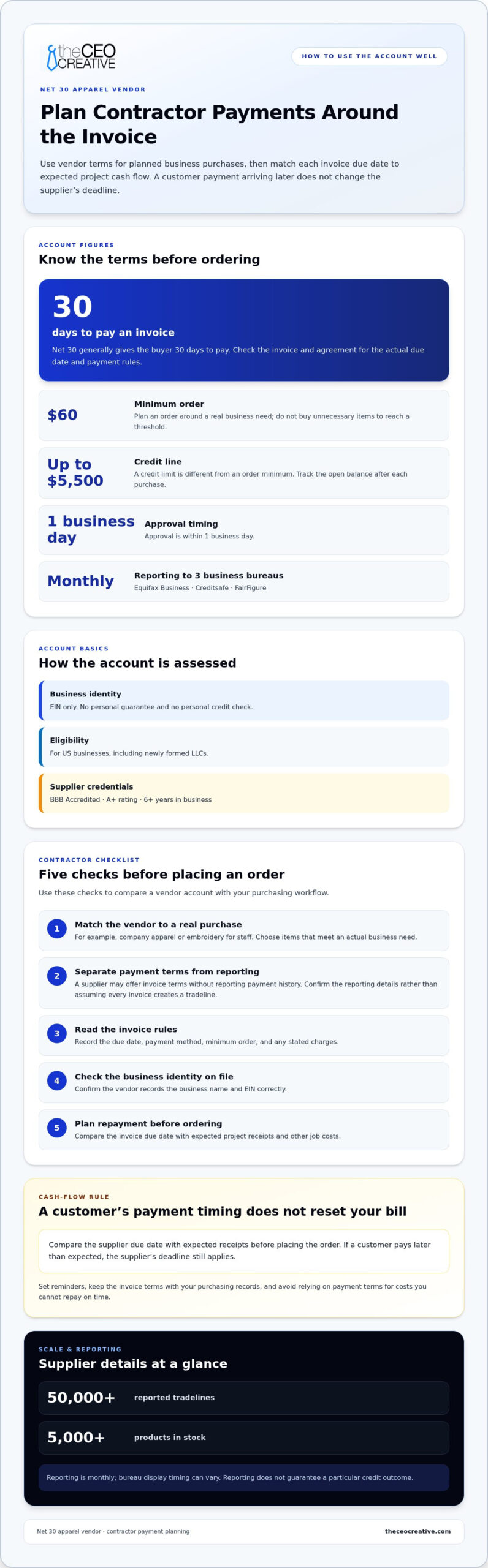
The CEO Creative offers a net 30 apparel vendor account for contractors buying company apparel as a planned business expense. Its options include a net 30 t-shirt supplier and net 30 embroidery supplier, which may suit businesses ordering branded clothing for their teams. The account also covers office supplies, so contractors can use one vendor relationship for eligible purchases across these categories.
The account uses an EIN only, with no personal guarantee or personal credit check. The minimum order is $60. Payments are reported monthly to Equifax Business, Creditsafe, and FairFigure. Reporting may support a business credit file, but it doesn’t guarantee a particular credit result.
Consider this option when apparel or office supplies match an actual purchasing need and the invoice fits your payment plan. Visit The CEO Creative’s net 30 apparel vendor page to review the account details.
Put Your Purchasing Plan Into Practice
Make your next step a simple purchasing policy. Decide who can place orders, how invoices enter your books, and who tracks payment status. A consistent process helps separate job purchases from general business expenses and gives your team a clearer view of upcoming obligations.
The strongest use of net 30 accounts for general contractors starts with purchases that already fit the business. Treat credit building as a longer-term practice, not a reason to order items you don’t need. Results vary, and reporting alone doesn’t guarantee a particular credit outcome.
Review the account details and consider whether this purchasing model suits your company’s next stage.
With a clear process and consistent follow-through, you can make purchasing decisions with greater confidence.
Frequently Asked Questions
What is a net 30 account for a general contractor?
For a contractor, this is a vendor purchasing arrangement, not a project loan or customer payment plan. The account applies to purchases from the supplier that opened it. For example, office materials ordered from one vendor belong in the business’s purchasing records, while lumber bought from another supplier follows that supplier’s account terms. Keep vendor accounts distinct in your books.
How can a new general contractor qualify for net 30 vendor credit?
Start by choosing a vendor that accepts businesses at your stage and reviewing its application criteria. The CEO Creative accepts US businesses, including newly formed LLCs, without a minimum time in business. Use the company’s correct legal name and EIN, and ensure the details match the business records used for the application. The account terms set the eligibility requirements.
Do net 30 accounts require a personal guarantee or credit check?
Vendors do not all use the same application terms. A personal guarantee concerns individual responsibility for an account, while a personal credit check concerns an inquiry into an individual’s credit. They are separate conditions. The CEO Creative’s account is based on the EIN only, with no personal guarantee or personal credit check. Review the account agreement to understand its requirements.
How can contractors apply for net 30 accounts step by step?
Choose a vendor for a planned business purchase, then read its eligibility and account terms. Submit the application with accurate business details. After approval, place an eligible order and save the invoice and confirmation. Record the due date, pay according to the agreement, and file the payment record. Before repeating the purchase, review the account balance and ensure the next order fits the business budget.
Does opening a vendor account automatically build business credit?
No. Opening an account alone does not guarantee a credit-file result. The vendor must report account activity, and the business’s identifying information must match its records. A contractor can support accurate reporting by using consistent business details and keeping invoices and payment confirmations. Bureau records take their own time to display reported activity, and results vary.
Can a contractor use a vendor account to pay subcontractors?
A supplier account applies to purchases from that supplier, not unrelated subcontractor invoices. For example, an apparel vendor account covers eligible apparel purchases from that vendor, not a payment owed to an electrician. Track subcontractor costs through the business’s usual accounts-payable process, and associate supplier purchases with the correct project or operating category.