


Longer payment terms don’t automatically mean healthier cash flow. Net 30 accounts for construction companies allow 30 days to pay an invoice, while Net 60 and Net 90 terms allow 60 and 90 days, respectively. The right fit depends on when project costs come due and when customer payments arrive.
That timing matters when you’re covering materials, labor, and other job costs while waiting for customer invoices to be paid. A longer payment term can give your business more time, but it still needs to fit your cash-flow plan and the terms you’ve agreed with your customers.
Learn how Net 30, Net 60, and Net 90 work, what to weigh when choosing vendor tradelines, and how to manage invoices so due dates don’t catch you off guard. This guide also explains how reporting works and why consistent, on-time payments matter when you’re building business credit. Use the details to choose terms that support your operations and establish a payment routine you can sustain.
Key Takeaways
- Compare Net 30, Net 60, and Net 90 due dates with your project expenses and expected customer payments before choosing terms.
- Start with a manageable number of vendor tradelines and keep each invoice’s due date visible in your payment schedule.
- Choose vendors whose reporting practices and purchasing categories fit your business credit goals and routine needs.
- Track invoices regularly and pay on time to manage vendor accounts responsibly.
- Review the account’s reporting bureaus and terms so you know how the tradeline may fit into your business credit-building plan.
Choosing and managing vendor tradelines
Requirements can differ for new construction businesses and sole proprietors because each vendor sets its own criteria. Net 30 accounts for construction companies should be selected by purchase fit, terms, and reporting practices, not just the length of the payment period.
Vendors Offering Net 30 Accounts
A vendor tradeline lets a business purchase eligible goods or services and pay later under agreed terms. It matters because a well-matched supplier account can support routine purchasing while recording business payment activity. Net 30 accounts for construction companies may cover office, apparel, technology, or printing needs. Start with 2-3 accounts you can track and pay reliably, rather than opening accounts without a clear business use.
Qualification Requirements for Construction Businesses
Qualification requirements are the vendor’s criteria for approving an account, and they vary by supplier. Business age, legal structure, credit history, and payment records may be considered, but no single score threshold or time-in-business rule applies to every vendor. A new LLC or sole proprietor should review each supplier’s stated criteria and submit accurate business information. Revenue alone does not determine approval.
Applying for Vendor Net 30 Accounts
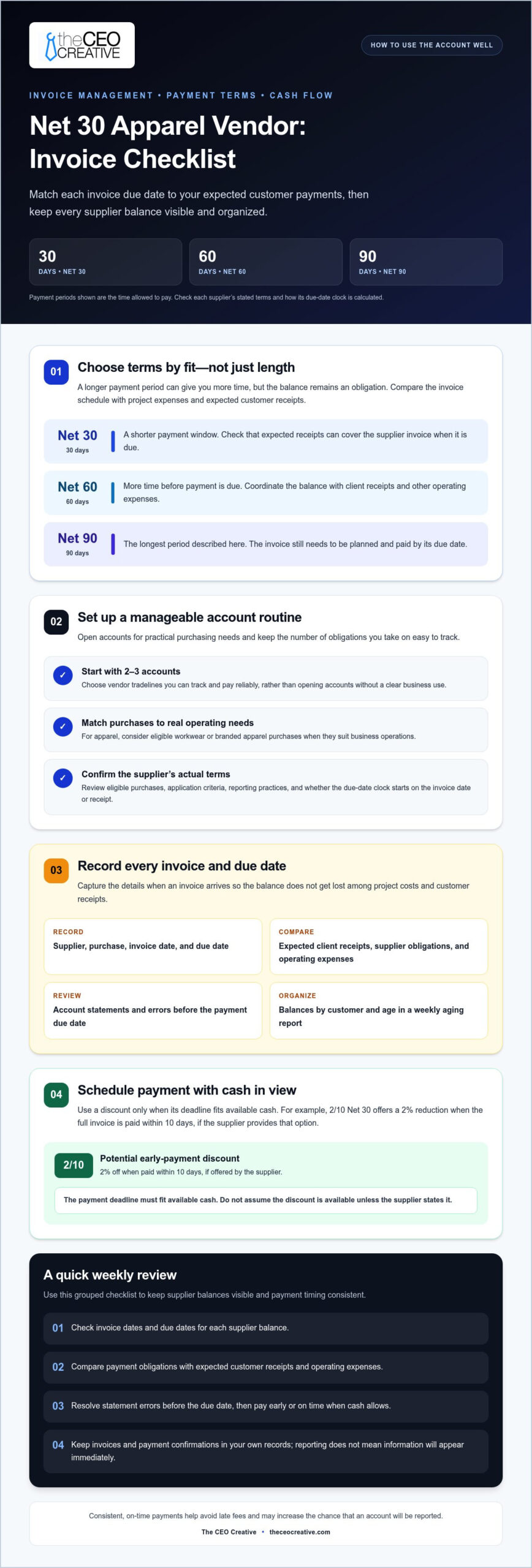
Applying means providing business information for a supplier to assess before extending payment terms. Prepare consistent details, including the legal business name, address, ownership structure, and tax identification information. Before purchasing, record the approved terms, invoice date, due date, and any discount conditions. For example, 2/10 Net 30 offers a 2% reduction when the full invoice is paid within 10 days, if the supplier provides that option.
Managing Invoices, Terms, and Cash Flow
Invoice management means tracking supplier balances against due dates and available cash. Net 60 gives a construction buyer 60 days to pay after the invoice date; Net 90 gives 90 days. Longer terms may help coordinate supplier payments with client receipts, but they remain obligations. Use a weekly aging report to organize balances by customer and age, then schedule payments to avoid late fees.
- Record each invoice’s supplier, purchase, invoice date, and due date.
- Compare expected client receipts with supplier obligations and operating expenses.
- Pay early or on time to maintain a clear payment history and support reporting.
- Review account statements and resolve errors before the due date.
- Use a discount only when its payment deadline fits available cash.
Paying invoices early or on time helps avoid late fees and may increase the chance that an account will be reported. Keep payment timing consistent across supplier accounts, and continue tracking balances against their due dates.
Which vendors offer Net 30 accounts to construction businesses?
Construction businesses can look for Net 30 terms from suppliers serving routine business needs, including office supplies, apparel, technology, and printed materials. These purchases differ from project-specific costs, so assess each account by what it lets your business buy and whether those purchases fit its operations. A vendor tradeline is most useful when the order is practical and the payment schedule fits expected cash flow.
Compare vendor accounts by their payment period, eligible purchases, application criteria, and credit-reporting practices. Net 30 generally gives a business 30 days to pay; Net 60 and Net 90 provide longer periods. The invoice terms matter more than the label alone. Check whether the stated clock starts on the invoice date or receipt, and record the due date when the invoice arrives.
Construction buyers may also use suppliers with project-related terms, but those arrangements can differ from standard vendor tradelines. A materials supplier’s invoice may follow a job schedule, while an office-supply account can cover recurring administrative purchases. Keep these obligations distinct in your records. This makes it easier to see which purchases support a job and which contribute to a consistent business payment history.
- Office suppliers: Consider recurring administrative purchases and confirm which items qualify for terms.
- Apparel suppliers: Use eligible workwear or branded apparel purchases when they suit business operations.
- Technology suppliers: Review account terms for eligible business technology purchases.
- Print and promotional suppliers: Match orders to actual business needs, such as client-facing materials.
Reporting deserves its own comparison. Business credit bureaus include Dun & Bradstreet, Experian Business, and Equifax Business, but vendors choose their reporting practices. Ask which bureau receives account information and how often it is submitted. Reporting does not mean the information will appear immediately, so keep invoices and payment confirmations in your own records.
For example, before using terms for office supplies, a contractor can compare the invoice due date with expected customer receipts. A separate apparel purchase should have its own invoice record and payment reminder. This helps prevent treating available credit as revenue and keeps each vendor’s payment history traceable if you review your business credit file later.
Choose accounts based on fit, not simply the length of the payment period. A longer term can leave more time before payment, but the balance still becomes an obligation. Review the vendor’s eligible purchases, reporting policy, due-date calculation, and account requirements together. If an EIN-based vendor account fits your purchasing needs, review the business Net 30 account details as one option.
What credit score or business history is needed to qualify for Net 30?
There isn’t one credit score or business-age rule that applies to every Net 30 vendor. Each supplier sets its own application criteria, which may include business identity, payment history, and credit-file details. A construction company with limited history can therefore face different requirements from an established contractor. Check the actual vendor’s criteria before applying, rather than relying on a general score threshold.
A credit score is one part of a business credit profile, not a universal pass-or-fail number. Suppliers may consider whether a business has established credit accounts and paid invoices as agreed. If a new LLC has little reporting history, a thin file may show less payment information than an established profile. Keep the business name and identifying details consistent across applications and records.
Business age can matter, but its importance varies by vendor. A newly formed construction LLC and a sole proprietor may encounter different application fields or documentation requests. Legal structure alone does not determine approval. Use the exact business identity attached to the application, and avoid mixing personal and business details unless requested. Consistent records make it easier to match invoices and payments to the right business.
Payment history also develops over time. A supplier’s reporting schedule and a bureau’s display timing are separate steps. On-time payments to Net 30 vendors may appear in a business credit score in about 90 days, but that timing isn’t a qualification rule. Before applying, identify which bureaus the vendor reports to and whether it reports account activity. A tradeline can only contribute information where it is reported and recorded.
Use these checks to assess your readiness before submitting applications:
- Review your business credit files: Look for accurate business details and existing payment history.
- Prepare consistent application information: Match the legal name, address, and business identifiers across records.
- Read each vendor’s criteria: Note any stated business-age, credit-history, or account requirements.
- Start with 2-3 accounts: Choose manageable vendor relationships rather than applying broadly at once.
- Track every invoice: Record due dates and payment confirmations to build an organized history.
A rejection from one supplier does not mean every vendor will decline an application. Criteria differ, and the decision may reflect that supplier’s policy or the information submitted. Review the application for errors, correct mismatched details, and focus on vendors whose stated requirements fit your business. For a sole proprietor, apply using the business identity the vendor accepts rather than assuming every vendor follows the same rules.
How do construction companies apply for vendor Net 30 accounts?
Apply directly through the supplier’s business-account process, then review the approved terms before placing an order. Each vendor sets its own application requirements, so prepare accurate business information and keep a copy of submitted details. For a Net 30 account, confirm when the payment period begins and how the vendor calculates the due date.
Start by matching the account to a real business purchase. A construction company might need office supplies for its project office or branded apparel for staff. Choose a supplier whose eligible purchases fit that need, then review its terms, credit-reporting policy, and application criteria before applying.
- Gather consistent business details. Use the business’s legal name, address, ownership structure, and tax identification information as applicable. Match these details across the application and business records. Inconsistent names can make account administration harder.
- Review the vendor’s criteria. Read the application instructions and note any requested information about business history, credit, or ownership. A newly formed LLC should use its current legal details rather than estimating its operating history.
- Submit the application accurately. Complete every required field and review entries before sending. Keep a copy of the application and any response for your business files. Avoid submitting duplicate applications while one is being reviewed.
- Read the approved terms. Record the credit limit, eligible purchases, invoice date, due-date rule, and payment methods. Net 30 usually refers to 30 calendar days unless the terms say otherwise. Don’t assume the payment clock starts on receipt if the supplier’s agreement uses the invoice date.
- Place an order that fits the account. Check that the purchase qualifies and stays within the available account limit. Save the order confirmation and match it to the invoice when issued.
- Set up invoice tracking. Enter the invoice amount and due date in your bookkeeping system or payment calendar. Keep the invoice and proof of payment together so each transaction has a clear record.
Before applying, decide who will manage vendor accounts and invoices. One person can maintain an account register with the supplier name, application status, approved terms, invoice dates, and payment records. For example, a project administrator can log a supplier invoice while the bookkeeper schedules payment. A shared process helps prevent purchases from being overlooked during a busy job.
After payment, retain confirmation and review the account statement for accuracy. When a vendor reports account activity, reporting may occur monthly, but bureau display can take time. Keep your records after payment, and compare reported account details with your business files when reviewing credit history.
How can contractors manage Net 30 invoices, payment terms, and cash flow
Start with a cash forecast that lists expected customer receipts alongside supplier invoices, payroll, and job costs. Payment terms create time before an invoice is due, but they do not guarantee that customer cash will arrive first. Compare each due date with the project’s billing schedule and available funds before committing to a purchase.
Use weekly aging reports to group outstanding invoices by customer and age. A report helps identify which balances are current, approaching due dates, or overdue. Add payment reminders 7, 15, and 30 days before each due date. Assign someone to review the report weekly and follow up on unpaid customer invoices before they disrupt planned supplier payments.
Construction billing can make timing harder to predict. Progress billing may trigger payments at 25%, 50%, 75%, and 100% project completion. Retainage can also delay part of a payment until project completion, subject to the contract and applicable rules. Build both items into the cash forecast instead of treating the full contract amount as available cash.
Consider a plumbing contractor’s school renovation example: the contract is $180,000 with Net 90 terms. Materials require $60,000 and labor requires $45,000 over two months, while collection doesn’t occur until month five. That gap shows why a contractor should compare project costs with payment timing before accepting long terms. Net 90 can put pressure on cash flow when job expenses arrive well before client payment.
For established commercial clients with a good payment history, Net 60 may be workable if the cash float is included in pricing. New construction customers are often better suited to shorter terms, such as Net 15 or Net 30. Avoid Net 90 unless the project margin can cover its carrying cost. The best schedule depends on cash available, billing timing, and the costs due before collection.
- Forecast weekly: List expected customer receipts beside supplier invoices and payroll obligations.
- Review aging: Use a weekly report to spot late customer balances and upcoming supplier due dates.
- Schedule reminders: Set alerts 7, 15, and 30 days before invoice due dates.
- Check project terms: Include progress billing and retainage in the forecast when they apply.
- Match term to margin: Assess whether the project can carry the cost of a longer wait for payment.
For a practical way to manage purchases on vendor terms, review the business Net 30 account.
The CEO Creative: net 30 apparel vendor
The CEO Creative offers a net 30 apparel vendor account for businesses purchasing apparel while building business credit. Construction companies can use it for eligible apparel, T-shirts, and embroidery purchases, or consider its net 30 office supplies vendor for routine administrative needs.
The account is based on an EIN, with no personal guarantee or personal credit check. Reporting is monthly to Equifax Business, Creditsafe, and FairFigure. US businesses, including newly formed LLCs, are eligible with no minimum time in business.
If these terms fit your purchasing needs, visit The CEO Creative’s net 30 apparel vendor page to learn more.
Make vendor credit part of your operating plan
Set a regular time to review purchase decisions and account records. Assign responsibility and adjust the process as workloads change. A consistent routine keeps vendor credit tied to current business needs.
Take the next step with a plan that fits your business.
Frequently Asked Questions
What are net payment terms, and how do they work?
Net payment terms set the agreed schedule for paying a supplier’s invoice. Read the account agreement and invoice together, then record the due date that applies to the purchase. If they seem inconsistent, resolve the discrepancy with the supplier before scheduling payment. Keep a copy of the applicable terms with the invoice so your accounts-payable records show why you used that date.
How do Net 30 accounts help you build business credit?
A Net 30 account can contribute business credit information when its vendor reports account activity. The account alone doesn’t establish a particular score. Reconcile each vendor statement with your bookkeeping ledger and retain payment confirmations. If a credit file later shows an unfamiliar balance or status, compare it with those records. This creates a clear audit trail for purchases and makes discrepancies easier to document.
What does Net 30 mean for construction companies?
For a contractor, Net 30 is a supplier payment arrangement to manage separately from customer billing. Assign each invoice to its project or operating expense in your books, then compare the payable schedule with job-cost records. This helps identify whether a supplier balance belongs to a specific contract, general overhead, or a purchase shared across several jobs. Clear allocation also supports more accurate project reviews.
What fees, interest, or late-payment charges apply to Net 30 accounts?
Before ordering, review the vendor agreement and invoice for interest, late-payment charges, administrative fees, or early-payment discounts. The terms for that account govern; they are not universal across suppliers. Add relevant charge conditions to your accounts-payable notes and retain the terms that applied when you placed the order. This gives your team a reference if an invoice amount needs review.
Do Net 30 vendors report payments to business credit bureaus?
Some Net 30 vendors report payment activity, while others don’t. Practices can differ by vendor and bureau, so review the account’s reporting terms. Keep invoices and payment confirmations in your own records as well. If a bureau file doesn’t match those documents, use them to identify the account entry and support a correction request. This recordkeeping helps distinguish a reporting discrepancy from an invoice or bookkeeping error.
What should a contractor do if a supplier invoice appears incorrect?
Before entering an invoice for payment, compare it with the purchase order, delivery record, and any approved changes. Note specific differences, such as a mismatched quantity or an unrecognized charge, and keep the supporting documents together. Record the resolution in your bookkeeping system. A consistent review process helps prevent disputed amounts from being mistaken for ordinary project costs or recurring supplier expenses.