

Finding capital can take more than one route.
It’s reasonable to want more than a list of programs. The right resource depends on what your business needs, whether that’s working capital, financing guidance, or help pursuing federal contracts.
This article explains how to explore SBA options and find support through SBDCs and other minority-business resources. You’ll also learn how vendor accounts with Net 30 terms can fit into a broader effort to establish business credit, and what to consider before choosing a path.
Key Takeaways
- Separate funding for operating costs from credit-building vendor accounts, then explore SBA, SBDC, and CDFI resources that fit your business needs.
- See how apparel, T-shirt, and embroidery purchases can be ordered through a Net 30 vendor account.
- Learn the account sequence: apply with an EIN, place an eligible order, pay according to terms, and track monthly reporting.
- Know which business credit bureaus receive reports: Equifax Business, Creditsafe, and FairFigure.
- Use a practical checklist to keep account details, payments, and reporting records organized without assuming a particular credit outcome.
Other Credit Resources for Minority-Owned Businesses
Minority-owned businesses can use reporting vendor accounts as one tool for building business credit. A vendor account is for purchases made on terms and paid under an account agreement; it is not a loan or other financing.
Vendor Accounts and Financing
Financing provides funds under terms set by a lender. A reporting vendor account instead connects purchases from a supplier with payment terms and account reporting. These serve different purposes, so consider whether your business needs financing or a vendor relationship that can report payment activity.
Before opening a vendor account, review what can be ordered, the payment terms, and how the vendor reports account information. When evaluating business credit resources for minority-owned businesses, distinguish financing for operating costs from vendor accounts used for purchases and credit-building activity.
Vendor Account Eligibility and Setup
Vendor account eligibility and application requirements depend on the supplier. Review the account terms and the business information requested before applying. Minority ownership alone does not establish eligibility for every vendor account.
State programs may set specific criteria for their services. For a reporting vendor account, check whether your business meets the supplier’s stated eligibility requirements and understand the account terms before placing an order.
Building a Strong Business Credit Profile
Start by organizing business finances and paying obligations according to their terms. Track business expenses separately, maintain accurate records, and review business credit reports for account information. SBDCs can provide business assistance and guidance as owners consider ways to build business credit.
A reporting vendor account is distinct from financing: purchases are made on terms, then paid under the account agreement. Explore EIN-only Net 30 vendor accounts as one possible credit-building tool. Read the full terms before sharing business information or placing an order.
Certifications and Registrations
Certification can support access to contracting opportunities, but it does not guarantee financing. The MBE criteria described for certification include at least 51 percent ownership and control by members of a presumed disadvantaged group. Requirements differ among programs, so identify the certification relevant to the contracts your business seeks.
The SBA 8(a) Business Development Program aims to award at least 5 percent of federal contracting dollars each year to small disadvantaged businesses. SBA 7(a), Microloan, and Community Advantage programs are separate financing options. Business credit resources for minority-owned businesses can include business development support from SBDCs and reporting vendor accounts.
What You Can Order on Net 30 Terms
A Net 30 apparel vendor lets a business purchase eligible apparel on account terms rather than paying for the order upfront. For a minority-owned business, apparel purchases can support staff needs, events, or business use while creating an opportunity to establish a payment history with a reporting vendor.
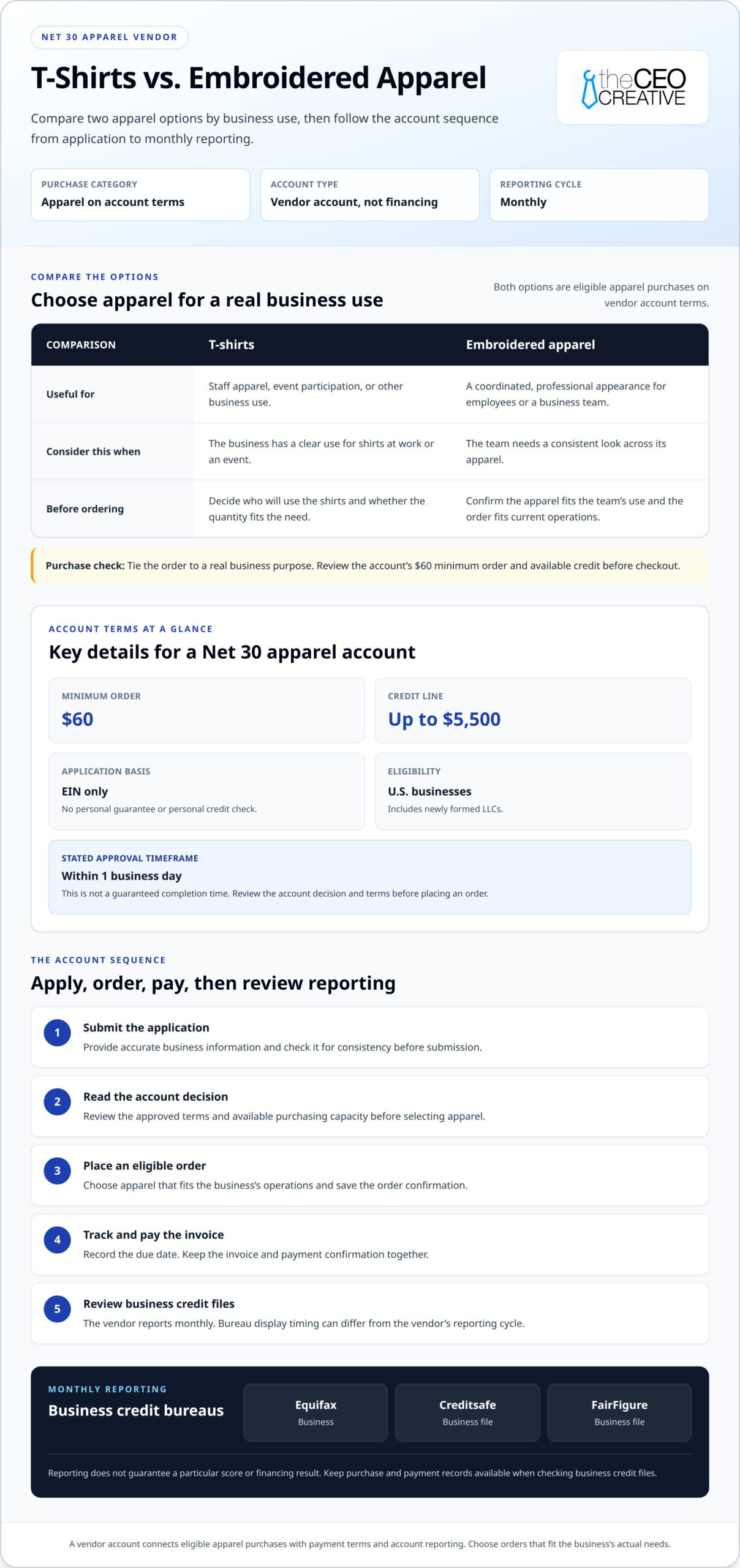
Available categories include apparel, T-shirts, and embroidery. The right choice depends on how the business will use the items. A T-shirt order may suit staff wear or a community event, while embroidered apparel can provide a coordinated look for employees or a business team. The Net 30 apparel vendor category brings these needs within a vendor-account context.
- T-shirts: Consider them for staff apparel, event participation, or business use.
- Embroidered apparel: Use this option when a business wants a consistent, professional appearance across a team.
Tie each purchase to a real business purpose. Before ordering, decide who will use the apparel, how it fits current operations, and whether the quantity meets the need. This helps distinguish a useful operating purchase from an order that could strain cash flow. Review the account’s order minimum and available credit before checkout, and follow the account agreement’s terms for eligible apparel purchases.
A Net 30 vendor account is not a loan. It connects apparel purchases to payment terms and, where the vendor reports, may contribute account activity to a business credit file. Reporting does not guarantee a particular score or financing result. Choose apparel the business can use, keep order records with the invoice, and follow the payment terms described in the account.
How the Net 30 Account Works
A vendor account follows a practical sequence: apply, review the account decision, make an eligible purchase, pay the invoice according to its terms, and keep the records organized. Minority-owned businesses can consider this option alongside other financing and business-development resources.
During application review, the business provides requested information and receives an account decision. The stated approval timeframe is 1 business day, but it is not a guaranteed completion time. Before ordering, review the account terms and the available credit shown with the decision. Keep the purchase aligned with an actual business need.
- Submit the application. Enter accurate business information and review it for consistency before sending it for consideration.
- Read the account decision. Understand the approved terms and available purchasing capacity before selecting items.
- Place an eligible order. Choose a purchase that fits the business’s operations and the account’s terms. Save the order confirmation.
- Track and pay the invoice. Record the due date in the business’s bookkeeping process. Retain the invoice and payment confirmation together.
- Review account reporting before repeating. Keep purchase and payment documents available when monitoring business credit files. Bureau display timing can differ from the vendor’s reporting cycle.
Business credit resources for minority-owned businesses can include financing programs, SBDC support, and vendor accounts, each serving a different purpose. A vendor account records purchases and payments under its terms; it is not a loan. Choose the resource based on whether you need to make an operating purchase, obtain financing, or get guidance.
Consistent records make it easier to follow the account from order to payment and identify discrepancies in later reviews. Keep applications, confirmations, invoices, and payment receipts together. As part of a broader plan, business credit resources for minority-owned businesses should be assessed by how each one fits current operations, cash flow, and longer-term credit-building goals. Review the business Net 30 account terms as you consider whether this account structure suits the business.
Which Business Credit Bureaus Receive Reports
The account reports to Equifax Business, Creditsafe, and FairFigure. These are the three business credit bureaus to include when reviewing account information. Check each file separately, since information in one bureau’s record does not establish what appears in another.
A vendor’s report and its appearance in a bureau file are separate steps. Each bureau maintains its own records and display process. Keep invoices and payment confirmations so you can compare bureau entries with your account history.
- Equifax Business: Review the business file for account information associated with your company. Keep relevant invoices and payment records on hand when checking entries.
- Creditsafe: Compare the business details and account activity in this file with the records maintained for your purchases and payments.
- FairFigure: Review this file independently as well. Use the same supporting business records to assess whether the account details align.
Consistent business details make account records easier to recognize. Keep the business name and identifying information aligned across applications, orders, and bookkeeping. If an entry seems inconsistent, gather the related invoice, payment confirmation, and account details before following the bureau’s process for addressing it.
Do not assume all three files will look identical or update at the same time. A bureau may display information differently from another, and each has its own file-review process. Organize records by transaction so you can identify the purchase or payment behind an entry. This also helps distinguish an account-reporting question from a difference in the business information on file. Regular file reviews provide a clearer view of recorded account activity, but do not guarantee a particular credit score, lending decision, or financing result.
Checklist: Steps to Use a Net 30 Vendor Account
Follow a consistent process from application through reporting. This helps organize account activity and track purchases, invoices, payments, and business credit records.
- Prepare the application details. Use the business’s EIN and enter its legal name and other requested information consistently. The account is available to US businesses, including newly formed LLCs, with no minimum time in business.
- Review the account decision. Read the approved terms and available credit line before ordering. Note the minimum order, payment due date, and any instructions that apply to eligible purchases.
- Choose a business-use purchase. Select items the business needs for operations, staff, or outreach. Keep the order within the available credit and retain the confirmation with the business’s purchasing records.
- Record the invoice details. Save the invoice and note its due date in the business’s payment calendar. Assign responsibility for payment so the invoice does not get missed during routine bookkeeping.
- Pay according to the terms. Use the payment instructions on the invoice and keep the confirmation. Match the payment to the correct order so account records remain clear and easy to review.
- Monitor business credit files. Review the relevant bureau records periodically and compare account details with saved invoices and payment confirmations. Reporting is monthly, but bureau display timing varies.
- Repeat with a planned purchase. Before placing another order, review the account balance, current business need, and payment schedule. Maintain the same business information across transactions to support orderly records.
Make this process part of the business’s bookkeeping routine. A simple folder or digital record can hold applications, order confirmations, invoices, and payment receipts. If a bureau file does not appear to match your records, organize the supporting documents and follow the bureau’s stated process for addressing file questions. Timely payments and accurate records support responsible account management, but do not guarantee a particular credit score, financing decision, or reporting outcome.
Common Mistakes to Avoid
A Net 30 vendor account works best when purchases, invoices, payments, and reporting records stay connected. These common mistakes can make account management harder or lead to incorrect expectations about business credit.
- Ordering without a business purpose. Choose items the company can use for operations, staff, or outreach. An order that strains cash flow may complicate payments. Review the business need and account balance before committing to a purchase.
- Overlooking invoice terms. Don’t rely on memory or a general understanding of Net 30. Read the invoice for its due date and payment instructions, then record them in the business’s payment calendar. Keep the invoice and confirmation together.
- Using inconsistent business details. Differences in the business name or identifying information across applications, orders, and records can make account activity harder to match. Use consistent business details, and retain documents that show the information used for each transaction.
- Assuming reporting means immediate bureau display. Reporting occurs monthly, but each bureau controls when information appears in its file. Avoid treating a short delay as proof that an account was not reported. Keep records and review the relevant files over time.
- Expecting every bureau to show identical information. Equifax Business, Creditsafe, and FairFigure maintain separate records. Review each file independently instead of assuming an update in one bureau automatically appears in another. Compare entries against invoices and payment confirmations.
- Expecting a guaranteed credit result. A vendor account can create reported payment activity, but it does not promise a particular score, loan approval, or financing outcome. Treat it as one part of a broader credit profile, not a substitute for responsible cash-flow planning.
Keep an account record with application details, order confirmations, invoices, payment receipts, and bureau-review notes. If an entry seems inaccurate, gather supporting documents and follow the relevant bureau’s process. Clear records help distinguish a reporting question from a missed payment or inconsistent business detail.
The CEO Creative: Business Credit Vendor
The CEO Creative offers a business credit vendor account for businesses that want to make eligible purchases on Net 30 terms while building business credit. A minority-owned business might consider this option when it has a real need for apparel and wants vendor-account activity as one part of its credit-building approach. It is not a substitute for SBA financing or other funding for operating costs.
The account is EIN-based and does not require a personal guarantee or personal credit check. US businesses, including newly formed LLCs, are eligible without a minimum time in business. The stated approval timeframe is 1 business day; timing is not guaranteed. Consider these terms alongside the business’s cash flow and planned purchases.
Eligible categories include apparel, T-shirts, and embroidery. Assess each purchase by its purpose in your operations:
- Net 30 apparel vendor: Consider apparel for staff or business use.
- Net 30 T-shirt supplier: T-shirts may suit team wear or business events.
- Net 30 embroidery supplier: Embroidered apparel can support a coordinated staff appearance.
Choose items the business expects to use, and keep invoices and payment records organized. The account reports monthly to business credit bureaus, but reporting does not guarantee a particular score, financing decision, or outcome. Bureau display timing can vary. Treat the account as one tool in a broader plan that may include business-development support, careful recordkeeping, and financing suited to the company’s needs.
This vendor account may suit a business seeking purchases on terms rather than a loan. Review the account terms and consider whether the order supports current operations before applying. The application uses the business EIN, and purchases remain subject to the stated terms and available credit.
Contact The CEO Creative to discuss the business Net 30 account.
Frequently Asked Questions
This content is general information, not financial or legal advice. Review each program’s current requirements when considering financing or grants.
Which federal grants, loans, and credit programs support minority-owned businesses?
Federal resources include SBA financing programs and grant opportunities offered through the U.S. Department of Commerce’s Minority Business Development Agency (MBDA). MBDA grant examples include the Enterprising Women of Color Grant, the Minority Business Enterprise Inner City Innovation Hub Grant, and the Entrepreneurship Education Program for Formerly Incarcerated Persons Grant. Each program has its own purpose and eligibility criteria, so match the opportunity to your business and its needs.
Which MBDA grants are named for minority business owners?
Named MBDA opportunities include the Enterprising Women of Color Grant, the Minority Business Enterprise Inner City Innovation Hub Grant, and the Entrepreneurship Education Program for Formerly Incarcerated Persons Grant. Their titles suggest distinct aims and audiences. Read each opportunity’s eligibility rules and application instructions carefully, then assess whether its goals align with your business before preparing an application.
Where can I look for federal grant opportunities?
Grants.gov provides access to more than 1,000 federal grant programs. Use the search and program details to identify opportunities relevant to your business, then read the eligibility conditions, purpose, and application instructions. A grant listing is not an approval or a promise of funding. Focus on programs whose stated goals and applicant criteria match your business situation.
Can every minority-owned business apply for the same grants?
No. Grant and financing programs set their own eligibility criteria, and minority ownership alone does not make a business eligible for every opportunity. Some programs target particular business purposes or applicant groups. Read the full requirements before investing time in an application, and organize your response around the criteria the program lists.
What if a federal funding opportunity does not fit my business?
Consider business-development assistance through an SBA resource or a Small Business Development Center (SBDC). These resources can help owners explore options and understand program information. You can also consider state or community-based resources whose stated purposes match your needs. Evaluate each opportunity separately, since eligibility and application processes vary.
How can I assess whether a grant opportunity is relevant?
Start with the grant’s stated purpose, eligible applicants, and application requirements. Compare them with your business’s activities and funding needs. For example, an opportunity focused on a particular group or business-development goal may not suit a company seeking support for another purpose. Use the published criteria to decide whether preparing an application is a practical next step.
Which banks and credit unions offer business credit programs for minority entrepreneurs?
Community banks and credit unions, along with CDFIs and nonprofit lenders, are potential lending channels for minority entrepreneurs.
What predatory lending risks and scams should minority business owners watch for?
Be cautious of lenders that promise approval or obscure fees. Read the full terms before sharing business or financial information. Verify that an online lender is licensed to originate loans in your location and has Better Business Bureau certification.