


Post type: HOW TO USE THE ACCOUNT WELL
Table of Contents
- Vendor Credit vs. Payroll Cash Flow
- Eligible Purchases for Staffing Agencies
- How the Account Works and Reports
- Checklist and Common Mistakes
- Next Steps
Net 30 accounts for staffing agencies provide terms for eligible business purchases, not worker payroll or client receivables. The CEO Creative offers Net 30 terms on business products such as apparel, office supplies, printing, drinkware, phone accessories, and promotional items.
Staffing agencies often manage client payment cycles alongside regular payroll obligations. A vendor account has a different purpose: it lets a business purchase eligible items on invoice terms and pay according to the invoice due date. Reporting may contribute account activity to business credit files, but results vary and no particular credit outcome is guaranteed.
This article explains how to choose useful purchases, manage invoices, and understand reporting. It also gives you a practical process for fitting vendor purchases into your agency’s purchasing routine without treating them as payroll funding.
Key Takeaways
- Net 30 accounts for staffing agencies cover eligible business purchases, not worker payroll or client receivables.
- Choose products that match an actual agency need, such as office supplies, printing, apparel, or branded promotional items.
- Review the account terms and invoice due date before ordering, then record and assign responsibility for each payment.
- The account reports monthly to Equifax Business, Creditsafe, and FairFigure. Reporting does not guarantee a specific credit outcome or bureau display date.
- Use a repeatable checklist to keep purchases, invoices, and payment records organized.
Net 30 Accounts for Staffing Agencies: Vendor Credit vs. Payroll Cash Flow
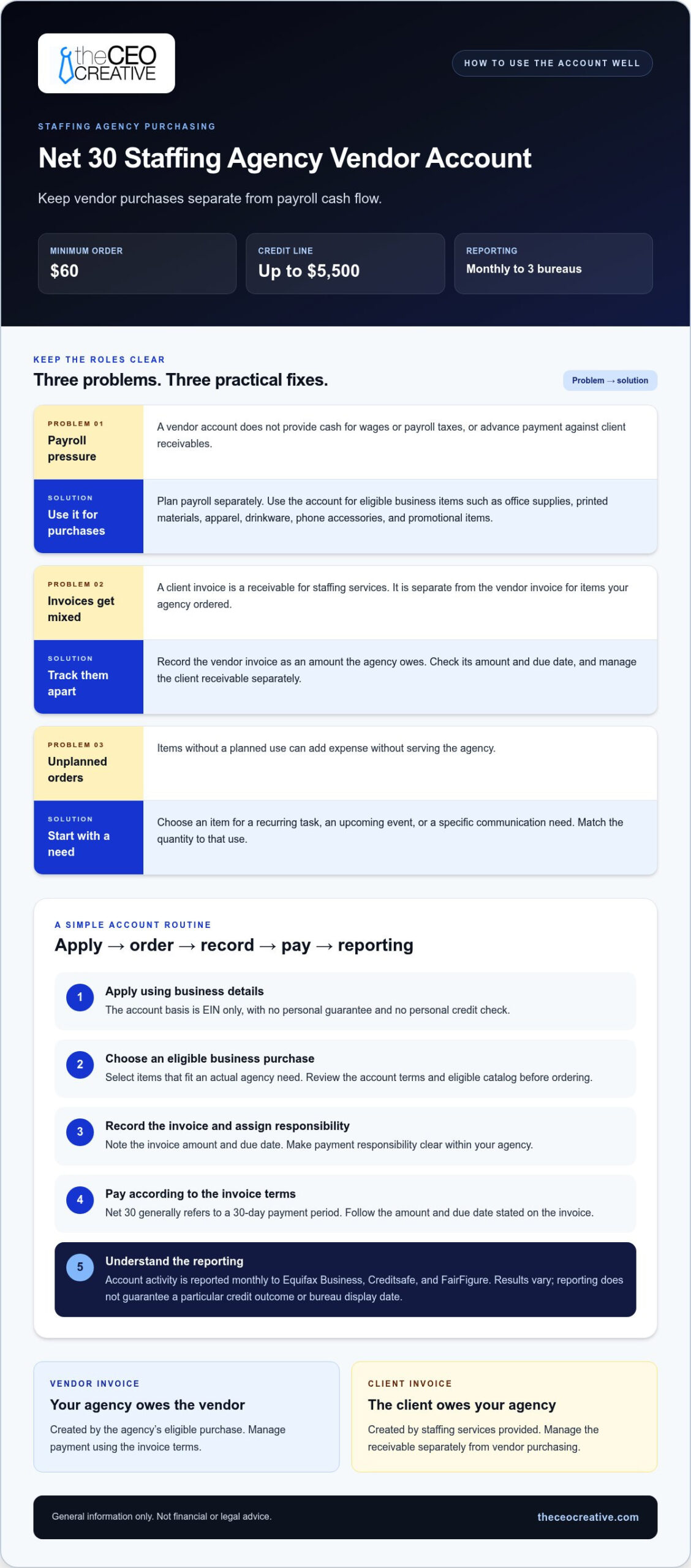
A Net 30 vendor account is for eligible business purchases, not worker payroll. For staffing agencies, it can cover useful items such as office supplies, printed materials, or branded apparel. Client payment terms, by contrast, govern when the agency expects to receive payment for staffing services.
These are separate transactions. A client invoice is a receivable for work the agency has provided. A vendor invoice is an amount the agency owes for items it ordered. Keeping the two distinct makes it easier to understand what a vendor account can do and where its limits are.
What Net 30 means for a staffing-agency vendor purchase
A Net 30 arrangement lets a business make eligible purchases on account and pay later under the invoice terms. Net 30 generally refers to a 30-day payment period. Check the account’s invoice for the amount due and payment due date, and follow the terms stated there. For background on understanding Net 30 payment terms, see the general definition of the term.
For example, an agency might order notebooks and writing supplies for administrative work. The vendor purchase creates an amount the agency owes. Separately, the agency may invoice a client for staffing services, creating an amount the client owes the agency. One invoice does not pay or settle the other.
Net 30 vendors can differ in application requirements, eligible purchases, reporting practices, and invoice terms. The Net 30 vendor comparison guide offers broader context for understanding vendor-account terms. For an account with The CEO Creative, review the account terms and eligible catalog before ordering.
Why vendor credit does not solve payroll float
Payroll is a separate operating obligation. A vendor account for eligible purchases does not provide cash for wages or payroll taxes, advance payment against client receivables, or fund payroll. It is a vendor purchasing account, not a payroll funding solution. Keep payroll planning separate from purchase planning.
Consider an agency ordering branded apparel for its team. The apparel may support team presentation, and the vendor invoice is paid according to its terms. That purchase does not change when the agency must pay workers or when a client pays an invoice. Those cash-flow dates still need to be managed separately.
This distinction matters when client payment cycles do not match the agency’s payroll schedule. A reporting vendor account can support eligible purchases and create a record of vendor payment activity, but it does not replace receivables management or dedicated payroll arrangements. Keep purchases and payroll in separate parts of your cash-flow process. This content is for general information only, not financial or legal advice.
What Staffing Agencies Can Order Through a Net 30 Vendor Account
Staffing agencies can use a reporting Net 30 vendor account for eligible catalog purchases that support day-to-day business operations. The best fit is an item your agency has a real reason to buy, not simply a product that happens to be available. Consider routine office administration, printed materials, staff apparel, or items for agency outreach. The CEO Creative has no minimum order limit, so you can base an order on your business needs rather than adding products just to reach a threshold.
Office supplies and printing for agency operations
Writing supplies, notebooks, and paper can support ordinary office tasks such as taking notes, organizing information, and preparing documents. Business cards, flyers, and brochures can support agency communications. These are practical examples, not staffing-specific inventory or a requirement to order every category.
The CEO Creative offers Net 30 office supplies and printing services, including business cards, car signs, brochures, bumper stickers, and flyers. Phone accessories are also available through the catalog. When deciding what to order, ask whether the item supports a recurring task, an upcoming event, or a specific communication need. Choose a product and quantity that fit that use, then review the invoice terms before placing the order.
Apparel and promotional products for agency branding
Apparel and customizable promotional products can support agency branding or team presentation. For example, an agency might use custom shirts for a staff event or branded items as part of business outreach. These are possible uses, not a claim that every agency needs promotional products or that every item suits every business.
Keep the purpose clear. Apparel that supports team identity may be a sensible business purchase; products without a planned use can add expense without serving the agency. Consider who will use the item, where it will be used, and whether the design fits your agency’s brand. The CEO Creative’s catalog includes customizable apparel, drinkware, headwear, office items, and other promotional products, as well as logo design services.
Net 30 accounts for staffing agencies can make eligible purchases across product categories through one vendor relationship. That can simplify purchasing when the items meet real business needs, but it does not make every catalog product appropriate for your agency. Match the order to a clear use and manage the invoice under its stated terms. Review the Net 30 account for eligible business purchases for account information.
How a Staffing Agency Net 30 Account Works and Reports
A reporting vendor account follows a practical sequence: apply, receive a decision, place an eligible order, pay the invoice under its terms, and repeat when another purchase makes sense. Tracking each step helps a staffing agency organize its purchasing records and understand how vendor payment activity may be reported. Reporting records account activity; it does not promise a particular credit result.
Application and ordering: what the account terms state
The account is available to U.S. businesses, including newly formed LLCs, with no minimum time in business. The application uses the business EIN, requires no personal guarantee, and does not involve a personal credit check.
Apply before planning an order around the account. After receiving a decision, review the terms, choose eligible items that suit the agency’s needs, and place an order within the approved account terms. Keep the order confirmation and invoice together so your team can reconcile the purchase and track the payable. The reporting Net 30 business account page provides account and application details.
Use this order of operations to manage the account:
- Submit the business application using the EIN.
- Review the decision and the terms that apply to the account.
- Choose and place an eligible order that fits the account terms.
- Record the invoice amount and due date in the agency’s payable tracking process.
- Pay according to the invoice terms, then consider another eligible purchase when it fits the agency’s needs.
Payment and monthly bureau reporting
Pay each invoice according to its stated terms. Record the due date when the invoice arrives, assign responsibility for payment, and retain proof of payment with the order records. This routine helps prevent an invoice from being overlooked among other agency expenses.
The account reports monthly to Equifax Business, Creditsafe, and FairFigure. Monthly reporting does not guarantee when information will appear in a bureau file. Each bureau controls how and when submitted information is displayed, so there is no promised appearance date. Reporting also does not guarantee approval for other credit, display of a tradeline, or a change to a business credit score. Results vary.
Manage the account as both a purchasing relationship and a payable: order for a business need, follow the invoice terms, and keep clear records. This information is for general purposes only and is not financial or legal advice.
Staffing Agency Net 30 Account Checklist and Common Mistakes
A short review before applying or ordering can keep a vendor account aligned with your agency’s actual needs. Use the checklist to confirm the purchase fits, understand the invoice obligation, and keep records accessible. The account is for eligible business purchases, so evaluate it separately from payroll and client receivables.
A practical checklist before using the account
Work through these steps before submitting an application or placing an order. They help your team make a clear purchasing decision and track the account consistently.
- Identify the business need. Choose an eligible purchase that supports agency operations, such as office supplies, printing, apparel, or promotional products. Do not order items simply to create account activity.
- Review the account terms. The credit line is up to $5,500 per account. Confirm that the intended purchase fits within the approved account terms.
- Check the invoice details. Note the amount due and payment deadline shown on the invoice. Use those stated terms to schedule payment.
- Assign recordkeeping. Keep the application, order confirmation, invoice, and payment record together in the agency’s accounting process. Make sure the person responsible for payment can find the due date.
- Separate purchase planning from payroll planning. Treat the vendor invoice as a payable for ordered items, not as cash available for wages or payroll taxes.
Common mistakes that can create confusion
Small process errors can lead to misunderstandings about what the account is for and what its reporting means. Keep these distinctions clear:
- Using vendor credit as payroll funding. An account for eligible purchases does not fund wages, payroll taxes, or client receivables. Do not build payroll plans around it.
- Missing an invoice due date. Assuming someone else will handle payment can leave an invoice untracked. Record the deadline and assign responsibility when the invoice arrives.
- Expecting guaranteed credit results. Monthly reporting does not promise approval elsewhere, a particular score change, or a specific date when a bureau will display account activity. Results vary.
- Ordering without a business purpose. An available catalog item is not automatically a useful purchase. Choose products your agency can put to a clear business use.
- Expecting reporting beyond the stated bureaus. Reporting is monthly to Equifax Business, Creditsafe, and FairFigure. Do not plan on reporting to other bureaus through this account.
For net 30 accounts for staffing agencies, sound account management starts with a suitable purchase, a recorded invoice deadline, and realistic expectations about reporting. Review the terms before each order and keep the purchase file complete. This information is general and is not financial or legal advice.
Take the Next Step with a Net 30 Account for Your Staffing Agency
A reporting Net 30 vendor account may fit a staffing agency that has eligible business purchases to make and wants vendor payment activity reported. The CEO Creative offers eligible products such as office supplies, apparel, printing, drinkware, phone accessories, and promotional products. The account is for purchases, not payroll or client receivables, so consider it as part of purchasing and payables management.
When this vendor account fits an agency’s purchasing plan
Start with a purchase your agency already needs. The account offers a credit line of up to $5,500. The application uses the business EIN, with no personal guarantee or personal credit check. U.S. businesses, including newly formed LLCs, are eligible, with no minimum time in business.
After an order, follow its invoice terms and keep the due date in your accounts-payable process. The account reports monthly to Equifax Business, Creditsafe, and FairFigure. Monthly reporting does not guarantee when information will appear in a bureau file or whether your business credit profile will change. Results vary, and approval is not automatic.
Apply with the account terms in view
Before applying, make sure the account’s purpose matches your agency’s purchasing plan. Choose eligible items based on a real operating need, keep the order separate from payroll planning, and be prepared to track and pay each invoice under its stated terms. This helps your team understand the account’s purpose and manage its responsibilities without expecting it to fund wages or client receivables.
Net 30 accounts for staffing agencies can provide a structured way to purchase eligible operating items while building a record of vendor payments. They cannot promise a credit outcome or a particular bureau display date. Read the account details and application information with those limits in mind before deciding whether it suits your business.
This content is for general information only and is not financial or legal advice.
Make Vendor Credit Part of a Clear Purchasing Plan
For a staffing agency, decide whether a reporting vendor account belongs in the purchasing process rather than treating it as a fix for every cash-flow pressure. Choose eligible items the business already has a reason to buy, and build invoice tracking into the same routine used for other payables. This gives your team a clear way to manage the account while keeping payroll planning separate.
Net 30 accounts for staffing agencies can support eligible business purchases and contribute to a record of vendor payment activity, but approval and credit outcomes are not guaranteed. Results vary, and bureau display timing is outside the account’s control. Review the account terms with your agency’s purchasing needs in mind before applying. This information is not financial or legal advice.
A deliberate purchasing process helps your agency make informed choices as it grows. Take the next step when the account fits your operating plan.
Frequently Asked Questions
Can a staffing agency use a Net 30 vendor account to pay employees?
No. A vendor account is for eligible purchases from the vendor, not wages or payroll taxes. For example, an agency might use it for office supplies or printing, then pay that vendor invoice under its terms. Payroll obligations and client receivables remain separate parts of the agency’s cash-flow plan. Do not count on vendor purchasing terms to make funds available for employee paydays.
Does a Net 30 vendor account guarantee that a staffing agency will build business credit?
No. A reporting account can provide payment information to business credit bureaus, but it cannot guarantee a particular credit profile, score change, or future approval. Results vary. Use the account for legitimate business purchases and pay invoices according to their terms, while treating credit reporting as one part of your broader business credit history. Do not assume one account will determine your overall profile.
How long does it take for a new Net 30 tradeline to appear on a business credit report?
There is no guaranteed display date. The account reports monthly, but each bureau controls when submitted information appears in its records. A delay in seeing an account does not by itself establish why it has not appeared. Keep your order and payment records available, and review the relevant bureau file over time. Do not plan a financing decision around a specific tradeline appearance date.
What happens if a staffing agency misses a Net 30 invoice due date?
The invoice remains an outstanding payable, and the agency should address it promptly under the account’s terms. Review the invoice and payment records, then follow the stated process for handling an overdue balance. Do not assume a specific fee, reporting effect, or grace period unless it appears in the applicable terms. Assigning an invoice owner and recording due dates can help prevent missed payments.
Can a newly formed staffing-agency LLC apply for a Net 30 account?
Yes. U.S. businesses, including newly formed LLCs, are eligible, and there is no minimum time in business. The application uses the business EIN. Before applying, have the agency’s business information ready and make sure the planned purchase is for an eligible business need. Eligibility does not mean approval is automatic.
Does a staffing agency need a personal guarantee for this Net 30 account?
No personal guarantee is required, and the application uses the business EIN without a personal credit check. The agency still needs to manage its purchases and pay invoices according to their terms. Review the account requirements before applying so the business understands its obligations.
Which business credit bureaus receive the account’s monthly reporting?
Monthly submission does not control how quickly information appears in a bureau file, and it does not guarantee a credit result. If you monitor business credit, keep the account’s invoices and payment records organized so you can compare your records with information that later appears.
What should a staffing agency check before placing its first Net 30 order?
Confirm that the items are eligible and useful to the agency, then check the available account credit and invoice payment terms. Make sure the purchase is separate from payroll planning and that someone is responsible for recording its due date. Save the order confirmation, invoice, and payment record together. These steps help the agency manage the purchase and payable without assuming a credit outcome.