


Post type: NET 30 hair salon vendor.
Net 30 accounts for hair salons can connect eligible business purchases with reported payment activity. The CEO Creative offers Net 30 vendor accounts alongside customizable apparel, drinkware, and stationery, so salon owners can consider products that support branding or administration.
This article explains what kinds of purchases may fit, how to manage an account, and what to consider before ordering. Reporting does not guarantee a score change, and results vary.
Table of contents:
- What a Net 30 Hair Salon Vendor Account Can Do
- How the Hair Salon Net 30 Account Works
- Assessing Whether This Net 30 Vendor Fits Your Salon
- A Hair Salon Owner’s Net 30 Account Checklist
- Start With a Net 30 Account That Fits Your Salon
- Frequently Asked Questions
Key Takeaways
- Choose products that address a real salon need, such as branded apparel, promotional drinkware, or stationery for administration.
- Manage the account in sequence: apply, place an eligible order, review the invoice, pay according to its terms, and order again only when there is a business need.
- A Net 30 account can contribute reported payment activity to a business credit profile, but it does not guarantee a score change or a particular bureau display timeline.
- Before ordering, organize your business information, identify a useful purchase, and make sure you understand the invoice terms.
What a Net 30 Hair Salon Vendor Account Can Do
A Net 30 vendor account lets a business purchase eligible products from a vendor and pay according to the invoice terms. It is a purchasing arrangement, not a loan or credit card. For a hair salon, the account is most useful when the order serves an existing branding or administrative need and the business can manage the payment obligation.
Net 30 generally refers to an invoice payment term, but the due date stated on the invoice is the one to follow. For more context on understanding Net 30 payment terms, consider how the invoice date and due date fit your cash-flow plan. Vendor tradeline reporting can support business credit-building activity, but it cannot guarantee a score increase. Results vary, and a bureau’s display timing is not guaranteed.
Which salon purchases may fit the account?
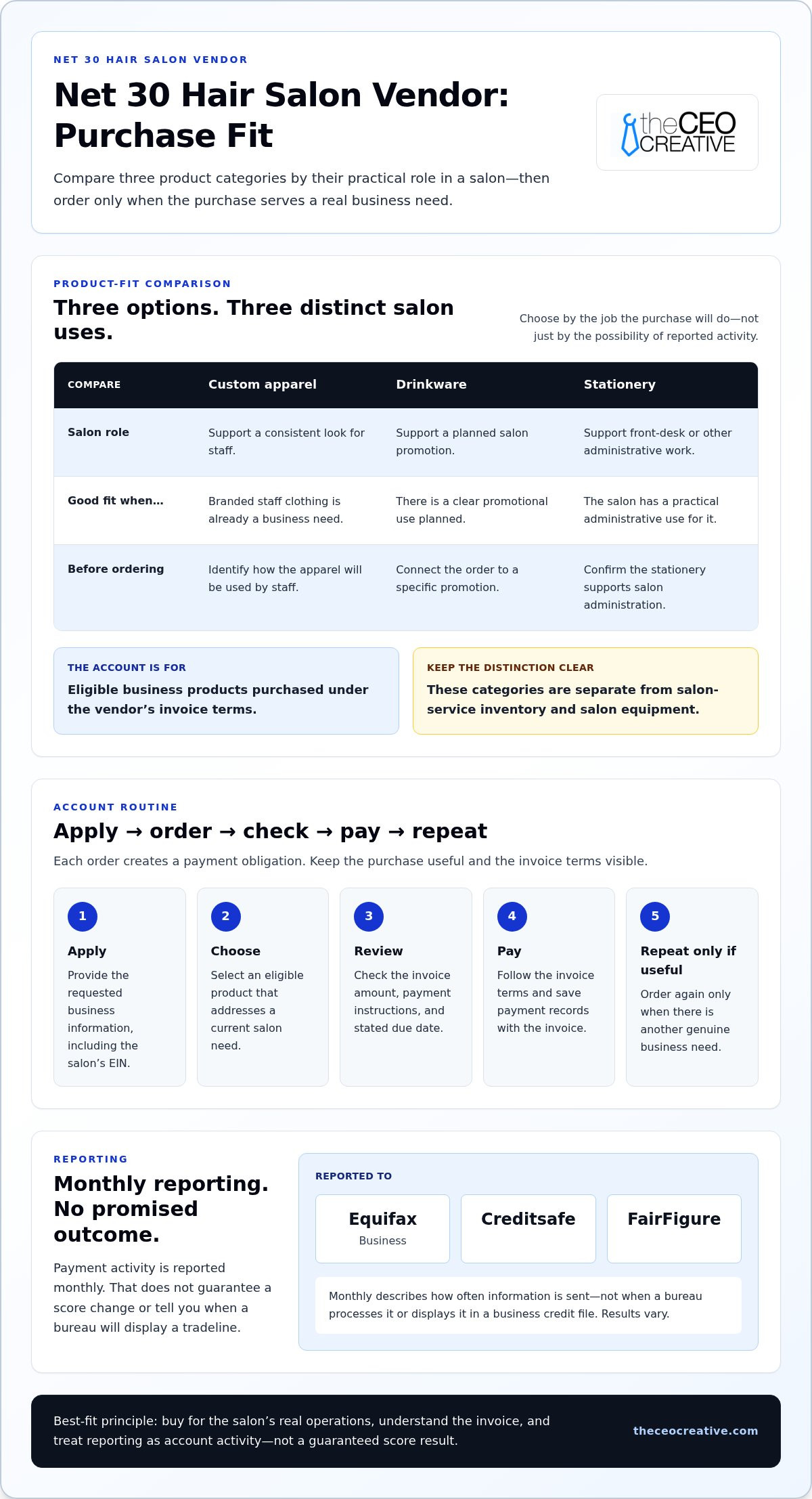
Start with the products your salon already needs. Custom apparel can help create a consistent look for staff. Drinkware may suit a planned promotion, and stationery can support front-desk or other administrative work. These are practical uses for business products, not a reason to order items that would otherwise go unused.
The CEO Creative offers customizable apparel, drinkware, and stationery. These product categories are distinct from salon-service inventory or salon equipment. If your salon is planning branded staff clothing, explore the Net 30 apparel vendor category. Choose a product based on its use in your business, not solely on the possibility of establishing a tradeline.
What the account terms mean for a salon
The CEO Creative provides Net 30 vendor accounts and tradeline reporting using a business’s EIN. The account is intended to help businesses establish a corporate credit profile without relying on personal credit lines. It remains a business payment obligation, so consider the planned purchase and your ability to pay before placing an order.
An EIN-based vendor account is different from a personal credit product. It does not remove the need to manage the invoice responsibly. Review the invoice terms, make a note of the due date, and plan how the salon will pay. This type of account is for eligible business purchases, not salon-equipment financing.
Used thoughtfully, net 30 accounts for hair salons can connect relevant purchases with reported business payment activity. The practical value lies in buying products that serve the salon, understanding the invoice, and paying according to its terms. Reporting may contribute to a business credit file, but it does not determine a particular score outcome.
How the Hair Salon Net 30 Account Works
The process is straightforward: apply, place an eligible order, review the invoice, pay according to its due date, and repeat when another purchase makes sense. Each order creates a payment obligation. Keeping purchase and payment records together makes it easier to manage the account and understand its activity.
From application to repeat purchasing
- Apply. Provide the business information requested as part of the account application, including the salon’s EIN. Keep the details consistent with your business records.
- Place an eligible order. Choose a product that fits the account and addresses a current salon need. Do not order solely to create credit activity.
- Review the invoice. Check the amount, payment instructions, and stated due date. Save the invoice with your business records.
- Pay, then repeat responsibly. Follow the invoice terms. Place another order only when it serves a genuine business purpose and the salon can manage the payment.
Deferring payment can affect the timing of a business purchase and its cash outflow. The SBA’s discussion of conserving cash flow with Net 30 provides useful context. A payment term does not replace a plan for paying each invoice on time.
What monthly bureau reporting does, and doesn’t, mean
Reported payment activity is sent monthly to Equifax Business, Creditsafe, and FairFigure. Monthly reporting describes how often information is sent. It does not promise when a bureau will process the information or display a tradeline in a business credit file. Bureau display timing varies, so an account may not appear immediately after a payment or reporting cycle.
Reporting does not guarantee a score result. A reported account is one part of a business credit profile, not a prediction of how a bureau or future reviewer will assess the business. Keep invoices and payment records, and review the relevant business files over time.
Use net 30 accounts for hair salons as a measured purchasing and payment routine. Order for a business reason, follow the invoice terms, and treat reporting as a record of account activity rather than a promised score change. Organized records help you track the account and understand what has been purchased and paid.
Assessing Whether This Net 30 Vendor Fits Your Salon
Start with the salon’s planned purchases, not the credit-building goal. Compare those needs with the account’s apparel, drinkware, and stationery categories. Then assess the invoice terms and reporting. Separating these questions helps you decide based on the salon’s operations rather than assuming that opening an account will produce a specific credit outcome.
Match account purchases to salon operations
Identify a purchase you already expect to make. If branded staff clothing supports your salon’s presentation, explore the Net 30 apparel vendor category. Drinkware or stationery may also fit when there is a clear business or promotional use. For example, stationery could support front-desk administration, while drinkware could be included in a planned promotion.
Keep the product categories in perspective. This account is for business products, not salon-service inventory. Do not assume that salon tools, hair color, or other products outside the stated categories qualify. Before ordering, identify who will use the item and how it supports the salon. If you cannot name a practical use, it may not be the right purchase.
Consider the full order and payment obligation before buying. If the order would include products the salon does not need, reconsider it. A credit-building goal is not a good reason to stretch a purchase beyond the business’s actual requirements.
Compare the account with your credit-building plan
Evaluate purchase fit, payment terms, and reporting separately. First, ask whether the salon would make the purchase without a credit-building goal. Next, review the invoice terms and due date against your cash-flow plan. Finally, consider whether the account’s reporting is relevant to the business credit files you intend to develop. These are separate decision points.
Net 30 accounts for hair salons can form one part of a broader business credit plan, but reported payment activity does not guarantee a score increase or a specific timeline for bureau display. Do not base an order on an assumed score change. Make sure the product and payment obligation make sense for the salon on their own.
When comparing vendor accounts, focus on the eligible product categories, payment terms, and reporting details. Do not treat a larger credit line or more frequent purchasing as a goal in itself. Choose an account when its products fit a real salon purchase and the business can manage the invoice.
A Hair Salon Owner’s Net 30 Account Checklist
A short review before applying and ordering can keep a vendor account aligned with salon operations. Use this checklist to confirm that the purchase is useful, the business details are ready, and the invoice fits your payment plan.
Before the first order
- Check your business details. Have the salon’s EIN and business information ready. Use consistent details and keep a record of what you submit.
- Choose a useful eligible purchase. Identify a genuine business need in the account’s apparel, drinkware, or stationery categories. Do not select a product just to create payment activity.
- Review the order before submitting it. Check that the products support the salon’s needs and that the order does not include items you would not otherwise use.
- Read the invoice terms. Note the amount due, payment instructions, and due date. Plan payment around the stated date and the salon’s available cash flow.
- Keep transaction records. Save the order details, invoice, due date, and payment confirmation with your business documents. This makes it easier to track each purchase and payment.
Common mistakes to avoid
Good account management depends on routine decisions, not on ordering frequently. Avoid these missteps:
- Buying without a business need. An unnecessary order creates a payment obligation without adding practical value to salon operations.
- Choosing products only for credit activity. Select items the salon can use, even if the account also supports credit-building activity.
- Overlooking the invoice due date. Record the due date when each invoice arrives. Do not rely on memory or assume every invoice follows the same schedule.
- Expecting a guaranteed score increase. Reporting records account activity, but it does not promise a specific credit-score result. Results vary.
- Expecting instant bureau display. Reporting frequency and bureau display timing are different. A tradeline may not appear immediately after payment or a reporting cycle.
Review the checklist before each order, not only when opening the account. A quick check helps distinguish useful purchases from credit-building-only spending and keeps invoice records complete. Net 30 accounts for hair salons work best as part of a broader, responsible business credit plan, with each purchase tied to a genuine need and each invoice handled according to its terms.
For an overview of the account, see The CEO Creative’s business Net 30 account.
Start With a Net 30 Account That Fits Your Salon
A salon may find a Net 30 vendor account useful when planned purchases fit the available business-product categories and the business can manage the invoice terms. The CEO Creative’s account supports business credit-building through EIN-based vendor purchasing and tradeline reporting. Make the decision around relevant products and responsible payment, not an assumed credit outcome.
The product fit for a salon may include apparel for staff branding, drinkware, or stationery for business or promotional use. These categories can support presentation and administration. They are distinct from salon-service inventory and equipment, so plan orders around products that fit the account and serve the salon.
Payment activity is reported monthly to Equifax Business, Creditsafe, and FairFigure. Reporting is one part of a broader business credit profile. Results vary, and bureau display timing is not guaranteed. A report being sent does not guarantee that a tradeline will appear immediately or that a score will change by a particular amount. Keep the account’s role in perspective and manage business obligations responsibly.
What to keep in mind before applying
Before applying, match a real salon purchase to the account’s product categories and make sure the invoice terms work with your cash-flow plan. Then consider how reported vendor activity fits into the rest of your business credit-building efforts. An account can contribute payment history, but it cannot guarantee a particular result.
This article provides general information and is not financial or legal advice. Consider your salon’s needs and ability to meet the account terms before applying or placing an order.
Take the next step
If the account’s products and terms suit your salon, review the details and apply using your business information. Choose an order because it serves the business, and keep the invoice terms and payment plan clear from the start.
Make each purchase with purpose, manage the payment obligation carefully, and keep your salon’s business records organized.
Build a Responsible Next Step for Your Salon
Choosing among net 30 accounts for hair salons is less about opening another account and more about setting a purchase-and-payment routine your business can sustain. Start with a genuine salon need, keep invoice details organized, and make decisions based on the terms and your business priorities. Reported activity is one part of a broader credit profile, and outcomes vary.
The CEO Creative is BBB Accredited with an A+ rating and has been in business for 6+ years, with 50,000+ reported tradelines. Consider these details alongside the account’s products and terms when deciding whether it fits your salon. A measured approach can help you build sound business habits while working on your business credit profile.
Choose purchases with purpose, manage payment obligations carefully, and keep building your salon’s foundation through responsible business decisions.
Frequently Asked Questions
Does monthly reporting mean my salon’s tradeline will appear right away?
No. Sending a report and a bureau updating a business file are separate steps. If you do not see the account immediately, that does not establish whether it was reported. Keep invoices and payment confirmations, then review the relevant business files periodically. These records can help you investigate an account entry if needed.
Will a Net 30 account guarantee that my hair salon’s business credit score improves?
No. A vendor account cannot promise a specific score result. Use it as one part of a broader business credit plan, not as a stand-alone measure of progress. Keep payment records and review your salon’s business credit files over time. Net 30 accounts for hair salons may support credit-building activity, but opening one account does not determine the outcome.
Can a salon use one account for both branded apparel and office purchases?
Yes, eligible purchases across business-product categories can be managed through one account. Keep records that show what each order was for, such as staff presentation or administrative use. This makes it easier to match invoices to business purchases and assess whether each order was useful. Each order remains subject to the account terms.
Should I place an order only to create a business credit tradeline?
No. A purchase should have a business purpose beyond the possibility of a tradeline. Before ordering, consider whether the item addresses an existing need and whether the salon can manage the invoice when due. If the purchase would not make sense without the credit-building goal, wait until there is an order that supports business operations.
Is a Net 30 vendor account the same as a business loan or credit card?
No. A vendor account is tied to purchases from that vendor and the invoice for those purchases. It is not cash for unrelated salon expenses. That distinction helps owners decide whether the account fits a planned business purchase or whether they are considering a different type of financial product.
Can a newly formed salon LLC apply for a Net 30 account?
Newly formed US LLCs can use EIN-based vendor accounts to work on establishing a corporate credit profile. Before applying, gather the salon’s business details and identify an appropriate purchase. Set up a way to track invoices and payments from the start so account activity stays organized as the business develops.