
Post type: HOW TO USE THE ACCOUNT WELL
Barbershops can use reporting vendor terms for purchases that support real business needs. Net 30 accounts for barbershops can connect planned branded-apparel orders with business-credit reporting, but they do not guarantee a particular credit result.
This article explains how to assess a Net 30 apparel vendor account, what to order, how the account workflow works, and how to plan purchases and payments responsibly.
Table of contents
- Why barbershops consider reporting Net 30 vendor accounts
- What a barbershop can order through a Net 30 apparel vendor
- How application, payment, and monthly reporting work
- A practical checklist and mistakes to avoid
- Consider The CEO Creative for barbershop Net 30 purchases
- Frequently Asked Questions
- Make your next purchase part of a clear plan
Key Takeaways
- Use net 30 accounts for barbershops to consider relevant branded purchases as part of a business-credit plan, not as a reason to buy items the shop does not need.
- Assess whether a Net 30 apparel vendor account fits planned purchases such as custom t-shirts or hats.
- Map out the account steps before ordering: apply, make an eligible purchase, pay by the due date, and allow time for monthly bureau reporting to appear.
- Review the $60 minimum order, credit line of up to $5,500, and monthly reporting to Equifax Business, Creditsafe, and FairFigure when assessing fit.
- Use a consistent payment and recordkeeping routine, while keeping expectations realistic. Reporting does not guarantee a particular credit outcome.
Why barbershops consider reporting Net 30 vendor accounts
Barbershops can use vendor terms for relevant business purchases, especially orders that support the shop’s brand or day-to-day operations. A reporting Net 30 vendor account lets a business purchase eligible products from a supplier and pay according to the invoice terms. The supplier reports account payment activity to business credit bureaus, where it may become part of the shop’s business-credit history.
This is a supplier purchasing account, not a loan or business credit card. Trade credit is the broader practice of a supplier allowing a customer to pay later. For background on how vendor accounts can fit into a credit-building approach, see these Net 30 vendor fundamentals.
Match account purchases to everyday shop needs
Start with products the barbershop already uses or has a clear plan to use. Branded t-shirts or hats can support staff presentation and shop promotion. Business stationery can help create a consistent look across customer-facing materials. These examples connect an apparel vendor account to branding purchases rather than specialized barber equipment.
Before ordering, identify the business purpose and how the item will be used. A purchase should make sense for the shop even without credit reporting. Buying products only to create account activity can add costs without improving the business’s operations.
Keep credit-building expectations realistic
Net 30 accounts for barbershops can be one part of an effort to establish a clear business-credit history. Keeping purchase and payment records under the business’s name helps the owner track activity separately from personal spending. It also makes it easier to review orders, invoices, due dates, and payments as part of routine bookkeeping.
Reporting does not mean an instant change to a bureau file. Vendors report on a schedule, and bureau display timing varies. Results vary, and no score outcome is guaranteed. Treat the account as a way to manage relevant supplier purchases while building a payment history over time, not as a shortcut to financing. Use terms only when the order fits the business budget and the shop can pay on time. This is general information, not financial or legal advice.
What a barbershop can order through a Net 30 apparel vendor
A Net 30 apparel vendor account connects a barbershop’s branded apparel and related business purchases with vendor terms. Custom t-shirts and hats can help staff present a consistent shop identity. Business stationery can support a coordinated look in customer-facing materials. These products are most useful when they have a defined purpose, such as outfitting staff or reinforcing the shop’s branding.
The value is not simply putting a logo on an item. Choose products that fit how the business operates and how it wants customers to recognize the shop. For example, a shop that plans to outfit staff can consider apparel that suits its day-to-day work. The right order depends on the business’s actual needs, not on buying the largest amount available.
Choose purchases that fit the shop’s operations
Separate recurring needs from optional promotion. If the shop regularly uses branded apparel or stationery, plan an order around that use. Promotional products may also fit a defined branding plan. Estimate what the business can use and repay before placing an order. Net 30 accounts for barbershops work best as a purchasing choice tied to a real operating need, not as a reason to spend for the sake of account activity.
Plan timing as well as quantity. A shop preparing to introduce its brand or update staff apparel can compare the planned order with actual use. Ordering more than the shop needs can leave it with unused items and an invoice to pay. The SBA on Net 30 Accounts and Cash Flow discusses how supplier terms can help businesses manage cash flow. Responsible planning still matters because payment is due under the account terms.
Understand the account’s stated terms
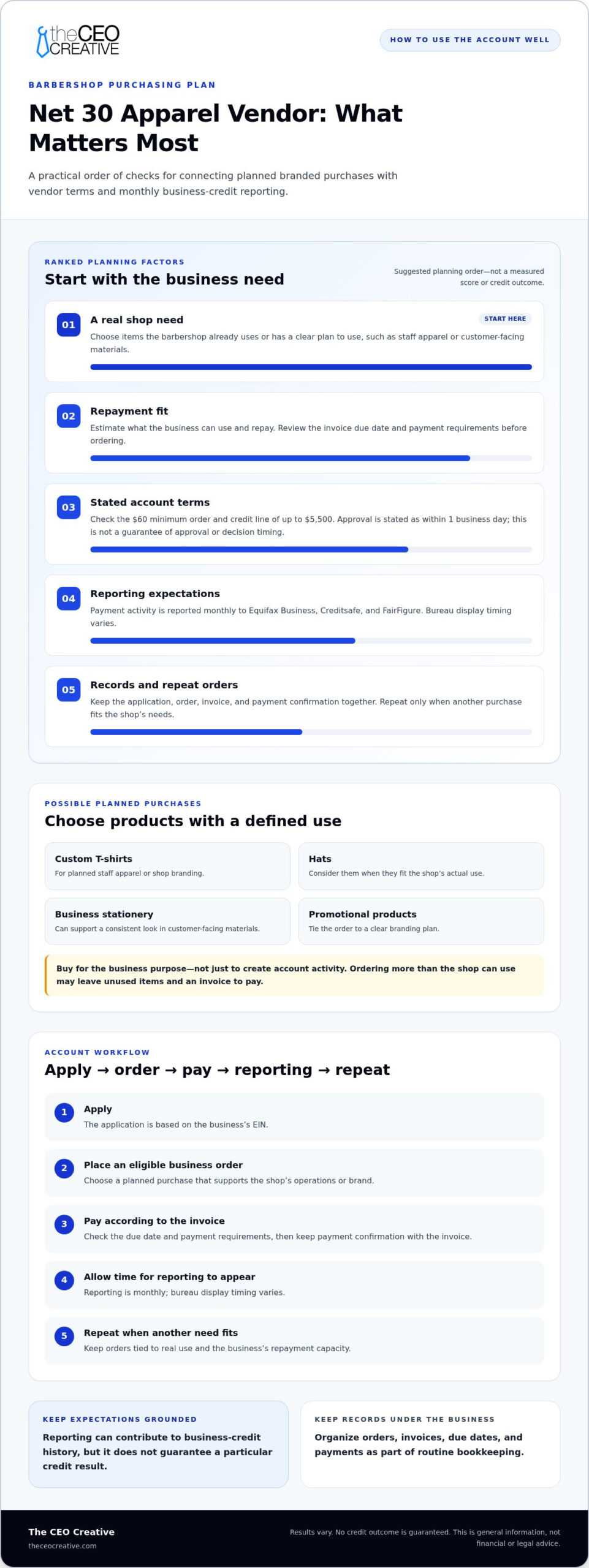
The minimum order is $60, and the credit line is up to $5,500. Approval is within 1 business day. That stated timeframe is not a guarantee of approval or a promise about an individual application. Consider the terms that apply to your account rather than assuming every order will receive the same treatment.
Before submitting an order, review the invoice and account terms to identify the due date and payment requirements. Net 30 describes the vendor arrangement, but the terms for your account and invoice govern your purchase. Keep the order within the business’s repayment capacity, even if the available credit line is higher. That makes the account a more practical purchasing tool and helps avoid unnecessary cash-flow pressure.
How application, payment, and monthly reporting work
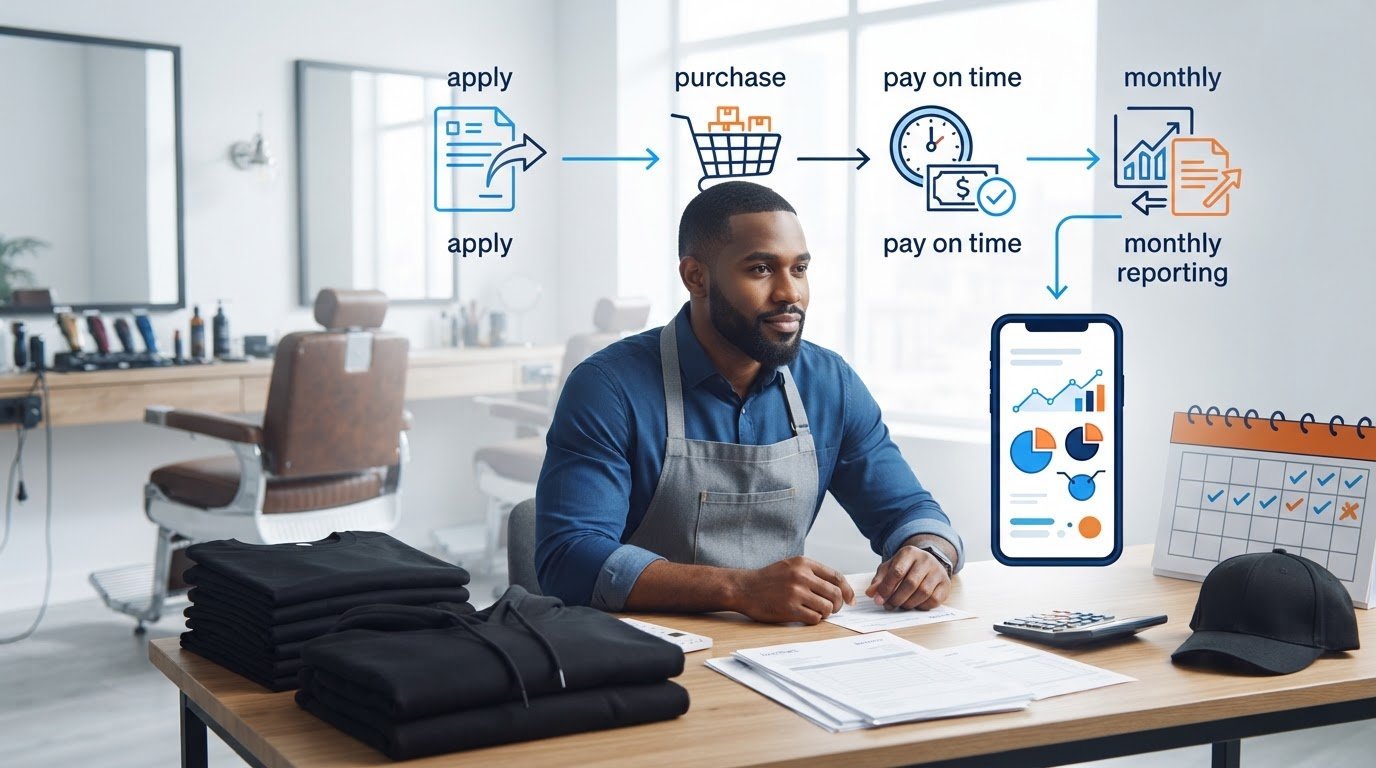
For net 30 accounts for barbershops, the process is: apply, place an eligible business order, pay according to the invoice terms, allow the vendor to report payment activity, and repeat only when another purchase fits the shop’s needs. Keep the application, order records, invoice, and payment confirmation together. These records make it easier to review account activity and keep the business’s finances organized.
What barbershop owners should know before applying
US businesses, including newly formed LLCs, can apply. There is no minimum time in business. The application is based on the business’s EIN, with no personal guarantee and no personal credit check. Review the application requirements and have your business details ready before applying.
The stated approval timeframe is within 1 business day, but it is not a promise of approval or a guaranteed decision time for every application. Once approved, use the account for an eligible order that matches the business purpose you identified. Save the order confirmation and invoice so the amount, terms, and due date are easy to track.
Follow the account workflow
- Apply. Submit the business application using the EIN-only basis. Keep your business details consistent across the application and purchase records.
- Place an eligible order. Choose an item that serves the shop and fits the account terms. Avoid ordering solely to create payment activity.
- Pay by the invoice due date. Review the applicable terms for each order and record when payment is made. Check the invoice rather than assuming the due date.
- Allow monthly reporting. The vendor reports monthly payment activity to Equifax Business, Creditsafe, and FairFigure.
- Repeat with care. Consider another order only when it fits the shop’s needs and repayment capacity.
What monthly reporting does, and does not, mean
A reported payment may contribute to the business’s credit file and payment history. Reporting is one part of the credit-building process, not a guarantee of a score increase, future credit approval, or any other specific result. Results vary.
The vendor’s reporting schedule and a bureau’s display timing are separate steps. Reporting occurs monthly, but each bureau controls its own processing and when information appears in a business file. A tradeline may not display immediately after a payment or reporting cycle. Keep copies of invoices and payment records so you can review your own account activity while bureau files update.
A practical checklist and mistakes to avoid
A short review before applying or ordering can help keep vendor terms manageable. For net 30 accounts for barbershops, treat the account as part of the shop’s purchasing and recordkeeping routine. Connect each order to a business need, track its invoice, and keep account activity organized without assuming a particular credit result.
Before placing an order
- Check the business purpose. Write down why the shop needs the item and how it will be used. If the order is optional, decide whether it still makes sense without considering credit reporting.
- Review the minimum. The minimum order is $60. Build the order around items the business can use rather than adding unneeded merchandise to reach the threshold.
- Read the applicable account terms. Identify the invoice due date and payment requirements before submitting the order. Do not rely on assumptions about when payment is due.
- Plan repayment. Consider the shop’s expected cash needs and confirm that funds will be available by the invoice due date. The available credit line is a limit, not a spending target.
- Keep records together. Save the order details, invoice, payment confirmation, and account correspondence in the business’s credit-building files.
Common account-use mistakes
- Buying items the shop does not need. Ordering merchandise solely to create a tradeline can burden the business with unnecessary spending. Choose purchases that serve a real operational or branding purpose.
- Missing an invoice due date. A busy schedule can make payment dates easy to overlook. Record each due date in the shop’s bookkeeping system or payment calendar and review it regularly.
- Assuming monthly reporting sets a display date. Monthly reporting does not control when a bureau processes or displays a tradeline. Keep your own payment records and allow bureau timing to vary.
- Expecting guaranteed credit results. A reporting account may contribute payment information to a business credit file, but no score change or future approval is guaranteed. Results vary.
- Using inconsistent business details. Keep the business name and identifying information consistent across account activity and internal records. This makes it easier to connect orders, invoices, and payments to the right business file.
- Treating vendor terms as a full financial plan. An account can support relevant purchasing, but it does not replace budgeting, cash-flow planning, or reviewing the shop’s wider financial commitments.
Use this checklist whenever you consider an order. A deliberate purchase and reliable recordkeeping help keep account use aligned with the shop’s actual needs.
Review the business Net 30 account to see how its terms fit your planned purchase and payment routine.
Consider The CEO Creative for barbershop Net 30 purchases
The CEO Creative offers Net 30 vendor terms alongside custom branding products, making it an option for a barbershop planning a branded-apparel purchase. The account has a $60 minimum order and a credit line of up to $5,500. It reports monthly to Equifax Business, Creditsafe, and FairFigure. These details help owners assess how an order may fit the shop’s purchasing and business-credit plans, but they do not promise a particular credit outcome.
The CEO Creative is BBB Accredited with an A+ rating, has been in business for 6+ years, and has 50,000+ reported tradelines. These details provide context about the vendor. They do not guarantee how an individual application will be handled or when bureau information will appear.
Check whether the account fits your purchasing plan
Start with the shop’s actual apparel needs. For example, consider whether branded t-shirts or hats have a clear use in the business, then compare the planned purchase with the $60 minimum order and the account’s payment terms. An available credit line is a limit, not a target. Choose an order you can repay on time and that makes sense apart from credit reporting.
Net 30 vendor terms can fit into a broader purchasing plan when the products serve a real business purpose. Keep expectations measured: reporting is one part of a business-credit history, bureau display timing varies, and results vary. No score change or future approval is guaranteed. This information is not financial or legal advice.
For net 30 accounts for barbershops, the practical decision is whether the product selection, order minimum, and payment terms align with a real shop purchase and its cash flow. If an order is attractive only because it might create a tradeline, pause and reconsider the business purpose. A planned purchase followed by on-time payment is more responsible than ordering solely to generate account activity.
Take the next step
Before applying or ordering, confirm that the purchase supports the shop, that you understand the invoice due date, and that repayment fits your budget. Keep order and payment records with the business’s files so you can track account activity over time. Learn more about the business Net 30 account.
Make your next purchase part of a clear plan
Start by identifying one upcoming purchase that supports your barbershop’s operations or brand. Decide how the item will be used, confirm that the invoice fits your budget, and note the payment date before ordering. This simple routine connects vendor purchasing to the shop’s priorities.
Net 30 accounts for barbershops are worth considering when the purchase is genuinely useful and the account terms fit the business’s cash flow. Treat credit reporting as a possible part of a longer-term business-credit plan, not as a promised result. A steady, well-documented approach can help you make future purchasing decisions with the shop’s needs in view.
Choose the next step that fits your shop. Thoughtful purchases and consistent payment habits can support the business systems you are building.
Frequently Asked Questions
Can a newly formed barbershop apply for a Net 30 account?
Yes. US businesses, including newly formed LLCs, can apply, and there is no minimum time in business. The application is based on the business’s EIN. Approval is not guaranteed, and the stated approval timeframe is within 1 business day, not a promised decision time for every application. A new shop can consider applying as part of its business-credit plan while keeping its purchasing and repayment plans realistic.
Does a Net 30 account require a personal guarantee?
No personal guarantee or personal credit check is required for this account, which is based on the business’s EIN. Those terms describe how the account is structured; they do not mean every application will be approved or guarantee a particular business-credit result. Before ordering, review the terms that apply to your account and make sure the purchase is appropriate for the business.
How many Net 30 vendor accounts should a barbershop open?
There is no universal number that fits every barbershop. Start by identifying purchases the shop genuinely needs, then consider whether a vendor account’s terms and reporting fit your plan. For example, a shop with a real need for branded apparel can assess one relevant account before taking on more commitments. Do not open accounts solely to chase tradelines. More accounts do not ensure stronger business credit.
Do all Net 30 vendors report to the same business credit bureaus?
No. Reporting policies differ by vendor. The CEO Creative reports monthly to Equifax Business, Creditsafe, and FairFigure. Monthly reporting does not set the date information appears in a bureau file. Each bureau controls its own processing and display timing, so a specific tradeline appearance date cannot be promised.
Will paying a Net 30 invoice on time guarantee a higher business credit score?
No. Results vary, and a reported on-time payment does not guarantee a score increase, financing approval, or any other specific outcome. Responsible payment can form one part of a business-credit history, alongside the business’s broader financial records and account activity. Keep invoices and payment confirmations organized, and treat credit reporting as one consideration in your plan. This information is not financial or legal advice.
Can a barbershop use this account to buy clippers or other barber tools?
The account is for business purchases such as customizable apparel and branding products, including t-shirts, hats, and stationery. For a barbershop, consider products that support its branding or business needs, and review the account terms before ordering.