

Net 30 accounts for nail salons are vendor accounts that let a business buy eligible goods and pay the invoice under the stated terms. For a salon, an apparel vendor account may make sense for a planned purchase such as branded staff t-shirts, but it is not a way to buy nail-care inventory or access general-purpose cash.
This article explains how a reporting vendor account works, which purchases may fit a salon, and how to manage orders and invoices. Use the checklist to assess whether an account fits your business and to plan for responsible payment management.
Table of Contents
- What Net 30 Accounts for Nail Salons Can, and Cannot, Do
- How a Nail Salon Net 30 Vendor Account Works
- Which Net 30 Purchases Fit a Nail Salon’s Business?
- A Nail Salon Checklist for Choosing and Managing Net 30 Terms
- A Relevant Net 30 Apparel Account for Nail Salon Branding
Key Takeaways
- Net 30 accounts for nail salons are vendor purchase accounts, not a source of nail-product inventory or financing.
- Match each order to a real salon need, such as branded staff apparel, instead of buying items only to create account activity.
- Review the invoice terms, plan payment dates, and keep records of orders and payments.
- The CEO Creative reports monthly to Equifax Business, Creditsafe, and FairFigure. Bureau display timing varies.
What Net 30 Accounts for Nail Salons Can, and Cannot, Do
Net 30 accounts for nail salons are vendor purchase arrangements. The business orders eligible goods or services, then pays the invoice according to its stated terms. The invoice sets the due date and any other payment conditions. For a general explanation of Net 30 payment terms, see the term’s common use in trade credit.
This article focuses on vendor tradelines, not loans, credit cards, or financing for nail products. A vendor account is connected to purchases from that supplier. It does not provide borrowed cash for general expenses. Before applying, consider whether the vendor’s catalog includes something your salon already needs for operations, branding, or administration.
Separate salon inventory from business-credit purchases
Nail polish, gels, and manicure tools are specialist salon inventory, not the focus of an apparel vendor account. Apparel is not a substitute for those supplies. Instead, consider whether branded uniforms or other business apparel would serve a real purpose, such as giving staff a coordinated look or representing the salon at an event. A reporting Net 30 apparel vendor may fit that planned purchase. Choose apparel your business can use, not an order made only to create account activity.
Why a salon might consider vendor terms
Invoice-based terms can help a salon organize a planned business purchase around its invoice due date. For example, if the salon plans to buy branded staff apparel, it can record the order and invoice, then schedule payment according to the stated terms. This is a purchasing arrangement, not access to cash for unrelated costs. Keep the invoice, payment confirmation, and order details together so your records show what the business bought and when it paid.
Some vendors report account activity to business credit bureaus. Responsible, on-time payments may contribute information to a business credit file, but reporting does not guarantee a score increase or any particular outcome. A bureau may take its own time to display reported information. Results vary, so focus on payment discipline and accurate records rather than expecting a specific credit result.
Use a practical test before ordering: would the salon make this purchase even without the credit-building goal? If yes, and the item supports salon operations, branding, or administration, the order may be relevant. If the main reason is to create a tradeline, pause and reconsider. This information is educational, not financial or legal advice.
How a Nail Salon Net 30 Vendor Account Works
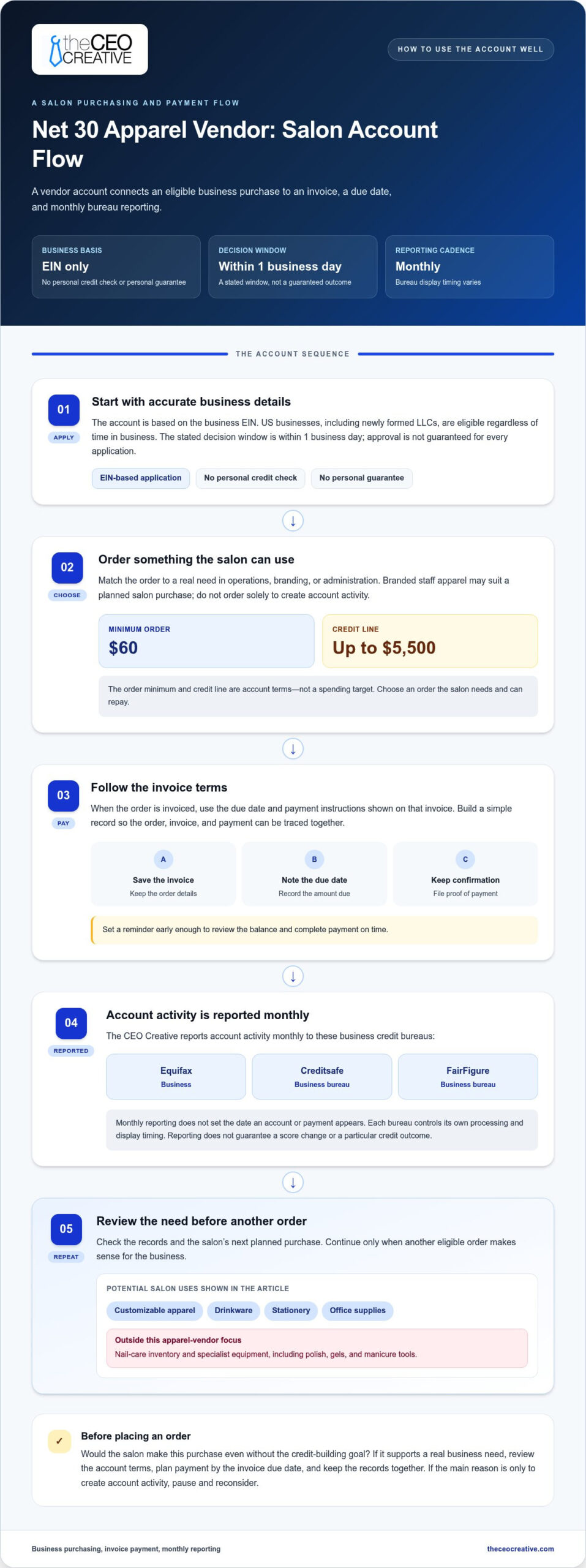
A reporting vendor account follows a straightforward sequence: apply, receive a decision, place an eligible order, pay the invoice by its due date, then order again only when another purchase makes sense. Understanding each step helps salon owners organize orders and payments while keeping expectations about bureau reporting realistic.
Application and ordering terms
The account is based on the business EIN, with no personal credit check and no personal guarantee. US businesses, including newly formed LLCs, are eligible regardless of time in business. The stated decision window is within 1 business day. This describes the approval process, not a guaranteed outcome for every application.
After approval, place an eligible order that fits the salon’s needs and the account terms. The minimum order is $60, and the credit line is up to $5,500. These figures describe the order minimum and maximum credit line, not a spending target. Choose an order your salon can use and repay rather than treating the available limit as a budget.
Invoice payment and monthly reporting
When an order is invoiced, follow the due date and payment instructions shown on the invoice. Record the invoice date, due date, amount, and payment confirmation in the salon’s bookkeeping system. Set a reminder early enough to review the balance and complete payment on time. Keep the order details and payment records together so you can trace account activity later.
The CEO Creative reports account activity monthly to Equifax Business, Creditsafe, and FairFigure. Monthly reporting describes the vendor’s reporting schedule. It does not mean a bureau will display an account or payment on a specific date. Each bureau controls its own processing and display timing. A reporting account may contribute information to a business credit file, but it does not guarantee a score change or a particular credit outcome.
Think of net 30 accounts for nail salons as a repeatable purchasing and payment routine, not a shortcut. Apply with accurate business information, place a relevant order, meet the invoice deadline, and review your records before ordering again.
Which Net 30 Purchases Fit a Nail Salon’s Business?
A useful vendor purchase should have a clear business purpose beyond creating account activity. For a nail salon, consider whether an item supports staff presentation, customer-facing branding, or day-to-day administration. The table shows potential uses for catalog categories and distinguishes them from nail-care stock and specialist equipment, which are outside the apparel-vendor focus.
| Purchase category | Possible salon use | Matches stated catalog? |
|---|---|---|
| Customizable apparel | Staff uniforms or branded salon wear | Yes |
| Drinkware | A branded or customer-facing item, if it fits the salon’s plans | Yes |
| Stationery | Appointment notes, business records, or salon administration | Yes |
| Office supplies | Routine administrative work | Yes |
| Nail-care inventory and specialist equipment | Polish, gels, manicure tools, and salon equipment | No, outside this vendor focus |
Apparel for salon teams and brand visibility
Customizable t-shirts and hats may suit a salon that wants staff clothing to reflect a consistent business identity. Branded apparel can help distinguish staff from customers and create a coordinated appearance, while still following the salon’s existing dress standards. Explore the Net 30 apparel vendor option for salon-branded apparel purchases.
Other business purchases to assess
Stationery may be useful for appointment notes, internal records, or other salon administration. Drinkware may fit a branding plan or customer-facing use, but it is not required stock for providing nail services. Office supplies may support routine business tasks. In each case, connect the item to an actual use before ordering.
Use a simple filter for net 30 accounts for nail salons: identify the purpose, decide who will use the item, and assess whether the invoice fits the salon’s payment capacity. An item can be in a vendor’s catalog and still be a poor fit for your business. Do not add products only to reach the order minimum or create account activity. Choose items the salon can use, keep the order within a manageable budget, and follow the invoice terms.
This distinction helps keep expectations clear. Apparel, drinkware, stationery, and office supplies may support branding or administration, depending on the salon’s needs. Nail polish, gels, manicure tools, and specialist equipment belong to salon inventory planning, not this apparel-vendor strategy. Keep those purchasing decisions separate so each order serves a clear operational purpose.
A Nail Salon Checklist for Choosing and Managing Net 30 Terms
Use this checklist before applying or placing an order. It can help you assess whether the account fits your salon’s purchases and whether you are ready to manage the invoice. Net 30 accounts for nail salons may contribute to business credit activity, but careful ordering and payment habits matter more than opening an account alone.
Five checks before applying or ordering
- Prepare business details. Have your EIN and accurate business information ready for an EIN-based application. Newly formed LLCs may be eligible, but eligibility does not guarantee approval.
- Match the purchase to the vendor category. Choose something the salon can use for operations, branding, or administration. Branded apparel, for example, may fit a staff-clothing plan. Nail-care inventory is a separate purchasing need.
- Check the order amount and available credit. The order must meet the $60 minimum and fit within the account’s available credit line. Do not assume the full line will be available to every applicant.
- Plan payment before ordering. Review the invoice due date and payment instructions, then decide how the salon will pay on time. Keep the order confirmation, invoice, and payment record together.
- Review current account terms. Read the account details before applying so you understand the terms that apply to your order. Base your decision on those terms, not assumptions about another vendor’s account.
Mistakes that can undermine a careful plan
Small oversights can make a relevant account harder to manage. Build a routine the salon can repeat, and avoid these common mistakes:
- Buying items the salon does not need. Do not place an order only to create account activity. Choose products with a real business purpose.
- Overlooking the $60 minimum. Check the order total before submitting it. Do not add unrelated items just to meet the threshold.
- Missing an invoice due date. Record the due date when the invoice arrives and set a reminder. Keep payment confirmation with the invoice.
- Expecting a guaranteed score change. Responsible payments may contribute to business credit-file activity, but they do not guarantee a score increase or a specific result.
- Expecting immediate bureau display or reporting to other bureaus. Reporting is monthly to Equifax Business, Creditsafe, and FairFigure. Bureau display timing varies, so do not assume information will appear immediately.
Use the account as part of a purchasing routine, not as a promise of credit results. This information is educational and is not financial or legal advice.
Review the business Net 30 account details before deciding whether a planned salon purchase fits.
A Relevant Net 30 Apparel Account for Nail Salon Branding
The CEO Creative is a reporting Net 30 apparel vendor, not a nail-supply wholesaler. Its account may suit a salon planning a practical business purchase, such as branded staff apparel, rather than a salon seeking polish, gels, manicure tools, or specialist equipment. A good fit depends on whether the salon can use the purchase and manage its invoice responsibly.
When the account may fit a nail salon
Consider the account if your salon has a genuine need for customizable apparel, such as t-shirts or hats for staff or business branding. The catalog also includes drinkware and stationery, which may fit the salon’s operations. Choose an order for its business value first. Credit-building should not be a reason to buy products the salon does not need.
The application is based on the business EIN, with no personal guarantee and no personal credit check. The minimum order is $60, the credit line is up to $5,500, and the stated approval window is within 1 business day. The CEO Creative reports monthly to Equifax Business, Creditsafe, and FairFigure. Monthly reporting does not guarantee a score change, and bureau display timing varies.
The company is BBB Accredited with an A+ rating and has been in business for 6+ years. These are background details, not a promise of approval or a particular credit outcome. For a salon, the account’s practical value comes down to the fit between a planned order, its payment capacity, and the invoice terms.
Take the next step with clear expectations
Before applying, decide what the salon would order and how the business will pay the invoice by its due date. Choose a purchase that supports branding or another genuine business need, keep the order within the salon’s available budget, and retain the invoice and payment record. Do not treat the credit line as a spending target or assume a new account will produce an immediate bureau update.
For owners comparing net 30 accounts for nail salons, this apparel account may fit when salon-branded apparel or another relevant catalog purchase is already part of the business plan. If the salon needs nail-care inventory, this is not the type of vendor account described here. Results vary, and this information is not financial or legal advice.
Plan an order the salon can use and pay on time. Review the Net 30 business account details before applying.
Make Your Next Vendor Purchase Deliberate
Choose a purchase your salon already has a reason to make, then create a routine for reviewing the invoice, scheduling payment, and keeping records. This helps keep business spending purposeful while you work on sound business credit practices. Net 30 accounts for nail salons are most useful when the vendor category fits the business and the payment plan fits its cash flow. Reporting may contribute information to a credit file, but results vary and are never guaranteed.
Before applying, review the account terms and consider whether a planned apparel or other relevant business purchase makes sense for your salon. A clear decision can help you manage the account responsibly.
Keep each order purposeful and each invoice on schedule. Review the business Net 30 account and apply when you are ready to place a relevant purchase.
Frequently Asked Questions
Can a newly formed nail salon LLC apply for a Net 30 account?
Yes. Newly formed US LLCs are eligible to apply regardless of time in business. The application uses the business EIN, with no personal credit check or personal guarantee. Eligibility does not mean every application will be approved. Before applying, make sure the LLC’s business details are accurate and consistent with the information associated with its EIN.
Does a Net 30 vendor account guarantee that a nail salon’s business credit score will improve?
No. A vendor account and responsible payments do not guarantee a score increase or a particular credit outcome. Reporting may add account activity to a business credit file, but results vary. For net 30 accounts for nail salons, focus on choosing a purchase the business needs, following invoice terms, and keeping clear records. Treat credit-file development as an ongoing business process, not a promised result from one account.
How soon will a Net 30 tradeline appear on a business credit report?
There is no guaranteed date for a tradeline to appear. The CEO Creative reports monthly to Equifax Business, Creditsafe, and FairFigure, but each bureau controls how and when it displays received information. Keep account and payment records available. If the account does not appear immediately on a business credit file, that alone does not establish whether reporting has occurred or whether the file is complete.
Can a salon use an apparel vendor account to buy nail polish and manicure tools?
No. An apparel vendor account is for purchases in its vendor category, not nail polish, gels, manicure tools, or specialist salon equipment. A salon may use apparel for staff branding, but it should not treat that purchase as a replacement for salon inventory. Keep the plans separate: manage service supplies through the salon’s inventory process, and use an apparel account only for relevant apparel orders.
Is a Net 30 vendor account the same as a business loan or credit card?
No. A vendor account is connected to eligible purchases from a supplier, with payment handled under the invoice terms. It is not a business loan or credit card, and it does not provide general-purpose cash for unrelated expenses. An apparel order, for example, does not provide funds to pay rent or buy nail-care stock. Review the invoice and account terms to understand the purchase obligation.
What should a nail salon do if it cannot pay a Net 30 invoice by its due date?
Review the invoice and account terms promptly. If you may miss the due date, use the vendor’s account channels before it arrives to explain the issue and review the steps available under the account terms. Do not assume an extension or a particular arrangement will be granted. Keep a record of the communication and any instructions, and avoid placing additional orders until you understand how to manage the outstanding balance.