

Can routine business purchases help a dental practice build business credit? Net 30 accounts for dental practices can connect eligible purchases with a vendor-reported payment history, when the account reports activity to business credit bureaus.
The practical fit is for purchases such as office supplies, stationery, staff apparel, drinkware, or promotional products, not clinical supplies or dental equipment. Here’s how to evaluate an account, place an appropriate order, manage invoices, and understand monthly bureau reporting. Reporting does not guarantee a score change or a particular bureau display date.
- What Net 30 Accounts Can a Dental Practice Use?
- How the Dental Practice Net 30 Account Works
- How to Evaluate Net 30 Accounts for a Dental Practice
- Dental Practice Net 30 Account Checklist and Common Mistakes
- Using The CEO Creative for Eligible Dental Practice Purchases
- Frequently Asked Questions
Key Takeaways
- Net 30 accounts for dental practices can connect eligible business purchases with a vendor tradeline and reported payment history.
- Routine purchases such as stationery or staff apparel may fit, while clinical supplies and dental equipment are outside this use case.
- Follow the application, order, payment, and repeat process. Keep invoices and payment records together.
- Monthly reporting does not guarantee a particular credit outcome or when a bureau will display account information.
What Net 30 Accounts Can a Dental Practice Use?
A reporting Net 30 vendor account lets a business buy eligible items from a supplier and pay according to the invoice terms. The vendor may report account activity to business credit bureaus, creating a tradeline that records payment history. Net 30 commonly refers to payment due within 30 days, but the invoice sets the actual due date. Read the supplier’s terms and invoice carefully. For background, see Net 30 payment terms.
For a dental practice, this is a way to purchase routine business items, not a loan, business credit card, or way to finance clinical equipment. A useful decision test is whether the practice would make the purchase for its business value even without the possibility of a reported tradeline. Reporting documents account activity, but does not guarantee a credit result.
Which dental practice purchases may fit vendor terms?
Eligible purchases depend on the vendor’s catalog. Office supplies and stationery can support administrative work. Drinkware, staff apparel, and promotional products may serve workplace or branding needs. For example, a practice might order branded apparel for staff or stationery for office administration. These are business purchases, not products for patient care or treatment.
For administrative items, explore The CEO Creative’s Net 30 office supplies vendor category. Match the order to the practice’s needs and the supplier’s available products. The CEO Creative also offers apparel, drinkware, stationery, and promotional products on Net 30 terms.
What should practices keep outside this use case?
Keep specialized clinical supplies and dental equipment separate from routine vendor-account purchases. The account is for eligible products in the supplier’s categories, not a way to finance treatment equipment or assume clinical products qualify. Before ordering, identify the business purpose of each item and confirm that it fits an eligible category.
A vendor tradeline records account activity, not a guaranteed credit result. Monthly reporting can document payment history, but it does not guarantee a credit-profile change or a date when a bureau displays the information. Choose purchases for their practical value to the practice, then manage them according to the invoice terms.
How the Dental Practice Net 30 Account Works
The account process is straightforward: apply, place an eligible order, pay by the invoice due date, and repeat when another suitable business need comes up. Treat each step as part of the practice’s purchasing routine. Clear records make it easier to track orders, due dates, payments, and reported activity.
What happens when a practice applies and orders?
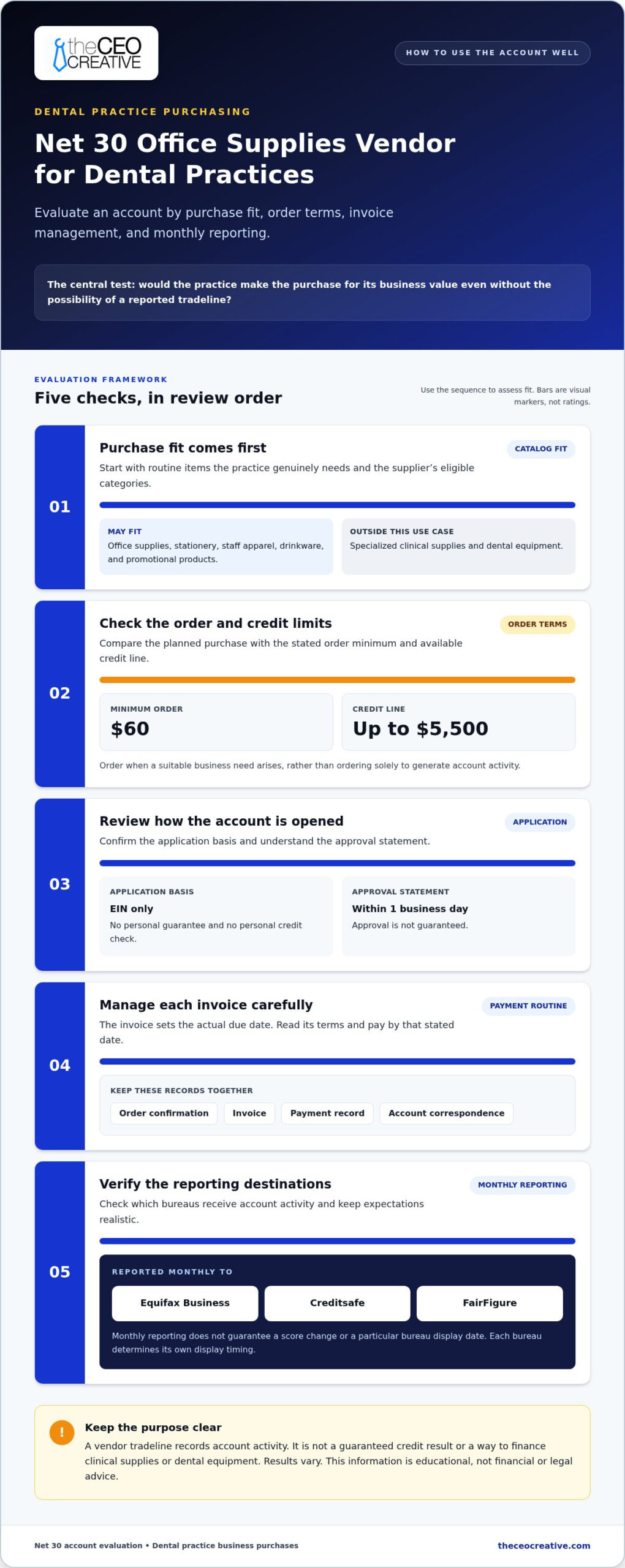
Eligible US businesses, including newly formed LLCs, may apply using an EIN. There is no minimum time in business. The account is EIN-only, with no personal guarantee and no personal credit check. Approval is stated within 1 business day, but approval is not guaranteed.
Use accurate, consistent business information throughout the application and ordering process. If approved, select an eligible item the practice needs and place an order that meets the $60 minimum. The credit line is up to $5,500. Follow the invoice terms and pay by the stated due date. Place another order only when a suitable business need arises, rather than ordering solely to generate account activity.
Keep the order confirmation, invoice, payment record, and relevant account correspondence together. A simple recordkeeping routine helps the practice match each payment to its invoice and review its account activity later.
Which bureaus receive monthly reporting?
Account activity is reported monthly to Equifax Business, Creditsafe, and FairFigure. Monthly reporting does not guarantee that a tradeline will appear in a business credit file on a specific date. Each bureau determines its own display timing.
Reporting records account activity. It does not guarantee a score change or another credit outcome. Results vary. This information is educational, not financial or legal advice.
How to Evaluate Net 30 Accounts for a Dental Practice
Compare reporting Net 30 vendor accounts by the purchases they support, their payment terms, and their reporting practices. These are purchase accounts, not loans or business credit cards. For a dental practice, start with the catalog: it should include items the business can use. Then review the order minimum, credit line, application basis, invoice terms, and reporting destinations before applying. For another industry-specific perspective, see this guide to Net 30 accounts for food trucks.
Which account details matter before choosing?
First, list routine business purchases the practice expects to make. Check whether the supplier’s catalog covers them and whether the order minimum is workable for a planned purchase. Next, review how the account is opened, the available credit line, when invoices are due, and which bureaus receive monthly reporting. The table summarizes The CEO Creative’s stated account terms. It is not a comparison of competitor offers.
| Account detail | The CEO Creative |
|---|---|
| Minimum order | $60 |
| Credit line | Up to $5,500 |
| Approval process | Approval within 1 business day; approval is not guaranteed |
| Guarantee | No personal guarantee; EIN only, with no personal credit check |
| Reporting destinations | Monthly to Equifax Business, Creditsafe, and FairFigure |
The CEO Creative is BBB Accredited with an A+ rating. This accreditation is separate from bureau reporting and should not be read as an endorsement by a credit bureau. Also review the invoice’s stated due date and payment terms. Those details determine how the practice needs to manage each purchase.
For a broader view of account features, read this Net 30 vendor comparison guide. Compare published terms carefully. Another vendor may have a different minimum, credit line, or list of reporting destinations.
What a reported tradeline can and cannot establish
Monthly reporting can send account-payment information to the named bureaus. A tradeline documents account activity; it does not guarantee a credit-score change, approval from another lender, or a particular display date. Each bureau determines when information appears in its files. Results vary.
Evaluate net 30 accounts for dental practices as a combination of useful business purchases, manageable payment terms, and clearly stated reporting practices. Keep these factors distinct: account terms describe the purchase relationship, while reporting describes where account activity is sent. This section is educational, not financial or legal advice.
Dental Practice Net 30 Account Checklist and Common Mistakes
A consistent routine helps a practice manage vendor terms and keep account records easy to review. Use this checklist before ordering, then repeat the payment and recordkeeping steps for each invoice.
A practical account-use checklist
- Confirm the business details. Use accurate, consistent practice information and the correct EIN in the application and account records.
- Review the account terms. Check the catalog, payment terms, reporting destinations, and $60 minimum order before submitting an order.
- Choose a needed item. Make sure the purchase fits the vendor’s catalog and meets a real business need. Do not order just to create account activity.
- Calendar the invoice due date. Record the due date as soon as the invoice arrives, then plan payment according to its stated terms.
- Retain account records. Keep the order confirmation, invoice, payment record, and relevant account correspondence together.
- Monitor reporting. Review the business credit files associated with the account, allowing for each bureau’s processing and display timing.
Common mistakes that weaken account management
- Ordering unnecessary items: A purchase should make sense for the practice even without a credit-building goal.
- Overlooking the minimum: The minimum order is $60. Check that the planned purchase meets it before submitting the order.
- Missing invoice due dates: Calendar each due date and retain payment confirmation. Do not assume a payment made after the due date will be treated as on time.
- Entering inconsistent business details: Differences in the practice’s name or EIN can make account records harder to reconcile.
- Expecting immediate bureau display: Reporting is monthly, but each bureau controls its own display timing. No display date is promised.
- Assuming a guaranteed result: A purchase or payment does not guarantee credit growth, a score change, or a particular lending decision.
Monthly reporting does not guarantee when a bureau will display a tradeline. Results vary, and this information is not financial or legal advice.
Using The CEO Creative for Eligible Dental Practice Purchases
The CEO Creative’s reporting Net 30 account brings eligible business purchases from several categories together under one account. For a dental practice, options include staff apparel, drinkware, stationery, office supplies, and promotional products. These items can support routine administrative and workplace needs. The account is not for dental equipment or clinical treatment supplies.
Where the account may fit in practice operations
A practice might buy staff apparel for its team, stationery for office administration, or drinkware for general workplace use. Choose items that fit the supplier’s catalog and that the practice has a clear business reason to purchase. The purpose is to manage a useful business order under stated terms, not to buy products solely in pursuit of a credit result.
One account can be used across the supplier’s categories, and in-house decoration is available for eligible products. This lets a practice make different routine business purchases through the same vendor relationship. It does not change which items qualify: keep orders within the available product categories and separate from specialized clinical purchasing.
Take the next step with clear expectations
The minimum order is $60, and the credit line is up to $5,500. Eligible US businesses, including newly formed LLCs, may apply using an EIN. There is no minimum time in business, no personal guarantee, and no personal credit check. Approval is stated within 1 business day, but approval is not guaranteed.
Account activity is reported monthly to Equifax Business, Creditsafe, and FairFigure. Reporting records account activity, but does not promise a score change or a particular date when a bureau will display a tradeline. Results vary. This information is not financial or legal advice. Read the business Net 30 account terms and consider whether an eligible purchase fits the practice’s needs.
Build a Clear, Responsible Purchasing Routine
For dental practices, net 30 accounts for dental practices are most useful when they support purchases the business already needs. Keep routine office and staff purchases separate from clinical supplies, review the account terms, and pay each invoice by its due date. Monthly reporting can document account activity, but it does not guarantee a credit-score change or when a bureau will display a tradeline.
The CEO Creative’s account is EIN-only, with no personal guarantee or personal credit check. It reports monthly to Equifax Business, Creditsafe, and FairFigure. The CEO Creative is BBB Accredited with an A+ rating. Results vary. This information is not financial or legal advice.
Choose purchases with practical value, keep clear records, and manage payment terms consistently. That routine helps the practice use vendor terms responsibly. The account terms are available through the business Net 30 account page.
Frequently Asked Questions
Can a dental practice use a Net 30 account to build business credit?
Yes. A dental practice can use a reporting Net 30 vendor account to record eligible purchases and payments. Net 30 accounts for dental practices are most useful when orders meet real business needs and invoices are paid by their due dates. Reporting can contribute account information to business credit files, but it does not guarantee a score increase, a particular credit outcome, or approval from another lender. Results vary.
What can a dental practice buy with a Net 30 vendor account?
A practice can order eligible items in the vendor’s catalog, such as office supplies, stationery, drinkware, apparel, and promotional products. Staff apparel or administrative stationery may serve routine workplace needs. The account applies to purchases in eligible categories, not specialized dental equipment or patient-care and treatment supplies. Choose items the practice already needs and review the catalog and account terms before ordering.
Which business credit bureaus does The CEO Creative report to?
The CEO Creative reports account activity monthly to Equifax Business, Creditsafe, and FairFigure. Monthly reporting does not guarantee when a bureau will display a tradeline in a business credit file. Each bureau determines its own display timing. Reporting documents account activity and payment history, but does not promise a particular score change or credit outcome. Keep account records so you can review activity over time.
Does applying for the account require a personal guarantee or personal credit check?
No. The account is EIN-only, with no personal guarantee and no personal credit check. Provide accurate, consistent business details during the application and ordering process. Approval is stated within 1 business day, but that timing does not guarantee approval. Before applying, review the eligible catalog, order minimum, credit line, invoice due dates, and reporting process.
Can a newly formed dental practice LLC apply for a Net 30 account?
Yes. Eligible US businesses, including newly formed LLCs, may apply using an EIN, and there is no minimum time in business. Enter the practice’s business information accurately and consistently throughout the application and account process. Eligibility to apply does not guarantee approval. If approved, use the account for eligible purchases that meet the practice’s needs and manage invoices according to their stated due dates.
What is the minimum order for The CEO Creative’s Net 30 account?
The minimum order is $60. Plan an order around eligible items the practice needs and make sure it meets this threshold before submitting it. The account has a credit line of up to $5,500, subject to the account terms and approval process. The minimum and credit line are not a reason to buy items solely to create tradeline activity.
How long does it take for a Net 30 tradeline to appear on a business credit report?
There is no guaranteed display date. The CEO Creative reports monthly to Equifax Business, Creditsafe, and FairFigure, but each bureau determines when account information appears in its files. Keep order, invoice, and payment records, then monitor the relevant business credit reports over time. Monthly reporting does not guarantee immediate display, a particular credit score, a credit outcome, or a lending decision.