


What if a purchase that helps your catering team look polished could also support your business credit profile? Net 30 accounts for catering companies can connect eligible operational and branding purchases with a vendor tradeline. The account is not a loan or business credit card: it lets a business buy eligible products and pay the resulting invoice under the vendor’s terms.
Catering businesses invest in the details customers see, from branded staff apparel and drinkware to stationery, office supplies, and promotional products. To choose useful purchases, match what you plan to buy to the vendor’s product categories, then understand the invoice and payment schedule. Net 30 gives your business 30 days to pay an invoice, but payment terms alone don’t guarantee credit improvement. Reporting practices and timely payments matter.
This guide explains how to match purchases to the account, what to expect during application and billing, and how monthly reporting to Equifax Business, Creditsafe, and FairFigure fits into the process. You’ll also learn what to consider about eligibility and payment responsibilities before applying. Use a vendor account thoughtfully as one part of your business-credit strategy. This article is for informational purposes only and isn’t financial or legal advice.
Key Takeaways
- Net 30 accounts for catering companies can pair planned branding or office purchases with a vendor tradeline, but they aren’t loans or business credit cards.
- Match each planned purchase to an eligible category, such as apparel, drinkware, stationery, office supplies, or promotional products.
- Understand the account sequence before ordering: apply, purchase, receive an invoice, pay, and allow reporting to take place.
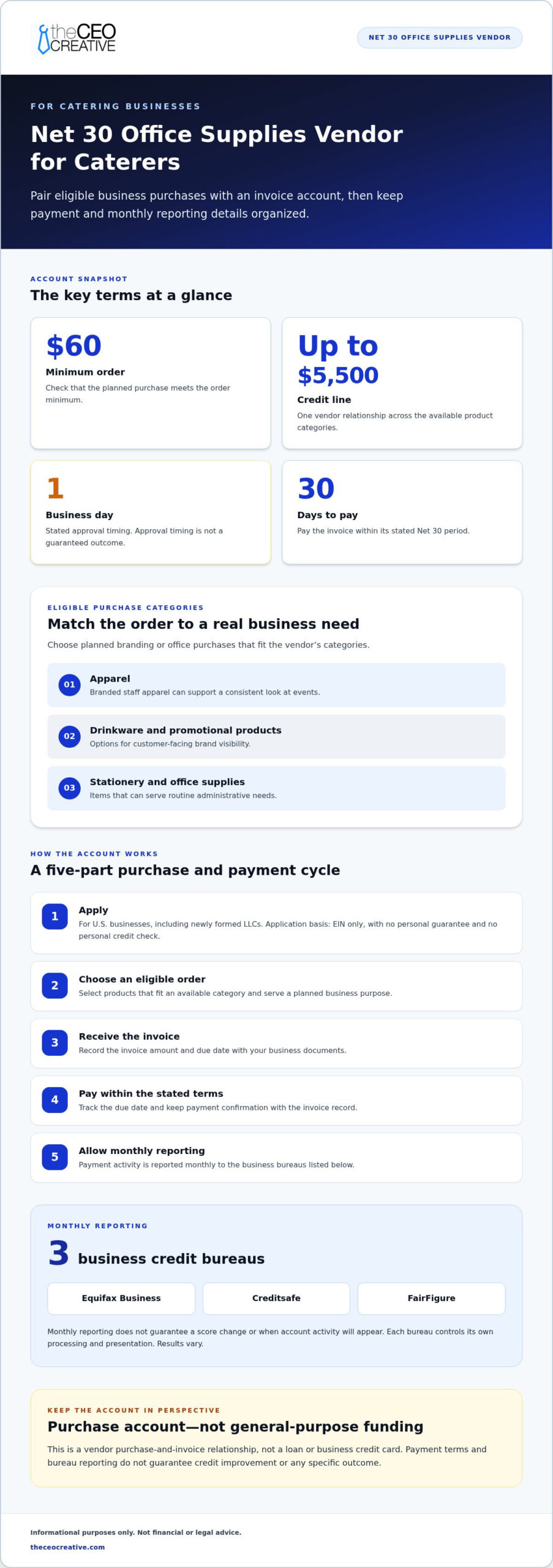
- The account has a $60 minimum order and a credit line of up to $5,500. Payment history is reported monthly to Equifax Business, Creditsafe, and FairFigure.
- Track invoice due dates and pay responsibly. Reporting doesn’t guarantee credit improvement, and results vary.
Why Net 30 Accounts Matter to Catering Companies
A relevant vendor purchase can pair payment terms with business-credit reporting. For a catering company, a planned investment in its brand or routine office needs may become part of a vendor relationship that reports payment activity to business credit bureaus. The practical value is straightforward: buy something the business can use, manage the invoice, and understand what the vendor reports.
This is different from using a loan or business credit card. A vendor account lets a business purchase goods or services from a supplier and pay the invoice according to its terms. It isn’t a source of general-purpose funding and shouldn’t be treated as a way to pay for food, equipment, or other catering costs outside the vendor’s product categories. A tradeline records a credit relationship; it doesn’t promise a particular credit result.
What a reporting Net 30 vendor account does
A Net 30 vendor account creates a purchase-and-invoice relationship: the business orders eligible items, receives an invoice, and pays within the stated 30-day period. This is a form of trade credit, where payment is deferred between businesses. The vendor reports payment activity, while each bureau determines how and when that information appears in its records.
The CEO Creative reports monthly to Equifax Business, Creditsafe, and FairFigure. Reporting makes account activity available to those bureaus, but it doesn’t guarantee a score change, financing, or any other specific outcome. Results vary, and bureau display timing is outside the vendor’s control. Treat the account as one possible part of a broader business-credit approach, not a shortcut to approval elsewhere.
Where catering-company purchases may fit
Start with needs your company already plans to address. Branded staff apparel can create a consistent look at events, while drinkware and promotional products can support customer-facing brand visibility. Stationery and office supplies can serve routine administrative needs. These are possible uses, not a reason to buy every category.
A vendor tradeline records purchases and payment activity with a supplier; it isn’t a loan or a business credit card. Keep that distinction in mind when deciding what belongs on the account. Food ingredients, catering equipment, and shipping supplies are separate from the branding and office categories discussed here. Choose products that fit the account rather than trying to use it for unrelated expenses.
Before ordering, identify the business need and consider whether the invoice can be paid on time. That keeps the account tied to useful operations instead of spending for the sake of generating activity. For educational purposes only; this content isn’t financial or legal advice.
How the Catering Company Net 30 Account Works
Think of the account as a repeatable sequence: apply, place an eligible order, receive an invoice, pay according to its terms, and allow the vendor to report payment activity. If the account continues to fit your planned purchases, you can repeat the cycle while keeping each order and due date organized. This makes it easier to connect a catering business’s eligible purchases with its vendor-account activity.
Application and purchasing terms
U.S. businesses, including newly formed LLCs, are eligible with no minimum time in business. The application is EIN-only, with no personal guarantee and no personal credit check. Approval is within 1 business day, but that timing isn’t a guaranteed outcome. Plan orders around the account’s stated limits: the minimum order is $60, and the credit line is up to $5,500.
After applying, choose items that fit the vendor’s categories and serve a real business purpose. For example, a caterer might order branded apparel or office supplies rather than adding products simply to use available credit. Check that the intended order meets the minimum before submitting it, and keep the order record with your business documents. The account is one vendor relationship across its categories, not a separate credit facility for each product type.
Payment and bureau reporting
When an order is invoiced, note the due date and plan payment within the stated terms. A simple tracking system can record the invoice date, amount, due date, and payment confirmation in one place. This is especially useful during busy event periods, when invoices can compete for attention with scheduling and other administrative work.
Account payment activity is reported monthly to Equifax Business, Creditsafe, and FairFigure. Monthly reporting means the vendor submits account activity; it doesn’t guarantee when or how a bureau will display it. Each bureau controls its own processing and presentation, so don’t assume a payment will appear by a particular date or produce a specific score change. Results vary.
These details make net 30 accounts for catering companies easier to assess before applying: confirm the business can meet the order minimum, understand the invoice responsibility, and use the account for relevant purchases. Review the business Net 30 account details to see how the vendor account fits your purchasing plans.
This information is educational and isn’t financial or legal advice.
Which Net 30 Account Fit Makes Sense for a Caterer?
Start with a purchase your catering business already plans to make, not a desire to use credit for its own sake. A vendor account can pair eligible purchases with payment terms and reporting, but it isn’t a substitute for financing or operating capital. The comparison below separates brand and office needs from food-service expenses.
| Purchase purpose | Account fit | What the vendor account is not |
|---|---|---|
| Branded apparel for staff identity | Apparel category | Food, ingredients, or catering equipment |
| Branded materials for events or customer visibility | Promotional products category | A general-purpose source of operating funds |
| Business drinkware | Drinkware category | Kitchen equipment or food-service supplies |
| Routine administrative needs | Stationery and office supplies categories | Shipping supplies or a business credit card |
Match the account to purchases the business already needs
Begin with your upcoming purchasing plan. If your team needs a consistent branded look at events, apparel may fit. If you’re preparing branded materials for customer-facing occasions, promotional products may be relevant. Drinkware and stationery can also support a company’s brand or administrative needs. Explore the Net 30 promotional products vendor category when considering materials for event visibility.
Keep the decision practical. Identify the intended use, who will use the items, and whether the purchase is already budgeted. This helps the account support a defined business need rather than encourage unnecessary orders. A category that fits one company’s branding plans may not be useful to another.
Know what this vendor account is not
This account is for eligible purchases within its branding and office categories. It should not be treated as a way to buy food, ingredients, kitchen equipment, or shipping supplies. Those are distinct from the categories described here. A vendor tradeline records purchase and payment activity with a supplier; it isn’t a loan, business credit card, or general-purpose line of credit.
Use a vendor account for a relevant order and manage the invoice under its terms. Don’t rely on it to cover payroll, event costs, or other expenses outside its purchasing categories. Net 30 may support a business-credit profile through reported activity, but reporting doesn’t guarantee a score change or access to financing. Results vary.
When comparing net 30 accounts for catering companies, judge fit by purchase purpose first, then consider payment responsibilities and reporting. Keep the account aligned with planned branding or office needs, and use other appropriate resources for food-service costs and broader capital needs. This content is for informational purposes only and isn’t financial or legal advice.
Catering Company Net 30 Account Checklist and Mistakes
A little preparation can make account management easier during busy event weeks. Before applying or placing an order, make sure the purchase fits the vendor’s categories and your company can track the invoice from receipt through payment. Use this checklist to establish a clear routine.
A practical checklist before the first order
Work through these steps before submitting an application or order. A consistent process keeps purchases, invoices, and payment records connected to the right business account.
- Match the purchase to a category. Choose a planned business need, such as apparel, drinkware, stationery, office supplies, or promotional products.
- Check the order minimum. The minimum order is $60. Make sure the items you intend to buy meet it without adding products your company doesn’t need.
- Review the invoice terms. Know where to find the due date and how your company will make payment.
- Schedule the due date. Enter it in the company’s payment system or calendar, leaving enough time to prepare payment before it’s due.
- Keep records together. Save application details, order records, invoices, and payment confirmations in an organized location.
- Use consistent business details. Keep the business name, address, and EIN information consistent across account records and internal bookkeeping.
Common mistakes that can undermine account management
Net 30 accounts for catering companies work best as part of a disciplined purchasing routine. Avoid these common missteps:
- Ordering items just to create activity. Purchases should serve a real branding or office need, not add unnecessary spending.
- Overlooking invoice dates. A busy service calendar can make an invoice easy to miss. Record the due date as soon as the invoice arrives.
- Paying late or losing proof of payment. Late payment can undermine responsible account management. Keep confirmation records so your books show when payment was made.
- Assuming reporting guarantees a result. The account reports monthly to Equifax Business, Creditsafe, and FairFigure, but reporting doesn’t guarantee a bureau score change or future credit approval. Results vary.
- Assuming other bureaus receive the account activity. Don’t describe the account as reporting to bureaus beyond those named above.
- Letting business details drift. Inconsistent account and company records can make internal tracking harder. Keep key identity information aligned.
Build the process around purchases the business needs, then manage each invoice with the same care as other operating records. This article is for informational purposes only and isn’t financial or legal advice.
Take the Next Step with a Catering-Relevant Net 30 Account
A Net 30 vendor account may fit if your catering company has a planned purchase in an eligible branding or office category and can manage the invoice responsibly. Treat it as a supplier relationship, not a source of general operating capital. Compare the account details with your purchasing plans, payment process, and business-credit goals before applying.
What to review before applying
Check the account basics against your needs: the minimum order is $60, the credit line is up to $5,500, and payment activity is reported monthly to Equifax Business, Creditsafe, and FairFigure. U.S. businesses, including newly formed LLCs, are eligible with no minimum time in business. The account is EIN-only, with no personal guarantee and no personal credit check.
Then consider whether you can make a relevant order and track its invoice through payment. Reporting doesn’t guarantee that a bureau will display information by a particular date, change a score, or lead to future credit approval. Results vary. Keep those limits in view as you decide whether the account supports your business plan, rather than treating a tradeline as a promised outcome.
Review the business Net 30 account details to understand the account before taking the next step.
Build a consistent vendor-account routine
Make the routine simple: order only items the business already needs, save each invoice, record its due date, and retain payment confirmation. Keep account and business identity details consistent in your records. This gives your bookkeeping a clear record and helps whoever manages payments follow each invoice from receipt to completion.
For a catering company, the account may be most useful when its categories match upcoming branding or administrative needs. Avoid ordering just to create activity, and don’t rely on vendor reporting to replace careful financial planning. Monthly submission doesn’t control how quickly Equifax Business, Creditsafe, or FairFigure processes or displays account information.
Before applying, make sure the planned purchase fits, the invoice can be managed within its terms, and the reporting expectations are clear. That practical check can help you decide whether net 30 accounts for catering companies belong in your business-credit approach. This information is for educational purposes only and isn’t financial or legal advice.
Make Your Next Purchase Part of a Thoughtful Credit-Building Plan
Choose a vendor account based on what your catering company is already planning to do. A purchase that supports your brand or routine operations can be more purposeful than ordering just to create account activity. Build a repeatable habit around reviewing each order, tracking the invoice, and keeping payment records together.
For businesses considering net 30 accounts for catering companies, the account combines monthly reporting to Equifax Business, Creditsafe, and FairFigure with an EIN-only application, no personal guarantee, and no personal credit check. The CEO Creative is BBB Accredited with an A+ rating. Reporting doesn’t promise a credit-score change or future approval, and results vary. This content isn’t financial or legal advice.
Review the account information, decide whether a planned purchase fits, and keep your invoice process organized. A careful routine helps you use vendor terms with purpose as your catering business grows.
Frequently Asked Questions
Can a newly formed catering LLC apply for a Net 30 account?
Yes. U.S. businesses, including newly formed LLCs, may apply, and there’s no minimum time in business. The account is based on the business EIN, with no personal guarantee and no personal credit check. These features describe the application structure, not a promise of approval. A new catering LLC’s eligibility doesn’t guarantee acceptance or a particular credit outcome; results vary.
Does a Net 30 vendor account guarantee a business credit score increase?
No. Monthly reporting can add payment information to Equifax Business, Creditsafe, and FairFigure, but it doesn’t guarantee a score increase or future financing. Each bureau controls how it processes information and applies its scoring methods. The vendor can report account activity, but it can’t promise how that activity will affect a business’s credit profile or another organization’s lending decision.
What happens if a business credit bureau does not show a reported tradeline?
Monthly reporting and bureau display are separate steps, and each bureau determines its own processing and display timing. There’s no guaranteed date when a tradeline will appear. Keep invoices and payment confirmations available so you can document the account activity. Also compare the business name, address, and EIN in your account records with the details used in your other business records.
Can catering companies use this account to buy food or kitchen equipment?
No. Relevant categories include branded apparel, drinkware, stationery, office supplies, and promotional products. Food ingredients, catering equipment, and shipping supplies aren’t categories for this account. For net 30 accounts for catering companies, match each order to the vendor’s eligible categories and a genuine business need. Don’t treat the account as a general catering-supply account or order unrelated items just to generate activity.
Is a Net 30 vendor account the same as a business loan or credit card?
No. It’s a vendor purchase account: the business orders eligible products and pays an invoice under the account’s stated terms. It isn’t a business credit card, loan, or general-purpose line of credit. Its role is to support eligible purchases and report payment activity. Using the account doesn’t guarantee access to other credit products, and it shouldn’t be treated as general operating funds.
Which business credit bureaus does this account report to?
The account reports monthly to Equifax Business, Creditsafe, and FairFigure. Monthly reporting means the vendor submits account activity; it doesn’t guarantee when or how a bureau will display the tradeline. Each bureau controls its own processing and presentation. Reporting alone also doesn’t promise a particular score change or financing result, so keep payment records and view the account as one part of your business-credit activity.