


Could supplies and marketing materials your property business already buys support a more deliberate business credit plan? Choosing net 30 accounts for real estate and property management means matching routine business purchases, such as office supplies, flyers, branded apparel, or promotional items, with vendor terms and checking how payment activity is reported. A vendor account is not a business credit card or loan, and reporting does not guarantee a particular score or credit outcome.
Start with purchases your company genuinely needs. Then review the account’s eligibility, order minimum, payment terms, and reporting practices before applying. This article explains which purchases may fit property operations, how the application-to-payment process works, which bureaus receive reports, and how to manage invoices.
Key Takeaways
- Learn how net 30 accounts for real estate and property management can connect eligible business purchases with a credit-building plan.
- Match office supplies, paper and print, apparel, and promotional products to practical property-business needs.
- Follow the account sequence: apply, order, pay invoices according to their terms, and repeat when another eligible purchase is needed.
- Understand monthly bureau reporting and why it does not guarantee a particular credit result.
- Use a checklist to keep personal purchases, missed due dates, and unnecessary orders out of your account routine.
Why Net 30 Accounts Can Fit Real Estate and Property Management Businesses
Net 30 vendor credit lets an eligible business buy from a supplier and pay an invoice within the stated 30-day period. For a property management company, real estate firm, or newly formed LLC, those terms can apply to purchases that support the company’s own operations, such as office supplies, printed marketing materials, or branded apparel for staff. The account is for eligible business purchases, not personal shopping or tenant expenses.
A vendor account differs from a business credit card, loan, or revolving credit line. It is tied to purchases from the supplier, which are invoiced under the account terms. This is one form of trade credit. When a vendor reports account activity, that information may contribute to a business credit file. Results vary, and reporting does not guarantee a particular score or outcome.
Which real estate businesses may find vendor terms relevant?
Property management companies and real estate firms may find vendor terms useful when they regularly buy eligible items for their own business operations. Newly formed US LLCs are also eligible to apply, with no minimum time in business. Eligibility does not mean every property-related expense is an eligible purchase or that every applicant is approved. Consider whether the specific order fits an available category and serves a real operating need.
What Net 30 does, and does not, mean
Net 30 refers to the invoice payment window: payment is due within 30 days under the account’s terms. It does not provide cash to use freely or finance a property acquisition. The account supports eligible vendor purchases, and the business is responsible for managing and paying each invoice. Record the due date when the invoice arrives so routine ordering does not create an avoidable payment problem.
For a property business, connect each order to a practical use. Office supplies can support administrative work. Print materials or promotional products that may also suit landscaping businesses can support business marketing and team identity. Avoid buying items solely to pursue credit-building activity. The value is in purchasing what the business needs and paying according to the invoice terms. This section is general information, not financial or legal advice.
How the Net 30 Account Works: Apply, Order, Pay, and Report
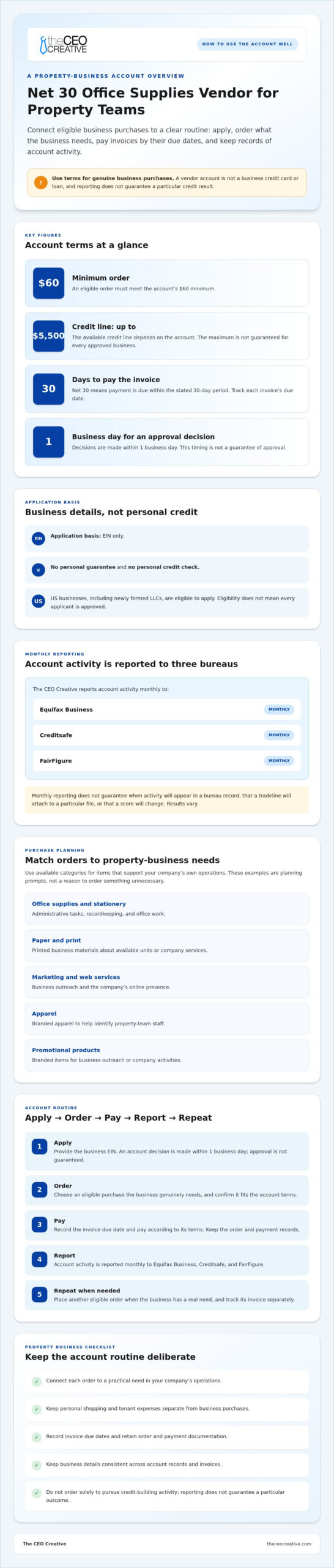
Using a Net 30 vendor account follows a clear sequence: apply, receive an account decision, place an eligible order, pay the invoice according to its terms, and repeat when the business needs another purchase. Keeping each step organized connects property-business purchases with responsible account management.
What happens after a business applies?
The application is based on the business’s EIN. There is no personal guarantee or personal credit check. US businesses, including newly formed LLCs, are eligible to apply, and there is no minimum time in business. Approval decisions are made within 1 business day. This is not a guarantee of approval or a particular account outcome.
Approved businesses can place eligible orders. The minimum order is $60, and the credit line is up to $5,500. The maximum is not a promise that every approved business will receive that credit line. Choose an order that meets an actual business need and fits the terms available to your account.
How monthly reporting relates to bureau records
The CEO Creative reports account activity monthly to Equifax Business, Creditsafe, and FairFigure. After ordering, pay the invoice by its due date and retain the order and payment records. If another eligible purchase is needed later, repeat the process and track its invoice separately.
Monthly reporting describes how often information is sent. It does not guarantee when the information will appear in a bureau record. Each bureau determines its own display timing, and reporting does not promise that a tradeline will attach to a particular file or change a score. Results vary. Keep business details consistent across account records, invoices, and payment documentation. This creates a clear record of account activity as you monitor your business credit file.
Which Net 30 Purchases Make Sense for Property Operations?
Choose orders that solve a real business need. For net 30 accounts for real estate and property management, eligible purchases may include administrative supplies, printed materials, and items that support staff identity or business outreach. The right fit depends on your operations, not simply on whether an item could be associated with a property.
Match recurring purchases to available categories
Use the table to connect common business needs with purchase categories. Treat each example as a planning prompt, not a reason to order something the business does not need.
| Purchase category | Possible property-business use |
|---|---|
| Office supplies and stationery | Support routine administrative tasks, recordkeeping, and office work. |
| Paper and print | Prepare printed business materials, such as information about available units or company services. |
| Marketing and web services | Support business outreach and the company’s online presence. |
| Apparel | Help identify staff through branded apparel used by the property team. |
| Promotional products | Support business outreach or provide branded items for company activities. |
| Drinkware | Serve as a branded business purchase for staff or outreach, not as a property-maintenance supply. |
For administrative purchases, see the Net 30 office supplies vendor. Place orders in the business’s name and use them for business purposes. Do not charge personal items or tenant expenses to an account intended for the company’s eligible purchases. Each order should also fit the account terms and your ability to pay its invoice on time.
Compare vendor terms with other credit-building approaches
A vendor account ties invoice terms to purchases from that supplier. A business credit card works through a card account, while a loan involves borrowing funds under its own terms. These are different arrangements, not interchangeable descriptions of a vendor account. This account supports eligible purchases. It is not property financing or an operating cash advance.
Before ordering, ask whether the purchase belongs in your operating budget and would make sense even without a credit-building goal. Routine supplies or a considered marketing purchase may fit. An unnecessary order does not become worthwhile just because it uses Net 30 terms. Match purchases to genuine needs, then manage each invoice according to the account terms.
A Property Business Checklist for Using Net 30 Terms Responsibly
A simple routine helps property businesses track why an order was placed and when payment is due. Use this checklist before ordering and throughout the account cycle. Net 30 accounts for real estate and property management may contribute account activity to a business credit file, but responsible use does not guarantee a particular result.
Five steps before placing an order
- Confirm the business purpose. Make sure the purchase supports your company’s operations and fits an eligible category. Keep business purchases separate from personal spending and tenant expenses.
- Review the account terms. Check the $60 minimum order and credit line of up to $5,500. Plan within the terms available to your account rather than assuming a particular credit limit.
- Set a payment plan. Before submitting the order, identify how the invoice will be paid and when. Enter the expected due date in your bookkeeping or invoice-tracking system.
- Record the transaction. Save the order confirmation and invoice with your business records. Use consistent business information across orders and payment records.
- Pay and retain proof. Pay according to the invoice terms, then keep payment documentation with the invoice. Review your records regularly so outstanding balances are not overlooked.
Common mistakes that can undermine account management
- Mixing personal and business purchases. Keep account activity tied to legitimate business orders.
- Missing invoice due dates. Record deadlines when invoices arrive and track payment completion.
- Ordering items the business does not need. Do not make unnecessary purchases solely to pursue a tradeline or an assumed score increase.
- Assuming approval is automatic. Applying does not guarantee approval or a particular account limit.
- Expecting guaranteed credit results. Reporting is monthly, but bureau display timing and credit outcomes are not guaranteed. Results vary.
Use the account as a purchasing tool first. Keep orders, invoices, due dates, and payments organized, and assess account activity based on what the business needs. This article is for educational purposes only and is not financial or legal advice.
Is The CEO Creative a Practical Net 30 Vendor for Property Businesses?
The CEO Creative provides a Net 30 vendor account for eligible US businesses, including property management companies and real estate firms. It can fit a business that needs eligible products, can manage invoice payments, and wants monthly reporting to business credit bureaus. The practical question is whether the account fits actual operations and the company’s payment plan, not whether opening an account will produce a particular credit result.
Account facts property businesses can assess
The account is based on the business’s EIN, with no personal guarantee and no personal credit check. US businesses, including newly formed LLCs, are eligible to apply, with no minimum time in business. Approval decisions are made within 1 business day, but this does not guarantee approval or a particular account limit.
The minimum order is $60, and the credit line is up to $5,500. The CEO Creative reports monthly to Equifax Business, Creditsafe, and FairFigure. Each bureau controls when reported information appears in its records. Reporting does not guarantee that a tradeline will attach to a file or lead to a specific credit outcome. Results vary.
The company is BBB Accredited with an A+ rating, has been in business for 6+ years, and has 50,000+ reported tradelines. Consider these details alongside the account terms and the fit of its eligible purchase categories. They do not replace checking whether your business can manage the invoices or whether orders support genuine operating needs.
For details about the application basis, read the EIN-only Net 30 vendor information. This article is educational and is not financial or legal advice.
Build a Business Credit Plan Around Real Purchases
For property businesses, net 30 accounts for real estate and property management can connect eligible operating purchases with invoice terms and monthly reporting. The practical fit depends on whether the business needs the items, can manage the payment schedule, and understands how reporting works. The CEO Creative reports monthly to Equifax Business, Creditsafe, and FairFigure, but bureau display timing and credit outcomes are not guaranteed. Results vary.
The account is based on an EIN, with no personal guarantee or personal credit check. The CEO Creative is BBB Accredited with an A+ rating. Weigh these details against your purchasing needs and invoice processes. This article is educational, not financial or legal advice.
Keep orders tied to real business needs and records organized. A steady, informed approach helps you manage vendor terms while your property business grows.
Frequently Asked Questions
Can a newly formed real estate LLC apply for a Net 30 account?
Yes. Newly formed US LLCs are eligible to apply, and there is no minimum time in business. Applications are based on the business’s EIN, but eligibility does not guarantee approval or a particular credit line. Approval decisions are made within 1 business day, but that is not a promise of approval. A real estate business should also consider whether it has eligible purchases and can manage invoice payments under the account terms.
Does a Net 30 account help a property management company build business credit?
A Net 30 vendor account may contribute payment activity to a business credit file when the vendor reports account information. The CEO Creative reports monthly to Equifax Business, Creditsafe, and FairFigure, but reporting does not guarantee that a tradeline will appear on a particular file or change a score. Results vary. For net 30 accounts for real estate and property management, use the account for eligible business purchases and pay invoices according to their terms.
Which business credit bureaus does The CEO Creative report to?
The CEO Creative reports monthly to Equifax Business, Creditsafe, and FairFigure. Each bureau determines when reported information appears, so monthly reporting does not mean information will show on a specific date. Reporting also does not guarantee that an account will attach to a business file or produce a particular credit result. Keep your business records consistent and review relevant bureau records through the channels available to your business.
Is a personal guarantee or personal credit check required?
No. The account application is based on the business’s EIN, with no personal guarantee and no personal credit check. This describes the application basis, not a guarantee of approval or a specific account limit. Before applying, consider whether your company has eligible business purchases and a workable process for tracking invoices and paying them by their due dates. Keep account activity separate from personal spending.
What can a real estate business order with Net 30 terms?
Eligible purchases may include office supplies, stationery, paper and print, apparel, drinkware, promotional products, and marketing and web services. A property business might use office supplies for administration or printed materials for business outreach. Branded apparel or promotional products may suit team identification or company activities.
How much is the minimum order, and what is the available credit line?
“Up to” means the stated maximum is not a promise that every approved business will receive that amount. Plan purchases around actual business needs and the account terms available to your company. Track each invoice and due date so the payment obligation is clear before placing another order.
How long does it take for a Net 30 tradeline to appear on a bureau report?
There is no guaranteed display timeline. The CEO Creative reports monthly to Equifax Business, Creditsafe, and FairFigure, but each bureau determines when reported information appears in its records. Monthly reporting does not guarantee that a tradeline will attach to a specific business file or result in a score change. Keep your business information and payment records consistent, and do not rely on a particular appearance date.