


What if a vendor bill could help a law firm build business credit, but only if the vendor reports payment history? Net 30 accounts for law firms can support useful purchases and a business credit profile, but ordinary invoice terms do not automatically create a reporting tradeline.
When comparing options, check whether a new firm can apply with its EIN and whether the required purchases fit its operations. This guide explains how vendor Net 30 differs from service provider billing, which reporting and eligibility details to verify, and how to choose purchases your firm can actually use.
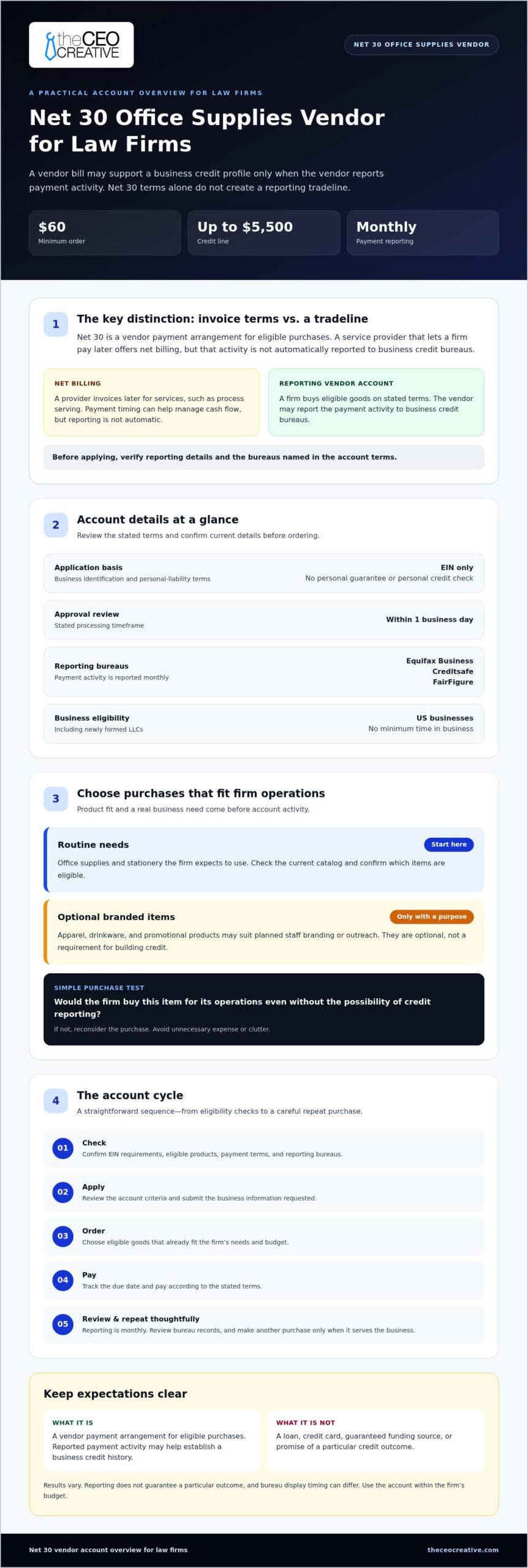
The account details covered here include an EIN only account with a $60 minimum order, a credit line up to $5,500, and monthly reporting to Equifax Business, Creditsafe, and FairFigure. These terms do not guarantee approval or a particular credit outcome. Review current account details before applying, and treat Net 30 as a vendor payment arrangement, not a loan.
Key Takeaways
- Compare net 30 accounts for law firms by checking whether the vendor reports payment activity, not just whether it offers invoice terms.
- Start with purchases your firm already needs, such as office supplies, and treat branded merchandise as optional.
- Before applying, confirm the account’s EIN requirements, eligible products, payment terms, and reporting bureaus.
- Use a consistent payment routine to track due dates, review bureau records, and avoid purchases that do not support firm operations.
What Net 30 Accounts for Law Firms Actually Do
A reporting vendor account lets an eligible law firm buy goods on stated payment terms. The vendor may then report the firm’s payment activity to business credit bureaus. In short, a reporting Net 30 account is a vendor purchase arrangement whose payment history may be reported to business credit bureaus.
This is a form of trade credit: a supplier provides goods before payment is due. But the payment schedule alone does not establish a tradeline. Before applying, confirm whether the vendor reports account activity and which bureaus it reports to. A reporting account may help establish business credit history, but results vary and are not guaranteed.
Vendor tradeline or net billing for legal services?
The difference comes down to what you are buying and whether the payment activity is reported. A process serving company might let a law firm receive services and pay the invoice later. That is operational net billing, which can help manage the firm’s payment schedule, but it is not automatically a business credit tradeline.
A vendor account for goods is different only if its terms include credit reporting. Do not assume every provider that offers “Net 30” reports to business bureaus. Look for explicit reporting details in the account terms and ask the vendor to clarify anything that is unclear.
Why a law firm might consider a vendor account
When a firm already plans to buy eligible business goods, a reporting vendor account may let it make a useful purchase while building a record of business payments. Fit is the priority: choose items the firm needs, rather than buying something solely in the hope of improving its credit profile.
An account tied to the business can also help keep eligible purchases and payment activity distinct from personal credit activity. Check how the vendor evaluates applications, including whether it uses the firm’s EIN and requires a personal guarantee. These terms differ among providers.
A vendor Net 30 account is not a loan, a credit card, or a guaranteed funding source. It is a payment arrangement for eligible purchases. Use it within the firm’s budget, pay by the stated due date, and treat any potential credit building benefit as a possible outcome, not a promise.
What a Law Firm Can Order on Net 30 Terms
Choose an account based on what your firm can use, not simply on the promise of payment terms. Office supplies, stationery, apparel, drinkware, and promotional products are purchasing categories to consider, but verify which items are currently eligible under the account before applying.
Match purchases to actual law-firm operations
Start with recurring, planned office needs. Depending on the current catalog, office supplies and stationery may support everyday administrative work, such as keeping desks stocked or preparing materials for internal use. A Net 30 office supplies vendor may suit your firm if these purchases fit its routine and budget. Do not assume the selection includes specialized legal supplies; confirm the available products directly.
Before ordering, compare the purchase with your existing purchasing plan. If your firm does not need an item, buying it just to open or use a tradeline can add unnecessary expense and clutter. Product fit matters more than order volume or choosing a category with little connection to your operations.
When branded products may make sense
Apparel, drinkware, and promotional products can be useful when the firm already has a branding or outreach purpose for them. For example, a firm might consider branded apparel for staff or promotional items for an event, provided those purchases are planned and appropriate. They are optional business purchases, not legal equipment and not a requirement for building credit.
Stationery and other print related items may also serve practical or branding needs, depending on the firm’s use and the vendor’s current catalog. Check specifications, eligible categories, and account terms before ordering. For a wider perspective on choosing vendors, review this overview of Net 30 vendor accounts for business credit.
A sensible shortlist separates purchases into two groups:
- Routine needs: Office supplies and stationery the firm expects to use.
- Optional branded items: Apparel, drinkware, and promotional products tied to a specific business purpose.
This distinction keeps account use grounded in real operations. If the firm needs only office essentials, focus there rather than adding merchandise simply because it is available. Review eligible products and payment terms before committing, then choose only items that make sense for the firm.
How a Law Firm Net 30 Account Works: Apply, Order, Pay, Report
Using net 30 accounts for law firms follows a straightforward cycle: apply, review the decision, order eligible goods, pay by the due date, and make another purchase only when it fits the firm’s needs. The account information states approval within 1 business day. That is a stated timeframe, not a promise of approval or a guaranteed decision time for every application.
Application and purchasing terms to check
The account is described as EIN only, with no personal guarantee and no personal credit check. Account information identifies US businesses, including newly formed LLCs, as eligible to apply. That does not mean every applicant will be approved. Provide accurate business details and confirm current requirements before submitting an application.
Check the purchasing terms, too. The stated minimum order is $60, and the credit line is up to $5,500. Neither figure guarantees a specific amount of available credit for an individual firm. Confirm which products qualify, the payment due date for each order, and whether the current terms match the account information.
From application to reporting
- Apply: Submit the firm’s accurate business information using its EIN.
- Receive a decision: Review the vendor’s response and any approved account terms before ordering.
- Place an eligible order: Choose goods that the account permits and the firm actually plans to use.
- Pay by the due date: Track the invoice and pay according to its stated terms.
- Repeat responsibly: Make another purchase only when it fits the firm’s budget and operating needs.
What monthly reporting means for the firm
The account information states that payment activity is reported monthly to Equifax Business, Creditsafe, and FairFigure. Monthly reporting means the vendor submits account information on a recurring basis. It does not promise that a particular bureau will display the information by a certain date or that the firm will receive a specific score or credit outcome. Each bureau controls when information appears, and timing is not guaranteed.
Keep invoices and payment records, then check the relevant business credit files over time. If you are assessing whether an EIN based account suits your firm, review the business Net 30 account details and verify the current terms before applying. Organizations comparing reporting and payment routines may also find this guide to Net 30 accounts for nonprofits and monthly business credit reporting useful.
How to Evaluate Net 30 Accounts for a Law Firm
Compare purchase fit and reporting terms, not just the “Net 30” label. The label describes when payment is due; by itself, it does not confirm that a vendor reports payment activity to business credit bureaus. Ask for reporting details and account terms before applying.
Compare the details that affect your firm
Use this snapshot as a starting point. The CEO Creative terms below come from the account information in this article; confirm current terms and eligible product categories with the vendor. Other vendors’ terms can change, so check their current published details or ask them directly.
| Account | Product fit | Reporting bureaus | Minimum order | Credit line | Application basis |
|---|---|---|---|---|---|
| The CEO Creative | Office supplies, apparel, drinkware, stationery, and promotional products; confirm current eligibility | Monthly to Equifax Business, Creditsafe, and FairFigure | $60 | Up to $5,500 | EIN only; no personal guarantee or personal credit check |
The account information states approval within 1 business day, but this is not a guarantee of approval. A stated credit line also does not promise that every applicant will receive access to that amount.
Questions to ask before choosing a vendor
For net 30 accounts for law firms, check whether the vendor confirms monthly reporting and names the business bureaus. Then consider whether its goods match purchases your firm already plans and can afford. Confirm the minimum order, available credit, eligibility rules, payment deadline, and any account requirements. If reporting terms are unclear, ask the vendor to explain them before relying on the account as a credit building option.
A practical law-firm account checklist
- Check that the firm’s legal business name and EIN details are accurate.
- Match eligible products to real, budgeted business purchases.
- Review the payment deadline and set a process to track it.
- Confirm reporting bureaus and terms directly with the vendor.
- Compare one suitable account carefully rather than applying indiscriminately.
A focused review helps your firm choose an account for its practical value while keeping reporting and payment expectations clear.
Manage a Law Firm Net 30 Account Responsibly
With a clear purchasing and payment routine, net 30 accounts for law firms can support business credit building efforts while covering planned firm expenses. An account alone does not guarantee a credit outcome, so confirm its terms and manage each invoice carefully.
Numbered checklist for using the account
- Verify terms before applying. Confirm eligible purchases, the minimum order, reporting bureaus, and the payment deadline. For this account, the stated minimum order is $60, the credit line is up to $5,500, and monthly reporting is to Equifax Business, Creditsafe, and FairFigure. The stated approval timeframe is within 1 business day, but approval is not guaranteed.
- Choose purposeful purchases. Order only goods the firm has a business reason to buy, such as office supplies it already needs. Branded apparel and promotional products are optional, not credit building requirements.
- Track and pay every invoice. Record invoice dates, amounts, and due dates in the firm’s bookkeeping or accounts payable system. Pay according to the account’s stated terms, and retain invoices, payment confirmations, and account correspondence.
Common mistakes to avoid
- Buying unneeded goods just to create account activity.
- Missing a payment deadline or relying on memory instead of reminders.
- Assuming bureau reporting guarantees a score increase or approval elsewhere.
- Expecting every bureau to display account information in the same way.
- Overlooking eligible purchase limits, minimum order requirements, or updated terms.
- Failing to keep invoices and proof of payment for bookkeeping and follow up.
What should a law firm verify before opening a Net 30 account?
Check the current terms, eligible purchases, minimum order, reporting bureaus, and payment deadline before applying. Confirm that the business name and EIN details you provide match the firm’s records. The CEO Creative account is described as EIN only, with no personal guarantee or personal credit check. Its terms include a $60 minimum order and a credit line up to $5,500. Verify the details before placing an order.
What should a law firm buy with a Net 30 account?
Choose goods the firm has a real operational reason to purchase. Office supplies may fit routine needs, while apparel or promotional products may make sense only if the firm already plans to use them. Do not add unnecessary items to meet a target or create activity. Check the vendor’s current eligible categories first, then keep the order within the firm’s budget and purchasing policies.
How should a firm manage Net 30 invoices?
Enter each invoice into the firm’s accounts payable system as soon as it arrives, record its due date, and assign someone to monitor payment. Follow the deadline stated in the account terms rather than assuming every vendor calculates terms identically. Retain the invoice and payment confirmation with the firm’s records. This routine helps prevent missed payments and makes it easier to resolve questions about account activity.
Which business credit bureaus does this account report to?
The account information states that monthly reporting is made to Equifax Business, Creditsafe, and FairFigure. It does not state reporting to Dun & Bradstreet or Experian, so do not assume those bureaus receive information. Confirm current reporting details directly in the account terms before applying. Reporting can support a credit file, but it does not guarantee that a bureau will create or update a particular record.
Does opening or paying a Net 30 account guarantee better business credit?
No. Opening an account or paying invoices on time does not guarantee a score increase, a particular credit profile, or approval for future financing. Outcomes can depend on factors outside the vendor relationship, including how information is received and evaluated. Treat a Net 30 account as one part of organized business credit management. Keep payments timely, use the account responsibly, and avoid borrowing or spending based on an assumed result.
Why might an account appear differently across credit bureaus?
Business credit bureaus maintain separate files and may receive or display account information differently. A tradeline might not appear in every file, or its details may not look identical across bureau records. Do not assume that a difference automatically means a payment was missed. Compare the account statement and payment records with each bureau’s file, then contact the vendor or bureau if information appears inaccurate or incomplete.
Results vary, and this article is not financial or legal advice. Review current terms and make decisions based on the firm’s needs and professional guidance.
For current terms and eligible purchases, review the business Net 30 account details.
Choose a Net 30 Account That Fits Your Firm
The most useful net 30 accounts for law firms are those that combine purchases the firm needs with clearly confirmed reporting terms. A Net 30 label alone does not prove that a vendor reports payment activity, and reporting does not guarantee a particular credit result. Check eligible products, payment deadlines, and bureau reporting before applying, then keep purchases within the firm’s budget and pay invoices on time.
The CEO Creative offers a membership program and custom branding products, including apparel, drinkware, and stationery, as well as professional logo design services. These products may suit a firm with planned branding or purchasing needs, but they do not replace the need to verify account eligibility, reporting, and payment terms.
Start by reviewing the current account terms and matching eligible purchases to a clear plan. A consistent payment process can help your firm use vendor credit thoughtfully as part of its broader business credit approach.
Frequently Asked Questions
Can a newly formed law-firm LLC apply for a Net 30 vendor account using only its EIN?
Yes, a newly formed law firm LLC can apply using its EIN under the account information provided. The CEO Creative serves newly formed LLCs, and its account is described as EIN only, with no personal guarantee or personal credit check. EIN only describes the application basis, not guaranteed approval. Provide accurate business details and verify current eligibility and terms before submitting an application.
Do Net 30 vendor accounts for law firms report to business credit bureaus?
Some do, but a Net 30 payment schedule alone does not confirm credit reporting. A vendor must state that it reports payment activity and identify the business credit bureaus it reports to. Before applying, check the account terms or ask the vendor directly. Also confirm whether reporting is monthly, and understand that bureau display timing and credit outcomes are not guaranteed.
Which business credit bureaus does The CEO Creative report to?
The CEO Creative’s account information states that it reports monthly to Equifax Business, Creditsafe, and FairFigure. It does not list Dun & Bradstreet or Experian as reporting destinations, so do not assume those bureaus receive account information. Confirm the current reporting terms with the vendor before applying. Each bureau manages its own records, and when information appears can vary.
Does opening a Net 30 account guarantee that a law firm will build business credit?
No. Opening an account or paying invoices on time does not guarantee a credit score increase, a particular business credit profile, or approval for future financing. Reporting may contribute payment information to a business credit file, but results vary. Choose purchases that fit the firm’s actual needs, pay according to the account terms, and treat credit building as a possible benefit rather than a promised result.
What can a law firm purchase through a Net 30 vendor account?
Eligible products depend on the vendor and account terms. The CEO Creative’s confirmed categories include office supplies, apparel, drinkware, stationery, and promotional products. Office supplies may fit routine firm needs, while branded apparel or promotional items are optional purchases, not requirements for building credit. Check current catalog availability and account eligibility before ordering, and avoid buying goods the firm does not have a business reason to use.
What is the minimum order for The CEO Creative’s Net 30 account?
The stated minimum order for The CEO Creative’s Net 30 account is $60. Confirm the current order requirement and which products qualify before placing an order, since terms and eligible categories should be checked directly with the vendor. Plan purchases around the firm’s real operating needs and budget rather than ordering extra goods solely to meet the minimum or create account activity.
How quickly can a law firm receive an account decision?
The account information states approval within 1 business day. This is the stated timeframe, not a promise that every application will be approved or receive a decision within that period. Submit accurate business and EIN details, then check directly with the vendor if you need an update. Review any decision and the assigned account terms before placing an order.
Ready to assess whether the account fits your firm? Review the current business Net 30 account terms and eligible purchases.