


What if a vendor purchase could help establish business credit, but only if the vendor reports your payment history? If you’re wondering what is a net 30 account, the basic idea is simple: a vendor lets your business pay an invoice within 30 days, according to the agreed terms. The due date and whether your payment activity appears on a business credit file are separate details to verify.
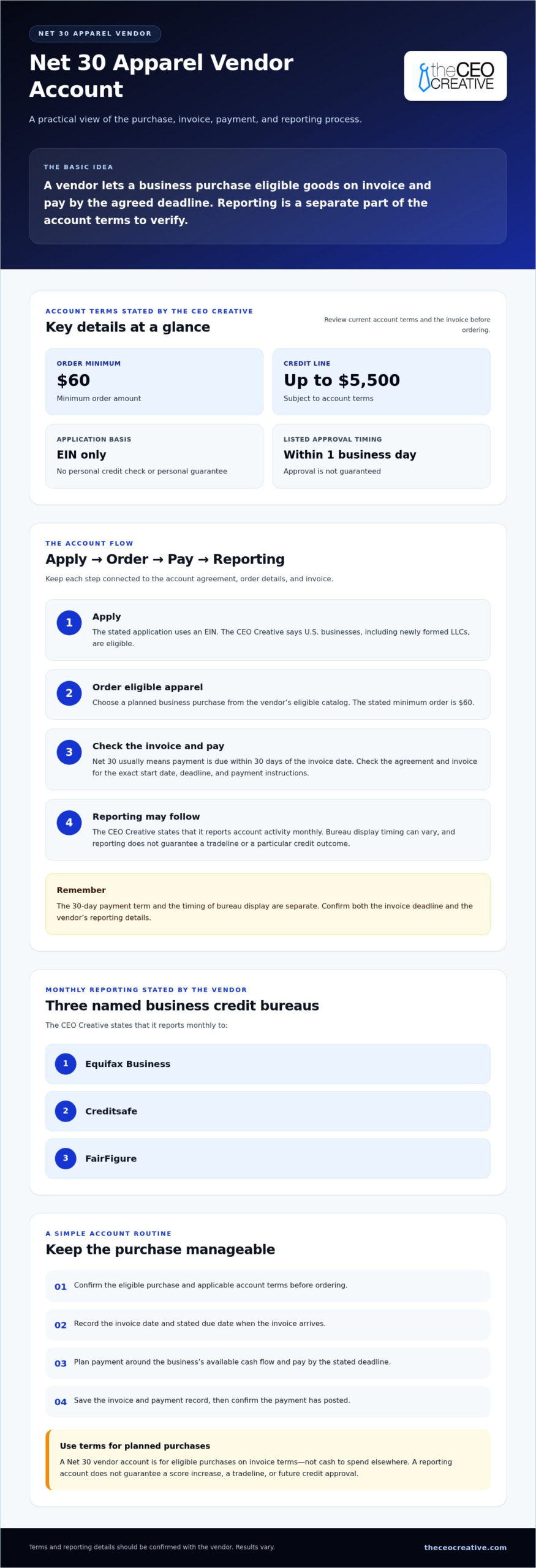
Before applying, it’s reasonable to ask when the payment clock starts, which bureaus receive reports, and whether the vendor checks personal credit or requires a personal guarantee. Terms vary, so don’t assume every Net 30 account works the same way. The CEO Creative states that it reports monthly to Equifax Business, Creditsafe, and FairFigure, and that its account terms include an EIN-only application with no personal credit check or personal guarantee.
This guide explains how Net 30 vendor accounts work, what to check about reporting and application requirements, and how to manage payments responsibly. A reporting account may support credit-building efforts, but it doesn’t guarantee a tradeline, a score increase, or another credit outcome.
Key Takeaways
- If you’re asking what is a net 30 account, understand the steps from application to order, invoice, and payment.
- Before applying or ordering, check the invoice date, payment deadline, eligible purchases, and reporting details.
- Use a Net 30 account for planned business purchases you can repay on time, not as a loan or credit card.
- A tradeline may contribute to your business credit profile, but reporting doesn’t guarantee a score increase or future credit approval.
- Track invoices and payments consistently so due dates don’t get lost in day-to-day business tasks.
What Is a Net 30 Vendor Account?
A Net 30 account is a vendor arrangement that lets a business buy eligible goods or services and pay the invoice within 30 days, subject to the agreed terms. In a business-to-business transaction, this is a form of trade credit: the vendor provides the purchase now, and the business pays later.
The term describes the payment deadline, not a promise about credit reporting. A vendor account isn’t automatically a loan, credit card, or reporting tradeline. Whether payment activity is reported depends on the vendor’s policies. For a neutral overview of how the term is used, see Net 30 payment terms.
When is a Net 30 invoice due?
Usually, “Net 30” means payment is due within 30 days of the invoice date. However, the agreement may define the starting point or other details differently. Check the vendor agreement and each invoice for the date that starts the payment period, the exact deadline, and accepted payment methods. The invoice due date is separate from when a bureau may display a reported tradeline.
For example, if your business orders apparel or office supplies on account, record the invoice date and stated due date as soon as the invoice arrives. That makes it easier to confirm whether the payment period starts with the invoice, the order, or another event specified by the vendor.
How is vendor credit different from a loan?
With vendor credit, a business can buy eligible goods or services on invoice terms. The business owes payment for those purchases. The vendor isn’t advancing cash for the business to spend elsewhere, as a lender might with a loan.
This distinction matters because a purchase may create a reporting tradeline if the vendor reports account activity, but opening an account alone doesn’t guarantee reporting or a particular credit outcome. The CEO Creative offers Net 30 accounts for business purchases, including apparel and office supplies. Review its business Net 30 account details to understand the stated terms. Treat vendor terms as a way to manage eligible purchases and invoices, not as a substitute for a card, loan, or individualized financial advice.
How a Net 30 Account Works: Apply, Order, Pay, Report
The process is easier to manage when you break it into steps: apply, receive an account decision, place an eligible order, pay by the stated deadline, and repeat as needed. If you’re researching what is a net 30 account, think of it as a purchasing relationship with terms to manage, not access to cash.
What happens after applying?
The CEO Creative states that its application is EIN-only, with no personal credit check or personal guarantee. Its stated eligibility includes U.S. businesses, including newly formed LLCs, with no minimum time in business. These terms don’t mean every applicant will be approved. The company lists approval within 1 business day, but approval isn’t guaranteed. Confirm current application requirements and account terms before placing an order.
After approval, check the available purchasing limit. The CEO Creative lists a credit line of up to $5,500, subject to account terms. Each order must meet its stated $60 minimum. Plan purchases around both your business needs and the terms that apply to your account.
What can a business order on terms?
Eligible purchases depend on the vendor’s catalog and your account terms. The CEO Creative offers categories such as apparel, office supplies, and promotional products. For example, a business might order branded apparel it already needs for its team, then record the invoice and plan payment before the deadline. Browse the Net 30 apparel vendor category to see an example of goods available through vendor purchasing terms.
Use the account for planned purchases, not as permission to spend up to the limit without a repayment plan. Net terms can help manage the timing between buying supplies and paying for them. The U.S. Small Business Administration explains how these arrangements may conserve your company’s cash flow, but the invoice still needs to fit your budget and cash-flow schedule.
Pay according to the invoice and account terms. Save the invoice, record the due date, and confirm that payment has posted. Reporting is a separate step: a vendor may report account activity, but bureau display timing can vary. To manage the account responsibly, order only what the business needs, pay on time, and check the terms before each new purchase. Review the business Net 30 account terms to decide whether the arrangement fits your purchasing plans.
Which Bureaus Receive Net 30 Account Reporting?
Before opening an account to support your business credit profile, verify which business credit agencies the vendor reports to and how often. The CEO Creative states that it reports monthly to Equifax Business, Creditsafe, and FairFigure. That cadence doesn’t promise that a tradeline will appear immediately or affect a score in a particular way.
The CEO Creative reports account activity monthly to Equifax Business, Creditsafe, and FairFigure. Reporting means the vendor submits account information. A bureau must then process that information before it may appear in a business credit file. This distinction matters when you’re building business credit: a vendor relationship may contribute account history, but reporting alone doesn’t guarantee a score increase or future credit approval.
What does a business tradeline show?
A business tradeline is an entry associated with an account relationship. It may include account details and payment activity, such as whether payments were made according to the terms. An account or payment won’t necessarily appear in every business credit file. Coverage depends on the vendor’s reporting practices and the bureau’s records.
When reviewing a business credit report, check that your company’s identifying details match its records. Look at the legal business name and other listed information for accuracy. If a tradeline seems missing or an entry looks incorrect, confirm the vendor’s reporting policy and ask the bureau about its process for reviewing report information.
Why might a tradeline not appear right away?
Monthly reporting doesn’t mean a bureau will display information as soon as a payment is made. The vendor’s submission and the bureau’s processing are separate steps, and display timing varies. A delay by itself doesn’t confirm that the vendor failed to report or that your payment wasn’t submitted.
Check the vendor’s current reporting policy, including which bureaus receive information and how often it’s sent. Allow time for the bureau to process the submission before drawing conclusions. If you’re unsure, contact the vendor to confirm whether the account activity was included in a reporting cycle, then check the relevant business credit file again later. Don’t count on a fixed appearance date or treat one tradeline as a guaranteed credit result.
Net 30 Account Checklist and Common Mistakes
A quick review before applying and ordering can help you manage vendor terms. Using a Net 30 account responsibly means understanding the purchase terms and having a repayment plan, not just submitting an application.
What should I check before applying?
Use this checklist before opening an account, then revisit the order-related details whenever you buy:
- 1. Verify business details. Make sure the legal business name, EIN, and application information are accurate and consistent.
- 2. Review eligibility. Check that your business meets the vendor’s current application requirements, and clarify whether an EIN-only application or personal guarantee applies.
- 3. Confirm the purchase terms. Review the minimum order, available credit line, payment deadline, and how the due date is calculated. The CEO Creative states a $60 minimum order. Verify current terms before submitting an order.
- 4. Check reporting claims. Confirm which bureaus receive reports, how often the vendor reports, and whether reporting applies to your specific account.
- 5. Assess the order. Buy only goods the business needs and can pay for by the invoice due date. Keep the invoice and record its deadline.
For a broader comparison as you evaluate options, review this Net 30 vendors guide. Businesses considering EIN-only Net 30 vendors should still read each provider’s application requirements and account terms.
Which mistakes can weaken account management?
- Assuming every vendor reports. Ask about reporting directly. Opening an account alone doesn’t guarantee a tradeline or a credit outcome.
- Missing the actual due date. Don’t rely only on “Net 30.” Read the invoice instructions and record the stated deadline as soon as it arrives.
- Expecting a tradeline to show immediately. Monthly reporting and bureau display are separate steps, and display timing varies.
- Ignoring vendor-specific terms. Minimum orders, eligible purchases, and account limits can differ. Recheck them before placing an order.
- Spending beyond repayment capacity. Don’t use terms for unnecessary purchases or assume future revenue will arrive in time to cover the invoice.
A simple system can help: save each invoice, set a payment reminder, and match every order to a real business need and available cash. Good account management starts before checkout.
Is a Net 30 Vendor Account Right for Your Business?
When weighing what is a net 30 account against your business’s needs, focus on the purchase, payment deadline, and reporting policy. A vendor account may fit if you already need eligible business goods, understand when invoices are due, and can pay on time. It’s less suitable if you’d order mainly to pursue a possible credit benefit or would need uncertain future revenue to cover the bill.
When can a reporting vendor account make sense?
Consider a vendor account when routine purchases, such as branded apparel, office products, or promotional items, fit your operations and budget. Responsible invoice payments may support a record of account activity when the vendor reports, but they can’t guarantee a tradeline, higher score, or approval for future credit. The CEO Creative states that it reports monthly to Equifax Business, Creditsafe, and FairFigure. Those reporting practices and other account terms are specific to this vendor, not standard features of every Net 30 account. Learn more about building business credit without a loan through vendor purchasing and reporting.
What should you confirm before choosing a vendor?
Check the details before applying and revisit them before ordering. Verify the minimum order, available credit line, approval process, payment deadline and due-date trigger, eligible purchases, and which bureaus receive reports. The CEO Creative states a $60 minimum order and a credit line of up to $5,500. Its account terms include an EIN-only application, no personal guarantee, and no personal credit check. Don’t assume another vendor offers the same terms or that a stated reporting cadence means a tradeline will appear immediately.
Make your decision based on cash flow, not hoped-for credit results. Could your business pay the invoice by its due date if expected revenue is delayed? Are the goods useful, and would you buy them without the reporting feature? If either answer is no, pause and reassess. Reporting and bureau display timing vary, and credit outcomes aren’t assured. This guide is for general information, not financial or legal advice.
Make Your Next Vendor Account a Thoughtful Business Move
Understanding what is a net 30 account helps you focus on the essentials: know when the invoice is due, confirm whether the vendor reports and to which bureaus, and order only what your business can repay on time. A Net 30 account is a purchasing arrangement, not a promise of a stronger credit score or future approval. Reporting submission and bureau display are separate steps, and outcomes can vary.
The CEO Creative states that its account uses an EIN-only application, with no personal guarantee or personal credit check, and reports monthly to Equifax Business, Creditsafe, and FairFigure. The company is BBB Accredited with an A+ rating. Review the current account terms carefully to decide whether they fit your purchasing needs and cash flow.
With clear terms and a reliable payment routine, you can make informed choices for your business’s day-to-day operations. Review The CEO Creative’s business Net 30 account details to see whether the stated terms fit your purchasing needs.
Frequently Asked Questions
What does Net 30 mean on a business account?
Net 30 generally means your business must pay the invoice within 30 days, but the agreement or invoice determines when that period starts and the exact due date. A vendor may specify that the count begins on the invoice date. Check the stated deadline and payment instructions for every order. The term describes payment timing, not whether the vendor reports account activity to business credit bureaus.
Is a Net 30 account a loan or a credit card?
No. A Net 30 vendor account lets a business purchase eligible goods or services from that vendor and pay the resulting invoice later, under the account terms. It isn’t cash advanced for the business to use elsewhere, and it isn’t a credit card. The purchase still needs to fit your budget, and you’re responsible for paying the invoice by its due date.
Do all Net 30 vendors report to business credit bureaus?
No. Vendors set their own reporting policies, and some may not report account activity. Others may report to specific business credit bureaus, so confirm the vendor’s current policy before applying. Ask whether reporting is monthly or follows another schedule. Even when a vendor submits information, bureau processing and display timing can vary, and reporting doesn’t guarantee a particular credit score or future approval.
Which credit bureaus does The CEO Creative report to?
The CEO Creative reports monthly to Equifax Business, Creditsafe, and FairFigure. That describes the vendor’s stated reporting process, not when information will appear in each bureau’s records. Submission and display are separate steps. If you’re checking for an account entry, confirm your business details are accurate, allow time for processing, and contact the vendor if you need to verify its reporting policy.
Can a newly formed LLC apply for a Net 30 account?
A newly formed LLC may be eligible to apply, but eligibility doesn’t mean automatic approval. The CEO Creative states that U.S. businesses, including newly formed LLCs, can apply, with no minimum time in business. Its account terms include an EIN-only application, no personal credit check, and no personal guarantee. Review current application requirements and account terms before placing an order, since terms vary between vendors.
How much is the minimum order for The CEO Creative’s Net 30 account?
The CEO Creative states a minimum order of $60 for its Net 30 account. Check the current account terms before ordering, and confirm that your selections are eligible under the vendor’s catalog and your account. Plan around the invoice due date as well as the minimum, so the purchase meets your business needs and you can pay on time. Minimums may differ across vendors.