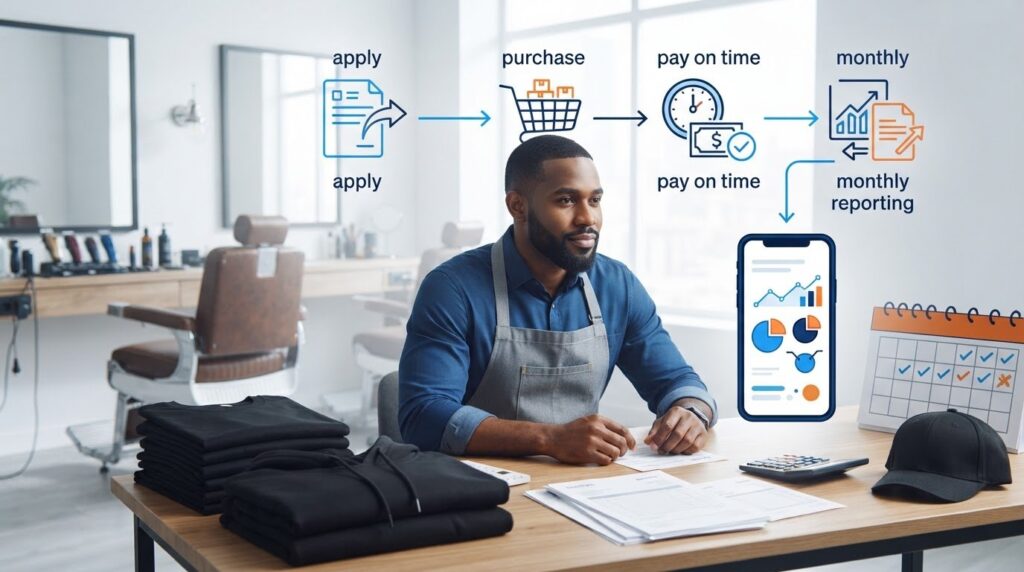


The most convenient platform for purchasing routine operational supplies might be doing nothing to build your commercial profile. When evaluating net 30 vs amazon business pay by invoice, dedicated Net 30 vendor accounts establish business credit far more reliably than Amazon’s procurement terms.
You already know that predictable invoicing helps protect working capital and cash flow. However, unclear underwriting requirements and inconsistent bureau reporting leave many business owners wondering if their timely payments are actually being tracked. While Amazon provides purchasing convenience, published reviews show its Pay by Invoice feature doesn’t reliably report positive payment activity to commercial bureaus.
This breakdown compares the exact qualification criteria, credit bureau reporting practices, and purchasing terms between standard Net 30 vendor accounts and Amazon Business Pay by Invoice. You’ll discover which option strengthens your commercial file without personal guarantees, helping you choose the right account structure for routine expenses.
Key Takeaways
- Understand the core reporting mechanics of net 30 vs amazon business pay by invoice to ensure your operational spending actually builds commercial tradelines.
- Discover why dedicated Net 30 vendor accounts offer fast, EIN-only approvals for new LLCs without requiring personal guarantees or lengthy transaction histories.
- Identify which credit bureaus receive monthly payment updates and why Amazon’s invite-only terms may leave gaps in your commercial credit file.
- Learn how to balance catalog utility between general operational supplies and custom business essentials like apparel, drinkware, and print materials.
- Implement a practical dual-track credit strategy that leverages accessible vendor terms first before expanding into broader corporate procurement options.
What Is the Difference Between Net 30 and Amazon Pay by Invoice?
Commercial purchasing requires structures that protect working capital while meeting day-to-day operational needs. At a glance, standard vendor invoicing and Amazon’s procurement options look almost identical. Both allow buyers to acquire items upfront and settle balances later. Yet the operational purpose behind these two financial instruments differs completely.
When weighing net 30 vs amazon business pay by invoice, you are choosing between a dedicated credit-building mechanism and a closed-loop procurement feature. Net 30 vendor arrangements center around business-to-business trade credit designed to generate positive payment records. Amazon Business Pay by Invoice, by contrast, functions strictly as a revolving digital purchasing line limited to orders placed across Amazon’s marketplace.
Defining Traditional Net 30 Vendor Credit
A standard Net 30 account gives a company 30 calendar days from the invoice date to pay for purchased goods. Rather than relying on commercial cards or third-party bank financing, a Net 30 supplier extends credit directly from its own ledger. This setup allows business owners to:
- Procure essential corporate items like branded apparel, promotional merchandise, and office products upfront.
- Preserve short-term cash reserves for payroll and immediate operational demands.
- Establish structured payment histories with commercial credit bureaus by paying invoices on time.
This approach provides dependable payment windows while turning standard overhead expenses into verifiable corporate credit markers.
How Amazon Business Pay by Invoice Functions
Amazon Business Pay by Invoice serves primarily as an internal procurement tool for medium and enterprise teams. Instead of functioning as an open tradeline account that any LLC can easily establish, it operates as an invite-only feature. Amazon assesses an account’s order volume and company profile before extending an offer.
Once activated, administrators receive an assigned spending limit. Invoices generate per shipment or consolidate into a single monthly statement depending on selected preferences. Standard terms require payment within 30 days, though businesses managing rapid stock turnover often review net 15 payment terms to align shorter settlement windows with immediate client billings.
The core distinction within the net 30 vs amazon business pay by invoice decision comes down to intent. Amazon designed Pay by Invoice to streamline checkout friction for high-volume purchasing departments. Dedicated Net 30 vendors build their accounts to provide accessible, direct trade credit that supports operational growth and formal credit file expansion.
Comparing Approval Criteria and Application Requirements
Underwriting criteria determine whether early-stage businesses can access practical credit lines or run into immediate roadblocks. Comparing net 30 vs amazon business pay by invoice reveals two opposing underwriting philosophies: accessible commercial onboarding versus institutional credit scrutiny.
Amazon Pay by Invoice Underwriting Standards
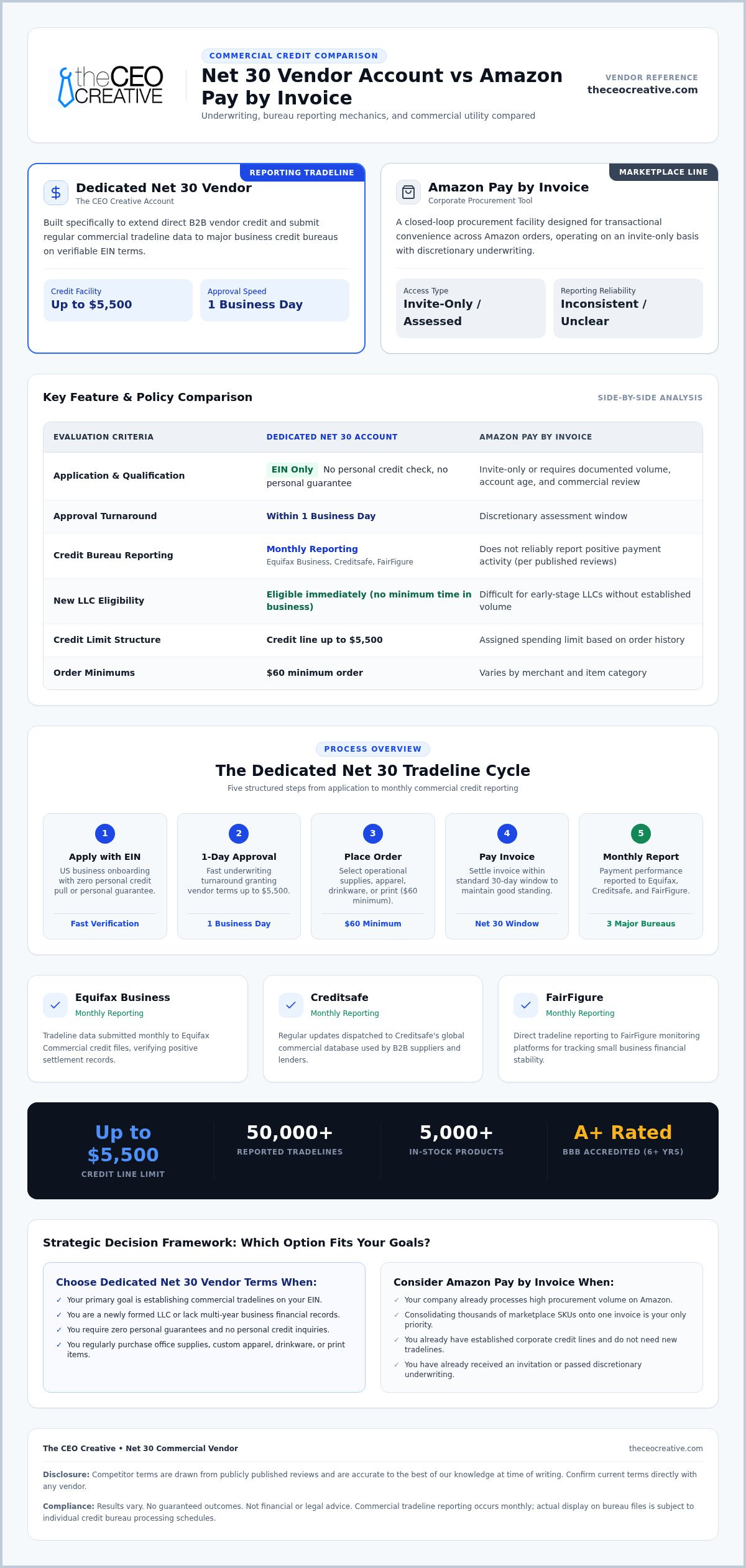
Amazon treats invoice financing as a discretionary privilege rather than an introductory trade line. Getting approved requires an invitation or passing an assessment based on established transaction volumes, account age, and commercial credit scores. If your LLC lacks documented revenue or a seasoned commercial file, obtaining this facility remains difficult. Competitor terms are drawn from publicly published reviews and are accurate to the best of our knowledge at time of writing. Confirm current terms directly with any vendor.
Accessible Net 30 Requirements for New LLCs
Dedicated vendors take an operational approach to extending Net Terms. Instead of pulling personal credit or requiring years of operational history, approvals rely strictly on verifying the legal existence of your business. This makes vendor credit accessible to enterprises at any growth phase.
Standard qualification criteria for dedicated tradeline accounts typically feature:
- EIN-only evaluation: Accounts require verification through an Employer Identification Number without personal credit inquiries.
- Zero personal liability: Approvals do not require personal guarantees, keeping company liabilities completely separate from individual assets.
- New business accessibility: Early-stage startups qualify without minimum operating durations or historical revenue demands.
- Fast processing: Account underwriting finishes quickly, often within one business day.
This structure allows new entities to place routine orders, with modest entry thresholds like a $60 minimum and credit lines reaching up to $5,500. Founders assessing an EIN only Net 30 alternative can bypass complex underwriting while protecting personal credit profiles. To establish predictable trade purchasing, consider opening an introductory business net 30 account that reviews your company on its own legal standing.
Credit Bureau Reporting: Building Tradelines That Matter
Generating verified commercial tradelines serves as the central motive for using trade credit. When evaluating net 30 vs amazon business pay by invoice, reporting reliability matters far more than checkout convenience. If a supplier fails to submit transaction data to commercial repositories, your on-time payments do nothing to develop your organization’s financial standing.
A structured approach to building business credit relies on creating an independent profile tied exclusively to your EIN. Without verified tradeline submissions, commercial credit scores cannot form. This leaves your company dependent on personal guarantees for future financing needs.
How Amazon Reports Commercial Invoices
Tracking payment records through Amazon Business Pay by Invoice presents significant ambiguity. Official program policies make no explicit commitment to report on-time settlement activity to commercial repositories. Published reviews and user reports indicate that reporting remains inconsistent, with some accounts noting intermittent updates to Dun & Bradstreet while others show no tradeline creation at all. Delinquent accounts, however, routinely get forwarded to collections, which quickly produces negative records across major agencies. Competitor terms are drawn from publicly published reviews and are accurate to the best of our knowledge at time of writing. Confirm current terms directly with any vendor.
Monthly Reporting via Equifax Business, Creditsafe, and FairFigure
Dedicated Net 30 vendors operate with transparent reporting protocols. Instead of treating credit data as secondary, specialized trade suppliers maintain established partnerships with commercial credit bureaus. Verified accounts receive regular payment reporting each month, providing reliable data points to Equifax Business, Creditsafe, and FairFigure.
To ensure your corporate overhead contributes to your credit profile, verify these three operational criteria before ordering:
- Targeted bureau network: Confirm which specific agencies receive the monthly payment files.
- Predictable reporting cadence: Ensure payments batch monthly rather than on sporadic quarterly cycles.
- Trade payment terms: Verify that qualifying orders, such as meeting a $60 minimum, attach directly to your business tax identifier.
While bureau display times vary by agency, consistent monthly vendor reporting remains the most dependable method for developing an independent corporate credit profile under the net 30 vs amazon business pay by invoice comparison.
Eligible Purchases and Everyday Utility Comparison
A credit line only delivers real value if the product catalog aligns with practical operational demands. Looking closely at net 30 vs amazon business pay by invoice shows how the utility of your spending changes depending on where you order. One path supplies broad commercial sundries; the other provides strategic brand assets and essential office supplies under confirmed reporting terms.
Amazon Catalog Strengths and Restrictions
Amazon provides an extensive online marketplace filled with routine operational merchandise, including electronics, breakroom goods, and facilities maintenance items. However, procurement through this platform introduces logistical hurdles for accounting departments. Third-party marketplace sellers often generate split shipments and separate invoices. Certain external merchant listings also exclude Pay by Invoice at checkout, forcing buyers to use personal cards instead. Confirm current terms directly with any vendor.
Custom Branding and Promotional Supplies on Terms
Specialized Net 30 suppliers streamline company spending by combining brand development with necessary operational items. Instead of buying unbranded generic goods from mixed merchant storefronts, business owners can outfit team members and market their services directly through structured catalog terms. These orders serve immediate commercial functions while establishing clear payment trails.
A dedicated net 30 office supplies vendor and branding partner allows growing companies to order essential items like:
- Decorated apparel: Custom corporate t-shirts, polo shirts, and in-house embroidered outerwear.
- Promotional assets: Branded drinkware, desk accessories, and corporate giveaway items via a net 30 promotional products vendor.
- Print and administrative essentials: Business cards, stationery, desk electronics, and daily office stock.
- Digital services: Website design packages and online marketing support.
With an accessible entry threshold of a $60 minimum order and credit facilities up to $5,500, dedicated vendors turn standard marketing and operational overhead into verifiable tradelines.
Balancing both purchasing methods across the net 30 vs amazon business pay by invoice landscape ensures your routine spending builds trade equity while keeping operations stocked.
How to Build a Dual-Track Corporate Credit Strategy
Relying on a single supplier leaves an enterprise vulnerable to sudden policy changes and limits commercial profile depth. Commercial underwriters want to see multiple active trade lines across distinct operational categories before extending large financing facilities. When assessing net 30 vs amazon business pay by invoice, the smartest operational approach treats them as complementary tools rather than mutually exclusive choices.
A dual-track purchasing model pairs accessible vendor accounts for consistent credit creation with general procurement portals for day-to-day office consumables. This strategy builds verifiable trade history while keeping daily purchasing fully functional.
Actionable Steps for First-Year Businesses
Establishing corporate trade credit requires a sequential roadmap. New companies can follow these four steps to build verifiable trade data from day one:
- Confirm formal registration: Register your LLC or corporation with the state, secure a clean EIN, and verify that your legal company name and commercial address match across all state databases.
- Secure Tier 1 vendor accounts: Apply to dedicated suppliers that extend terms based solely on your EIN without requiring personal guarantees or operating histories.
- Generate reportable transaction activity: Place qualifying orders that satisfy vendor thresholds, such as meeting a $60 minimum, rather than leaving accounts dormant.
- Settle invoices early: Pay every invoice ahead of the 30-day window to establish a flawless record of trade payment performance.
Establishing Structured Trade Credit Today
Once you establish initial tradelines through entry-level vendors, qualifying for closed procurement systems like Amazon Pay by Invoice becomes significantly easier. Commercial underwriting teams look for established payment references when evaluating risk. By routing required branded merch, decorated uniforms, and basic supplies through specialized vendors first, you build the transaction volume necessary to access broader procurement lines later. Confirm current terms directly with any vendor.
Balancing both channels delivers the best results. Apply for a business Net 30 account to begin securing confirmed monthly tradeline submissions while using marketplace procurement tools for incidental office sundries.
Strengthen Your Commercial Credit Foundation Today
Choosing between net 30 vs amazon business pay by invoice comes down to whether your primary goal is marketplace convenience or dependable commercial file growth. While Amazon streamlines procurement for established operations, dedicated Net 30 vendor accounts provide the verified tradeline reporting new enterprises need to build standalone credit profiles without personal liability.
Partnering with a reliable vendor turns ordinary operational overhead into credit-building milestones. Backed by over 6 years in business, more than 50,000 reported tradelines, and BBB Accreditation with an A+ rating, The CEO Creative provides fast approvals within 1 business day. Qualified companies can access credit lines up to $5,500 with a simple $60 minimum order requirement.
Taking intentional steps with reporting vendor accounts gives your company the structured trade history and operational momentum it needs to thrive.
Frequently Asked Questions
Can a brand new LLC qualify for Amazon Business Pay by Invoice?
Qualifying as a brand new LLC is rare because Amazon Business Pay by Invoice is an invite-only feature. Amazon assesses operational longevity, historical purchase volume, and existing credit files. Newly formed entities usually lack the transaction depth needed for an automated invitation. Startups seeking credit terms typically turn to dedicated trade suppliers that approve accounts using only an EIN without operating history requirements. Competitor terms are drawn from publicly published reviews; confirm current terms directly.
Does Amazon Pay by Invoice report on-time payments to credit bureaus?
Published reviews indicate Amazon Business Pay by Invoice doesn’t consistently report on-time payments to commercial bureaus. While co-branded Amazon payment cards report activity, standard Pay by Invoice terms make no public commitment regarding positive tradeline reporting. When assessing net 30 vs amazon business pay by invoice, dedicated vendor accounts provide far more value for credit building because they submit verified monthly payment data to commercial agencies. Competitor terms are drawn from publicly published reviews.
What is the difference between Net 30 vendor accounts and corporate credit cards?
Net 30 vendor accounts offer direct trade credit tied to specific supplier catalogs, requiring full balance settlement within 30 calendar days. They generally approve applications using an EIN without personal guarantees. Corporate cards function as revolving lines usable across general merchants, but they almost always demand personal credit checks, personal liability, and established annual revenue. Vendor tradelines provide early-stage enterprises with a significantly more accessible credit-building path.
Do all Net 30 accounts require a personal credit check or personal guarantee?
No, many specialized vendor accounts operate strictly on corporate identity verification without personal inquiries or personal guarantees. Suppliers designed for trade credit development evaluate businesses using their Employer Identification Number and state filing standing. This structure protects the owner’s personal credit score and keeps corporate liabilities separate from individual finances. Certain retail credit lines and institutional purchasing accounts, however, may still require personal underwriting.
Which credit bureaus track payments from dedicated Net 30 vendors?
Reporting bureaus depend entirely on each vendor’s commercial partnerships. Dedicated trade suppliers commonly report monthly transaction data to major commercial repositories such as Equifax Business, Creditsafe, and FairFigure. Other trade programs may submit files to Dun & Bradstreet or Experian Business. Before placing orders to build trade references, confirm which specific bureaus your vendor updates each month, as reporting practices differ widely across commercial suppliers.
What happens if a company pays an Amazon Pay by Invoice balance late?
Late payments on Amazon Pay by Invoice can lead to immediate purchasing freezes, account cancellation, and collections action. While on-time settlements rarely generate positive tradelines, past-due balances forwarded to third-party collection agencies are routinely reported to commercial credit bureaus. This creates severe negative marks on your corporate file. Settling invoices promptly protects account standing and prevents adverse credit entries. Competitor terms are drawn from publicly published reviews.
Can I use both Amazon Pay by Invoice and independent Net 30 vendors?
Yes, combining both structures creates an effective corporate purchasing system. In the net 30 vs amazon business pay by invoice comparison, using dedicated vendor accounts helps you generate structured monthly tradelines on operational and branding essentials. Once qualified, Amazon Pay by Invoice provides convenient cash flow management for incidental marketplace purchases. Maintaining multiple active accounts expands the depth and resilience of your commercial credit profile across multiple bureaus.