

Can a new business apply for Net 30 wholesale terms? Yes, some vendors consider newly formed businesses, but approval and account terms vary.
Before ordering, understand how the vendor sets invoice due dates, which products qualify, and how reporting works. This article walks through the application and purchasing process, practical account checks, and ways to manage invoices responsibly. Treat vendor terms as a purchasing arrangement, not a shortcut to a particular credit outcome.
Key Takeaways
- Understand what Net 30 means by checking the vendor’s stated invoice due date and account terms before ordering.
- See how a net 30 wholesale terms new business owner account can support planned business purchases, including apparel, drinkware, and stationery.
- Follow the account sequence from application and approval to ordering, payment, and monthly reporting, without assuming a particular credit outcome.
- Use a simple recordkeeping checklist to track each order, invoice date, due date, and payment confirmation.
- Decide whether vendor terms fit your business by weighing a real purchasing need against your ability to pay the invoice on time.
What Net 30 Wholesale Vendor Terms Mean for a New Business
Net 30 vendor terms let an approved business buy eligible products and pay later. The invoice due date follows the vendor’s stated terms, so confirm how the vendor calculates it rather than assuming every account gives you 30 days from the day you place an order.
This arrangement is a form of trade credit: a supplier provides goods or services before payment is due. It’s still a purchasing account, not a business credit card, loan, or promise of future financing. If the vendor reports the account, that information may appear as a business tradeline, but reporting does not guarantee a score change or a particular credit outcome.
How Net 30 terms differ from paying at checkout
At checkout, payment is generally made as part of the purchase. With vendor terms, an approved business places an eligible order and receives an invoice to pay according to the account’s rules. The invoice’s due date, not a date you choose, determines when payment is expected.
Before ordering, confirm the invoice date, due date, accepted payment methods, and any account rules that affect the purchase or payment. Don’t treat “Net 30” as a 30-day grace period starting from any date that suits your schedule. For a related explanation of payment terms, see Net 15 payment terms.
What a new LLC should expect from vendor credit
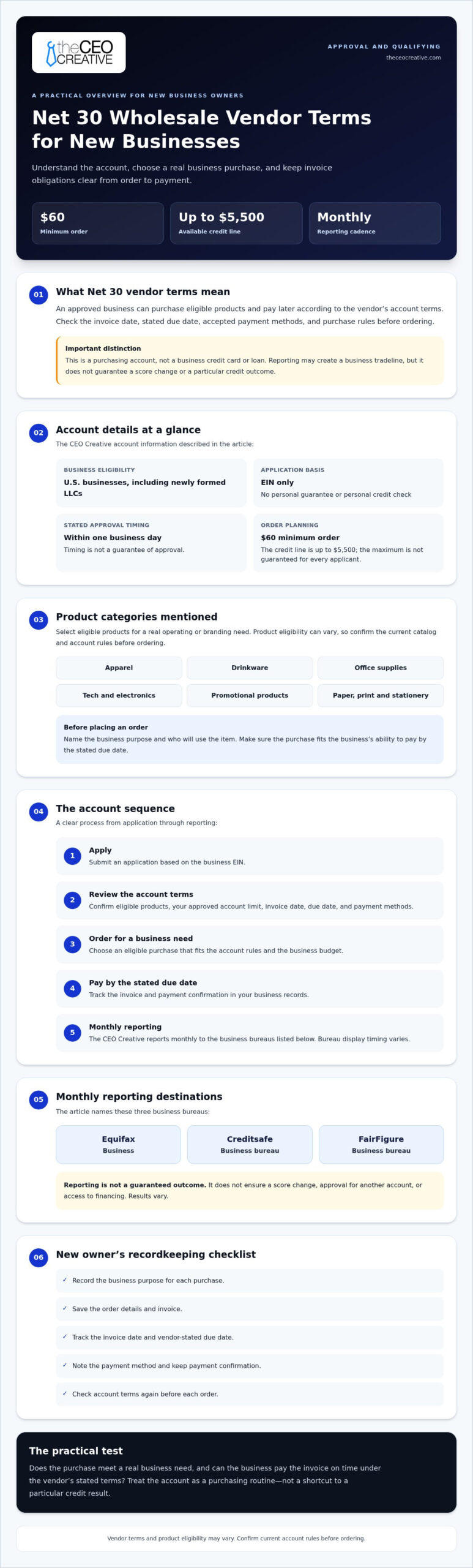
A newly formed LLC may be eligible for vendor terms. The CEO Creative considers U.S. businesses, including newly formed LLCs, with no minimum time in business. Its account is based on EIN only, with no personal guarantee or personal credit check. Approval is within one business day, but that timing isn’t a guarantee of approval.
A vendor tradeline can record the account relationship and, when furnished, payment history. The CEO Creative reports monthly to Equifax Business, Creditsafe, and FairFigure. Bureau display timing varies, and reporting doesn’t ensure a score change, approval for another account, or access to financing. Results vary.
For a net 30 wholesale terms new business owner, the practical test is whether the purchase meets a real business need and the invoice can be paid on time under the vendor’s terms. Treat the account as a structured purchasing routine, and review the terms before placing each order.
What a New Business Can Order on Net 30 Wholesale Terms
Net 30 wholesale terms connect an eligible business purchase with an invoice that’s paid under the vendor’s account terms. For a new owner, the useful question isn’t simply what’s available. It’s which eligible items serve a real business need and fit the payment the business can manage.
The CEO Creative offers product categories that include apparel, drinkware, office supplies, tech and electronics, promotional products, and paper and print, including stationery. Product eligibility can vary, so confirm the current catalog and account rules before you order. These terms apply to eligible purchases, not to loans, business credit cards, shipping supplies, or industrial tools.
Match the purchase category to a real business need
Start with the work your business already needs to do. Apparel may be useful for a team or as branded merchandise. Review the Net 30 apparel vendor page to see that category in context. Drinkware, office supplies, or stationery may also fit an operating or branding need. Choose based on intended use, not simply because an item can be ordered on terms.
A practical check: name the business purpose for the purchase and who will use it. If you can’t identify a clear use, pause before ordering. A vendor account creates a payment obligation, so the purchase should make sense even apart from any potential reporting benefit.
Check the minimum order and available credit line
The CEO Creative account has a $60 minimum order. That’s an order minimum, not a fee. Plan a qualifying purchase that meets the minimum and reflects a genuine need. The available credit line is up to $5,500; that’s a maximum, not an amount every applicant is guaranteed to receive.
Before placing an order, verify which products qualify, your approved account limit, and the applicable invoice and payment terms. Keep the purchase within what the business can repay by the stated due date. If you’re comparing purchasing terms with other ways to fund business needs, the U.S. Small Business Administration outlines several business financing options. A vendor account is for eligible purchases from that supplier, not general-purpose funding.
For a net 30 wholesale terms new business owner, a useful first step is to compare the planned item with the business’s actual operating, team, or branding priorities. That keeps the decision centered on the purchase itself and the payment obligation it creates.
How the Net 30 Account Works: Apply, Order, Pay, Report
For a net 30 wholesale terms new business owner, the account process is a sequence: apply, receive a decision, place an eligible order, pay by the invoice due date, then allow for monthly reporting. Each step has a separate purpose. Approval doesn’t mean every product qualifies or that a particular credit result will follow.
Application and ordering: what to prepare and confirm
Use accurate, consistent business details and EIN information in the application. The CEO Creative’s application is based on EIN only, with no personal guarantee and no personal credit check. U.S. businesses, including newly formed LLCs, may be eligible, and there’s no minimum time in business. Approval is within one business day as a stated account term, not a guarantee that an application will be approved.
After receiving a decision, check the approved account terms before ordering. The minimum order is $60, and the credit line is up to $5,500; the approved limit may be lower. Confirm that the items are eligible, that the order fits within the account’s available credit, and that you understand the invoice due date and accepted payment methods. The business Net 30 account details provide a place to review the account offering.
Payment and monthly bureau reporting
Once an order is placed, follow the invoice and account terms to make payment by the stated due date. Keep a record of the order, invoice, due date, and payment confirmation. This gives you a clear reference for managing the account and resolving questions about a transaction.
The CEO Creative reports monthly to Equifax Business, Creditsafe, and FairFigure. Monthly reporting describes the vendor’s reporting schedule, not the date a tradeline will appear in a bureau file. Each bureau controls its own processing and display timing, so don’t treat a particular appearance date or credit outcome as guaranteed.
After payment, review the account records and continue only with purchases the business needs and can repay under the terms. Reporting may record account activity, but results vary. A vendor account is for eligible supplier purchases, not a loan or business credit card.
A New Owner’s Checklist for Using Wholesale Net 30 Terms
A simple account routine helps keep purchasing, payment, and records in order. Before applying or placing an order, review the account terms and confirm the purchase fits your business’s needs and budget. The EIN-only Net 30 account details explain related eligibility information.
- 1. Check the account details. Confirm the application information you’ll use, the invoice terms, accepted payment methods, and any account rules. The CEO Creative’s minimum order is $60, so make sure a planned purchase meets that requirement.
- 2. Identify a real purchase need. Choose eligible products that support your operations, team, or branding. Check that the order fits the available account terms and that the business can pay the invoice by its stated due date.
- 3. Record the transaction. Save the order confirmation and invoice in your business records. Note the order, invoice date, and due date in one place, such as an accounting record or payment calendar. If you need support organizing payables and maintaining structured books, Fair View Accounting Services can help keep company accounts accurate and compliant.
- 4. Pay and retain proof. Pay according to the invoice and account terms. Keep the payment confirmation with the invoice so you can verify the transaction later if a question comes up.
Afterward, review relevant business bureau files periodically. Reporting is monthly, but bureau processing and tradeline display timing vary. Checking your files can help you see whether account information appears; it can’t guarantee a particular score change or future credit decision. Results vary.
Common mistakes to avoid
- Ordering beyond the business’s capacity. Don’t treat the available credit line as a spending target. Base each purchase on an actual need and a realistic plan to pay.
- Missing or misreading the due date. Don’t assume the due date starts from the order date or another date you choose. Use the date and terms shown on the invoice.
- Using inconsistent business details. Enter accurate, consistent business and EIN information in the application and keep records that match the transaction.
- Expecting guaranteed credit results. A reporting account isn’t a promise of a score increase, bureau display by a certain date, or future financing. Don’t open an account solely on that assumption.
For a net 30 wholesale terms new business owner, good account management starts with a suitable purchase, clear records, and timely payment. Contact the vendor promptly if you have a question about an invoice or account term.
Is a Net 30 Wholesale Vendor Account Right for Your New Business?
A vendor account may suit a business that has a planned purchase and can pay the invoice by its stated due date. It isn’t general-purpose funding, and monthly reporting doesn’t guarantee a score change, a tradeline display date, or future financing. Consider it a purchasing arrangement first, with reporting as one feature of the account.
When the account may fit your purchasing plans
Think about whether the business already needs items such as apparel for a team, drinkware, or stationery. If the purchase has a clear operating or branding purpose and the business can meet the payment obligation, vendor terms may be worth considering. If the order is mainly intended to produce a credit result, pause. Results vary, and a reporting account can’t promise one.
The CEO Creative considers U.S. businesses, including newly formed LLCs, with no minimum time in business. Eligibility doesn’t mean approval is assured. Before applying, look at expected cash needs and other upcoming obligations. Could the business pay the invoice on time without relying on a bureau display or a hoped-for credit outcome? That’s a more useful test than the business’s age alone.
What to verify before choosing a vendor
Read the account terms before committing. Confirm the eligible products, minimum order, approved credit limit, payment terms, accepted payment methods, and which bureaus receive reports. The CEO Creative states a $60 minimum order and a credit line of up to $5,500. The approved limit may be lower. Its reporting is monthly to Equifax Business, Creditsafe, and FairFigure; bureau processing and display timing vary.
For a net 30 wholesale terms new business owner, the account may be a fit if the order makes business sense and the due date works with the company’s cash flow. If either point is uncertain, take time to review the terms and reconsider the purchase before applying. This overview is for general information, not financial or legal advice.
Choose Terms Your Business Can Manage
For a net 30 wholesale terms new business owner, the right starting point is a planned purchase, a clear understanding of the invoice due date, and a reliable way to track payment. A vendor account is a purchasing arrangement, not funding, and reporting doesn’t guarantee a credit score change or future approval. Review the terms and make sure the payment fits your business’s cash flow.
The CEO Creative is BBB Accredited with an A+ rating and has been in business for more than six years, with 50,000+ reported tradelines. It reports monthly to Equifax Business, Creditsafe, and FairFigure. Bureau display timing varies, and results vary. This information is for general purposes and isn’t financial or legal advice.
Take a careful, step-by-step approach. With a real purchasing need and consistent account management, your new business can make informed decisions as it grows.
Frequently Asked Questions
Can a new business qualify for Net 30 wholesale terms?
Yes, a newly formed U.S. business may be eligible, but approval isn’t guaranteed. The CEO Creative considers U.S. businesses, including new LLCs, with no minimum time in business. Its application is based on EIN only, with no personal guarantee or personal credit check. The stated approval timeframe is within one business day, but that isn’t a promise that an application will be approved.
What does Net 30 mean for a wholesale vendor account?
Net 30 generally refers to paying an invoice under the vendor’s stated terms rather than paying at checkout. Check the invoice for its due date and confirm how the vendor calculates that date. Don’t assume the payment period starts from the order date or another date you choose. Follow the specific account terms, since payment rules can differ between vendors.
What can I order through The CEO Creative’s Net 30 account?
The CEO Creative offers business product categories including apparel, drinkware, stationery, office supplies, tech and electronics, promotional products, and paper and print. Choose items that support an actual operating, team, or branding need, and confirm which products are eligible before ordering. The account has a $60 minimum order. Its credit line is up to $5,500, subject to the account decision and approved limit.
Which credit bureaus does The CEO Creative report to?
The CEO Creative reports monthly to Equifax Business, Creditsafe, and FairFigure. Monthly reporting doesn’t mean a tradeline will display in a bureau file on a particular date. Each bureau controls its own processing and display timing. Keep your invoices and payment confirmations in your business records, and review relevant bureau files periodically without assuming when an account entry should appear.
Does opening a Net 30 account guarantee a business credit score increase?
No. Opening an account or having it reported doesn’t guarantee a score increase, bureau display, or approval for future credit. The effect of account information can vary, and bureau processing takes its own time. Treat Net 30 as a purchasing arrangement with an invoice obligation. Choose an order your business needs and can repay under the stated terms, rather than relying on a promised credit result.
What happens if a Net 30 invoice is paid late?
The applicable account terms determine how a late payment is handled. Review the invoice and vendor rules, then contact the vendor promptly if you expect a payment problem or have a question. Don’t assume a fee or reporting outcome without checking the terms. The CEO Creative reports monthly to Equifax Business, Creditsafe, and FairFigure, but bureau processing and tradeline display timing vary.