

Table of contents
- What Net 30 Accounts Can and Cannot Cover
- How an Account Works From Application to Reporting
- How to Evaluate Vendor Credit Before Ordering
- Restaurant Account Checklist and Common Mistakes
- Is The CEO Creative a Fit?
- Frequently Asked Questions
Could a restaurant use vendor credit for eligible business purchases while building payment history? Net 30 accounts for restaurants and food service offer vendor terms for purchases in a supplier’s catalog, not a way to finance food or ingredient purchases.
Before applying, compare the catalog with your actual needs and check that your cash flow can cover the invoice by its due date. This guide explains which purchases may fit, how applications and reporting work, and what to verify before choosing an account.
Key Takeaways
- Use net 30 accounts for restaurants and food service for eligible vendor purchases, not to source food or ingredients.
- Check that a vendor’s products meet a real business need before applying or ordering.
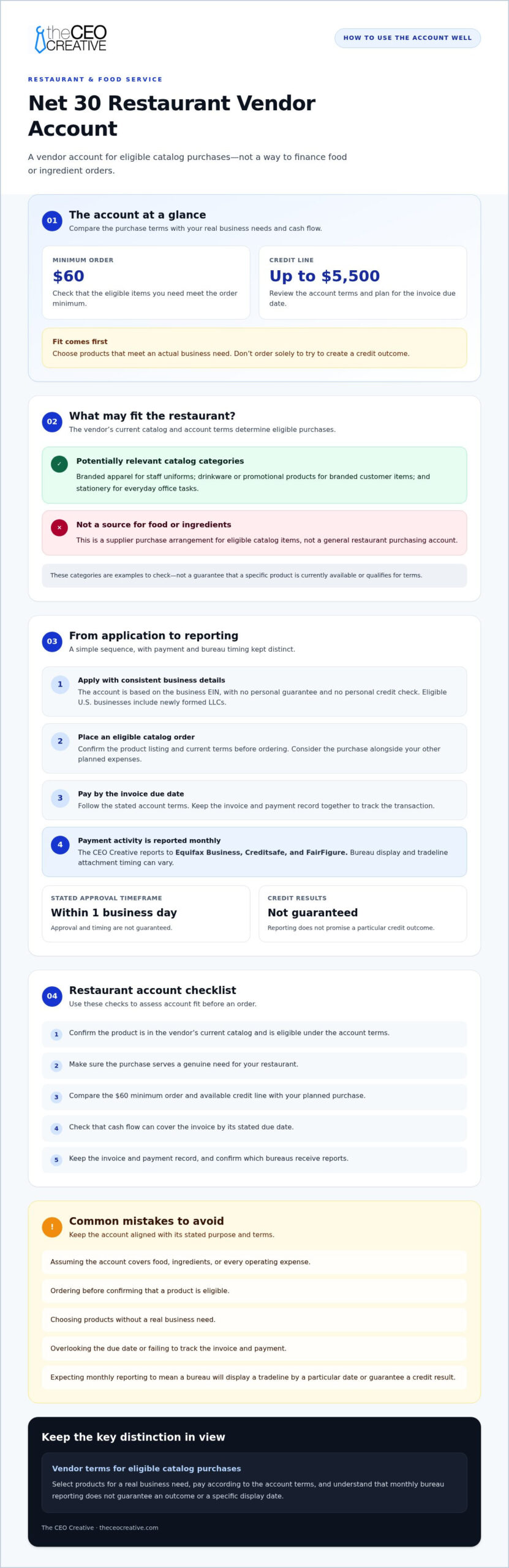
- Compare the $60 minimum order, credit line of up to $5,500, and payment terms with your cash flow.
- Understand the sequence: apply, place an eligible order, pay by the due date, then allow time for monthly reporting and bureau processing.
- Confirm which bureaus receive reports and track invoices so you can manage the account responsibly.
What Net 30 Accounts for Restaurants and Food Service Can, and Cannot, Cover
Net 30 accounts for restaurants and food service provide vendor terms for eligible purchases. A restaurant orders items in the vendor’s catalog and pays the invoice according to the account’s stated terms. This is a purchasing arrangement, not general-purpose financing.
The distinction matters: a vendor account may help a business establish payment history with a reporting vendor, but it is not a way to buy food or ingredients. Trade credit describes an arrangement where a supplier allows a business to pay for purchases later under agreed terms. Reporting may add information to a business credit file, but results vary and no particular credit outcome is guaranteed.
Which restaurant purchases may fit a Net 30 vendor account?
Start with items that fit both your restaurant’s needs and the vendor’s current catalog. Branded apparel may suit staff uniforms. Drinkware or promotional products may be useful for branded customer items, while stationery can support everyday office tasks. These are categories to check, not a guarantee that a particular product is available or eligible for terms.
If branded items are relevant, review the Net 30 promotional products vendor page. Check the current product listings and account terms before ordering to confirm that the items you want qualify.
Which expenses should restaurant owners not assume are covered?
Don’t treat a reporting vendor account as a general restaurant purchasing account. It isn’t for food, ingredients, shipping, or packaging supplies. It also isn’t a loan, line of credit, or business credit card. Coverage depends on the vendor’s catalog and stated terms, so even a purchase that supports restaurant operations may be outside the account’s offerings.
Before ordering, check the product listing and account terms. Confirm that the item is eligible, serves a genuine business need, and can be paid for by the due date. This keeps the account focused on suitable vendor purchases instead of expenses it was not designed to cover.
How a Restaurant Net 30 Account Works From Application to Reporting
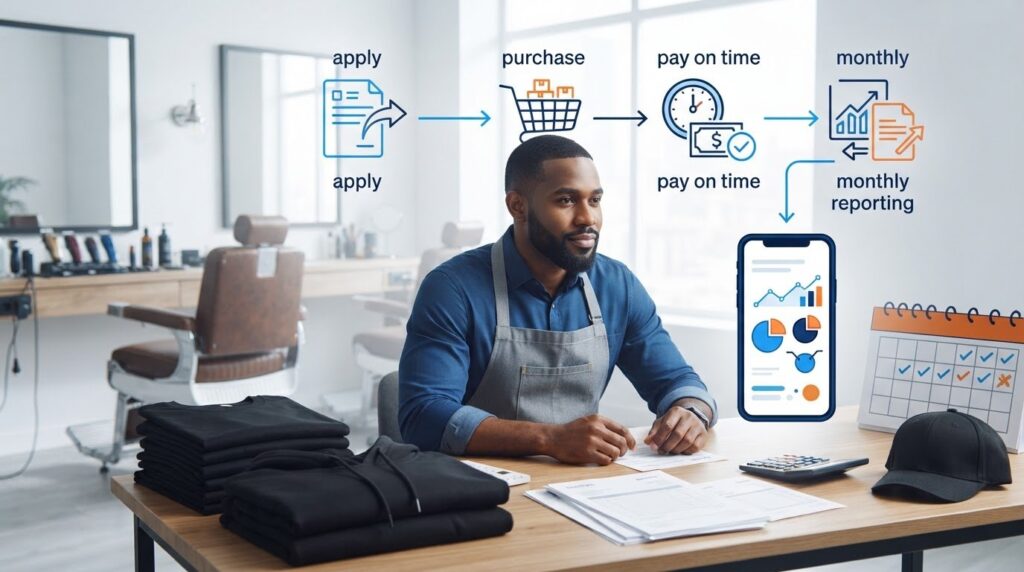
For net 30 accounts for restaurants and food service, the process is straightforward: apply, place an eligible order, pay by the due date in your account terms, then allow the vendor to report payment activity monthly. The account is based on the business EIN, with no personal guarantee and no personal credit check.
The CEO Creative states that eligible U.S. businesses can apply, including newly formed LLCs, with no minimum time in business. Its stated approval timeframe is within 1 business day, but approval and timing aren’t guaranteed.
What should a restaurant prepare before applying?
Use consistent business identity details throughout the application. Check that the legal business name, EIN, and other information match your business records. Consistent details can help avoid preventable questions about which business is applying. For related eligibility information, review the EIN-only Net 30 vendor overview.
Before ordering, check that the products are eligible under the current catalog and account terms. Then weigh the purchase against your other planned expenses. The 2026 State of the Restaurant Industry report discusses persistent cost increases, a reminder to ensure that any vendor purchase fits your needs and payment plan.
How do payment and monthly reporting fit together?
After placing an eligible order, follow the account terms and pay the invoice by its stated due date. Keep the invoice and payment record together so you can track the transaction and resolve questions if needed. The vendor reports payment activity monthly to Equifax Business, Creditsafe, and FairFigure.
Monthly reporting does not mean a bureau will display or attach a tradeline by a particular date. Each bureau manages its own records, so display timing can vary. Opening or using an account also does not guarantee a particular credit result or approval from another provider.
How to Evaluate Restaurant Vendor Credit Before You Order
Choose an account based on purchases your restaurant already needs, not on the expectation that opening a tradeline will produce a specific credit result. Before applying, compare the catalog, order minimum, stated credit line, invoice due date, and reporting details. A simple fit test is: Does the catalog include a useful item, can you meet the minimum, and can you pay on time?
Match the account to real restaurant business needs
List planned or recurring needs for eligible branded business products. Team apparel may fit if your restaurant has a genuine uniform need. See the Net 30 apparel vendor page for that category. Keep these purchases distinct from core food-service expenses, such as food and ingredients, which are outside the stated catalog. The Small Business Administration guide on Net 30 accounts provides background on how supplier payment terms can affect cash flow. That context does not mean every vendor purchase is suitable for your business.
| What to evaluate | What to check |
|---|---|
| Purchase relevance | Does the catalog include eligible products tied to a real restaurant need? |
| Minimum order | The stated minimum order is $60. Confirm your planned order meets it. |
| Stated credit line | The account offers a credit line of up to $5,500. Don’t assume you’ll receive a particular amount. |
| Payment ability | Can your business pay the invoice by its due date without disrupting planned expenses? |
| Reporting | Confirm the monthly reporting destinations and understand that bureau display timing can vary. |
Check the terms against cash flow and reporting goals
Review the due date and payment instructions before ordering. The credit line is not a target to spend up to. Order only what the business needs and can pay for on time. For general cash-flow context, read the SBA’s explanation of Net 30 terms, then compare your own invoice schedule with the cash available to pay it.
The CEO Creative states that it reports monthly to Equifax Business, Creditsafe, and FairFigure. Consider whether those destinations align with your reporting goals, but don’t assume reporting guarantees a particular outcome or that every bureau will display a tradeline on a set schedule.
A vendor tradeline records account activity; it doesn’t guarantee a credit-building result. Choose the account for a relevant purchase first, and treat reporting as one factor in your decision.
Restaurant Net 30 Account Checklist and Common Mistakes
A short review before applying or ordering can help you decide whether a vendor account fits your restaurant. Use this checklist to verify the details, understand the terms, and plan how you will track the invoice.
A practical pre-order checklist for food-service businesses
- Verify your business details. Check that the legal business name and EIN are accurate and consistent with your business records.
- Confirm product eligibility. Make sure the products you plan to order appear in the vendor catalog and meet the account terms. Choose items with a genuine business use.
- Review the minimum and account terms. The stated minimum order is $60. Check the due date and payment instructions before submitting an order.
- Assess repayment capacity. Plan how the invoice will be paid by its due date. Don’t order simply because account capacity is available.
- Track the transaction. Keep the application, order confirmation, invoice, and payment record together for your bookkeeping.
Common account-use mistakes to avoid
- Ordering irrelevant products: Don’t buy items the restaurant doesn’t need just to pursue a tradeline. The purchase should make sense even apart from reporting.
- Missing the due date: Record the invoice due date and payment confirmation. Follow the account’s stated terms.
- Assuming approval: An application does not guarantee that an account will be approved. Wait for the vendor’s decision before relying on the account for a purchase.
- Expecting a guaranteed score change: Monthly reporting does not promise a particular credit outcome. Results vary.
- Assuming a display date: Reporting and bureau display are separate. Don’t assume a tradeline will appear by a specific date.
Keep the account in perspective. Net 30 vendor terms are not a loan, a line of credit, or a personal credit product. For an overview of the account’s stated terms and application details, review the business Net 30 account information before deciding whether it fits.
Use the account details link below to check the current terms and decide whether the catalog and payment schedule work for your restaurant.
Is The CEO Creative a Fit for Restaurant and Food-Service Businesses?
The CEO Creative may suit a restaurant or food-service business when eligible branded business purchases meet a real need. It offers a reporting vendor account, not food-service supplies or general-purpose financing. Consider the catalog and terms together before adding it to your purchasing plan.
Who may find this vendor account relevant?
U.S. restaurants and food-service businesses that need eligible branded products may find the account relevant. Examples include apparel, drinkware, stationery, or promotional products, subject to catalog availability and current account terms. The CEO Creative also offers custom branding products and professional logo design services. Newly formed LLCs are included in the stated eligibility, and there’s no minimum time in business.
The account has a $60 minimum order and a credit line of up to $5,500. The CEO Creative reports monthly to Equifax Business, Creditsafe, and FairFigure. These details describe the account, not a promise of approval, a particular credit result, or a bureau display date.
The company is BBB Accredited with an A+ rating and has been in business for 6+ years. It also reports 50,000+ reported tradelines. Treat these as company background, not evidence that an account will produce a particular result for your business.
Look elsewhere if your main need is food, ingredients, shipping or packaging supplies, or a loan product. Those needs do not match this vendor account’s stated purpose. It makes sense only if the products are eligible, useful to the business, and manageable under the payment terms.
What should a reader do next?
Before applying, check that your intended purchases appear in the catalog, meet the minimum order, and can be paid by the stated due date. A clear fit between the products and your business needs matters more than opening an account simply to pursue business credit.
This information is not financial or legal advice. Results vary, and approval, credit outcomes, and bureau display timing aren’t guaranteed.
Choose a Vendor Account That Fits Your Restaurant
The right net 30 accounts for restaurants and food service should match purchases your business genuinely needs. Treat vendor terms as a way to buy eligible products and establish payment history, not as a substitute for food-supply purchasing or a promise of a particular credit outcome.
Before applying, confirm that the catalog fits your plans and that you can pay invoices by their due dates. The CEO Creative states that it reports monthly to Equifax Business, Creditsafe, and FairFigure. It is BBB Accredited with an A+ rating. Reporting and accreditation provide context, but neither guarantees approval, bureau display timing, or credit results. Results vary.
Review the current account terms and decide whether they work for your business. This information is not financial or legal advice. A clear purchase plan and careful invoice tracking can help you make a considered choice for your restaurant.
To assess whether the account fits, review The CEO Creative’s current business Net 30 account details, including eligible products and payment terms.
Keep building your business with steady, informed decisions.
Frequently Asked Questions
Can a restaurant use a Net 30 account to build business credit?
Yes. A reporting vendor account can report payment activity to business credit bureaus, which may contribute information to a business credit file. Net 30 accounts for restaurants and food service are useful when the account supports eligible purchases the restaurant needs and the business manages payments according to the terms. Reporting doesn’t guarantee a credit-score change, a tradeline appearing, or approval from another provider. Results vary.
What can a restaurant order through a Net 30 vendor account?
A restaurant may order eligible items listed in the vendor’s catalog, such as branded apparel, drinkware, stationery, or promotional products. These could fit needs like staff apparel or branded customer items, depending on catalog availability and current account terms. Don’t assume the account covers food, ingredients, shipping, or packaging supplies. Check the product listing and account terms before placing an order.
Does The CEO Creative report restaurant accounts to business credit bureaus?
The CEO Creative states that it reports monthly to Equifax Business, Creditsafe, and FairFigure. Reporting is separate from when, or whether, a bureau displays or attaches a tradeline to a business file. Display timing can vary, and reporting doesn’t guarantee a particular credit outcome. Check your account records and the bureau files you use, but don’t assume a specific appearance date.
Can a newly formed restaurant LLC apply for a Net 30 account?
Yes. The CEO Creative’s stated eligibility includes U.S. businesses, including newly formed LLCs, with no minimum time in business. An LLC still needs to submit an application using accurate business details and its EIN. Eligibility doesn’t guarantee approval. Review the vendor’s current account terms and confirm that the products you plan to buy are eligible before applying or placing an order.
Does applying require a personal guarantee or personal credit check?
The CEO Creative states that its account is based on the business EIN, with no personal guarantee and no personal credit check. Use consistent business identity and EIN details in your application. These stated terms describe the application basis, but they don’t guarantee approval. Review current account requirements before submitting your information, and contact the vendor if you need clarification about a specific application detail.
How much is the minimum order for The CEO Creative’s Net 30 account?
The stated minimum order is $60. Before ordering, confirm that the items are eligible under the current catalog and account terms. Choose products that serve an actual business need, and check that your restaurant can pay the invoice by its stated due date. The minimum order is not a recommendation to spend that amount solely to pursue a business credit tradeline.
How long does it take for a Net 30 tradeline to appear on a business credit report?
There’s no guaranteed date for a tradeline to appear. The CEO Creative states that it reports monthly to Equifax Business, Creditsafe, and FairFigure, but each bureau controls how and when it processes or displays information. Reporting and bureau display are separate steps. If you don’t see an account reflected right away, avoid assuming it will appear by a particular date.
Is a restaurant Net 30 account the same as a business loan or credit card?
No. A Net 30 vendor account lets a business purchase eligible items from a vendor and pay according to the account’s terms. It isn’t a business loan or credit card, and it shouldn’t be treated as a way to pay for food-service expenses outside the vendor’s catalog. Check the available products, invoice due date, and payment requirements before deciding whether the account fits.