


Credit scores and revenue can affect eligibility for net 30 accounts for optometry practices, but each supplier sets its own criteria. Review the application requirements before applying.
New practice owners often ask what vendors consider when reviewing applications. Business credit history can show payment patterns, while revenue can help demonstrate business activity.
This guide covers supplier options, account risks, and practical steps for prequalifying and applying online. Use those details to decide whether net terms fit your practice’s purchasing plans.
Key Takeaways
- Compare suppliers by their reporting practices, application criteria, and the purchases their terms cover.
- Review your practice’s cash flow and due dates before placing orders on net terms.
- Prepare your business details and understand how credit history and revenue may factor into an application.
- Use a consistent routine to apply, order within your budget, pay on time, and track reported account activity.
- Choose a vendor account that aligns with your practice’s real purchasing needs and business-credit goals.
Which suppliers offer net 30 accounts to optometry practices?
Start with supplier categories that match purchases your practice already expects to make. An optometry office may need administrative supplies, printed materials, staff apparel, or branded drinkware. These differ from clinical inventory, frames, and equipment, so keep general business suppliers separate from clinical vendors when reviewing purchases.
Next, distinguish a reporting net 30 account from ordinary invoice terms. A supplier may allow payment after an order without reporting the account to business credit bureaus. Ask whether the account reports payment activity, which bureaus receive it, and whether the account is linked to the practice’s legal business name and EIN.
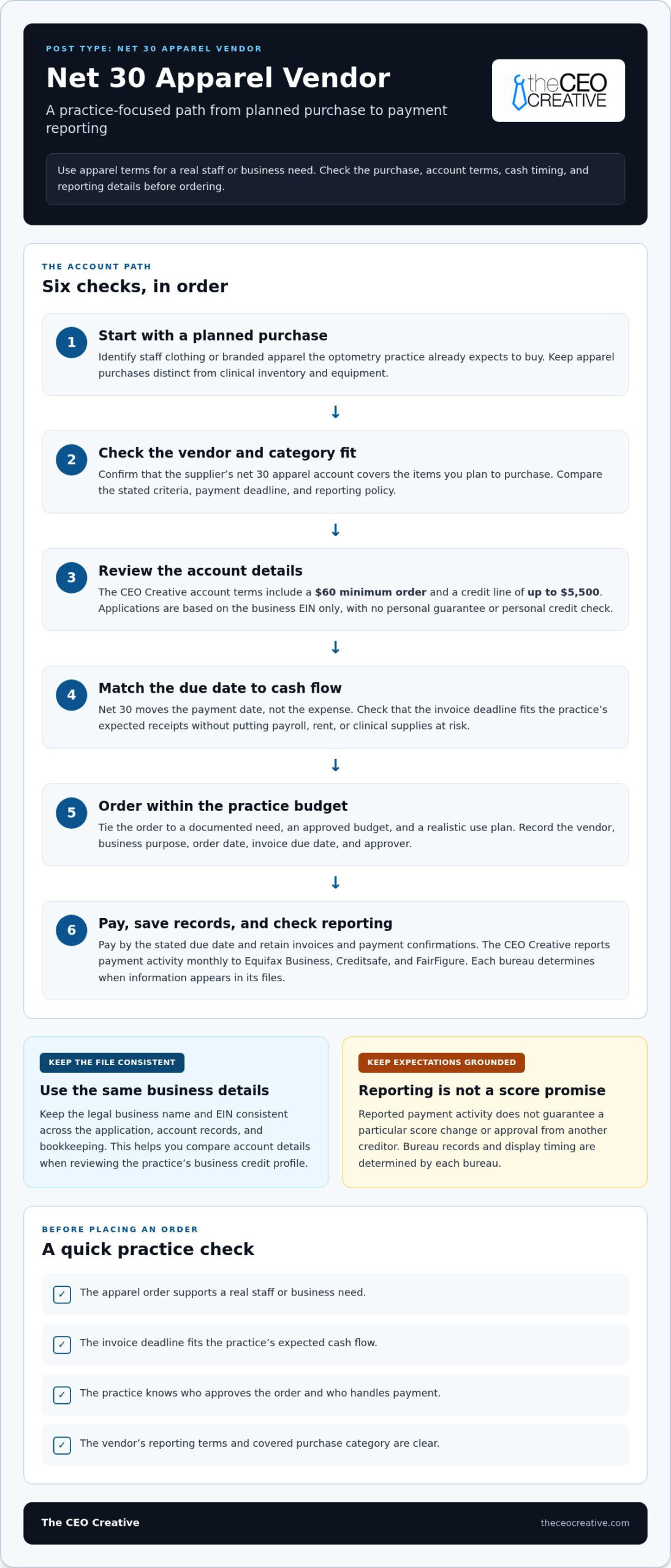
The CEO Creative reports account payment activity monthly to Equifax Business, Creditsafe, and FairFigure. Each bureau determines when that information appears in its files. Keep invoices and payment confirmations with your practice’s records so you can compare account details when reviewing its business credit profile.
Use a comparison record to assess each supplier. Note the product category, application criteria, payment deadline, reporting policy, and eligible business types. For example, when comparing an office-products supplier with a print vendor, check whether both report payment activity rather than focusing only on their net terms.
- Office products: Review whether paper, writing supplies, and administrative items fit the practice’s regular purchasing.
- Print suppliers: Consider business forms and printed materials when they serve an existing operational need.
- Apparel and drinkware vendors: Assess staff clothing or branded items as planned purchases, rather than orders made only to open an account.
- Optical and clinical suppliers: Evaluate these separately for clinical inventory or equipment. Confirm whether their stated terms include business-credit reporting.
Eligibility is another point to compare. Suppliers set their own application criteria and may consider business credit history, revenue, or business identifiers. A newer practice should review each vendor’s stated requirements rather than assume every supplier uses the same credit-score cutoff. Keep the business name and EIN consistent across applications and accounting records.
Before applying, compare the payment deadline with the practice’s expected cash flow. If an invoice will come due before a scheduled receipt, decide how the practice will cover it without delaying other obligations. Record the invoice date, due date, approval owner, and planned payment source in your bookkeeping system.
Check that the supplier’s category supports a real purchasing need. An office-products account may suit administrative orders, while apparel or print terms may fit a planned staff or patient-facing project. Don’t treat a supplier category as a substitute for clinical purchasing, or assume every vendor account creates a reported tradeline.
A practical supplier review ends with three clear answers: what the practice will purchase, when payment is due, and whether payment activity is reported. Compare those details before applying. That gives an optometry owner a more useful basis for choosing among net 30 supplier accounts than category labels alone.
What are the risks of using net 30 accounts for an optometry practice
Net 30 terms move the payment date, not the expense. An optometry practice still owes the supplier by the stated due date, even if insurance payments arrive later than expected. For example, ordering office materials before a reimbursement delay can leave less cash available for payroll, rent, or clinical supplies.
The gap between receipts and invoice deadlines is a key risk to manage. Claims processing, patient balances, and vendor invoices follow separate schedules. If the practice depends on a payer deposit to cover a supplier invoice, a delayed claim payment can create a shortfall. Track each invoice’s due date alongside expected receipts instead of treating all incoming revenue as available cash.
Ordering more than the practice can use creates another risk. Excess branded apparel or office items tie up cash while the invoice still comes due. A growing optometry practice may be tempted to stock up when opening a location or hiring staff. Tie each order to a documented need, approved budget, and realistic use plan.
Watch for these account-level risks before ordering:
- Late payment: A missed due date can weaken the supplier relationship and may affect how the vendor evaluates future orders. Set a calendar reminder from the invoice date and confirm who owns payment approval.
- Unclear reporting: A net 30 invoice does not automatically establish a reported business tradeline. If bureau reporting is a goal, confirm the account’s reporting terms and keep the business name and EIN consistent.
- Personal exposure: Some applications may request a personal guarantee or personal credit review. Read the application terms before submitting it, especially if the practice wants an EIN-only account.
- Renewed orders without review: Recurring purchases can continue after the original need changes. Review open invoices and planned orders during each bookkeeping close.
Reporting has limits: a supplier may report payment activity, but that does not guarantee a particular score change or approval from another creditor. Business bureaus maintain their own records and display information on their own schedules. Keep invoices, payment confirmations, and account statements so you can identify discrepancies using specific transaction details.
Cash-flow pressure can also expose weak purchasing controls. If multiple staff members can place orders, separate the person requesting supplies from the person approving payment. A purchase record can include the vendor, item category, business purpose, order date, invoice due date, and approver, giving the owner a clear view of upcoming obligations.
Before opening an account, compare the due date with the practice’s cash cycle and review whether the purchases are necessary. If the account requires a personal guarantee, decide whether that obligation fits the practice’s risk controls. An EIN-based net 30 account may be relevant for businesses seeking supplier terms without a personal guarantee; read its stated conditions before applying.
Use net terms as a purchasing tool, not as a replacement for working capital or a plan for delayed receipts. Track each invoice from order through payment, and pause new orders if existing balances strain the practice’s operating budget. This is general information, not financial or legal advice.
How can a new optometry practice build business credit with net 30 accounts
A new optometry practice can build a credit history by managing supplier accounts consistently. A net 30 account gives the business a stated payment period after purchase. The account helps establish a tradeline only when the vendor reports eligible payment activity to business credit bureaus.
Start with the business identity. Use the same legal business name, address, and EIN on the vendor application, invoice records, and bookkeeping profile. For example, if the application lists “Clearview Optometry LLC,” avoid paying invoices from an account under a different business name. Consistent records help connect account activity to the correct business profile.
Next, choose one supplier account tied to a planned expense. An optometry office might order administrative supplies it already uses instead of buying excess items just to create account activity. Before applying, review whether the vendor reports payment history, which bureaus receive reports, and what business details the application requires. Net terms alone don’t establish reporting.
Use this process to manage the account from application through reporting:
- Prepare the application: Gather the practice’s legal name, EIN, business address, and authorized applicant details. Enter them consistently.
- Review the terms: Identify the invoice due date, accepted payment methods, and any account conditions before placing an order.
- Make a business purchase: Select an item the practice needs and keep the order confirmation with its invoice.
- Schedule payment: Record the due date in the bookkeeping system and assign a staff member to approve payment.
- Keep evidence: Save the invoice and payment confirmation. Compare account statements with the practice ledger.
Payment discipline matters more than opening several accounts at once. If a practice opens multiple vendor accounts but loses track of their separate invoices, missed due dates can undermine the record it intended to build. Start with an account the office can manage. Add another only when its purchases fit the budget and the team can track its terms.
Track the account after payment, too. Record the vendor’s reporting frequency and the bureau names. Business credit files may not display new activity immediately, so keep payment confirmations and statements while monitoring the business profile. If an entry appears inaccurate, those records help identify the vendor, invoice, payment date, and amount involved.
Review account activity during each bookkeeping close. Match the order, invoice, due date, and payment confirmation. For example, if an office manager orders printer paper, the practice’s records should show its business purpose and who approved the purchase. This supports clear controls and makes account activity easier to explain.
A new practice should treat net 30 accounts as one part of its credit-building routine, not as a promise of a particular score or future approval. Keep purchases necessary, pay according to the stated terms, and maintain accurate business records. Results vary, and this information is not financial or legal advice.
Credit-building should support sound purchasing rather than encourage orders made only to generate account activity. Optometry practices typically spend 26% to 32% of gross revenue on cost of goods sold, with the range varying by practice focus. Practices with cost of goods sold above 40% of optical revenue may be over-ordering inventory, failing to negotiate with vendors, or underpricing products. These benchmarks can help the practice scrutinize whether supplier purchases charged to a net 30 account are necessary and affordable; they do not replace invoice-level tracking.
Revenue review also provides context for managing supplier commitments. A routine optometry exam might reimburse $80 from a vision plan, compared with $150 or more for a medical exam billed to medical insurance. Medical-plan reimbursement for visits involving symptoms such as floaters, diabetes-related eye disease, or ocular pain is $120-$180 per encounter, compared with $45-$70 through a vision plan. Optometry practices should review provider participation status with payers annually. An optometry practice with a 15% no-show rate loses over $50,000 annually. Treat these figures as operational checks alongside account records, not as a reason to buy unnecessary supplies or assume a particular invoice will be covered.
Assessing Your Practice for Net 30 Accounts
Review your practice’s financial position before adding a vendor account. Credit scores and revenue can affect eligibility, but suppliers set their own application criteria. Start by reviewing current business credit records, revenue consistency, existing payment obligations, and cash available for upcoming expenses.
Revenue is not the same as cash available to pay invoices. A practice may record revenue while waiting for payer payments or patient balances. Track deposits against upcoming obligations, then decide whether a planned supplier purchase fits the operating budget. For example, don’t place an order based only on projected collections if those funds haven’t arrived.
Operating performance can also affect how much room the practice has for supplier payments. Optometry practices should maintain cash reserves covering 3-6 months of operating expenses. Setting aside 5-10% of monthly revenue is one approach to building those reserves. Use your own expense records to assess whether a new payment obligation fits without disrupting payroll, rent, or clinical operations.
Collections deserve attention too. High-performing multi-provider eye care groups are reported to target a net collection ratio of 96%-98%. For a group seeing 50 patients daily, a four-point gap in that ratio represents $180,000-$240,000 in annual revenue. These figures show why owners should understand collection performance before relying on expected revenue to support new purchasing.
A 2024 American Optometric Association survey found that 67% of optometry practice owners felt unprepared to manage practice finances effectively. Build a simple review routine rather than relying on memory. Include the practice’s current revenue trend, upcoming invoices, cash reserves, and credit-file information. This gives the owner a clearer basis for assessing whether an account fits.
Use these steps before applying:
- Review business credit: Check whether the practice’s legal name and business details appear consistently across its records.
- Organize revenue records: Use current bookkeeping reports to understand cash receipts and outstanding balances.
- List payment obligations: Include supplier invoices alongside payroll, rent, and other recurring business expenses.
- Set a purchase limit: Choose an order amount that fits the practice budget, not the maximum available account limit.
- Read application terms: Identify whether the vendor asks for business credit information, revenue details, an EIN, or a personal guarantee.
A newly formed practice may have a shorter operating history and fewer internal records to review. Prepare the business’s formation details, EIN, and available bookkeeping information before starting an online application. Use the same legal business name throughout. If a vendor offers an EIN-only account with no personal guarantee, read its terms carefully and confirm they fit your business-credit plan.
Keep the decision tied to practice needs. A vendor account should support planned purchases, fit the cash-flow process, and have clear reporting terms. There is no single revenue figure or credit score that applies across every supplier. Review the written criteria and your practice’s records before applying.
Billing and receivables merit review before another payment obligation. A group seeing 30 patients daily may lose $200,000-$275,000 in annual collections when medical-plan visits are billed to a vision plan. High-performing practices using optometry billing dashboards report days in accounts receivable under 28 days, compared with a national average of 35-40 days.
An optometry net collection ratio of 92%-95% is average performance, with $100K-$180K in annual leakage for a 50-patient-per-day group. Improving a practice’s ratio from 91% to 97% on $2M in annual allowable charges represents $120,000 in recovered revenue.
The CEO Creative: net 30 apparel vendor
The CEO Creative gives optometry practices a supplier option for planned apparel and office purchases. Consider its net 30 apparel vendor or net 30 t-shirt supplier when staff clothing is already part of your purchasing plan. A net 30 embroidery supplier may also fit practices ordering embroidered apparel, while a net 30 office supplies vendor can support routine administrative needs.
Choose an account based on purchases your practice expects to make, then review the application and payment terms before ordering. The account is intended for business purchasing and credit-building activity, not as a reason to buy items your practice doesn’t need. Explore the net 30 apparel vendor details, or visit The CEO Creative to learn more.
Choose a practical next step for your practice
Build your vendor-credit plan around purchases your optometry practice already expects to make. Before opening another account, decide which business expenses belong in the plan and how your team will track invoices, approvals, and payments. This connects credit-building activity to daily operations instead of creating extra purchases.
For practices planning staff apparel, The CEO Creative offers a net 30 apparel vendor, net 30 t-shirt supplier, and net 30 embroidery supplier. These options may suit a practice whose upcoming purchases align with those categories. Review the account terms and application details, then choose the next step that fits your purchasing needs. Net 30 accounts for optometry practices can support a deliberate business-credit routine, but results vary and this information isn’t financial or legal advice.
Keep your plan clear, manageable, and grounded in your practice’s needs.
Frequently Asked Questions
What does net 30 mean for an optometry practice?
It means the supplier’s invoice is due according to net 30 terms, generally within 30 days. Check the invoice for the date that starts the payment period. For example, record the supplier’s stated due date in your accounting system so the invoice is included in the correct payment run.
What are the eligibility requirements for net 30 vendor accounts for optometrists?
Requirements vary by supplier, and there is no universal credit-score cutoff for all vendor accounts. The CEO Creative accepts US businesses, including newly formed LLCs, with no minimum time in business. Its account is EIN-based and requires neither a personal guarantee nor a personal credit check.
How can an optometry practice apply for net 30 accounts, and what documents are required?
Apply through The CEO Creative’s online application and provide the requested information. The account is based on the business’s EIN. Enter the practice’s legal business details consistently, and review the application requirements as you complete the form.
Which business credit bureaus receive payment reports?
The CEO Creative reports monthly to Equifax Business, Creditsafe, and FairFigure. Reporting practices can vary, so check which business credit bureaus receive updates. Keep your account records so you can compare the supplier’s reporting with the business credit file when reviewing reported activity.
Will a reported payment appear on a business credit file right away?
Business credit bureaus do not share a fixed display date. The CEO Creative reports monthly, but each bureau controls when information appears in its file. Keep invoices and payment confirmations while monitoring the relevant business profiles.
Is there a minimum order for a net 30 account?
Yes. Plan an eligible purchase around items your practice needs, and review the account terms before placing the order. The minimum order is a purchasing requirement, not a credit-score or revenue threshold.