


Post type: HOW TO USE THE ACCOUNT WELL
Table of contents
- Why Net 30 Accounts Can Fit an Insurance Agency’s Business Purchases
- What Insurance Agencies Can Order on Net 30 Terms
- How a Net 30 Account Works: Apply, Order, Pay, Report
- A Practical Checklist for Choosing and Using an Agency Vendor Account
- The CEO Creative Net 30 Account: Agency Terms and Next Steps
- Frequently Asked Questions
Net 30 accounts for insurance agencies can pair eligible business purchases with a vendor’s payment terms and monthly business credit reporting. The CEO Creative offers a Net 30 vendor account for products such as office supplies, printed materials, apparel, drinkware, and promotional items.
To use an account well, match a planned purchase to the vendor’s catalog, understand the application and payment terms, and keep complete order and payment records. Reporting does not guarantee that a tradeline will appear or produce a particular credit result.
Key Takeaways
- Match routine agency purchases, such as office supplies and printed materials, to an eligible Net 30 vendor category.
- Understand how net 30 accounts for insurance agencies connect an application, eligible order, payment, and monthly reporting.
- Keep vendor purchasing terms separate from insurance coverage and policy premium payments.
- Review the order and payment terms, application basis, and reporting bureaus before choosing an account.
- Monthly reporting does not guarantee a tradeline will appear or lead to a specific credit result.
Why Net 30 Accounts Can Fit an Insurance Agency’s Business Purchases
Net 30 accounts for insurance agencies can be useful when they cover a genuine, planned business purchase. A reporting Net 30 vendor account lets a business order eligible products and pay according to the account’s terms, rather than paying at the point of purchase.
This is a form of Trade credit: a supplier provides goods or services with payment due later under agreed terms. For an agency, vendor terms may help coordinate purchases such as office materials with available cash. They do not guarantee savings, approval for other credit, or a particular change to a business credit profile. Before ordering, review the invoice amount and due date against the agency’s budget.
Which agency purchases might fit vendor terms?
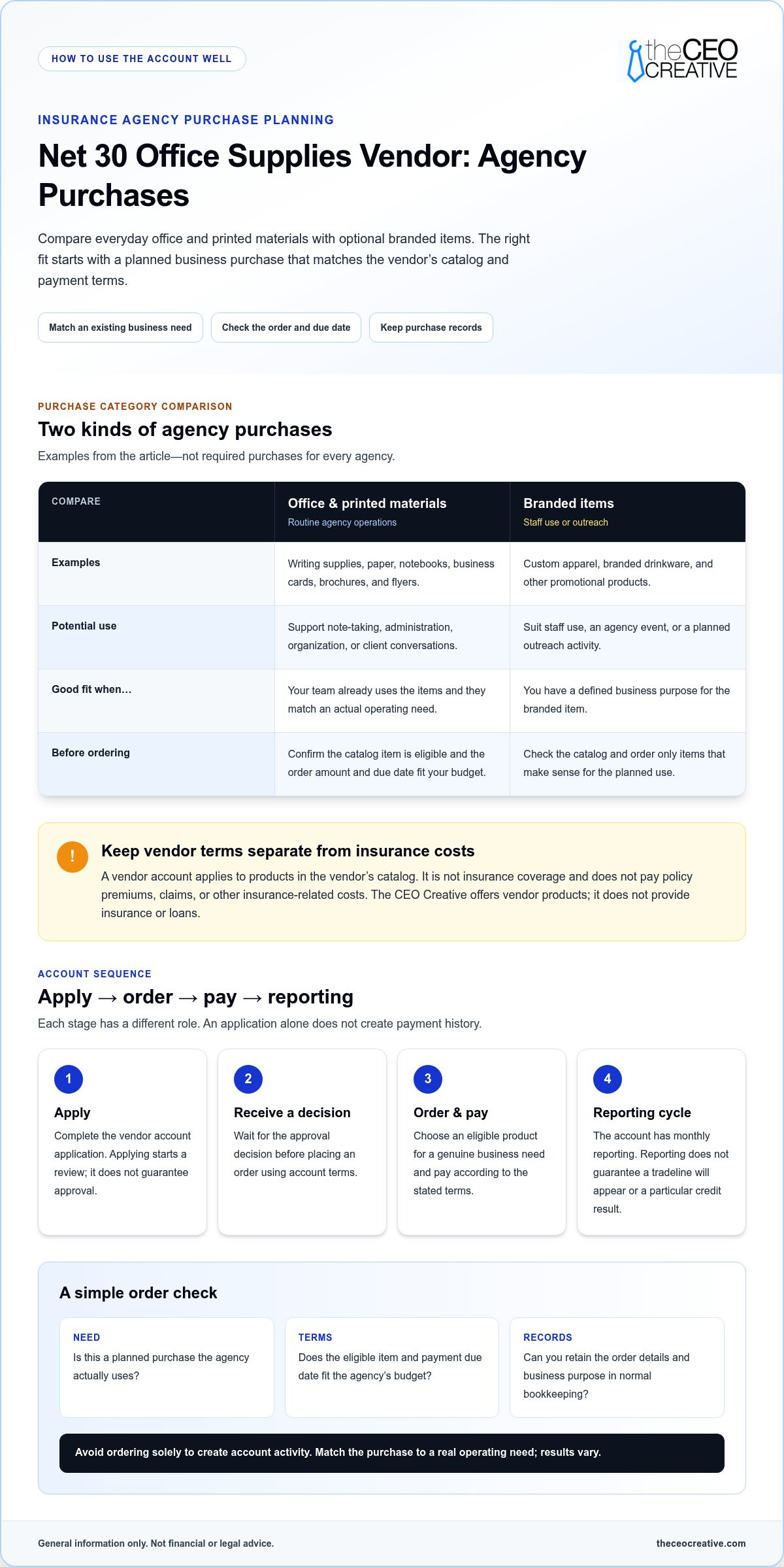
Start with items your agency already uses. Office supplies can support routine administration. Printed materials and business cards may serve client-facing needs. Branded apparel may suit staff use or agency events. These are examples of purchase categories, not claims that every insurance agency needs each item.
Match the intended purchase to the vendor’s catalog. For example, an agency planning to order eligible office products can review a Net 30 office supplies vendor. Keep a record of the purchase and its business purpose as part of the agency’s normal bookkeeping.
Net 30 vendor account versus insurance financing
These are different types of transactions. A vendor account applies to products available through the vendor’s catalog. It is not insurance coverage and does not pay policy premiums, claims, or other insurance-related costs. The CEO Creative offers vendor products and does not provide insurance or loans.
Keep that distinction in mind when planning agency spending. Do not treat a vendor purchase account as a way to finance an insurance policy or meet a premium obligation. Instead, identify an eligible operational purchase and assess whether the payment due date fits the agency’s cash flow. The account’s reporting feature is separate from the value of the products ordered. Reporting does not guarantee that a tradeline will appear or that a credit result will follow.
A practical first step is to list planned purchases by category, such as office supplies, printing, or apparel. Compare that list with the vendor’s products and terms before ordering. This section is general information, not financial or legal advice. Results vary.
What Insurance Agencies Can Order on Net 30 Terms
Choose purchases by the work they support, rather than assuming every insurance agency needs the same supplies. Separate day-to-day office items from client-facing materials and optional branded products. Then match each planned purchase to a vendor category and its terms. The SBA on Net 30 Accounts and Cash Flow offers broader context on using Net 30 purchases in business cash-flow planning. An account still needs to fit your budget and order needs.
Office and printed materials for agency operations
For routine office work, consider whether your team already uses writing supplies, paper, and notebooks. These items can support note-taking, internal administration, and day-to-day organization. A Net 30 office supplies vendor can be relevant when eligible catalog items match an actual business need.
Printed business materials serve a different purpose. Business cards may help staff introduce themselves, while brochures or flyers can provide printed information for client conversations or outreach. These are examples, not required purchases or substitutes for materials your agency has chosen to use. Review the catalog and order only items suited to your operations. Buying a product on terms does not automatically create a credit result.
Branded items for staff and outreach
Branded items are optional. Custom apparel may suit staff use or an agency event. Branded drinkware or other promotional products may fit a planned outreach activity. These are general catalog categories, not insurance-specific products. For clothing purchases, a Net 30 apparel vendor connects the order to that product category.
Before ordering, define the purpose: staff wear, a client-facing activity, or another planned business use. Consider whether the item and order amount make sense for that purpose. Avoid ordering solely to create account activity. The goal is to match a real purchase to vendor terms, not to buy products the agency does not need.
For net 30 accounts for insurance agencies, the category is only one part of the decision. Review which products are eligible, the applicable order and payment terms, and whether the due date fits expected cash flow. Results vary, and reporting does not guarantee a tradeline will appear or lead to a particular credit outcome.
If these categories match planned purchases, review the business Net 30 account details before deciding whether to apply. This information is general and is not financial or legal advice.
How a Net 30 Account Works: Apply, Order, Pay, Report
For an agency, the process is: submit an application, receive an approval decision, place an eligible order, pay under the account’s stated terms, and allow the vendor’s reporting cycle to proceed. Each step matters. Applying alone does not create payment history, and an order should meet a genuine operating need.
- Apply. Complete the vendor’s account application. An application starts the review, but does not guarantee approval.
- Receive a decision. Wait for the approval decision before placing an order using account terms. The decision determines whether the account is approved and the purchasing capacity available.
- Place an eligible order. Choose products covered by the vendor account. Review the order details and applicable terms before submitting it.
- Pay by the stated due date. Follow the payment deadline attached to the order and account. The stated Net 30 terms govern when payment is due. Do not assume a different starting point or schedule.
- Allow reporting, then repeat as appropriate. The CEO Creative reports account activity monthly to the business bureaus named below. Make future purchases only when they fit genuine business needs and the account terms.
From application to payment
Keep a simple record of the application decision, order details, invoice, payment date, and payment confirmation. These records make it easier to review account activity and reconcile purchases. Note the due date stated in the account terms, and plan payment from the business’s available cash. No specific penalty or late-fee amount is stated here.
What monthly reporting does, and does not, mean
The CEO Creative reports monthly to Equifax Business, Creditsafe and FairFigure. Vendor reporting is one step in a larger process. After information is sent, each bureau handles its own processing and may need to match the account information to a business file. That process affects whether and when activity appears in a bureau file.
Monthly reporting is not a promise that a tradeline will attach, display by a particular date, or change a score. Do not treat a reporting account as a guaranteed credit outcome. Keep the business information associated with the account consistent and retain order and payment records. File matching and score outcomes are not controlled by the vendor.
For net 30 accounts for insurance agencies, the practical sequence is to apply, receive a decision, order, pay on time under the stated terms, and understand what monthly reporting can and cannot establish. Results vary. This section provides general information and is not financial or legal advice.
A Practical Checklist for Choosing and Using an Agency Vendor Account
A short review before applying can help an agency avoid orders that do not fit its operations or payment capacity. Treat the account as a purchasing arrangement first. Consider reporting as one feature, not a promised credit result.
Before applying, check purchase fit and account terms
Write down the office, printing, or branding items your agency expects to use. Compare that list with the vendor’s catalog and account terms. Review how an EIN only Net 30 account without a personal guarantee is described, then assess the specific terms of the account you are considering.
- Match purchases to a category. Identify products the agency genuinely plans to use, such as office materials, printing, or branded items. Do not choose a category simply because it sounds useful for credit building.
- Review order requirements. Check the applicable order terms and choose items that match the agency’s planned purchase. Do not add unrelated products just to reach an order threshold.
- Read the payment terms. Note when payment is due and how the invoice states the deadline. Make sure the timing works with the agency’s cash flow.
- Understand the approval basis. Review what the application evaluates and whether its stated basis fits your business. Approval is not guaranteed.
- Review the reporting details. Confirm which business bureaus the vendor reports to and how often. Reporting does not promise a tradeline will attach or appear by a specific date.
- Plan recordkeeping before ordering. Decide where invoices, due dates, payment confirmations, and account details will be stored so the agency can track them consistently.
After opening an account, keep records and expectations clear
Use a simple account log with the order date, invoice, payment deadline, payment date, and confirmation. Keep business account details consistent across records. This creates a practical trail for reviewing purchases and checking that an invoice has not been overlooked.
Order only items the agency can use, and pay according to the invoice terms. Avoid placing extra orders solely to pursue a credit outcome. Timely vendor payments may be reported, but results vary. A bureau’s processing and file matching are separate from the vendor’s reporting, so payment does not guarantee a particular score or tradeline display.
Common mistakes to avoid
- Assuming that monthly reporting guarantees a tradeline or a specific credit result.
- Overlooking order requirements or the payment due date before placing an order.
- Spending beyond what the agency can reasonably pay under the account terms.
- Adding unrelated products to reach an order threshold instead of buying items the business needs.
- Failing to retain invoices and payment records for account tracking.
Results vary. This information is general and is not financial or legal advice. For account details, review the business Net 30 account information.
The CEO Creative Net 30 Account: Agency Terms and Next Steps
For an agency considering Net 30 accounts for insurance agencies, the key question is whether the vendor’s catalog matches purchases the business already plans to make. The CEO Creative account covers eligible vendor products and services. It is not insurance coverage or funding for policy premiums, and it does not guarantee a credit-file result.
Who may find the account relevant?
The account can suit agencies seeking vendor terms for catalog purchases such as office supplies, printed materials, apparel, drinkware, or promotional products. The fit depends on whether those categories support actual agency operations. A planned order should make sense for the business regardless of the account’s reporting feature.
Eligibility includes US businesses, including newly formed LLCs, with no minimum time in business. The application basis is EIN only, with no personal guarantee and no personal credit check. These terms describe the application basis, not a promise of approval. Treat the account as a vendor purchasing option, not a source of policy funding or other financing.
What to do before submitting an application
Review the account details against the purchase you have in mind. Consider the amount of the intended order, the payment terms that will apply, and whether the agency can pay the invoice on time. The account has a credit line of up to $5,500. Approval is not guaranteed.
The CEO Creative reports monthly to Equifax Business, Creditsafe and FairFigure. Monthly reporting does not ensure that a tradeline will attach to a business file, appear by a particular date, or produce a specific score outcome. Bureau processing and file matching are outside the vendor’s control, so treat reporting as one account feature rather than a promised result.
Before applying, identify an eligible catalog purchase the agency can use and make a plan to track its invoice and payment deadline. Keep the order tied to the agency’s needs, not to the expectation of a credit outcome. Results vary. This information is not financial or legal advice.
Make Your Next Purchase a Deliberate Step
Choose an account based on purchases your agency already expects to make, not on the hope of a particular credit outcome. Identify a suitable catalog purchase, confirm that it fits your business needs, and plan how to track its invoice and payment date. That keeps the decision grounded in agency operations.
The CEO Creative is BBB Accredited with an A+ rating and has been in business for six-plus years, with 50,000-plus reported tradelines. These details provide context about the vendor, but they do not guarantee approval, bureau display, or a specific credit result. Results vary. This content is not financial or legal advice.
If net 30 accounts for insurance agencies fit your purchasing plans, review the account details and decide whether the terms work for your business.
Build your process around thoughtful purchases and clear payment records. A steady, informed approach gives your agency a practical foundation for its next step.
Frequently Asked Questions
Can a Net 30 vendor account pay an insurance agency’s policy premiums?
No. A Net 30 vendor account is for eligible purchases from the vendor’s catalog, not for paying insurance premiums, claims, or policy expenses. Net 30 accounts for insurance agencies may fit planned business purchases, such as office materials or printed items, when those products suit the agency’s needs. Keep policy payments separate from vendor orders and review each purchase against the account terms before ordering.
Does monthly reporting guarantee that a tradeline will appear on an agency’s credit file?
No. A vendor’s monthly reporting does not guarantee that a tradeline will appear in a particular agency’s file. Bureau processing and matching information to a business file happen separately from the vendor’s submission. Keep order invoices and payment confirmations available, and do not treat an account as a guaranteed way to create a credit profile or achieve a specific score.
How long does it take for a reported Net 30 tradeline to appear?
There is no guaranteed display date. A vendor may report monthly, but a bureau’s processing and file-matching steps affect when information becomes visible, if it appears. If you are checking for a new entry, note the purchase and payment dates and review the business file over time. A delay does not by itself mean the vendor failed to submit the account activity.
Can one vendor account replace a business credit card or business loan?
No. A vendor account applies to purchases within that vendor’s catalog and under its stated payment terms. It is not a business credit card or a loan, and it should not be treated as a replacement for either. For an agency, its role is narrower: consider it for eligible products the business plans to buy, and assess other financial needs separately.
What should an insurance agency do if a bureau does not display a reported tradeline?
Start by organizing the account records: the business name and details used for the account, order invoice, payment confirmation, and relevant dates. Compare those details with the agency’s bureau file, since matching can affect whether an entry appears. If the record is still not visible, use the bureau’s process for questions about a business file and keep the vendor account documentation available.
Can an agency use Net 30 terms for purchases unrelated to its business?
Use the account for eligible products that serve a genuine business purpose, not personal items or unrelated purchases. Office materials used for agency administration, for example, may fit better than products chosen only to generate account activity. Before ordering, confirm the item belongs to an eligible vendor category and that the agency can pay the invoice under its terms. Results vary.