

A veteran-owned startup may qualify for business financing, but veteran status alone doesn’t secure approval. For founders exploring corporate credit solutions for veteran-owned businesses, it’s important to distinguish a loan application from a Net 30 vendor account: one seeks financing, while the other can help establish business credit history through reported payments.
Starting with limited business history can make credit-building feel uncertain. Lenders consider factors such as the application, ownership, collateral, credit profile, and cash flow, so understanding each factor can help you prepare.
This article explains how startup eligibility and veteran ownership fit into lending decisions, what application materials and underwriting factors matter, and how credit and cash flow shape the options. It also clarifies where Net 30 vendor accounts fit when your goal is to build business credit rather than borrow funds.
Key Takeaways
- A Net 30 vendor account can build business credit history through reported payment activity. It is a vendor tradeline for eligible business purchases.
- Payment activity is reported monthly to Equifax Business, Creditsafe, and FairFigure. Bureau display timing varies.
- Newly formed U.S. LLCs can be eligible with no minimum time in business; applications are based on an EIN, without a personal guarantee or personal credit check.
- Use the checklist to keep applications, orders, invoice payments, and bureau monitoring organized, while remembering that credit outcomes vary.
What Can Be Ordered on Net 30 Terms
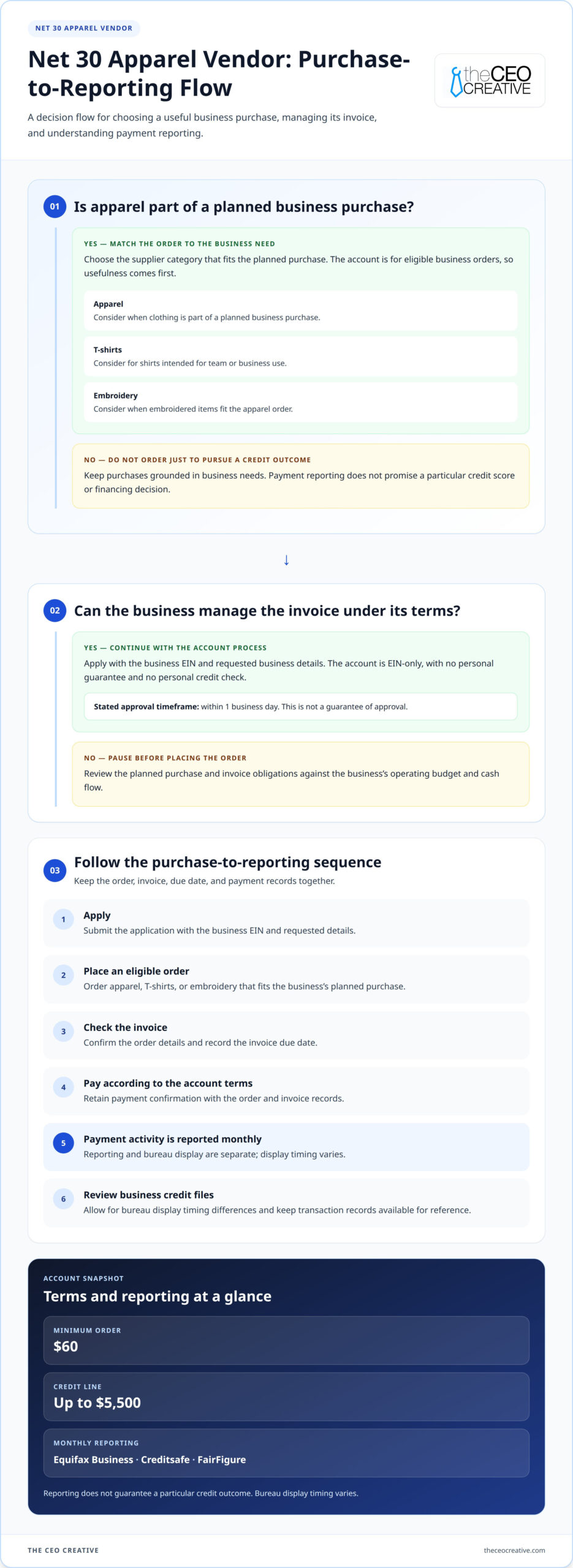
The CEO Creative is a business credit vendor offering Net 30 terms on eligible purchases in apparel-related categories. This may fit a veteran-owned business that plans to make a useful business purchase while building a business credit profile through vendor-account activity. The account is tied to an order, so start with the business need rather than the credit-building goal alone.
Available options include apparel, T-shirts, and embroidery. A company ordering clothing for its team or business operations may consider a Net 30 apparel vendor. A business planning a T-shirt purchase can consider that supplier category, while embroidery may fit an apparel order that calls for embroidered items. Select the category that best matches the intended purchase.
- Apparel: Consider this category when clothing is part of a planned business purchase.
- T-shirts: This supplier category may suit a business ordering shirts for team or business use.
- Embroidery: Consider this option when embroidered items fit the apparel order.
Keep the decision tied to the company’s actual operations. For example, a business preparing apparel for its staff may find that category relevant, while a company with a specific T-shirt need may choose that supplier type instead. Embroidery is best considered in relation to the planned apparel order, not as a separate reason to buy items the business doesn’t need.
These options are purchases made through a vendor account. The account is for eligible orders, and the business pays the invoice according to the Net 30 terms. Before ordering, confirm that the items fit the company’s needs and that the business can manage the payment when due. Keeping the purchase and payment terms clear helps owners assess whether this vendor account fits their purchasing plans.
For veteran-owned startups, ask whether an eligible item serves a clear business purpose and whether the business can manage the invoice under the account terms. Consider how the purchase will be used, whether it fits the operating budget, and how it aligns with normal purchasing plans. Do not order solely in the hope of changing a credit profile. Payment reporting may contribute to a business credit file, but it does not promise a particular score or future financing decision.
Choose products for their business usefulness first. Keep order documentation with your business records, and treat the account as one part of a broader credit-building approach. This keeps purchasing grounded in business needs while making it easier to track the account’s payment activity.
How the Net 30 Account Works
A veteran-owned business can apply using its EIN, place an eligible order, pay the invoice by its due date, and continue using the account as needed. When comparing Net 30 vendor accounts for veteran-owned businesses, focus on the application, purchase terms, payment process, and reporting.
Applying for and getting a Net 30 vendor account reviewed
Submit the application with the business EIN and requested business details. The account is EIN-only, with no personal guarantee and no personal credit check. U.S. businesses, including newly formed LLCs, are eligible without a minimum time in business. The stated approval timeframe is within 1 business day. This is the approval timeframe, not a guarantee that every application will be approved.
After approval, place an eligible order and review the invoice for its due date and payment terms. Keep the invoice details with your business records so you can track the order and payment.
Establishing Business Credit With a Net 30 Vendor Account
Place an eligible order, track the invoice and due date, and pay according to the account terms. Payment activity is reported monthly, although bureau display timing varies. This process records vendor payment activity tied to purchases made on the account.
- Apply with the business EIN and requested details.
- Review the invoice, record its due date, and pay according to the terms.
- Repeat purchases when they fit business needs and cash flow.
- Review bureau files for reported activity, allowing for display timing differences.
Keep accurate records of applications, orders, invoices, due dates, and payments. After each purchase, confirm that the invoice matches the order and note when payment is due. Pay according to the account terms, then review your business credit files for reported activity. Bureau display timing varies, so reported activity may not appear immediately.
Use the account for eligible purchases that fit your business needs. Paying invoices according to their terms and repeating the process gives the account a record of vendor payment activity. Results vary, and reporting does not guarantee a particular credit outcome.
Which Business Credit Bureaus Receive Reports
Payment activity is reported MONTHLY to Equifax Business, Creditsafe, and FairFigure. These are the three business credit bureaus that receive reports for this account. Because display timing varies, a report may not show new activity immediately after a payment or reporting cycle.
Reporting and display are separate steps. Payment activity is sent to the named bureaus, then each bureau determines when it appears in a business file. Monthly reporting does not mean every bureau will update a file on the same day or present the information identically.
If you are building a profile for a veteran-owned business, keep transaction records organized. Retain order details, invoices, payment confirmations, and the business information used for the account. These records help you track account activity and identify which transaction to review if an entry appears differently than expected.
- Equifax Business: Receives monthly payment activity reports for the account.
- Creditsafe: Also receives monthly payment activity reports.
- FairFigure: Receives monthly payment activity reports as well.
Review the business file at each named bureau periodically, allowing time for activity to appear. Compare entries with your invoice and payment records. If a trade account is not visible yet, that alone does not show that a payment was late or reporting failed; bureau display timing varies.
A vendor tradeline records business payment activity. It does not guarantee a particular score or outcome. Each bureau controls how and when reported activity appears in a business file. Check the entries against your account records, and allow time for bureau display to vary.
Consistent business records make monitoring more useful. Keep the legal business name and EIN details handy when reviewing files, and note each order and payment date. Tracking these details alongside the account’s monthly reporting cycle can help you understand which activity has had time to appear and which may still be processing.
For a clear view of how the account and reporting process fit together, review the business Net 30 account details. This can help you understand the account’s reporting process before opening an account.
Checklist for Applying and Using the Account
Follow this sequence to keep application, order, invoice, and bureau records aligned. It also helps a new veteran-owned business distinguish account requirements from assumptions about credit outcomes.
- Confirm business eligibility. The account is available to U.S. businesses, including newly formed LLCs, with no minimum time in business. A startup does not need an established operating history to meet that eligibility condition.
- Prepare the business details. Apply using the business’s EIN and the information requested in the application. The account basis is EIN only, with no personal guarantee and no personal credit check. Keep the business details consistent across the application and order records.
- Submit the application. Complete each required field and review it for accuracy before sending. Approval is within 1 business day. Treat this as the stated review period, not a promise of approval.
- Choose a suitable purchase. Select an eligible business order that supports an actual operating need. Keep the requested purchase within the available line.
- Save the order and invoice. Store the order confirmation and invoice with the business’s account records. Note the due date and amount owed, and keep these details with the order records.
- Pay according to the terms. Follow the invoice due date and retain the payment confirmation. Keep payment records with the corresponding invoice.
- Track repeat purchases carefully. Place another order only when it fits the business’s needs and account terms. Keep each invoice and payment record separate so activity can be reviewed clearly over time.
- Monitor bureau files. Payment activity is reported monthly to Equifax Business, Creditsafe, and FairFigure. Check each business file periodically and compare visible entries with your records. Bureau display timing varies, so an update may not appear immediately.
Use the checklist as an account-management routine, not a credit-score forecast. Reporting records payment activity, but results vary and do not guarantee a particular credit profile. Keep account and payment records current as the business grows.
Common Mistakes to Avoid
Small account-management errors can make a Net 30 tradeline harder to track and less useful as part of a business credit plan. Avoid these five mistakes when applying, ordering, paying, and reviewing bureau activity.
- Assuming veteran status changes account eligibility. Veteran ownership does not replace the account’s stated eligibility requirements. Newly formed U.S. LLCs can be eligible without a minimum time in business, but the application still needs accurate business details and an EIN. Keep the company information consistent so the account activity can be associated with the business.
- Overlooking the order minimum. Don’t treat the account as available for purchases below that threshold, and don’t add unnecessary items just to reach it. Choose an eligible order that fits an actual business need and the company’s available cash.
- Paying without tracking the invoice. An order confirmation isn’t a substitute for a payment record. Record each invoice, its due date, and the payment confirmation in the business’s files. This gives the owner a clear way to compare account activity with the company’s own records if a bureau entry later needs review.
- Expecting immediate bureau display. Payment activity is reported monthly to Equifax Business, Creditsafe, and FairFigure, but bureau display timing varies. Don’t assume a payment has failed to report simply because it doesn’t appear right away. Review the files periodically and allow for the bureaus’ separate display processes.
- Expecting a guaranteed credit result. A reported payment is account activity, not a promise of a particular score, credit limit, or financing decision. Avoid placing an order solely to pursue a credit outcome. Lenders may also assess creditworthiness, financial standing, and business operations, so one vendor tradeline does not determine the result of a separate application.
Keep the account’s purpose clear: make a needed business purchase, meet the terms, and maintain records of the transaction. A Net 30 vendor account is not a substitute for cash financing when the business needs funds for operating expenses. Review payment timing against expected cash flow before committing to an invoice. If a bureau entry differs from your records, use the order and payment documentation to identify the specific activity in question. This steady process supports accurate tracking without assuming that reporting alone will produce a particular credit outcome.
The CEO Creative: Business Credit Vendor
The CEO Creative is a business credit vendor for businesses that want to pair a planned purchase with Net 30 account activity. Its apparel, T-shirt, and embroidery supplier offerings may fit a veteran-owned company that needs these items for business use. This is a vendor-account option for recording payment activity through a business purchase.
Choose a category based on the purchase your business already intends to make. A Net 30 apparel vendor may suit a company ordering clothing for its operations. A Net 30 T-shirt supplier can fit a business with a practical use for T-shirts. A Net 30 embroidery supplier may suit an apparel order that calls for embroidered items. Match the category to the purchase, not simply to a goal of establishing credit.
- Net 30 apparel: Consider this option when apparel serves a clear business purpose.
- Net 30 T-shirts: Choose this supplier category when T-shirts are part of a planned business purchase.
- Net 30 embroidery: Consider it when the intended apparel order includes embroidered items.
When assessing vendor accounts for veteran-owned businesses, start with whether the order fits current operations. Review the product category, account terms, and invoice obligation before proceeding. Keep purchase records with the business’s financial documents, and track payments alongside other vendor expenses.
A vendor account may suit a startup that wants to establish payment history through a useful business purchase. The account is tied to an order for apparel, T-shirts, or embroidery. If the business does not need these items, this vendor account may not fit its current plans. This distinction helps owners choose a credit-building step that matches their company’s needs.
Vendor accounts for veteran-owned businesses can serve different purchasing needs. A Net 30 vendor account links payment activity to an order, so evaluate the purchase on its own business value. Credit reporting does not guarantee a particular score or future credit outcome. Use the account as one part of a broader plan, and base each purchase on a real operating need rather than an assumed result.
To review the account details, visit the business Net 30 account page.
Frequently Asked Questions
Does being a veteran improve my approval odds?
Veteran status alone does not guarantee approval or improve the odds for every type of business credit. A lender evaluates financing applications under its own criteria, while vendor-account approval follows separate terms. Veteran-focused programs may offer additional financing pathways, but they do not replace review of an individual application. Keep the purpose of each application clear, whether you are seeking financing or pursuing a business credit tradeline.
Does federal veteran-owned small business certification affect access to business credit or contracts?
Federal certification is designed to support access to contracting opportunities, not guarantee business credit. The SBA’s Veteran Small Business Certification program serves veteran-owned businesses pursuing federal contracts. SBA-certified veteran-owned and service-disabled veteran-owned small businesses can pursue set-aside contracts through the VA’s Vets First program. Certification and credit applications serve different purposes, so treat them as separate parts of business planning.
Does the VA directly provide SBA loans?
No. The U.S. Department of Veterans Affairs does not directly provide SBA loans. Approved lenders issue SBA loans, with the SBA providing a partial guarantee. When planning an application, remember that a veteran-focused resource or certification program is not itself the lender. Consider the financing purpose and the lender’s application requirements when evaluating a loan option.
Can military spouses qualify for veteran SBA loan programs?
Certain military spouses and surviving spouses may qualify for veteran SBA loan programs, subject to SBA eligibility requirements. Eligible categories may also include veterans, service-disabled veterans, active-duty service members in transition assistance programs, National Guard members, and reservists. These categories do not mean every applicant qualifies automatically. Eligibility rules and the business’s circumstances determine whether an applicant may participate.
What support can a Veteran Business Outreach Center provide?
Veterans Business Outreach Centers provide business advising and information about local grants or funding programs. The SBA also funds free counseling through these centers for eligible veteran and military-connected entrepreneurs. This support can help owners understand available resources and plan next steps. Counseling is distinct from lending, so it does not itself provide a loan or guarantee financing approval.
What can SBA financing be used for?
Depending on the program and eligibility, SBA financing may support working capital, business acquisitions, commercial real estate, equipment and machinery, inventory, expansion, and certain debt refinancing. Permitted uses depend on the financing program and the specific application. Define the business need before pursuing a loan, then match the intended use to program requirements and the lender’s review process.