

A clear answer to how to separate personal and business finances is to use a dedicated business bank account, send business income and expenses through it, and pay yourself using a consistent, recorded method. Keep personal purchases out of business accounts, and keep business transactions out of personal accounts.
Using one account can seem simpler when you’re starting out, but mixed transactions make it harder to track cash flow, organize expenses, and prepare tax records. A separate system gives you a clearer view of the business and helps distinguish business funds from personal money.
This guide explains how to set up separate accounts, organize business spending, use a business credit card for company purchases, and record owner payments. It also covers how an LLC’s or corporation’s separate finances relate to personal asset protection, and why separation alone does not create that protection. Follow the steps to build a practical routine that can grow with your business.
Key Takeaways
- See which product categories are available through a reporting Net 30 vendor account, from apparel to office supplies.
- Understand the account process, from applying with an EIN to placing an order and paying its invoice.
- Learn which business credit bureaus receive monthly payment reports and why display timing can vary.
- Use a practical checklist to organize account activity and make each step easier to manage.
- Avoid common mistakes that can create confusion around orders, invoices, and business records.
What You Can Order on Net 30 Terms
The CEO Creative’s Net 30 vendor account gives businesses a way to order apparel and T-shirts on terms while using eligible purchases as part of their business credit activity. It fits owners who need apparel for their business and want vendor-account activity kept distinct from personal spending.
The available categories for this section are apparel and T-shirts. A Net 30 apparel vendor can suit a business ordering apparel for its team, brand presence, or business activities. A Net 30 T-shirt supplier is the more focused fit when T-shirts are the intended purchase. Choose based on what the business actually needs, rather than buying items simply to create account activity.
Before ordering, connect the purchase to a genuine business purpose. For example, a company might need staff apparel or T-shirts for a business event. Consider how the items will be used and whether the order supports your operations. This keeps purchasing decisions grounded in business needs, not just payment terms.
- Apparel: Consider this category when the business needs apparel for its work or brand use.
- T-shirts: Choose this focused category when T-shirts are the items the business intends to purchase.
- Business credit vendor account: Use the account for eligible purchases made for the business, keeping the order and its payment records associated with business activity.
The account is also described as a Net 30 account with no personal guarantee. That feature concerns the account terms; it does not change the need to make considered purchases or keep clear business records. Use a business account and record the order, invoice, and payment in the same organized system you use for other business transactions. This makes it easier to see what was ordered and how it relates to the company.
Keep the category choice straightforward. If you need apparel, choose an apparel option; if you need T-shirts, choose a T-shirt supplier. A vendor account is most useful when the purchase fits the business and you can manage the invoice responsibly. It does not replace the need to keep personal purchases separate from business expenses.
When apparel or T-shirts are a practical business purchase and you want to use a vendor account, explore the Net 30 account details. Contact The CEO Creative to discuss the account.
How the Net 30 Account Works
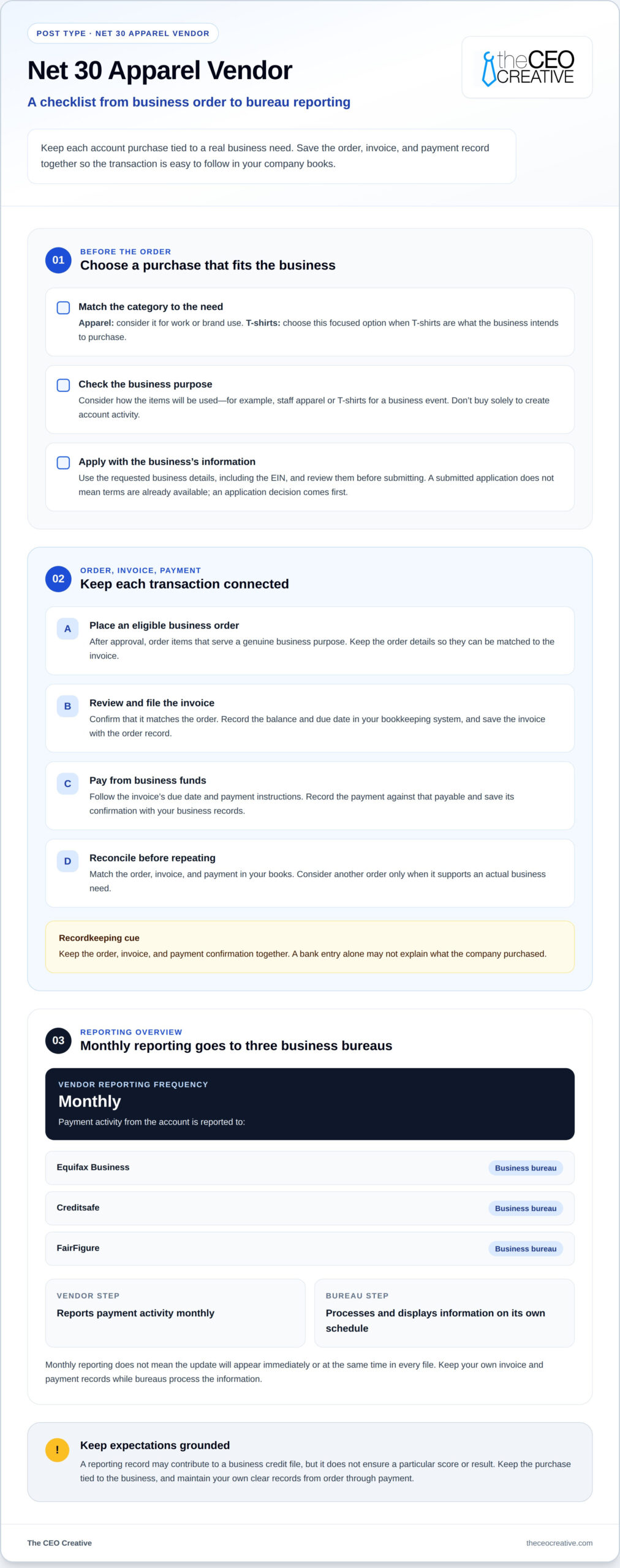
A Net 30 vendor account follows a practical sequence: apply, place an eligible business order, review the invoice, pay according to its terms, and keep the transaction record. Treat each purchase as a business transaction from application through payment. That makes the account activity easier to manage alongside your other company finances.
- Apply with business information. Complete the application using the business details requested, including its EIN. Review the information before submitting it so the application reflects the correct business identity. An application decision comes before using the account for an order, so don’t assume a submitted form means credit terms are already available.
- Place an eligible business order. After approval, choose a purchase that serves a real business purpose. Consider how the items will be used and whether the order fits the company’s current needs. Avoid buying solely to create account activity. Record the order details so the invoice can later be matched to the purchase.
- Review and record the invoice. When the invoice arrives, confirm that it corresponds to the order and note its balance and due date. Enter the expense and payable in your business bookkeeping system. Save the invoice with the order record, rather than relying on a bank entry alone to explain what the company purchased.
- Pay the invoice from business funds. Use the business account to make the payment and follow the due date and payment instructions shown on the invoice. Record the payment against that specific payable. If the business has several invoices due, review them together so each amount is assigned to the correct vendor and recorded once.
- Keep records and repeat deliberately. Eligible payment activity is shared with business credit bureaus. Keep the invoice and payment confirmation in your business records, then consider another order only when it supports an actual business need. A reporting record may contribute to a business credit file, but it does not ensure a particular score or result.
Use a consistent routine to keep account activity clear: save the order, file the invoice, pay from business funds, and reconcile the transaction in your books. A vendor’s reporting and a bureau’s processing are separate steps, so an update may not appear immediately. Track the purchase and payment in your own records while the bureau processes the information.
Which Business Credit Bureaus Receive Reports
Payment activity from the Net 30 vendor account is reported monthly to Equifax Business, Creditsafe, and FairFigure. These are the three business credit bureaus named for the account. Knowing where reports are sent helps you understand where the account may contribute to your business credit history, while keeping expectations realistic about when information appears.
Reporting information and seeing it appear in a business credit file are separate steps. Each bureau controls its own processing and display timing, so an update may not appear in all three files at once. Monthly reporting refers to the vendor’s reporting frequency, not a matching display schedule across bureaus.
This distinction matters when you’re managing a newer business. If you’ve paid an invoice but don’t immediately see an update in a bureau file, the delay alone does not show whether the payment was reported. Keep the order invoice and payment record with your bookkeeping so you can track account activity and identify the transaction associated with an update.
Use consistent business details in your account and financial records. Recording the business name, order, invoice, and payment clearly makes account activity easier to follow. Keep personal expenses out of business purchases to avoid confusing your books. The goal is a reliable record of business spending and payments, not an assumed credit outcome.
- Equifax Business: Receives monthly reports of account payment activity.
- Creditsafe: Also receives monthly reports.
- FairFigure: Also receives monthly reports.
Business owners may review bureau files as part of their record-keeping routine, but reporting does not guarantee a change in a particular score or any specific result. What appears depends on bureau processing and the information in the business file. Focus on accurate account details, responsible purchasing, and paying invoices according to their terms.
A reporting Net 30 business credit vendor can make vendor payment activity part of a company’s credit-building efforts. The account has no personal guarantee, but that feature does not change the importance of tracking business purchases and payments carefully. Treat reporting as one part of an organized financial routine, alongside keeping business transactions distinct from personal activity.
Checklist: Steps to Open and Use a Net 30 Vendor Account
Use this checklist to separate business banking from personal accounts and manage vendor activity consistently. Work through the steps, from opening an account to recording payments.
Open a Dedicated Business Bank Account
Open a bank account in your business entity’s name and route business revenue and expenses through it. Banks commonly request an EIN and documents showing the entity’s formation or registration. Fees and minimum balance requirements vary, so compare account fees, balance conditions, and waiver terms before choosing.
Set Up Separate Records and Expense Policies
Set up separate business accounts in your accounting software, connect the business bank account, and record transactions there. Write an expense policy that defines business purchases, required receipts, and how to handle a personal charge made by mistake. This keeps your accounts, records, and expense rules distinct.
- Gather bank documents. Prepare the business EIN and formation or registration paperwork for opening the account. The Internal Revenue Service describes an EIN as a nine-digit federal tax ID used to identify businesses. A bank may request other details based on the entity and account application.
- Choose business banking tools. Compare business bank accounts by their fees and minimum balance terms, since those requirements differ. If a dedicated business credit card suits your spending process, keep it for company purchases and pay it from business funds. Don’t treat a card as a replacement for organized records.
- Set transaction rules. Direct customer revenue into the business bank account and pay business expenses from it. Record each purchase with its receipt and purpose. If a personal transaction accidentally uses business funds, document the correction instead of leaving it unexplained in the accounts.
- Connect bookkeeping and review cash flow. Use accounting software to categorize income, expenses, and vendor invoices. Reconcile its entries against bank activity and keep supporting records together. The Internal Revenue Service states that the self-employment tax rate on net earnings is 15.3%, so track business income and expenses carefully for tax preparation.
- Pay yourself consistently. Choose a schedule and record each transfer as an owner’s draw or salary, as appropriate for the business entity. If you pay yourself a salary, record it through payroll. Keep personal spending out of business accounts after paying yourself.
Separate accounts give you a clearer picture of business cash flow and make it easier to identify company revenue, expenses, and vendor payments. They also keep business records distinct from personal activity. However, account separation alone does not establish legal protection for personal assets.
Common Mistakes to Avoid
Five habits can make it harder to distinguish company activity from personal finances. Keep clear records and review your payment routine. This article is not financial or legal advice.
- Paying personal expenses from the business account. Avoid using company funds for groceries, personal subscriptions, or household bills. A business bank statement should show business activity, not a mix of household and company expenses. If a personal charge slips through, record it clearly and update your books. Leaving it categorized as a business expense can distort your expense records and cash flow picture.
- Paying business expenses personally without documenting them. A personal card used for a company purchase can leave the transaction disconnected from business records. For example, if you buy a business subscription with personal funds, save the receipt and record the business purpose. Follow your documented process for recording the payment. Don’t enter the purchase as though it came directly from the business bank account.
- Relying on software without reviewing its categories. Accounting software can organize transactions, but an incorrect category still creates an inaccurate record. Review imported bank activity and match vendor invoices with payments. Keep receipts connected to the related transaction. For example, don’t classify a personal purchase as an office expense simply because the charge appears beside business purchases.
- Assuming separate accounts guarantee personal asset protection. Separate accounts can help distinguish business and personal activity, but they don’t guarantee personal asset protection. The U.S. Small Business Administration explains that a sole proprietorship isn’t a separate business entity, so its owner remains personally responsible for business liabilities and debts. The legal and financial effects of an LLC or corporation depend on the circumstances. Mixing funds can make business and personal records harder to distinguish. Consult a qualified professional, such as Ronald A. Davidson Attorney at Law, for advice about your situation.
- Ignoring the business structure when handling money. Keep the entity’s legal and financial records consistent. An LLC or corporation should use accounts and records associated with that business, rather than treating company funds as personal money. Don’t assume every owner can take money out in the same way. For example, salary and owner’s draw are different payment approaches; the appropriate method depends on the entity and tax treatment. Consult a qualified professional about how to handle money for your business.
During a regular bookkeeping review, check account transactions, receipts, expense categories, vendor invoices, and owner payments. For growing businesses that need hands-on financial guidance, utilizing outsourced solutions like CAAS (Client Accounting Advisory Services) can streamline ongoing records and strategic oversight. Correct misclassified expenses and undocumented transfers promptly to make your records easier to understand. Keep business and personal activity distinct in your records. Account separation alone does not guarantee liability protection. This article is not financial or legal advice.
To keep personal and business finances organized, build a routine you can maintain as your business changes. Give each purchase a clear business purpose, keep its record with the related payment, and review your accounts regularly. This consistency gives you a clearer picture of company activity when making decisions.
For a business purchase that also fits vendor-account activity, The CEO Creative offers net 30 apparel, T-shirt, and embroidery supplier options. Choose an order that serves an actual business need, and treat reporting as one part of your wider credit-building activity. Results vary, and bureau display timing is determined by each bureau.
Keep the system simple enough to follow, and strengthen it as your business grows.
Frequently Asked Questions
Do sole proprietors need a separate business bank account?
Whether a sole proprietor is required to open a separate business bank account can depend on applicable rules and the bank’s terms. Separate accounts can make income and expenses easier to identify. For example, customer payments can go into one account and software subscriptions can be paid from it. A sole proprietorship is not a separate legal entity from its owner. This general information is not legal or financial advice.
How do I open a business bank account in the U.S.?
Choose an account suited to your business, then complete the bank’s application with your business and owner information. Banks commonly request an EIN or other tax identification details, along with documents showing the business’s formation or registration. An LLC owner, for example, may need formation paperwork. Requirements vary by bank and business, so check with the bank about the documents it requires. This general information is not legal or financial advice.
How do I separate personal and business expenses for taxes?
Separate accounts and clear transaction records can help distinguish personal and business activity. Keep receipts with their matching entries. For example, record a business supply purchase separately from household shopping, even if both happen on the same day. If you pay a company expense personally, keep a record of the transaction and its business purpose. Tax treatment depends on your circumstances; consult a qualified professional for guidance. This article is not financial or legal advice.
What accounting software or bookkeeping methods help track business finances?
Accounting software may let you categorize transactions, attach receipts, and reconcile activity against bank statements. A spreadsheet can also track the transaction date, amount, payee, business purpose, and payment account. Match each vendor invoice to its payment rather than recording a payment without context. Review entries regularly, and consider professional bookkeeping support if transactions or reporting become difficult to manage consistently.
How should I pay myself from a sole proprietorship, LLC, or corporation?
How owners take money from a business can depend on the business structure and tax treatment. Record transfers accurately rather than labeling every owner payment as a business expense. Entity and tax rules vary. Consult a qualified tax or legal professional about your circumstances. This article is not financial or legal advice.
What are the tax and legal risks of mixing personal and business finances?
Mixed transactions can make it harder to identify business expenses, support records, and prepare tax filings. They can also make it less clear which transactions belong to the business or its owner. For example, paying household bills from an LLC account can complicate company records. The effects depend on the circumstances and applicable rules. Consult a qualified professional for advice. This article is not financial or legal advice.
Can I use a personal bank account for a small business, and what are the rules?
A sole proprietor may be able to use a personal account, but a dedicated business account can make transactions easier to organize. Consider the account’s permitted use and your record-keeping needs. Requirements for LLCs and corporations can vary, so check applicable rules and consult a qualified professional. This article is not financial or legal advice.