

Uniforms can be purchased through a Net 30 vendor account and paid under invoice terms, not recurring installments.
With a direct purchase, the business owns the garments and decides when to replace them.
This guide covers pricing factors, eligible apparel, account steps, reporting, and production planning.
Key Takeaways
- Separate invoice terms from installment financing so you can plan uniform payments around the account’s actual terms.
- Review which apparel and decoration options fit your team’s order before submitting a purchase.
- Understand how application details, payment, and repeat orders connect to business credit reporting.
- Allow for bureau processing time when planning around reported account activity.
- Use a checklist to assess eligibility, order requirements, payment expectations, and reporting before choosing a vendor.
Business uniform prices
The cost of a uniform order depends on the garments, quantity, and customization. An order for custom-branded shirts may cost differently from one that also includes embroidered hats. There is no universal uniform price: the total depends on the items selected and is provided after a quote request.
When considering business uniforms on a payment plan, separate the apparel quote from the payment terms. The quote covers the selected garments and decoration; the account terms set the payment deadline. There is no universal price per employee because teams may choose different items, quantities, and branding.
Net 30 terms describe payment timing for an eligible purchase. They don’t automatically split a uniform order into recurring installments. Businesses can purchase business uniforms on a payment plan through vendor invoice terms, then pay according to the invoice. If the order includes several garment types or decoration choices, consider all selections together when reviewing the total.
Before comparing options, list the garments employees need, the quantities, and the branding requirements. For example, distinguish shirts that need embroidered logos from garments without decoration. This clarifies what the order includes and what affects its cost. Avoid estimating the total from an unrelated garment or decoration example.
A quote reflects selected apparel and customization, while Net 30 governs payment for the eligible purchase. Review both the order details and invoice terms when planning a uniform budget. This distinction helps businesses assess whether a purchase fits their purchasing plan without treating vendor terms as a loan or installment contract. Keep custom garment choices grouped by employee role if different teams require different uniform items.
What can be ordered on Net 30 terms
A Net 30 vendor account applies to eligible purchases, not a cash loan for any uniform supplier. Apparel may include branded garments such as T-shirts and hats, with embroidery used to add a company logo. The order covers the selected items and decoration, then follows the account’s invoice terms.
For businesses considering business uniforms on a payment plan, the key distinction is how payment works. Net 30 is an invoice term, not a promise to divide the balance into monthly installments. A corporate merchandise order can include different items for employees. For example, specify branded shirts separately from jackets, and identify which garments need embroidery.
Fees, interest, or late-payment charges depend on the account terms. Net 30 alone doesn’t establish a rate or charge. Read the applicable terms to understand what the account requires, rather than assuming every vendor uses the same conditions.
U.S. businesses, including newly formed LLCs, can apply, with no minimum time in business. The application uses the business’s EIN, without a personal guarantee or personal credit check. Eligibility does not guarantee approval or identical account terms for every business.
A startup planning business uniforms on a payment plan can use vendor invoice terms for an eligible apparel purchase, rather than treating the order as installment financing. Start by defining the uniform needs: list garment types, quantities, and branding details. Then place the eligible purchase through the account and follow its invoice terms. The same approach applies to corporate merchandise. Keep apparel and decoration choices clear in the order, so the invoice reflects the items selected. This makes it easier to plan the purchase without confusing a vendor account with a loan or recurring payment program.
How the Net 30 account works: apply, order, pay, report, repeat
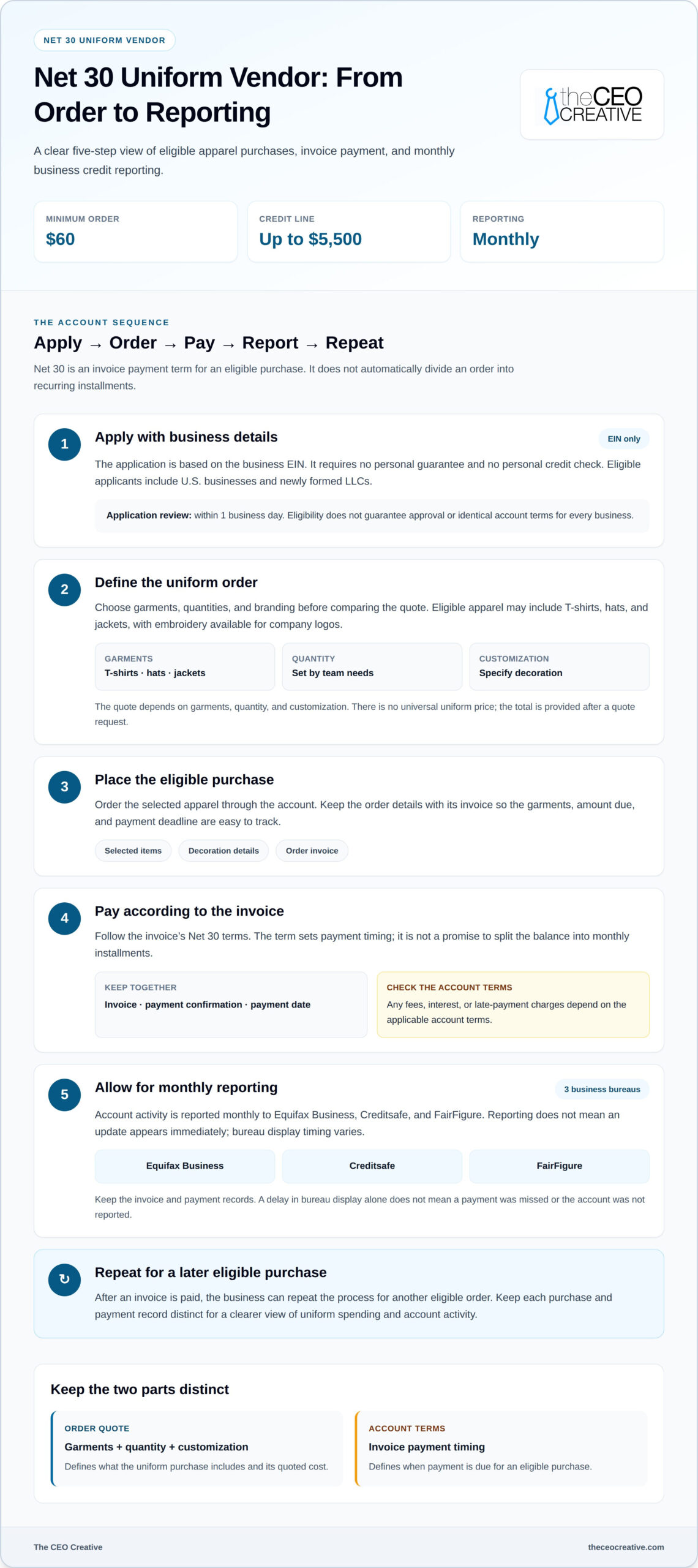
A Net 30 account creates a repeatable process for uniform purchases. The business applies, orders eligible garments, pays according to the invoice terms, and builds a record of account activity. This is vendor payment timing, not a loan or a series of monthly installments.
Start with the application. Approval is within 1 business day, and the application is based on the EIN only. It requires no personal guarantee and no personal credit check. US businesses, including newly formed LLCs, are eligible, with no minimum time in business.
After approval, place an eligible apparel purchase through the account. Keep the order details with the invoice so the business can track the garments purchased, the amount due, and the payment deadline. For example, match an order for branded shirts with embroidered logos to its invoice. This makes the next payment easier to manage.
Pay the invoice according to its Net 30 terms. A consistent method, such as assigning invoice review to the same person each time, helps keep the due date visible. Payment activity is reported monthly to the business credit bureaus. Bureau display timing varies, so reporting does not mean an update appears immediately.
Once an invoice is paid, the business can repeat the sequence for a later eligible purchase. Use the same account process and keep each order and payment record distinct. That creates a clearer view of uniform spending and account activity. A business Net 30 account follows this vendor-account structure.
Uniform purchases and payments are not automatically tax deductible just because a business uses Net 30 terms. Tax treatment depends on the business’s circumstances and applicable rules. This section is not tax advice; consult a qualified tax professional for guidance on a specific return.
Which business credit bureaus receive monthly reports
Account activity is reported monthly to Equifax Business, Creditsafe, and FairFigure. Reporting monthly does not mean an update will appear immediately in each bureau’s records. Display timing varies, so a recent payment may not show at once.
Keep two steps distinct: the account reports activity monthly, but each bureau controls when information appears in its records. Monthly reporting does not guarantee a particular display date. A business may make a payment without seeing an immediate change in a bureau file. That delay alone does not mean the payment was missed or the account was not reported.
Keep a simple record for each uniform purchase by saving the invoice, payment confirmation, and payment date together. If you review your business credit files later, these records help you compare account activity with what appears. Use consistent business details in account records to keep documentation organized.
Monthly reporting can add account history, but it does not promise a score increase, approval, or a particular bureau result. Equifax Business, Creditsafe, and FairFigure may display information at different times. Avoid planning around an assumed posting date or treating a display delay as a measure of account performance.
For a practical review, record the invoice’s due date and the payment date. Allow for bureau display timing to vary before drawing conclusions from a file. If a record appears inconsistent with your invoice and payment documents, use those documents to understand the account activity. Reporting frequency and bureau display are separate parts of the process.
Production and delivery times
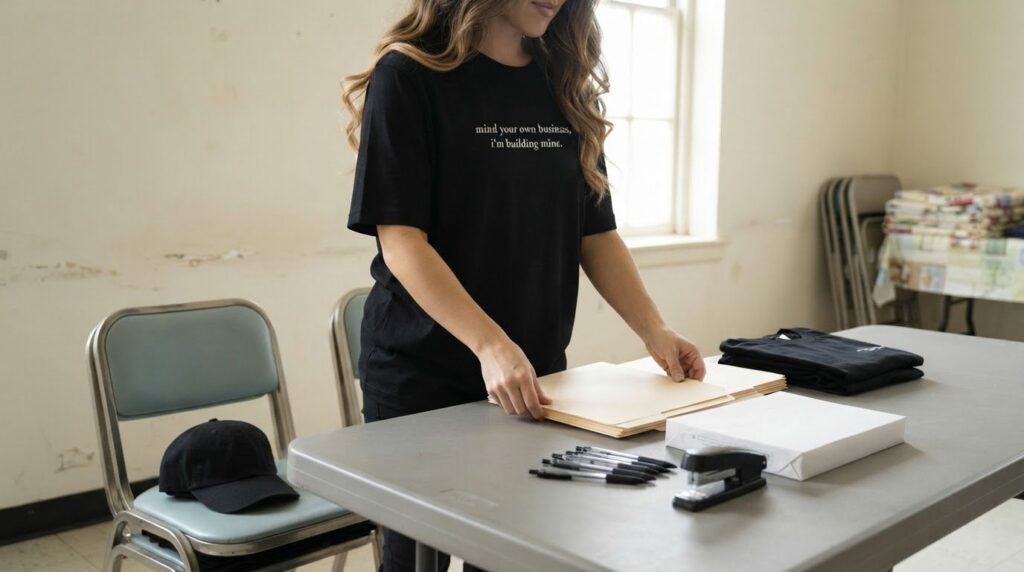
Production and delivery timing depends on the finalized order details. For branded garments, these include apparel selections, sizes, quantities, and decoration instructions. A logo that needs stitching requires clear artwork and placement decisions before production can proceed. Keep these choices together to define the order.
Plan backward from the date employees need their uniforms. First, identify the required in-hand date. Then allow time for garment selection, artwork review, production, and delivery. This is a planning sequence, not a guaranteed schedule. Changes to the logo or garment selection can affect the work required before completion.
Separate payment terms from production timing. Net 30 describes when an invoice is due, not when uniforms will be produced or delivered. A business can organize its budget around invoice terms while planning its rollout around the order’s production stages. The payment schedule does not shorten production or set a delivery date.
For a uniform order tied to a contract, event, or new employee start, document the deadline and required items before submitting the purchase. For example, specify which branded shirts need embroidery and which garments need no decoration. Clear specifications help reduce avoidable changes during order preparation.
A Net 30 apparel vendor account covers eligible apparel purchases on account terms. It does not establish a universal production timeline. Treat each order’s scope and readiness as planning inputs, and keep the budget separate from assumptions about delivery. If timing is critical, build the schedule around the confirmed order details rather than assuming that payment terms determine fulfillment speed.
Uniform rental is different from purchasing: the rental company owns the garments, launders them, and delivers them on a route. The customer never owns the garments. Keep this distinction clear when setting expectations for a uniform program. Do not assume a branded apparel purchase follows the rental model. Clarify whether the arrangement is a rental or purchase before planning for garment ownership and delivery.
Checklist for choosing and using a Net 30 uniform vendor
Use this checklist to assess whether an apparel purchase fits. Confirm eligibility, order requirements, payment terms, and reporting details so the account process is clear.
- Review eligibility. Confirm the account accepts US businesses, including newly formed LLCs. The application uses an EIN only, with no personal guarantee or personal credit check. There’s no minimum time in business. These are the key points to review for EIN-only Net 30 vendors.
- Check the order minimum. Make sure the uniform purchase meets it before submitting the order. This is an order threshold, not a per-item price.
- Understand the account terms. Review the payment deadline, account limit, and any applicable charges in the terms. Net 30 is an invoice payment arrangement, not a promise to split the balance into installments.
- Confirm eligible items. Identify the apparel and decoration needed, such as branded shirts or embroidered garments. Keep item choices and quantities clear so the purchase matches the team’s uniform needs.
- Plan invoice payment. Assign responsibility for recording the invoice and its due date. Save payment confirmation with the order record. Use the account’s stated terms to plan cash flow.
- Review reporting. Confirm that reporting is monthly to Equifax Business, Creditsafe, and FairFigure. Bureau display timing varies, so don’t treat an immediate file update as part of the process.
Before repeating a purchase, review the previous invoice and payment record. This helps keep uniform orders, account activity, and internal bookkeeping aligned.
Common mistakes to avoid
Small assumptions can create confusion between uniform ordering, invoice terms, and credit reporting. Avoid these five mistakes when using a Net 30 vendor account:
- Expecting guaranteed credit results. Monthly reporting does not guarantee a score increase, approval, or a particular credit profile. Treat each purchase and payment as account activity, not a promised outcome. Keep invoices and payment records to track what happened.
- Confusing Net 30 with financing. Net 30 sets the invoice payment deadline. It does not automatically divide a uniform purchase into recurring installments or provide a loan. Plan for the invoice under its stated terms, and don’t build a budget around assumed monthly splits.
- Overlooking the minimum order. Check the combined purchase amount before submitting an order. The minimum applies to the order, not to the price of each garment.
- Expecting immediate bureau display. Reporting is monthly to Equifax Business, Creditsafe, and FairFigure, but display timing varies. A payment may not appear in a bureau file right away. Don’t treat a delayed display as proof that reporting failed.
- Assuming every order detail is interchangeable. Garment choices, branding, and decoration define what the uniform purchase includes. For example, a shirt with embroidery differs from an undecorated shirt in its order specifications. Keep the purchase details and invoice aligned.
These distinctions help keep payment planning realistic. Review the invoice terms, confirm the order meets the minimum, and record each payment. Treat bureau reporting as one part of account tracking, not a guarantee of a specific credit outcome.
The CEO Creative: business credit vendor
The CEO Creative is a business credit vendor for companies purchasing branded apparel through Net 30 terms. Its Net 30 apparel vendor, Net 30 T-shirt supplier, and Net 30 embroidery supplier offerings connect uniform purchases with a business vendor account. This is a fit for businesses that need branded garments and want account activity reported as they build a business credit profile.
For a uniform order, decide which apparel needs branding and whether embroidery belongs in the specification. A business ordering T-shirts, for example, can consider the Net 30 T-shirt supplier offering. If embroidered decoration is part of the garment requirement, the Net 30 embroidery supplier offering is relevant. These are purchases on vendor terms, not a promise to split the amount into installments.
The account may suit US businesses at different stages, including newly formed LLCs. Applications use the business EIN, without a personal guarantee or personal credit check. Approval is within 1 business day. Those details help a business assess order fit before planning its purchase.
Using a reporting account does not guarantee a particular credit result. Monthly reporting goes to Equifax Business, Creditsafe, and FairFigure, while bureau display timing varies. Keep purchase invoices and payment records organized, and make payments according to the account terms. This distinguishes uniform purchasing from financing and keeps account activity trackable.
Consider this option when the business needs eligible apparel, T-shirts, or embroidery and wants those purchases connected to a reporting vendor account. The right fit depends on whether the items meet the company’s uniform needs and the account terms suit its payment planning.
Contact The CEO Creative to discuss the business account.
Frequently Asked Questions
Is there a long-term contract or minimum order requirement?
Review the order terms for any contract duration, renewal clause, or continuing purchase commitment. A uniform purchase and a separate service agreement may involve different obligations. Before approving an order, identify who manages garment replacement, care, and future purchases. This helps determine whether the arrangement suits a one-time uniform need or an ongoing program without assuming every vendor uses the same contract structure.
Which uniform companies offer payment plans for businesses?
The CEO Creative is the business credit vendor discussed here for uniform-related apparel purchases, including T-shirts and embroidery. To assess the fit, start with the uniform items your team needs, then match them to the vendor’s apparel category. Payment terms apply to eligible purchases through the account, so consider them alongside the order details.
What financing options are available for business uniform purchases?
The relevant option here is purchasing eligible apparel through a reporting vendor account, not taking out a loan or using a separate financing product. To compare ways of managing a uniform budget, first define the order, then consider how its invoice fits the business’s purchasing process. This keeps the decision focused on the garment purchase rather than an assumed financing structure.
What are the typical costs per employee for business uniforms?
For a useful per-employee comparison, start with a consistent uniform specification. Define which roles receive each garment, whether branding is needed, and how many items each employee gets. Then divide the order quote by the number of employees covered. For example, calculate embroidered shirts for customer-facing staff separately from other garments for other employees. This gives a more relevant internal budget comparison than a single blended figure.
Do uniform suppliers require a minimum order or deposit?
Order minimums and deposits are separate conditions. A minimum sets the purchase threshold; a deposit is an upfront payment requirement. Do not assume one implies the other. Review the purchase terms for any deposit, when it is due, and how it applies to the order balance. The pricing section covers the account’s minimum order requirement, so focus here on checking for any separate upfront payment.
How do uniform subscription, rental, and installment plans compare?
Compare the obligations of each arrangement, not only the payment schedule. Check who handles garment care, replacement decisions, and changes in employee needs. For a growing team, consider how new hires will receive garments and how unused items will be handled. These operational details affect whether a program fits, even when the initial order or payment structure seems suitable.
What information does a business uniform vendor need to set up a payment plan?
Prepare the order specifications: garment types, size breakdowns, quantities, logo artwork, and decoration placement. If different roles need different items, group those requirements clearly. This gives the vendor a defined order to process and helps the business compare the final details with its needs. Account application information is separate from garment and branding specifications.
What contract, cancellation, and return policies should businesses check?
Review cancellation deadlines, return eligibility, size exchanges, and how issues with custom branding are handled. Check whether the policy treats undecorated garments differently from personalized items, and note the steps for reporting an order problem. Keep the approved order details with the applicable terms. These checks clarify responsibilities before production begins without assuming cancellation or return rules are the same across vendors.