


Blog Title: Build Business Credit Without Credit Cards: 2026 Guide
Meta Description: Learn how to build business credit without credit cards using Net 30 vendor accounts and trade credit. Establish an independent EIN-only profile today.
What if you could scale your company’s purchasing power without ever touching a personal credit card or risking your own credit score? Many entrepreneurs feel trapped by the belief that a high-interest card is the only gateway to growth. It’s common to feel anxious about personal credit checks or confused by which bureaus actually matter for your new LLC. You want to grow, but the traditional path often feels like it’s designed to keep you personally liable for every business expense.
The truth is that you can build business credit without credit cards by using strategic vendor tradelines that link directly to your EIN. This approach allows you to establish a robust credit profile through the everyday purchases your business already needs. We’ll show you how to leverage Net 30 vendor accounts to fill cash flow gaps and secure higher credit limits. You’ll learn a clear, step-by-step path to reporting with Equifax and Creditsafe; this ensures your business stands on its own two feet from day one. Throughout this guide, we highlight how The CEO Creative acts as a reporting Net 30 vendor that helps build business credit through real business purchases, providing a foundational support system for your long-term success.
Key Takeaways
- Establish a clear separation between personal and company finances by using an EIN-only path to build corporate credibility.
- Discover how to build business credit without credit cards by leveraging Tier 1 Net 30 vendor accounts for the supplies your business already needs.
- Follow a streamlined five-step checklist to ensure your trade credit activity is properly reported to bureaus like Equifax and Creditsafe.
- Identify and avoid critical mistakes, such as mismatched business names or late payments, that can damage a new credit profile.
- Learn how to scale your brand identity while simultaneously strengthening your credit file through strategic branding and office supply purchases.
The Foundation of Business Credit Without Personal Cards
You don’t need a personal guarantee to establish corporate credibility. For many new business owners, the idea of tying personal assets to a startup feels like a necessary evil. It isn’t. You can build a profile that lenders trust independently by focusing on your Employer Identification Number (EIN). This “EIN-only” path creates a clear boundary between your private life and your professional obligations. Choosing to build business credit without credit cards allows you to scale safely while keeping your personal assets protected.
A common mistake to avoid is using personal funds for business supplies without a paper trail. When you pay for a laptop or office furniture with your personal debit card, you’re missing a reporting opportunity. These transactions are invisible to credit bureaus. Without a formal invoice and payment record, you aren’t building the history needed for future financing; to ensure your records are always professional and audit-ready, you can discover Proledger for expert accounting and advisory services.
Key Definitions: Tradelines and Payment Reporting
To succeed, you must understand what is trade credit and how it functions as a financial tool. A vendor tradeline is essentially a credit line extended to your business by a supplier. Instead of paying at the time of purchase, you receive the goods first and pay the invoice later. “Net 30” terms are the standard for these agreements; they mean you have 30 days from the invoice date to settle the balance.
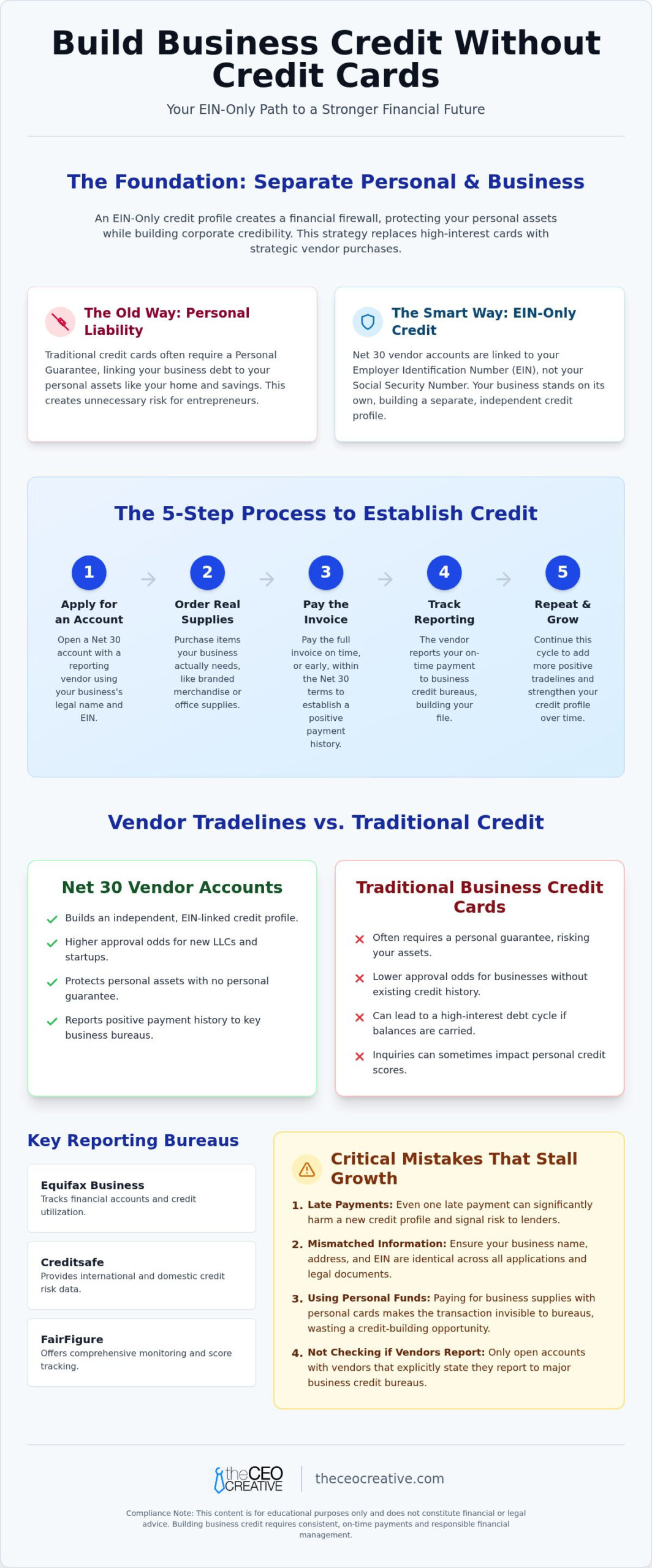
When you pay these invoices, the vendor reports your activity to business credit bureaus. Unlike personal credit, which focuses on FICO, business credit relies on specialized agencies. Learning how to build business credit without credit cards is a strategic move for any modern brand because it targets the following bureaus:
- Equifax Business: Tracks financial accounts and credit utility.
- Creditsafe: Provides international and domestic credit risk data.
- FairFigure: Offers comprehensive monitoring and score tracking.
Consistent reporting to these entities builds a track record of reliability. It transforms routine operational expenses into powerful data points for your credit file.
Why Traditional Credit Cards Aren’t Always the Answer
Traditional credit cards often come with the trap of the personal guarantee. This means if your business hits a rough patch, the bank can come after your personal savings or property. It also creates a debt cycle fueled by high interest rates. According to the Federal Reserve’s 2025 Small Business Credit Survey, 34% of small businesses that applied for financing received less than they sought. This highlights the difficulty of relying on traditional banking alone.
Beyond avoiding high-interest debt, business owners can further optimize their finances by utilizing cash discount merchant services to eliminate credit card processing fees and boost their bottom line.
In contrast, structured trade credit offers a more sustainable way to grow. Vendor accounts typically provide higher approval odds for new LLCs because they’re based on the purchase of physical goods or services rather than unsecured cash loans. This makes them a foundational tool for early-stage growth and long-term sustainability.
How Net 30 Vendor Accounts Replace Traditional Credit Lines
Traditional lenders often overlook startups with zero history. This is where vendor accounts become your most valuable asset. When you choose to build business credit without credit cards, you’re turning overhead into a financial track record. Each time you place an order with a Net 30 vendor, they extend a line of credit for that purchase. Once you pay that invoice, the transaction is reported as a positive data point, transforming simple supply orders into powerful credit history.
Tier 1 vendors are the ideal entry point because they welcome new LLCs without demanding high annual revenue. For a deeper look at which companies to prioritize, explore our guide on Net 30 Vendors 2026: The Ultimate Guide to Building Business Credit. These accounts allow you to prove reliability without high interest rates.
The “Buy What You Need” strategy is highly effective. Instead of unsecured debt, you purchase branding essentials like engraved merchandise and custom mugs. Following the 5 simple steps to build business credit requires this type of reported spending to move beyond a blank file.
Strategic Reporting and Tangible Assets
Reporting to Equifax and Creditsafe is vital for future loan approvals. You should also track your progress through FairFigure, an emerging bureau for modern entrepreneurs. Building credit with physical goods like apparel and stationery creates a stronger “active” file. The CEO Creative functions as a reporting Net 30 vendor that helps you build business credit without credit cards through these real business purchases. Whether you need branding or office supplies, each transaction solidifies your corporate identity. Start building your profile today by applying for a business Net 30 account.
The 5-Step Checklist to Establish Credit with Your EIN
Establishing a business identity requires more than just filing paperwork. It requires a systematic approach to financial activity. You can build business credit without credit cards by following a disciplined cycle of purchasing and payment. This process ensures that your business creates its own footprint, independent of your personal financial history. Use this checklist to move from a blank file to a credible corporate profile.
- Step 1: Apply for a Net 30 account. Use your legal business name and EIN exactly as they appear on your IRS documents. The CEO Creative is a reporting Net 30 vendor that helps you establish this initial link by offering an online application process for LLCs and startups.
- Step 2: Place a qualifying order. Select essential business products such as custom apparel or office supplies. These purchases must be large enough to trigger a reportable event for your file.
- Step 3: Pay your invoice early. Settle the balance in full before the 30 day deadline. Paying early often signals peak reliability to bureaus and can help accelerate your progress.
- Step 4: Track your reporting status. Use business credit monitoring services to confirm the tradeline appears on your Equifax or Creditsafe reports.
- Step 5: Repeat the process. Consistency is the most important factor. Active, ongoing accounts show lenders that your business can handle recurring financial obligations.
Ensuring Your Business is ‘Credit Ready’
Lenders and vendors look for consistency across all public records. Ensure your business address and phone number match exactly on your website, tax filings, and bank accounts. A professional website and a business email address are also foundational requirements. These details prove that your company is a legitimate, operational entity. For a deeper look at these requirements, see our How to Build Business Credit Without a Loan: The 2026 Guide.
Monitoring Your Progress
Expect a tradeline to take 30 to 60 days to appear on your report after your first payment is settled. If a reporting vendor doesn’t show up after 60 days, contact their support team to verify the information they have on file. Small errors in your EIN or business name can prevent data from syncing correctly. As you learn to build business credit, using membership tools can streamline this tracking. These tools provide a central hub to view your standing across multiple bureaus, helping you catch errors before they stall your growth. Staying proactive ensures you always have a clear view of your company’s independent financial health.
Critical Mistakes That Stall Your Business Credit Profile
You have the checklist and the strategy. Now you must protect your progress from common pitfalls that can freeze your growth. Even when you choose to build business credit without credit cards, a single administrative oversight can prevent your data from reaching the right bureaus. Understanding these mistakes allows you to navigate the credit building process with confidence and precision.
- Paying late: Business credit scores are highly sensitive to payment timing. Settling an invoice even one day past the due date can damage a fledgling score. Always aim to pay early to demonstrate peak financial reliability.
- Using mismatched information: Consistency is the foundation of corporate identity. If you use a personal name on a vendor application instead of your registered LLC name, the bureau won’t know which file to update. Every document must match your IRS filings exactly.
- Low purchase volume: Buying one item and never returning doesn’t establish a “history.” Lenders look for recurring activity. To maintain an active status, you need to use your accounts consistently over several months.
- Neglecting report errors: Data entry mistakes happen. If you don’t regularly check your business credit report, you might miss a typo in your EIN or a payment that wasn’t credited correctly. Catching these early prevents long term damage.
The Danger of Non-Reporting Vendors
Many entrepreneurs assume that every Net 30 account helps their score. This isn’t the case. “Big box” retailers often provide trade credit but don’t report that data to Equifax or Creditsafe. You could spend thousands of dollars and have nothing to show for it on your credit file. Before you buy, verify the vendor’s reporting schedule. A dedicated partner like The CEO Creative ensures your real business purchases actually count toward your score. If you’re ready to secure a tradeline that works for you, apply for a business Net 30 account today.
Administrative Errors to Avoid
Your EIN and D-U-N-S number must be perfectly aligned across every account you open. If there’s a discrepancy in your business address or phone number, bureaus may create “split files,” which fragments your credit history. Additionally, using a residential address can sometimes trigger red flags for high tier credit applications. Ensure your business remains in “Good Standing” with your Secretary of State. If your entity falls out of compliance, vendors may suspend your credit lines immediately, halting your ability to build business credit without credit cards until the issue is resolved.
Scaling Your Brand and Credit with The CEO Creative
Growth is a strategic procurement process. You don’t have to wait for a bank’s permission to start scaling your operations. By choosing to build business credit without credit cards, you’re investing in your company’s identity while simultaneously strengthening its financial foundation. The CEO Creative acts as your foundational support system, providing the branding services and office gear you need to present a professional image to the world. For specialized retail and delivery services like Green Express DC, establishing this level of corporate credibility is essential for long-term operational success. Each purchase you make is a deliberate move toward corporate independence.
As your business grows, you may also host corporate milestones or launch parties to celebrate your success. To ensure these events reflect your brand’s professional image, you can explore Event Entertainment and Equipment Rental for expert DJ, lighting, and photobooth services.
The CEO Creative Membership offers a structured path for modern brands. This membership provides access to tools designed for long term sustainability, allowing you to manage your tradelines and track your progress through a centralized hub. It is built for new LLCs and startups: a U.S. business with an EIN can apply, with no minimum time in business. Because we report your payment activity to Equifax, Creditsafe, and FairFigure, your routine spending becomes a permanent part of your business’s success story.
You have the power to build credit through smart, necessary spending. You don’t need to take on high interest debt to prove your reliability. Instead, focus on the items your business already requires to function and grow. This method ensures that your credit profile is a true reflection of your operational strength rather than a list of unsecured loans. It’s a safer, more logical way to establish a footprint that future lenders will respect.
What Happens Next: Your Growth Path
Once you’ve established your account, your focus should shift to consistency. A healthy credit file typically requires 3 to 5 Tier 1 vendor tradelines to stabilize. These early accounts prove that your business can handle multiple obligations at once. After maintaining these for several months, you’ll be ready to graduate to Tier 2 and Tier 3 credit. This next level includes store cards and fleet cards that offer more flexibility for your daily logistics. Eventually, this path leads to unlocking high limit corporate credit lines and equipment leases without the need for personal guarantees.
Ready to Get Started?
Your journey toward a robust corporate credit profile begins with a single transaction. Follow these steps to start your growth today:
- Apply for your CEO Creative Business Net 30 Account to secure your first Tier 1 tradeline.
- Shop for custom apparel and office supplies to trigger your first reporting event.
- Watch your business credit profile grow as you build your brand and settle your invoices on time.
Take control of your company’s financial future by choosing to build business credit without credit cards. By leveraging trade credit and professional branding, you’re setting the stage for a sustainable, independent business that stands on its own merits.
Take Control of Your Company’s Financial Future
Establishing corporate credibility doesn’t require high-interest debt or personal risk. You’ve learned that everyday operational expenses can become your greatest credit-building assets when managed through strategic vendor tradelines. By following the five-step checklist and avoiding common administrative pitfalls, you can create a robust profile that lenders trust independently of your personal history.
Choosing to build business credit without credit cards is a visionary move that protects your personal assets while positioning your LLC for sustainable growth. The CEO Creative supports this journey with a decision within 1 business day on Net 30 accounts, and no personal credit check is required. We report your purchases of custom branding products and office essentials to Equifax, Creditsafe, and FairFigure to ensure your reliability is documented where it matters most.
Your brand deserves a foundation as strong as your vision. Apply for a CEO Creative Net 30 Account Today and start making your necessary business spending work for you. We’re ready to be your partner in long-term success.
Frequently Asked Questions
Do I need a personal guarantee for a Net 30 vendor account?
No, you don’t need a personal guarantee for most Net 30 vendor accounts. These accounts are designed to help you build business credit without credit cards by using your company’s EIN instead of your Social Security number. This structure protects your personal assets and ensures the debt belongs solely to the business entity. It’s a foundational step for any startup looking to establish independent corporate credibility.
Which credit bureaus does The CEO Creative report to?
The CEO Creative reports your payment activity to Equifax Business, Creditsafe, and FairFigure. By reporting to these specific bureaus, your business establishes a diversified credit profile that future lenders can verify. Consistent on-time payments to these agencies help build a track record of reliability. This reporting schedule typically happens on a monthly basis to ensure your file stays active and current with the most recent data.
Can a new LLC with no revenue apply for business credit?
Yes, a new LLC can apply for business credit through Tier 1 vendors. To qualify with The CEO Creative your business should be U.S.-based and have an EIN, with the IRS CP-575 notice available if we ask for it. These suppliers focus on your business registration and legal structure rather than your annual earnings. This allows you to grow your purchasing power as your business revenue naturally increases over time.
How quickly will my Net 30 purchase show up on my credit report?
Your Net 30 purchase typically appears on your business credit report within 30 to 60 days after your invoice is paid in full. Vendors usually report data in monthly batches to the bureaus. It’s important to settle your balance early to ensure the data is ready for the next reporting cycle. Once the bureau processes the information, the tradeline will reflect as an active, positive data point on your file.
What should I do if my tradeline isn’t appearing on Equifax?
If your tradeline isn’t appearing on Equifax after 60 days, first verify that your business information matches your IRS filings exactly. Mismatched addresses or EIN typos are the most common reasons for reporting failures. If all details are correct, contact the vendor’s support team to confirm they’ve sent the data. Sometimes bureaus require multiple reporting cycles to trigger the creation of a new business credit file for a startup.
Is there a minimum purchase amount required for reporting?
Most vendors require a minimum purchase to trigger a reporting event for your credit file. While this amount varies, a purchase of at least $100 is generally recommended to ensure the activity is significant enough for the bureaus to track. Small, consistent orders are more effective than a single large purchase. These routine transactions prove your business has a recurring need for credit and the capacity to repay it responsibly.
Can I build business credit if I have a bad personal credit score?
You can absolutely build business credit even if you have a low personal credit score. Because Net 30 vendors often provide approval based on your EIN alone, your personal financial history is not a factor in the decision. This creates a fresh start for entrepreneurs who want to keep their personal and professional finances separate. It allows you to build business credit without credit cards that require invasive personal credit checks. If you require other financial products like business bonds but are concerned about your history, check out Hard 2 Place Bonds for specialized options.
How many vendor accounts do I need to get a good business credit score?
To generate a reliable score, such as a Dun & Bradstreet PAYDEX, a business typically needs at least three tradelines reporting to its file. Having 3 to 5 active reporting vendor accounts shows lenders that your company can manage different types of recurring credit obligations responsibly. Once you have these foundational lines, you’ll find it easier to qualify for higher tier financing and corporate leases.