

More than 62% of new entrepreneurs use strategic credit-building tools to establish their company’s financial identity, yet many founders still feel trapped by the “no credit” cycle. You’ve likely felt the frustration of being denied for a lease or a supplier agreement because your LLC lacks a formal track record. Learning how to get vendor tradelines is the fastest way to stop putting your personal assets on the line for every company purchase. It’s intimidating to navigate which bureaus matter, but establishing these accounts is a vital step toward professional independence.
The good news is that you don’t need a massive loan to start growing. We’re going to show you the exact process to secure accounts that report to major bureaus like Equifax, Creditsafe, and FairFigure. By using the right net 30 accounts, you can establish a high business credit score and finally separate your personal and professional finances once and for all. This separation is essential for protecting your private assets while scaling your operations.
This guide provides a clear, action-oriented roadmap to build your profile from scratch. We’ll walk through the specific steps to apply, order, and pay for business essentials with vendors like The CEO Creative, a reporting net 30 vendor that helps you build business credit through real business purchases. Get ready to transform your routine operational spending into a strategic asset for your brand’s long-term success.
Key Takeaways
- Understand how vendor tradelines act as the foundation for your business credit profile by reporting routine purchases to major bureaus.
- Master the specific process of how to get vendor tradelines by ensuring your LLC is credit-ready and selecting the right Tier 1 partners.
- Identify the most effective vendors that report to Equifax, Creditsafe, and FairFigure to maximize your profile’s visibility.
- Avoid common pitfalls like mismatched business information and late payments that can stall your credit growth before it starts.
- Learn why a consistent cycle of ordering and on-time payments is the key to securing better terms and higher credit limits.
What Are Vendor Tradelines and How Do They Build Business Credit?
A vendor tradeline is a credit relationship between your business and a supplier that allows you to purchase products on credit terms. Unlike a traditional bank loan where you receive a lump sum of cash, a tradeline is an agreement to pay for specific goods or services at a later date. This is the most practical way to understand how to get vendor tradelines because it focuses on routine operational spending rather than high-interest debt. When you buy office supplies or branding materials, the vendor extends you a line of credit, creating a permanent record of your reliability.
Traditional bank loans often require years of profitable tax returns and significant collateral. In contrast, vendor credit is designed to be accessible for new LLCs and startups. Most of these accounts operate on Net 30 terms, giving you a full month to settle your invoice. This functions as interest-free short-term financing, which keeps your cash flow liquid while you grow your operations. By using your Employer Identification Number (EIN) to apply, you begin the essential process of separating your personal finances from your business obligations.
Establishing your own history is much more sustainable than looking into what a seasoned tradeline is or trying to “piggyback” off another entity’s credit. Authentic vendor reporting builds a profile that you own and control entirely. It proves to the market that your business entity is responsible and creditworthy without always relying on a personal guarantee from the owner.
The Mechanism of Payment Reporting
The real value is realized when your vendor shares your payment data with major business credit bureaus. Vendors like The CEO Creative report your transaction history to bureaus like Equifax, Creditsafe, and FairFigure. This data includes your “Days Beyond Terms” (DBT), which measures how many days after the due date you paid. If you pay early, your DBT is negative, which signals exceptional financial health to future lenders. Frequent reporting ensures your credit file grows and matures every single month.
Why Your Business Needs Tradelines Now
Building tradelines isn’t just about the current purchase; it’s about the foundation for your company’s future. You need these Tier 1 accounts to qualify for Tier 2 and Tier 3 credit, such as high-limit store cards and fleet accounts. A strong credit profile can also lead to lower insurance premiums and better terms with future suppliers. Establishing this professional corporate identity now ensures you’re ready when a major growth opportunity requires fast access to capital or expanded logistical support.
The Step-by-Step Checklist: How to Get Your First Tradelines
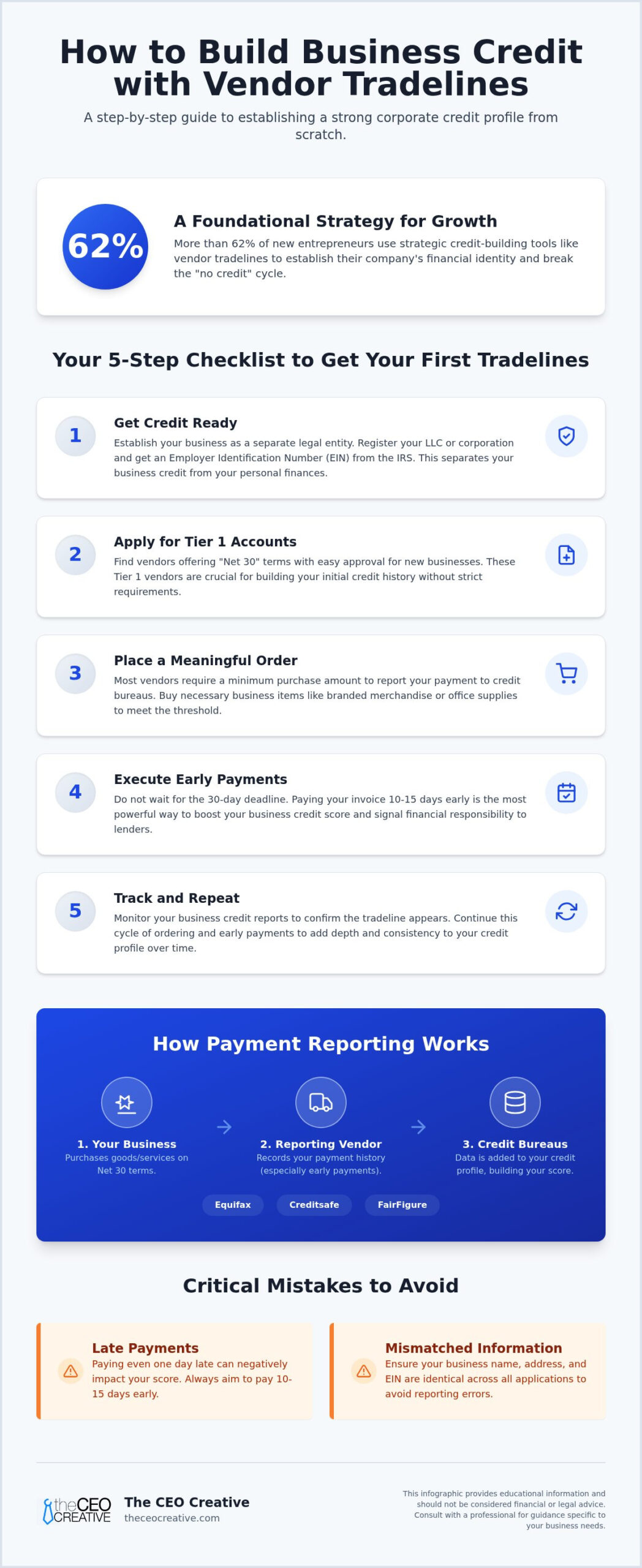
Building a corporate credit profile is a systematic process. It requires more than just opening accounts; it demands a disciplined cycle of activity that proves your business is a reliable partner. Understanding how to get vendor tradelines starts with a clear checklist that takes you from a new LLC to a credit-worthy enterprise. By following these five steps, you can establish a robust profile that major lenders will respect.
- Step 1: Get Credit Ready. Your business must exist as a legal entity. Register your LLC and obtain an EIN from the IRS. This ensures your business credit is decoupled from your personal social security number.
- Step 2: Apply for Tier 1 Accounts. Seek out vendors that offer Net 30 terms with easy approval for new businesses. These vendors are often willing to work with startups that have no prior history.
- Step 3: Place a Meaningful Order. Most vendors require a minimum purchase to trigger a report to the bureaus. Whether it’s office supplies or branding materials, ensure your order meets the threshold.
- Step 4: Execute Early Payments. Don’t wait for the due date. Paying your invoice 10 to 15 days early is the most effective way to boost your score.
- Step 5: Track and Repeat. Monitor your reports to ensure the tradeline appears. Once it does, continue the cycle to add depth to your profile.
Preparing Your Business for Approval
Before you submit your first application, you must verify that your business data is consistent. Mismatched addresses or phone numbers are common reasons for automated denials. Ensure your business is listed in 411 directories and that your address matches your Secretary of State filing exactly. You should also obtain your D-U-N-S number, as many vendors use this as a primary identifier. A professional website and a business email address help you avoid “high-risk” flags that might stall your progress.
The Apply-Order-Pay-Track Cycle
To build business credit quickly, you should aim for a minimum of 3 to 5 reporting tradelines. A single account isn’t enough to generate a comprehensive score. When researching how to get vendor tradelines, many founders forget that the “Track” phase is just as important as the application. Use a monitoring service to verify that your payments are reaching Equifax and Creditsafe. Consistency is your greatest ally. If you’re ready to start this cycle, you can apply for a Net 30 account with a vendor that understands the needs of growing brands. The CEO Creative is a reporting NET 30 vendor that helps build business credit through real business purchases, making it a perfect starting point for your Tier 1 strategy.
Strategic Vendor Selection: Finding the Right Partners in 2026
Choosing the right partners is a strategic move that separates successful founders from those who stay stagnant. If you’re researching how to get vendor tradelines, you must prioritize Tier 1 vendors. These are suppliers that approve businesses with no prior credit history and, crucially, do not require a personal guarantee. This allows you to build a corporate profile using only your EIN. You want vendors that provide items your business actually needs so your spending remains productive and purposeful.
Evaluating the utility of products is a critical step that many founders overlook. You shouldn’t open an account just for the sake of a tradeline if the products don’t serve your daily operations. Instead, focus on vendors that offer high-utility items like office supplies or branding materials. This approach ensures your cash flow is supporting your business growth while your payment history builds your score. It’s a more sustainable way to manage your company’s early financial stages without wasting capital on useless inventory.
Identifying Tier 1 Reporting Vendors
Tier 1 vendors act as the entry point for your corporate financial journey. The best candidates for this stage offer low entry barriers and report to multiple bureaus. You should look for partners that share data with Equifax, Creditsafe, and FairFigure to ensure your profile is visible to the widest range of future lenders. Common categories for these accounts include office supplies, custom apparel, and digital branding services. For a curated selection of current options, review our Tier 1 Net 30 Vendors Top List to find the best fit for your specific industry needs. Selecting the right starting point prevents you from getting stuck with non-reporting accounts that don’t help your score.
The CEO Creative: Branding and Credit Synergy
The CEO Creative is a reporting NET 30 vendor that helps build business credit through real business purchases. Many traditional guides suggest buying industrial shipping boxes or janitorial supplies you might never use. This is an inefficient use of capital for a modern agency or ecommerce brand. Startups today need professional branding to compete and build trust with their own clients. Understanding how to get and build business credit involves making every dollar work twice. By opening a Business Net 30 Account, you can purchase custom apparel and office products that actually serve your growth. This dual-purpose strategy ensures that even your routine operational costs are building a foundation for long-term growth and higher credit limits with bureaus like Equifax, Creditsafe, and FairFigure.
7 Critical Mistakes to Avoid When Building Vendor Credit
Success in business credit isn’t just about what you do right; it’s about what you don’t do wrong. Many founders fail because they overlook the technical details of how to get vendor tradelines that actually stick to their profile. These errors can lead to “ghost” tradelines that exist in your vendor account but never appear on your Equifax or Creditsafe reports. Avoid these seven pitfalls to ensure your efforts result in a high-limit corporate profile.
- Mismatched Business Information. Inconsistency is the primary reason tradelines fail to report. If your name or address varies by even a single character across applications, the bureaus won’t know which file to update.
- Late Payments. Business credit is far less forgiving than personal credit. Even a payment made one day late can trigger a negative mark that stays on your profile for years.
- Applying Too Fast. “Shotgunning” ten applications in a single afternoon signals desperation to automated underwriting systems. Space out your applications to show steady, controlled growth.
- Ignoring Minimum Purchases. Many vendors require a specific dollar amount per order before they transmit data to the bureaus. Small, incidental purchases might not trigger a report.
- Not Verifying Reporting. Don’t assume every supplier reports. Some only report sporadically or to bureaus that lenders in your industry don’t use.
- Mixing Personal and Business Expenses. Paying your Net 30 invoice with a personal credit card defeats the purpose of building corporate identity. Always use your business bank account.
- Using Only One Bureau. A perfect score with Equifax won’t help you if a future lender only pulls your Creditsafe or FairFigure report. You need diversity across all major platforms.
Data Integrity and Matching Errors
Your business needs a consistent NAP (Name, Address, Phone) profile. This acts as your digital fingerprint in the financial world. Before you submit another application, audit your records with the Secretary of State, the IRS, and your local business listings. Your EIN must match your filing exactly. If you’ve moved offices or changed your phone number, update every existing account immediately to prevent data fragmentation. This technical hygiene is the “secret sauce” for founders who see their scores jump quickly.
Cash Flow vs. Credit Building
It’s easy to get caught up in the excitement of a new credit line. However, you should never overspend just to get a tradeline. Buy only what is necessary for your daily operations. Managing your Net 30 dates is a logistical skill; set reminders for 15 days before the due date to ensure you never miss a payment window. This disciplined approach allows you to build business credit without a loan while keeping your cash flow healthy. If you’re ready to start building with a partner that prioritizes your growth, you can apply for a reporting Net 30 account today and begin your journey with a Tier 1 vendor that understands modern branding needs.
Recap: Your Path to Corporate Credit Success
Building a robust corporate identity is a marathon. It requires patience and a strategic approach to every transaction you make on behalf of your brand. You’ve learned the fundamentals of how to get vendor tradelines, but the real growth happens in the months following your first approval. It’s not just about opening accounts; it’s about maintaining a flawless history of reliability. Consistency in your ordering and payment habits is the key to a robust tradeline profile that major lenders will eventually find irresistible.
By following the Apply-Order-Pay-Track cycle, you’re transforming routine operational costs into a powerful financial tool. This process establishes a foundation that allows you to stop relying on personal guarantees. Every on-time payment to a reporting vendor like The CEO Creative acts as a brick in your company’s financial fortress. You aren’t just buying office supplies or apparel; you’re building a sustainable asset that will serve your business for years to come. Stick to the plan, stay organized, and watch your corporate profile mature.
Scaling Beyond Tier 1
Once you have successfully established 5 to 8 solid tradelines, you’ll find that your business is ready to scale beyond basic vendor accounts. This is the stage where you can move from simple Net 30 terms to corporate credit cards and high-limit revolving store accounts. Your established score gives you the leverage to negotiate better terms with larger suppliers, such as longer payment windows or bulk discounts. If you’re ready to plan your next moves, our Net 30 Vendors 2026 Guide provides a comprehensive roadmap for moving into Tier 2 and Tier 3 credit. This progression is essential for accessing the capital needed for major expansions or equipment purchases.
Trust and Compliance Note
This content is provided for educational and informational purposes only. It doesn’t constitute financial, legal, or investment advice. While we strive to provide the most accurate information on how to get vendor tradelines, every business situation is unique. Business credit building involves risks, and results can vary based on many factors. You should consult with a qualified financial professional or legal advisor for specific credit strategies tailored to your organization. The CEO Creative is a reporting NET 30 vendor that helps build business credit through real business purchases, but we don’t guarantee specific credit score outcomes.
Take Command of Your Corporate Financial Future
Establishing a professional credit profile is one of the most significant strategic moves you can make for your brand. By mastering how to get vendor tradelines through a disciplined cycle of early payments and accurate data matching, you’re securing more than just a score. You’re building a foundation that allows your business to stand on its own two feet, independent of your personal financial history. Consistency is the primary driver of growth; every routine purchase of office supplies or custom branding materials becomes a permanent record of your reliability.
Don’t let a lack of history hold your ambitions back. You can start building today by partnering with a vendor that understands the logistical needs of modern entrepreneurs. Apply for a CEO Creative Business Net 30 Account Today to begin your journey. Once you submit your application, you’ll receive a decision within one business day. From there, you can shop our catalog of high-quality office supplies and custom merch, then watch your on-time payments report to major bureaus like Equifax and Creditsafe. Your brand’s long-term success starts with these foundational steps, and we’re here to support your growth every step of the way.
Frequently Asked Questions
Do I need a personal guarantee to get vendor tradelines?
You don’t need a personal guarantee to secure most Tier 1 vendor tradelines. These accounts are specifically designed to help you build business credit using your Employer Identification Number (EIN) alone. This structure protects your personal assets and allows your business to stand as its own financial entity. By avoiding a personal guarantee, you ensure that your personal credit score remains unaffected by your business spending habits.
How long does it take for a vendor tradeline to show up on my credit report?
It typically takes between 30 and 90 days for a new tradeline to appear on your business credit report. Vendors usually report payment data in monthly batches, so the timing depends on when you settled your invoice relative to their reporting date. If you’re learning how to get vendor tradelines for the first time, patience is key while waiting for the bureaus to process and display your initial transaction history.
Which credit bureaus does The CEO Creative report to?
The CEO Creative reports your payment history to Equifax, Creditsafe, and FairFigure. By sharing data with multiple bureaus, we ensure that your financial reliability is visible to a broad range of future lenders and suppliers. This multi-bureau reporting strategy helps you build a comprehensive and balanced credit profile that isn’t dependent on a single data provider.
Can a new LLC with no revenue get approved for Net 30 terms?
Yes, a new LLC with no current revenue can often get approved for Net 30 terms with Tier 1 vendors. These suppliers understand that startups need to establish a track record before they can access traditional bank financing. As long as your business is properly registered with the Secretary of State and has a valid EIN, you can qualify for foundational accounts that help you grow.
What happens if my tradeline does not appear on my business credit file?
If a tradeline doesn’t appear after 90 days, you should first check your business records for any data mismatches. Small errors in your business name, address, or EIN can prevent bureaus from matching the data to your file. Contact the vendor’s credit department to verify they have your correct information and confirm their current reporting schedule to ensure your account was included in the last batch.
Is there a minimum purchase amount for a tradeline to be reported?
Many vendors require a minimum purchase amount, often ranging from $45 to $100, before they report the activity to credit bureaus. Small or incidental orders might stay in the vendor’s internal system without triggering an external report. Always verify the specific reporting threshold with your supplier to ensure your purchases are actively contributing to your business credit building strategy.
Do I need a D-U-N-S number to apply for Net 30 accounts?
You don’t always need a D-U-N-S number to apply, but having one is highly recommended for a complete profile. While many Tier 1 vendors only require an EIN for the initial application, a D-U-N-S number is essential for building a score with Dun & Bradstreet. Obtaining this number early in the process of how to get vendor tradelines ensures that your business is recognized by all major credit reporting agencies from the start.
Will closing a Net 30 account hurt my business credit score?
Closing a Net 30 account can potentially lower your score by reducing the average age of your credit history and the total number of active tradelines. A robust profile relies on a diverse mix of accounts with long-standing, positive payment records. If an account has no annual fees, it’s often better to keep it open and make occasional small purchases to maintain the depth and maturity of your business credit file.
Building business credit? Open a Net 30 Account — EIN only, no personal guarantee, $60 minimum order, credit lines up to $5,500, a decision in one business day, and every on-time payment reported monthly to Equifax Business, Creditsafe and FairFigure.