


Table of Contents
- What are Business Credit Tradelines and Why Do They Matter?
- How Tradelines Report to Business Credit Bureaus
- Vendor Tradelines vs. Financial Tradelines: Which is Better?
- 5-Step Checklist: How to Build Credit with Tradelines
- Strategic Credit Building with The CEO Creative
- Frequently Asked Questions
Did you know that over 40% of small business credit applications are denied simply because the business has no reportable credit history? It’s incredibly frustrating to be held back by a lack of data, especially when you’re working hard to scale your vision. This guide will show you exactly how to leverage trade lines that build business credit using your EIN, allowing you to establish a robust profile without risking your personal score. We’ll walk you through the reporting ecosystem of Equifax and Creditsafe, compare vendor versus financial accounts, and provide a step-by-step roadmap to achieving Tier 1 status.
Key Takeaways
- Understand how vendor tradelines allow you to buy essentials now and pay later to establish a credit file in weeks rather than years.
- Discover the specific trade lines that build business credit using your EIN, helping you separate personal and business finances without a personal guarantee.
- Learn how reporting schedules for bureaus like Equifax, Creditsafe, and FairFigure impact your score so you can track your growth accurately.
- Follow a clear five-step checklist to apply for Net 30 accounts, place qualifying orders, and ensure your payments are recorded correctly.
- Identify how strategic purchases like custom apparel and office supplies serve a dual purpose by building both your brand identity and your credit profile.
What are Business Credit Tradelines and Why Do They Matter?
A vendor tradeline is a straightforward “buy now, pay later” arrangement between your company and a supplier. This type of Trade credit allows you to purchase essential supplies while deferring payment for a set period, typically 30 days. Unlike personal credit, which relies on your Social Security Number, these accounts focus on your Employer Identification Number (EIN). This separation is vital for protecting your personal assets and scaling your operations without risking your individual credit score.
You can establish a visible credit file in weeks rather than years by choosing the right trade lines that build business credit. Many entrepreneurs struggle to get financing because they lack a verifiable history, but the solution is manageable. By avoiding reporting errors and working with vendors that actively share data with major bureaus, you create a paper trail of reliability that lenders find attractive. This foundational step ensures your business is recognized as a legitimate entity by the financial ecosystem.
Most major business credit bureaus require a minimum of three to five reporting accounts before they generate a score for your LLC. Without this foundation, your business remains invisible to lenders. Starting with vendor accounts is the most efficient way to bridge this gap. It allows you to build a reputation based on your business performance rather than your personal history. This strategy is especially effective for startups that don’t yet have the revenue to qualify for traditional bank loans.
The Role of Net 30 Terms in Tradeline Building
Net 30 terms mean you have 30 days to pay the full invoice amount after the purchase date. These short-term agreements are powerful tools for growth. They build trust with bureaus much faster than long-term bank loans because they demonstrate high-frequency, reliable payment behavior. Consistent success at this level helps you graduate from Tier 1 vendor accounts to Tier 2 and Tier 3 financial products. Eventually, this leads to high-limit business credit cards and favorable lease agreements.
Key Terms: Vendor Tradeline vs. Payment Reporting
A vendor tradeline is the actual credit account listed on your business credit report. Payment reporting is the active process of transmitting your transaction data to bureaus like Equifax, Creditsafe, and FairFigure. You must distinguish between the two. Some suppliers offer credit but don’t report it to the bureaus. To grow, you need partners that prioritize reporting to ensure your consistency is rewarded. For a deeper look at this process, check out our ultimate guide to building business credit.
How Tradelines Report to Business Credit Bureaus
Understanding the reporting mechanism is just as vital as finding the right trade lines that build business credit. Without consistent data transmission, your on-time payments remain invisible to the financial world. Most vendors batch their transaction data and send it to bureaus like Equifax Business, Creditsafe, and FairFigure on a set schedule. This process ensures that your consistent payment behavior reflects on your credit profile, eventually influencing critical scores like the Dun & Bradstreet Paydex or the Experian Intelliscore.
Equifax, Creditsafe, and FairFigure: The New Standard
Modern lenders have moved beyond traditional bureaus. They now rely heavily on Creditsafe and FairFigure to assess real-time risk for small businesses. These platforms provide a more granular view of your financial health than older models. The CEO Creative integrates directly with these specific bureaus to ensure your purchases help build a robust file from day one. For a deeper dive into which providers offer the best visibility for your LLC, read our Net 30 Vendors 2026: The Ultimate Guide.
The Reporting Timeline: When Will Your Tradeline Appear?
Patience is required after you make your first purchase. It usually takes between 30 and 90 days for a new tradeline to post to your credit report. This delay occurs because vendors typically report in monthly or weekly cycles rather than in real-time. A standard Tier 1 vendor typically transmits payment data to the bureaus once every 30 days at the close of the billing period. If you don’t see an update immediately, don’t panic; the bureaus need time to process the incoming data batches.
Mismatched information is the most common cause of reporting failures and delays. Your business name, physical address, and EIN must match your Secretary of State filings exactly across every account you open. Even a small discrepancy, like using “St.” instead of “Street,” can prevent a bureau from linking a payment to your profile. Establishing and managing business credit requires meticulous attention to these administrative details to ensure every dollar spent works in your favor.
A high Paydex score, which ranges from 1 to 100, requires a history of paying invoices on or before the due date. Similarly, the Intelliscore predicts the likelihood of a business becoming seriously delinquent within the next year. By adding trade lines that build business credit to your profile, you provide the data points these algorithms need to calculate a favorable rating. If you’re ready to start with a provider that prioritizes accurate and timely reporting, you can apply for a business Net 30 account to begin your reporting journey.
Vendor Tradelines vs. Financial Tradelines: Which is Better?
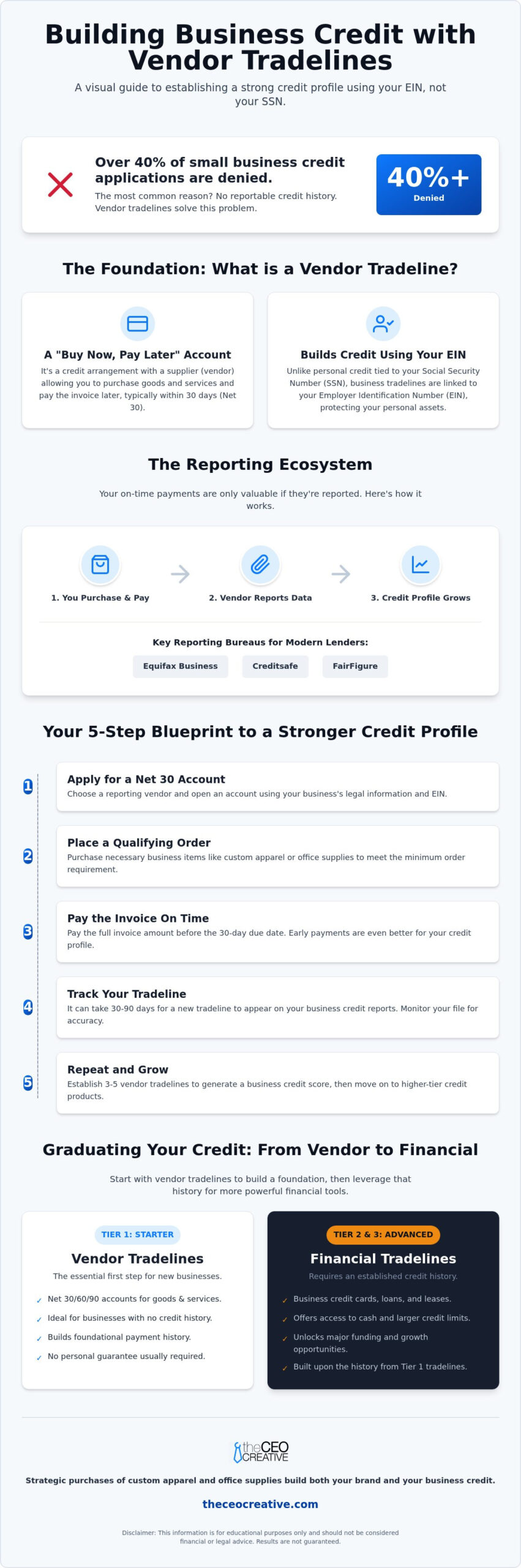
Choosing between vendor and financial tradelines is a critical fork in the road for any new business owner. Vendor tradelines, often called Tier 1 credit, are the most accessible trade lines that build business credit for startups and new LLCs. These accounts generally don’t require a personal guarantee. Instead of relying on your Social Security Number, these vendors look at your business’s legal standing and EIN. Financial tradelines, such as corporate credit cards or bank loans, represent Tier 2 and Tier 3. These typically demand a pre-existing credit history and often force you to be personally liable for the debt. For a new LLC, starting with financial tradelines is like trying to run before you can walk. It’s much more effective to build a foundation where the risk is lower and the approval odds are higher.
The “No Personal Guarantee” advantage is the primary reason entrepreneurs prioritize vendor accounts. When you use your EIN to open an account, you’re building a wall between your personal life and your business obligations. If your business credit profile is strong enough, you won’t need to leverage your house or personal savings to secure the supplies you need to scale. This separation is a hallmark of a mature, well-organized company. It allows you to take calculated risks and invest in growth without the constant fear of impacting your personal credit score or family’s financial security.
Net 30 Accounts for LLCs: Low Risk, High Reward
Net 30 accounts for LLCs offer a low-risk entry into the credit ecosystem. When you purchase essentials like office supplies or custom apparel on terms, you’re using a “soft” entry to build your file. This strategy allows you to manage cash flow effectively by keeping your liquid capital in the bank while your credit profile grows. You can learn more about this approach in our 2026 guide on how to build business credit without a loan. It’s a strategic move that helps you stay liquid while proving your reliability to bureaus like Equifax and Creditsafe.
Strategic Purchases: Branding While Building Credit
Beyond basic supplies, you can make strategic purchases that improve your brand identity while you build credit. Using trade lines that build business credit to acquire services like logo design or custom gear creates a dual benefit. You’ll look more professional to your clients while simultaneously becoming more creditworthy in the eyes of lenders. High-quality branding signals stability to both customers and credit bureaus. Consider exploring logo design for business credit as a way to invest in your company’s future and its financial reputation at the same time. This approach turns routine operational costs into strategic assets that fuel long-term success.
5-Step Checklist: How to Build Credit with Tradelines
Executing a strategy with trade lines that build business credit requires a disciplined approach to documentation and timing. You’ve already learned how reporting works and why vendor accounts are superior for startups. Now, it’s time to put that knowledge into action. This checklist provides a roadmap to ensure every purchase you make contributes to a stronger financial profile. Following these steps helps you avoid the administrative errors that often stall credit growth for new LLCs.
- Step 1: Apply with precision. Submit your application for a Net 30 account using your EIN. Ensure your business email, phone number, and physical address match your official filings exactly. Avoid using personal contact information, as this can trigger fraud alerts or prevent reporting.
- Step 2: Place a qualifying order. Purchase products that your business actually needs, such as office supplies or custom gear. Most vendors have a minimum purchase amount required for reporting; ensure your order meets this threshold to trigger a data transmission to the bureaus.
- Step 3: Pay early. Don’t wait for the 30-day deadline. Paying your invoice 10 to 15 days early demonstrates superior cash flow management. This behavior is often rewarded with higher scores in systems like the Paydex model.
- Step 4: Track your reporting. Monitor your business credit files to ensure the tradeline appears within the 30 to 90-day window. If you’re unsure if the cost is justified, consider if business credit monitoring services are actually worth it for your specific goals.
- Step 5: Diversify and repeat. One account isn’t enough to generate a high score. Repeating this cycle with 3 to 5 different trade lines that build business credit creates a dense, reliable file that traditional lenders trust.
Common Mistakes to Avoid (The Pitfalls)
Late payments are the most common way to destroy a business credit file before it truly begins. even a single payment made one day past the due date can cause your score to plummet. Another frequent error is mismatched business information. If you use a home address for one vendor and a virtual office for another, the bureaus may fail to link those accounts to your EIN. Low activity also hurts your profile. Opening an account but never making a purchase creates a zombie tradeline that adds no value. You must also avoid relying on non-reporting vendors. If a supplier doesn’t share data with Equifax, Creditsafe, or FairFigure, your on-time payments won’t help you scale. Additionally, never pay business invoices from a personal bank account; this “pierces the corporate veil” and can confuse bureau data matching. Finally, avoid using PO Boxes or UPS Store addresses for applications, as many bureaus flag these as high-risk or non-commercial locations.
Compliance Note: Not Financial Advice
This content is provided for educational and informational purposes only. It does not constitute legal, financial, or tax advice. You should consult with a qualified professional before making significant financial decisions or seeking specific credit score guarantees. Every company is unique; therefore, results vary based on your overall business health and individual credit history. To start building your foundation today with a provider that understands these mechanics, you can apply for a business Net 30 account and begin your first reporting cycle.
Strategic Credit Building with The CEO Creative
The CEO Creative functions as a strategic partner for modern entrepreneurs who need trade lines that build business credit through high-utility purchases. By offering a reporting Net 30 account, we simplify the process of establishing a file with Equifax, Creditsafe, and FairFigure. Our membership model is designed to guide you through the “Apply, Order, Pay” cycle with clarity and transparency. You aren’t just buying items; you’re investing in your company’s financial footprint. You get the branding tools you need to grow while the credit bureaus receive the data they need to score your business accurately.
Building Brand Identity and Credit Simultaneously
Every dollar you spend on your business should work twice as hard. When you shop for essentials, you’re doing more than just stocking a supply cabinet. You’re creating a verifiable history of reliability. If you’re looking for where to buy office supplies online, choosing a reporting vendor is a strategic move that pays dividends. Similarly, investing in business t-shirts and corporate apparel allows you to look professional while your credit profile matures. This dual-purpose strategy ensures your operational costs are never wasted; they’re repurposed into credit-building assets.
Getting Started: a decision within one business day for Net 30 Accounts
We’ve streamlined the entry process to remove the typical barriers faced by new LLCs and startups. You can apply using only your EIN, which means no personal guarantee is required and there’s no hard inquiry on your personal credit. Once approved, your first 30 days focus on establishing consistency. Place your first order, receive your gear, and pay your invoice early to set a strong tone for the bureaus. This foundational step is the fastest way for a new company to prove its creditworthiness to the broader financial market without risking personal assets. Using trade lines that build business credit is the most logical path for any owner who values financial separation.
What Happens Next
- Apply for your Net 30 account using your verified business EIN and professional contact details.
- Browse our catalog of office supplies and custom branding products to place your first qualifying order.
- Pay your invoice within the terms to trigger the reporting process to major business credit bureaus.
Establishing a robust business credit profile doesn’t have to be a confusing or long-term struggle. By leveraging trade lines that build business credit through real product purchases, you create a sustainable foundation for future financing and growth. Take control of your company’s financial destiny today by choosing a partner that reports your success and understands your entrepreneurial spirit.
Apply for your Net 30 vendor account here.
Start Scaling Your Business Credit Profile Today
You now have a clear roadmap to move from a thin credit file to a robust, reportable history. By focusing on trade lines that build business credit, you’ve learned how to separate your personal assets from your company’s obligations while avoiding common reporting pitfalls. This strategic approach ensures your LLC is recognized by major bureaus through consistent, early payments on essential products. Building a strong financial foundation is a deliberate process that starts with the right partners and the right reporting visibility.
Apply for a Net 30 Business Account with The CEO Creative to start reporting your success to Equifax, Creditsafe, and FairFigure without a personal guarantee. Our platform allows you to invest in custom branding products that build your business identity while simultaneously maturing your credit profile.
What happens next
- Submit your application using your EIN for a decision within one business day on a Tier 1 vendor account.
- Order custom branding products or office supplies to establish your first reporting tradeline.
- Pay your invoice early to maximize your score and prepare for higher credit tiers.
The CEO Creative provides the tools you need to grow your brand and your credit simultaneously. Take this first step toward financial independence and long-term sustainability for your organization. Your path to Tier 1 credit starts with a single purposeful purchase.
Apply for a Net 30 Business Account with The CEO Creative
Frequently Asked Questions
Do I need a personal guarantee to open a business tradeline?
Most Tier 1 vendor tradelines do not require a personal guarantee. These accounts are designed to use your business’s legal entity and EIN as the primary qualifying factors. This allows you to protect your personal assets and score while building a separate financial identity for your LLC. It is a vital step for entrepreneurs who want to scale their operations without risking their individual financial security.
Which business credit bureaus does The CEO Creative report to?
The CEO Creative reports your payment history to Equifax, Creditsafe, and FairFigure. These bureaus are widely used by modern lenders and suppliers to assess business risk and reliability. By reporting to these specific agencies, we help you build a comprehensive profile that traditional and alternative lenders can verify easily. This visibility is essential for securing larger lines of credit and more favorable terms in the future.
How many tradelines do I need to get a business credit score?
You generally need at least three to five reporting accounts to generate a business credit score. Bureaus require a minimum amount of data to calculate a reliable rating like a Paydex or Intelliscore. Starting with multiple trade lines that build business credit ensures your file is dense enough to be recognized by algorithms. Diversifying your vendors also shows lenders that you can manage multiple credit relationships simultaneously.
Can a new LLC with no revenue get a Net 30 account?
Yes, a new LLC can qualify for a Net 30 account even without established revenue. Many Tier 1 vendors focus on your business’s legal standing and EIN rather than your current bank balance or tax returns. This makes vendor accounts the perfect starting point for startups looking to establish creditworthiness from day one. It provides the initial data points needed to build a history that eventually leads to larger loans.
What should I do if my tradeline does not appear on my credit report?
If a tradeline hasn’t appeared within 90 days, verify that your business information matches your Secretary of State filings exactly. Small discrepancies in your address or business name can prevent bureaus from linking the data to your profile. You should also confirm with the vendor that your account has reached the minimum purchase threshold for reporting. Consistent data across all platforms is the key to successful credit building.
Is there a difference between a vendor tradeline and a credit card?
A vendor tradeline is a credit agreement specifically for purchasing goods or services from that supplier, whereas a credit card provides a revolving line of credit. Vendor accounts are typically easier to obtain for new businesses because they often don’t require a personal guarantee. Credit cards usually require higher scores and more established history, making vendor tradelines the ideal foundation for businesses in their early stages.
How often do Net 30 vendors report to the bureaus?
Most Net 30 vendors report to the bureaus on a monthly or weekly cycle. Your payment data is usually batched and transmitted at the end of the billing period rather than in real time. It can take one to two reporting cycles for the activity to reflect on your official business credit report. Patience is necessary during this initial phase as the bureaus process the incoming data from various suppliers.
Can I use my EIN only to build business credit?
You can build business credit using only your EIN by focusing on trade lines that build business credit through vendor accounts. This method is the most effective way to separate your personal and professional finances completely. It allows your business to stand on its own merits and qualify for financing without risking your personal Social Security Number or family assets. This separation is a hallmark of professional business management.
Building business credit? Open a Net 30 Account — EIN only, no personal guarantee, $60 minimum order, credit lines up to $5,500, a decision in one business day, and every on-time payment reported monthly to Equifax Business, Creditsafe and FairFigure.