

What if you could build a high-limit credit profile for your LLC without ever touching your personal credit score? Most entrepreneurs feel the sting of being denied for a traditional bank loan because their business credit file is a blank slate. It’s a common struggle to face high startup costs when you lack the flexible payment terms needed to scale. Identifying the right vendors that build business credit is the most effective way to bridge this gap. You shouldn’t have to risk your personal assets just to buy office essentials or branding services.
You’ll learn exactly how to leverage Net 30 terms to establish a robust profile using only your EIN. By choosing reporting partners like The CEO Creative, a reporting Net 30 vendor that helps build business credit through real business purchases, you can turn routine orders for apparel or engraved merchandise into financial assets. This article provides a clear roadmap to understanding Net 30 mechanics; we identify top vendors and provide a checklist to ensure your payment history reaches bureaus like Equifax and Creditsafe. It’s time to stop worrying about bureau confusion and start accessing the larger credit lines your business deserves. This content is for educational purposes and doesn’t constitute financial or legal advice.
Key Takeaways
- Master the mechanics of Net 30 terms to secure 30-day payment windows for essential business supplies without using a personal guarantee.
- Identify strategic vendors that build business credit by reporting your on-time payments to major bureaus like Equifax Business and Creditsafe.
- Streamline your growth by purchasing custom branding and apparel that doubles as a verifiable business credit tradeline.
- Follow a structured checklist to ensure your business is credit-ready, from EIN registration to maintaining consistent contact information across all applications.
- Avoid common pitfalls like late payments or mismatched business names that can stall your progress toward higher credit limits.
Understanding Business Credit Vendors and Net 30 Terms
Establishing credit without a personal guarantee starts with vendor relationships. You don’t have to rely on your Social Security Number to fund your operations or secure essential tools. By partnering with vendors that build business credit, you can establish a professional reputation using only your Employer Identification Number (EIN). This process is the first step toward financial independence for your brand. This content is for educational purposes and doesn’t constitute financial or legal advice.
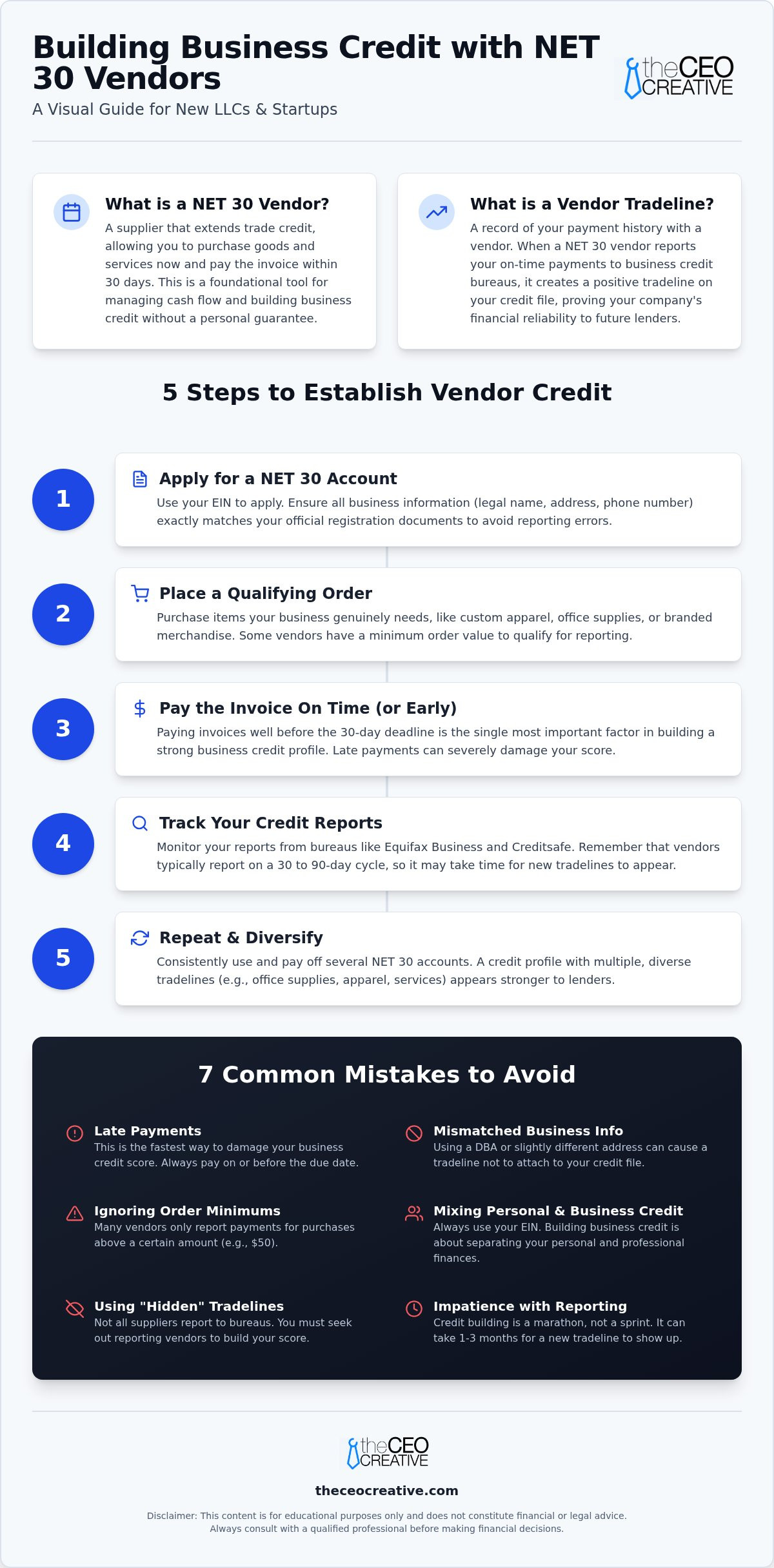
A Net 30 vendor is a supplier that extends trade credit by allowing you to pay for goods or services 30 days after the invoice date. This structure is a foundational tool for growth. It moves you away from the “pay now” retail model toward a professional B2B relationship. It’s a strategic way to acquire what you need while building a track record of reliability.
What is a Vendor Tradeline?
A vendor tradeline is a record of your credit history with a specific supplier. When you make a purchase on Net 30 terms, the vendor treats that invoice as a short term loan. If they report this activity to business credit bureaus, it becomes a tradeline on your report. This data tells future lenders that your business is capable of managing debt.
Not all suppliers report your data; these are often called “hidden” trade lines. To build a score, you must specifically seek out reporting vendors like The CEO Creative. As a reporting Net 30 vendor, The CEO Creative helps build business credit through real business purchases, such as office supplies and custom branding. Diversity matters to bureaus. They want to see that you can manage different types of accounts, including apparel and office essentials.
The Benefits of Net 30 Accounts for New LLCs
The most immediate advantage is cash flow management. Instead of depleting your bank account the moment you need supplies, you keep your capital in the business for an extra month. This flexibility is vital for startups with tight margins. It allows you to reinvest that cash into marketing or product development while your credit matures.
Establishing these “Tier 1” accounts also creates a foundation for the future. Lenders look for a history of responsible borrowing before they approve high limit credit cards or large equipment loans. By using vendors that build business credit, you’re proving your LLC is a reliable entity. This process separates your personal life from your professional obligations; it builds the credibility required to scale your operations.
How Vendor Tradelines Report to Major Credit Bureaus
Understanding how your payment history moves from an invoice to a credit report is vital for scaling your company. Most vendors that build business credit follow a specific reporting cycle; they typically send data to the bureaus every 30 to 90 days. This means your first on-time payment might not appear on your profile instantly. Consistency is the key to seeing measurable results over time. To ensure your activity is recorded correctly, your business information must match your Secretary of State filing exactly. Even a small discrepancy, like omitting “LLC” or using a different suite number on an application, can prevent a tradeline from attaching to your file.
The Small Business Administration provides excellent guidance on how to build business credit, emphasizing the need for a D-U-N-S Number. This unique nine digit identifier acts as a digital fingerprint for your company within the reporting ecosystem. It’s the primary way bureaus like Dun & Bradstreet organize your data. Without this number, your efforts with Net 30 accounts might go unnoticed by major bureaus, leaving your file empty despite your hard work.
Understanding Equifax Business and Creditsafe
Equifax Business uses a specialized algorithm to calculate your small business credit risk score. They look at your payment trends to determine how likely you are to default. Meanwhile, Creditsafe offers a global reach that’s particularly beneficial for ecommerce brands looking to establish international credibility. It tracks millions of businesses across the world. You should consider if are business credit monitoring services actually worth it for your specific needs. Monitoring these reports ensures you can catch errors early and maintain a clean profile.
The Rise of FairFigure in 2026
In 2026, FairFigure has become a dominant force in the credit landscape. Modern vendors prioritize this bureau because it offers real-time reporting and integrates diverse data points for a holistic view of your financial health. It doesn’t just look at debt; it looks at your overall operational stability. The advantage of using vendors that report to multiple bureaus simultaneously is clear. When a vendor like The CEO Creative reports to Equifax, Creditsafe, and FairFigure at once, your creditworthiness is visible to more lenders. As a reporting Net 30 vendor that helps build business credit through real business purchases, The CEO Creative ensures your spending on branding and supplies works for you. If you’re ready to start building your foundation, you can apply for an account to begin your reporting journey today.
Top Tier 1 Vendors for New LLCs and Startups
Strategic spending is the secret to scaling without overextending your resources. Instead of purchasing items just to trigger a report, you should select vendors that provide products your company actually needs to grow. Choosing the right vendors that build business credit allows you to turn necessary operational costs into a powerful financial track record. According to the Federal Reserve’s Small Business Credit Survey, access to credit remains a primary concern for employer firms; establishing these early relationships is the most effective way to address that challenge before you need a large loan.
Tier 1 vendors are the entry point for new LLCs because they typically don’t require a long time in business or a high annual revenue. Traditional “big box” options like Uline are staples for shipping supplies and janitorial needs. Grainger serves as the go-to for hardware and industrial equipment. While these are reliable, modern startups often need more than just boxes and lightbulbs to compete. They need a brand identity that commands respect in the marketplace.
The CEO Creative: Branding and Credit Synergy
Your corporate identity is more than just a name; it’s how your clients perceive your professionalism. The CEO Creative is a reporting NET 30 vendor that helps build business credit through real business purchases, such as logo design and custom apparel. When you invest in high quality business t-shirts or branded merchandise, you’re building your brand and your credit profile at the same time. This dual benefit is why many modern founders prioritize this account. You can establish your Net 30 account with The CEO Creative to get a decision within one business day on terms that don’t rely on your personal credit history. It’s a strategic move that elevates your brand’s aesthetics while strengthening its underlying financial systems.
Office Supply Vendors with Flexible Terms
Office supplies are often the easiest category for new LLCs to secure. Suppliers in this space understand the needs of developing companies and offer more flexible approval requirements. When comparing reporting schedules, it’s vital to find vendors that send data to bureaus like Equifax and Creditsafe monthly. This ensures your on-time payments are reflected on your score as quickly as possible. You can explore the best websites to buy office supplies online to find partners that fit your specific workflow. Whether you’re buying toner, paper, or custom stationery, every purchase should serve the purpose of keeping your capital fluid while your credit profile matures. By rotating your orders among a few key Tier 1 vendors, you create the tradeline diversity that major bureaus look for when calculating your business creditworthiness.
Step-by-Step Checklist for Establishing Vendor Credit
Establishing vendor credit is a sequence of deliberate actions. Before you engage with vendors that build business credit, your company must be structurally sound. Lenders and bureaus look for specific markers of legitimacy. If your business isn’t “credit ready,” your applications might be flagged or denied. Follow this checklist to ensure your reporting is successful:
- Apply: Submit applications for Tier 1 Net 30 accounts that don’t require a personal guarantee. This protects your personal assets while building a professional reputation for your LLC. Ensure your business address and phone number are correctly registered before you start.
- Order: Place an initial purchase that meets the vendor’s reporting threshold. Most reporting vendors require a minimum order between $50 and $100 to trigger data transmission to the bureaus. Choose items that add value to your operations, such as custom branding or essential supplies.
- Pay: Pay the invoice early. Do not wait until day 30. Early payments are the most significant factor in high credit scores and demonstrate financial stability to potential lenders.
- Track: Monitor your reports to ensure the tradeline appears within 60 to 90 days. Use monitoring services to verify that your activity is reaching Equifax, Creditsafe, and FairFigure correctly.
- Repeat: Continue this process with 3 to 5 different vendors. Building a diverse portfolio of tradelines is essential for moving toward Tier 2 credit and higher financing limits.
By choosing reporting partners like The CEO Creative, you ensure that every dollar spent on custom apparel or office essentials contributes to your financial health. The CEO Creative is a reporting NET 30 vendor that helps build business credit through real business purchases. If you’re ready to begin, you can apply for a Net 30 account today to start your reporting journey.
The “Pay Early” Strategy
Your payment timing is more important than the amount you spend. Paying on day 15 instead of day 30 can positively impact your credit score. For example, the Dun & Bradstreet PAYDEX score is heavily weighted toward early payments. A score of 80 indicates you pay exactly on time, but scores above 80 are only achieved by paying early. Set up autopay for all your vendor accounts. It’s the best way to avoid late payments, which are the primary reason new business credit files fail to grow.
Tracking Your Tradelines
If a vendor tradeline doesn’t show up on your report after 90 days, check your information. Mismatched business names or incorrect EINs are common culprits. Use a business credit monitoring service to verify that your data is reaching the bureaus correctly. Remember that you also need to understand how to get a D-U-N-S number quickly to ensure your Dun & Bradstreet file is active. This number is the bridge between your payments and your credit profile. Without it, your activity with Tier 1 vendors may never be recorded.
7 Common Mistakes to Avoid When Building Credit with Vendors
Identifying the right vendors that build business credit is only half the battle. Many founders stall their progress by making small, avoidable errors that prevent payment data from reaching their reports. If you want a robust score, you must be precise with your administrative operations. Consistency and timing are the pillars of a successful credit building strategy. Avoid these pitfalls to ensure your efforts result in a high PAYDEX or Equifax score.
- Mismatched Business Information: Using “LLC” on some forms and omitting it on others creates fragmented files that bureaus can’t merge.
- Late Payments: Even a single day of delinquency can severely damage a new business credit file.
- Credit Thirst: Applying for too many accounts at once signals financial instability to underwriters.
- Useless Spending: Don’t buy random items just to get a report. Invest in functional assets like branded mugs or professional apparel.
- Personal Credit Neglect: While Tier 1 is often EIN only, your personal score still matters for accessing high limit Tier 3 credit lines in the future.
Administrative Errors That Block Reporting
Precision in your administrative setup is a requirement for reporting success. Your business address must be a physical location; many reporting systems automatically reject P.O. Boxes or virtual offices that aren’t properly registered. Your business phone number should also be listed in 411 directories to prove you’re a legitimate entity. Ensure your EIN is correctly linked to your vendor profile from your very first order. If the vendor lacks your correct tax ID, your on-time payments won’t be attributed to your profile, leaving your credit file empty despite your spending.
Scaling Too Fast Without a Foundation
It’s tempting to rush toward high limit store cards. However, you should master 3 to 5 Tier 1 vendors before moving to Tier 2. Scaling too fast creates high debt to income ratios that signal risk to future lenders. Establishing a solid base with partners like The CEO Creative ensures your foundation is strong. They are a reporting NET 30 vendor that helps build business credit through real business purchases, such as engraved merchandise. You can explore the 2026 guide to building business credit without a loan to understand how to pace your growth effectively. This methodical approach protects your cash flow while proving your reliability to bureaus.
Scale Your Brand with Strategic Credit Partnerships
Building a robust credit profile is a strategic byproduct of necessary operational spending. By focusing on Tier 1 relationships and maintaining strict administrative consistency, you separate your personal finances from your professional obligations. Early payments and diverse tradelines are the most effective tools for establishing long term credibility with major bureaus. Choosing the right vendors that build business credit allows you to reinvest your capital while your reputation grows. It’s time to stop letting a lack of credit history hold your LLC back from its full potential.
Apply for a Net 30 Account with The CEO Creative Today
What happens next:
- Get a decision within one business day for eligible memberships.
- Shop for custom branding, apparel, or office supplies.
- We report your on-time payments to Equifax, Creditsafe, and FairFigure.
You’ve done the hard work of launching your business; now let your credit profile reflect your dedication. This content is for educational purposes and doesn’t constitute financial or legal advice. We’re here to support your growth every step of the way.
Frequently Asked Questions
Do all Net 30 vendors report to credit bureaus?
No, many suppliers offer trade credit without sharing your activity with major bureaus. These are often referred to as “hidden” tradelines. To build a score, you must specifically partner with vendors that build business credit. These organizations have formal agreements to share your payment history with bureaus like Equifax or Creditsafe. Always confirm a vendor’s reporting status before placing an order to ensure your spending contributes to your financial profile.
Can I get a Net 30 account with a new LLC and no history?
Yes, new LLCs can secure Net 30 accounts without any prior history. Tier 1 vendors are the starting point for most startups because they don’t require a personal guarantee or years in business. You simply need a valid EIN, a business address, and a professional phone number. These accounts provide the foundational tradelines necessary to prove your company’s reliability to future lenders and higher tier credit providers who require a more established file.
How long does it take for a vendor tradeline to show up on my credit report?
You should expect a tradeline to appear within 30 to 90 days after your first payment. Vendors typically report data in batches on a monthly or quarterly basis. If you pay your invoice just after a vendor has sent their monthly file to the bureaus, your data won’t show up until the next reporting window. Consistency is vital; making regular purchases helps ensure your file remains active and updated with the latest payment information.
Is a personal guarantee required for Net 30 vendor accounts?
No, a personal guarantee is generally not required for Tier 1 vendor accounts. These vendors allow you to establish credit using your business’s EIN alone. This is a significant advantage for new entrepreneurs who want to keep their personal and professional finances separate. By avoiding personal guarantees, you protect your personal credit score and assets from business related liabilities while you scale your operations and build corporate credibility.
Which credit bureaus do The CEO Creative report to?
The CEO Creative reports to Equifax Business, Creditsafe, and FairFigure. As a reporting Net 30 vendor that helps build business credit through real business purchases, we prioritize multi bureau reporting to give our members maximum visibility. When you purchase office supplies or custom branding from us, your on-time payments are shared with these major institutions. This helps you establish a comprehensive credit profile that appeals to a variety of modern lenders and financial partners.
What is the difference between Tier 1 and Tier 2 vendors?
Tier 1 vendors are entry level suppliers that approve businesses with no credit history. They are the building blocks of your profile. Tier 2 vendors, such as major retail store cards, have stricter requirements. They usually look for an established credit file with at least 3 to 5 existing tradelines from Tier 1 sources. Mastering Tier 1 is a mandatory step before you can successfully apply for higher credit limits with Tier 2 providers.
How much do I need to spend for a vendor to report my payment?
Most reporting vendors have a minimum spend threshold, typically between $50 and $100. If your order is too small, the vendor might not process it as a reportable tradeline. It’s best to make a meaningful purchase of items your business actually needs, such as custom apparel or essential office supplies. This ensures the transaction is large enough to trigger the reporting process and contributes positively to your business credit score without wasting capital.
What should I do if my tradeline isn’t appearing on Equifax or Creditsafe?
Start by checking your account details for any administrative errors. Your business name and EIN must match your official registration documents exactly. Even a missing comma or an incorrect suite number can prevent a tradeline from attaching to your credit file. If your information is correct and 90 days have passed, reach out to the vendor to confirm your payment was included in their most recent data transmission to the bureaus for processing.
Building business credit? Net 30 Promotional Products Vendor — EIN only, no personal guarantee, $60 minimum order, credit lines up to $5,500, a decision in one business day, and every on-time payment reported monthly to Equifax Business, Creditsafe and FairFigure.