

Table of Contents
- Why Your Business Credit Profile is the Foundation of Investor Readiness
- Understanding the Mechanics: Net 30, Tradelines, and Bureau Reporting
- Why Investors Prioritize a Strong EIN Credit File Over Personal Guarantees
- The Step-by-Step Checklist to Build an Investment-Grade Credit Profile
- Strategic Branding: Leveraging The CEO Creative to Build Credibility
- Frequently Asked Questions
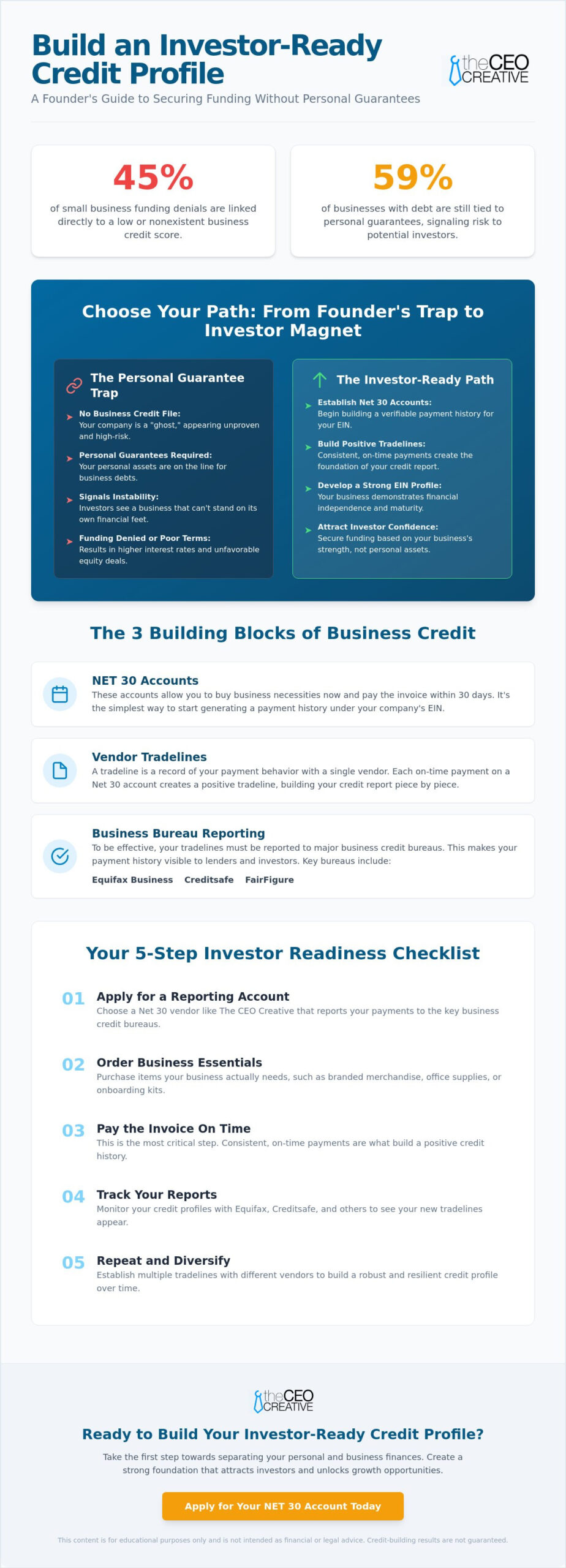
Did you know that 45% of small business funding denials are tied directly to a low credit score? It’s a staggering figure that highlights a common trap: relying on personal assets to fuel professional growth. You likely started your LLC to protect your personal life, yet you might still be signing personal guarantees for every equipment lease or supply order. According to current research from 2025, 59% of firms with debt are still tethered to personal guarantees, which can signal a lack of institutional stability to potential partners.
We agree that your pitch deck should shine, but savvy investors look deeper at your company’s independent financial health. This guide shows you exactly how to get investor-ready with a strong credit profile by building a robust, EIN-based history. You’ll discover how to leverage Net 30 accounts to satisfy bureaus like Equifax, Creditsafe, and FairFigure. We’re providing a clear roadmap to separate your personal liability from your business growth. This process ensures you can scale with confidence and secure the trust of high-level investors without risking your own financial security.
Key Takeaways
- Learn why separating personal liability from business debt is the first step toward creating an entity that stands on its own.
- Discover how to get investor-ready with a strong credit profile by strategically opening Net 30 vendor accounts that report to key bureaus.
- Understand the role of Equifax, Creditsafe, and FairFigure in validating your company’s creditworthiness to potential partners.
- Master a clear, five-step checklist to build a robust EIN-only credit file that avoids the trap of restrictive personal guarantees.
- Leverage high-quality office supplies and branding materials to build both your credit history and your professional image simultaneously.
Why Your Business Credit Profile is the Foundation of Investor Readiness
The CEO Creative operates as a reporting Net 30 vendor dedicated to helping startups and established LLCs build a verifiable financial history. Learning how to get investor-ready with a strong credit profile begins with the realization that your business must eventually stand on its own feet. We promise that by following a structured approach to credit building, you can develop a robust profile in as little as 90 days. This foundation is what allows you to unlock traditional funding and attract serious venture capital without the constant shadow of personal liability. Please keep in mind that this content is for educational purposes and is not intended as financial or legal advice.
When you present your brand to potential partners, they look far beyond your pitch deck. They scrutinize your business credit reports to gauge your company’s operational maturity. A strong EIN profile signals to venture capitalists that your organization has the systems in place to manage debt independently. It transforms your business from a project tied to a founder into a scalable asset that manages its own obligations.
The Problem: Having No Credit File
Sophisticated investors view a “ghost” credit file as a major red flag. If your business has no reporting history, it appears unproven and high-risk. This lack of data often leads to personal guarantee traps, where your own home or savings are collateral for business growth. Thin files also result in higher interest rates and unfavorable equity terms, as lenders and investors demand more in exchange for the perceived risk of an unrated entity.
The Solution: Proactive Credit Architecture
Building a proactive credit architecture means establishing your business as a separate legal and financial pillar. By moving from founder-funded to business-backed operations, you protect your personal debt-to-income ratio and demonstrate professional reliability. This shift has a massive psychological impact on potential partners. They see a company that is prepared for institutional growth. Applying for a business net 30 account is the first step in creating this professional separation and proving your company can handle credit responsibly.
Understanding the Mechanics: Net 30, Tradelines, and Bureau Reporting
Understanding the mechanics of credit is essential for any founder aiming for high-level funding. A “Net 30” term means you have 30 days to pay for a purchase after the invoice date. While it helps manage cash flow, its primary value for startups lies in credit building. Each time a vendor reports your on-time payment, they create a “vendor tradeline.” These tradelines are the individual building blocks of your business credit report. Consistency is key. Investors look for a history of reliable behavior rather than one-off large purchases. To establish business credit properly, you need vendors that report frequently to the right places.
Learning how to get investor-ready with a strong credit profile requires a shift in how you view everyday expenses. When you use business Net 30 accounts, you aren’t just buying supplies. You’re buying a data point for your future credit report. This strategic approach builds a foundation that can support future capital. You might consider applying for an account today to start documenting your company’s reliability for the long term.
The Major Business Credit Bureaus
Equifax Business remains a staple for traditional banks and SBA lenders. If you want a bank loan, your Equifax score matters. Creditsafe has become increasingly vital for B2B assessments and international trade. It provides a global perspective on your company’s risk level. For modern startups in 2026, FairFigure offers a more accessible way to track standing across multiple bureaus in real-time. Monitoring these ensures you aren’t surprised when an investor pulls your data during due diligence.
The Reporting Lifecycle
Vendors typically report to bureaus once a month, but the exact date varies. This is why timing your purchases and payments is crucial for score growth. Unlike your personal FICO score, which focuses on your personal social security number, business credit uses your Employer Identification Number (EIN). The “holy grail” of credit building is EIN-only reporting. This means the debt doesn’t show up on your personal report, protecting your personal assets and debt-to-income ratio. It creates a clean separation that sophisticated investors appreciate when evaluating your leadership and risk management.
Why Investors Prioritize a Strong EIN Credit File Over Personal Guarantees
Founders often ask why they shouldn’t just use their personal credit to fund early growth. While a high personal score is a great asset, it doesn’t prove that your business can stand on its own. Using personal credit for business expenses creates a messy financial trail that sophisticated investors find unprofessional. It blurs the line between you and your entity. Establishing a separate file allows you to build their company credit, which signals that the organization is a distinct, manageable asset. This independence is a primary requirement for institutional-grade funding.
High personal debt-to-income ratios can severely hinder your ability to lead. If your personal name is attached to every company laptop or marketing campaign, your personal borrowing power for a mortgage or vehicle disappears. More importantly, it weakens the “Corporate Veil.” This legal separation protects your family assets from business liabilities. Understanding how to get investor-ready with a strong credit profile means prioritizing this separation early. By focusing on building business credit without a loan, you demonstrate fiscal discipline and a commitment to protecting your personal legacy while scaling.
Institutional vs. Individual Investors
Banks and traditional lenders prioritize risk mitigation. They pull business credit reports to see if you have a history of paying vendors on time. Angel investors and venture capitalists look for operational maturity. They want to see a founder who doesn’t over-leverage personal wealth to keep the lights on. A robust credit profile actually increases your company’s valuation. It proves the business has its own financial reputation and access to capital, making it a more attractive acquisition or investment target for investor relations platforms like Pre-IPO Hype that connect high-growth companies with institutional and retail investors.
Operational Scalability
Vendor lines are secret weapons for managing seasonal inventory or sudden branding pushes. Net 30 terms effectively act as interest-free short-term capital. When you pay an invoice 30 days after the purchase, you’re using the vendor’s money to generate revenue before the bill is due. This track record of on-time payments to B2B partners is exactly what investors look for during due diligence. It shows you can handle the logistics of growth without needing a constant infusion of equity to cover basic operational costs. This organizational maturity is often reflected in the use of specialized tools; for example, you can learn more about Best Bid and how their estimating software helps contractors maintain the high standards investors expect.
The Step-by-Step Checklist to Build an Investment-Grade Credit Profile
Building a reputation that attracts capital requires a methodical approach. It isn’t enough to just exist; you must actively document your financial reliability. If you’re wondering how to get investor-ready with a strong credit profile, the process begins with tangible transactions. This roadmap turns your everyday operational needs into strategic assets for your credit report.
- Step 1: Open Reporting Accounts. Apply for a Net 30 account with a vendor that reports to major bureaus. The CEO Creative is an ideal starting point for startups because we report to Equifax, Creditsafe, and FairFigure.
- Step 2: Procure Essentials. Order business office supplies or branding materials that your company actually needs. This ensures your spending remains professional and purposeful.
- Step 3: Settle Invoices Early. While paying on time is the minimum, paying early can sometimes trigger even better reporting indicators. Prompt payment is the fastest way to prove fiscal responsibility.
- Step 4: Monitor Your Data. Use dashboards like Creditsafe or FairFigure to track your scores. Seeing your progress in real-time allows you to catch errors and watch your “thick” file develop.
- Step 5: Maintain Consistency. Repeat this cycle across multiple tradelines. A diverse history with several vendors shows you can manage various obligations simultaneously.
Ready to start your journey? You can apply for a business Net 30 account now and secure your first reporting tradeline within minutes.
Common Mistakes to Avoid
- Inconsistent business info: Your name, address, and phone must match exactly across all files and bureaus.
- Missing the reporting window: Ensure your orders meet the minimum dollar threshold required for the vendor to report.
- Over-extending: Don’t take on more Net 30 accounts than your monthly cash flow can comfortably support.
- Ignoring small bureaus: Focusing only on Dun & Bradstreet is a mistake; investors often check Equifax or Creditsafe too.
- Late payments: Even a single day of delay can cause significant damage to a young, fragile credit score.
Optimizing Your Spend
Strategic spending is about more than just credit. Focus on items like onboarding kits, uniforms, and promotional gear. These products serve a dual purpose: they build your credit file while increasing your corporate credibility in the eyes of clients and partners. Consistent, small purchases are far more effective than one large, infrequent order. They create a steady rhythm of reporting that proves your business is active and stable. This approach shows you understand how to get investor-ready with a strong credit profile by managing resources wisely.
Strategic Branding: Leveraging The CEO Creative to Build Credibility
Professional branding is often the silent partner in a successful funding round. When you present your company to an investor, custom apparel and high-quality stationery signal that you lead a “real” business with a long-term vision. These tangible items do more than just look good. They provide a psychological anchor that suggests stability and operational maturity. By using the CEO Creative Membership, you can combine logo design services with active credit tradelines. This ensures that every dollar spent on your brand identity also contributes to your company’s financial reputation.
Consider the example of a new ecommerce LLC that used professional branding to secure its first commercial warehouse lease. By presenting a consistent brand identity on stationery and apparel alongside a developing credit file, the founder demonstrated the maturity required to satisfy a skeptical landlord. This approach proves that knowing how to get investor-ready with a strong credit profile is about the intersection of how you look and how you pay. It transforms routine operational expenses into a dual-purpose strategy for growth.
Product-Focused Credit Building
You can use customizable products to build your score while maintaining client relationships. Sending high-quality, branded gifts to your early partners creates goodwill and generates a reporting tradeline simultaneously. Equipping your team with professional apparel for pitch meetings also enhances your “Investor Readiness.” It shows a unified front and a level of polish that many startups overlook. Even basic items like branded stationery meet a daily operational need while serving your broader financial strategy.
Conclusion and Strategic Recap
Ultimately, investor readiness is a sophisticated blend of internal financial models and external credit health. You shouldn’t wait until you need a loan to start thinking about your EIN history. Building a robust profile takes time and consistent reporting from reliable vendors. Start building your tradelines today so they are mature and “thick” by the time you sit down at the negotiating table. Focus on these core takeaways:
- Establish your EIN as a separate financial entity to protect your personal assets.
- Use Net 30 accounts to create a history of on-time payment data.
- Monitor your progress through bureaus like Equifax, Creditsafe, and FairFigure.
- Leverage professional branding to prove operational maturity to potential partners.
Your journey toward independent business growth is a marathon, not a sprint. By following this roadmap, you ensure that your company is viewed as a low-risk, high-value asset by anyone who reviews your files. This foundation is what allows you to scale with confidence and lead your organization toward a sustainable, business-backed future.
Secure Your Company’s Financial Independence
Moving from a startup to an established entity requires a commitment to institutional-grade systems. You’ve now mastered the roadmap for moving beyond personal guarantees and building a reputation that speaks for itself. By focusing on how to get investor-ready with a strong credit profile, you’re ensuring your brand is viewed as a low-risk, high-value asset in any future negotiation. It’s time to stop signing for your business and start letting your business sign for itself.
Apply for a CEO Creative Business Account and Start Building Credit Today
What happens next:
- Submit your EIN-based application and get a decision within one business day, without a hard credit pull.
- Select the office supplies or branding materials your company needs to maintain a professional edge.
- Settle your first invoice to trigger positive payment reporting to Equifax, Creditsafe, and FairFigure.
Building business credit is most effective when it aligns with your operational branding. Strengthen your corporate identity by exploring our custom apparel, professional mugs, or engraved items. These strategic purchases build your credit file while cementing your brand’s presence in the marketplace.
Frequently Asked Questions
Does The CEO Creative require a personal guarantee for Net 30 accounts?
No, The CEO Creative doesn’t require a personal guarantee for our Net 30 accounts. We focus on helping you build a credit profile tied specifically to your Employer Identification Number (EIN). This structure ensures that your business obligations remain separate from your personal assets. By removing the requirement for a Social Security Number during the application, we empower you to scale your organization without risking your personal financial security or home equity.
Which credit bureaus does The CEO Creative report to?
The CEO Creative reports your payment history to Equifax Business, Creditsafe, and FairFigure. We understand that having visibility across multiple bureaus is essential when you’re learning how to get investor-ready with a strong credit profile. Lenders often pull data from different sources during due diligence, so our multi-bureau reporting ensures your reliability is documented where it matters most. This broad exposure helps you build a more comprehensive and trustworthy financial reputation.
How long does it take for a Net 30 account to show up on my business credit report?
You’ll typically see a Net 30 account appear on your business credit report within 30 to 60 days. Vendors generally report to the major bureaus on a monthly cycle, so the exact timing depends on your purchase date and the bureau’s processing schedule. It’s important to maintain consistent activity. Frequent, smaller purchases ensure that your file stays active and continues to reflect a steady history of responsible debt management.
Can I build business credit using only my EIN and no SSN?
Yes, you can build business credit using only your EIN by working with reporting vendors that offer non-PG (no personal guarantee) terms. This is the foundation of creating a “corporate veil” that protects your family’s assets. By focusing on EIN-only reporting, you prove to future partners that your company is a self-sustaining entity. It’s a strategic move for any founder who wants to preserve their personal borrowing power while growing a brand.
What is the difference between a Tier 1 and Tier 2 vendor?
Tier 1 vendors are entry-level accounts that approve businesses with little to no established credit history. The CEO Creative is an example of a Tier 1 vendor that helps you establish your first tradelines. Tier 2 vendors are more selective and usually require you to have at least three to five reporting Tier 1 accounts before they extend credit. Progressing through these tiers is a standard roadmap for building a robust, investment-grade credit file.
Does paying my Net 30 invoice early help my credit score more than paying on the due date?
Early payments are highly beneficial because some credit scoring models, like the Dun & Bradstreet PAYDEX, specifically reward businesses that pay before the due date. This is often referred to as “Days Beyond Terms” (DBT) in reverse. Paying early signals exceptional cash flow management and high fiscal discipline. While paying on time is the minimum requirement for a good score, early settlement is a proactive way to accelerate your credit growth and impress lenders.
Will my personal credit score be affected if I apply for a business Net 30 account?
Your personal credit score won’t be affected when you apply for an account with The CEO Creative. We don’t perform a hard inquiry on your personal credit report, which means there’s no impact on your FICO score. This allows you to build your business reputation in total isolation from your personal life. It’s a professional way to manage growth without cluttering your personal financial history with business-related debt or inquiries.
How many tradelines do I need before I am considered investor-ready?
Most institutional lenders and investors prefer to see a “thick” credit file containing 5 to 10 active tradelines. This depth proves that your company can successfully manage multiple financial relationships at once. Diversity in your reporting history is key to understanding how to get investor-ready with a strong credit profile. A balanced mix of vendor accounts shows that your business is stable, active, and capable of handling various levels of operational credit.
Building business credit? Open a Net 30 Account — EIN only, no personal guarantee, $60 minimum order, credit lines up to $5,500, a decision in one business day, and every on-time payment reported monthly to Equifax Business, Creditsafe and FairFigure.