

Did you know that the U.S. private credit default rate hit a record high of 6.0% in April 2026? For a growing organization, knowing what happens if you default on a net 30 account is more than just a theoretical exercise; it’s a vital part of your strategic risk management. You’ve worked hard to establish your brand from the ground up, so it’s natural to feel concerned about how a sudden cash flow gap might impact your standing with vendors and your long-term scalability.
Protecting the corporate identity you’ve built starts with understanding the critical consequences of missed payments before they escalate. We’ll show you exactly how business bureaus like Equifax Business, Creditsafe, and FairFigure track these events and what they mean for your EIN-based credit profile. This guide provides a clear look at reporting timelines, default APRs, and the specific actions you can take to mitigate damage. You’ll learn how to handle these logistical hurdles effectively so your business remains sustainable, credible, and ready for future opportunities.
Key Takeaways
- Understand the immediate operational risks of a missed payment, including account locks and losing access to essential branding and office supply procurement.
- Learn exactly what happens if you default on a net 30 account regarding your reporting to major business bureaus like Equifax Business, Creditsafe, and FairFigure.
- Discover the step-by-step recovery roadmap to fix a defaulted account and rebuild your corporate credit profile through a disciplined “Apply, Order, Pay, Track, Repeat” framework.
- Identify common mistakes that derail EIN-based credit progress and learn how to maintain consistent business information across all reporting accounts.
- Leverage a structured membership model to maintain active tradelines using practical items like apparel and office essentials to ensure long-term financial sustainability.
Understanding Net 30 Terms and The CEO Creative
The CEO Creative serves as a strategic partner for modern entrepreneurs, operating as a reporting Net 30 vendor that helps businesses establish a professional footprint. By utilizing the principles of Understanding Trade Credit, we allow your organization to manage cash flow while building a robust EIN-based profile. Our promise is to help you learn the critical consequences of defaulting on business credit terms and how to protect your EIN-based credit profile. This section explores what happens if you default on a net 30 account so you can lead your brand with confidence and clarity.
Trust Note: Please understand that this content is for educational purposes only and does not constitute financial or legal advice. We make no specific guarantees regarding credit score increases, as results depend on your overall business behavior and bureau algorithms.
In the context of business credit, a “vendor tradeline” is a record of your credit account with a specific supplier. “Payment reporting” refers to the vendor sending your payment performance data to bureaus like Equifax, Creditsafe, and FairFigure. For a startup or a new LLC, these tradelines are the lifeblood of a developing credit file, providing the necessary data points that lenders look for when evaluating your organization’s risk profile.
The Role of Net 30 Vendors in 2026
Net 30 accounts are often considered the “Tier 1” foundation for new organizations. They’re accessible to brands that might not yet qualify for high-limit bank loans. By consistently purchasing practical items like apparel or office supplies, you create a paper trail of reliability. These tradelines act as proof to future lenders that your brand can handle financial obligations responsibly. It’s a strategic move to turn routine operational costs into a credit-building asset.
The Mechanics of the 30-Day Clock
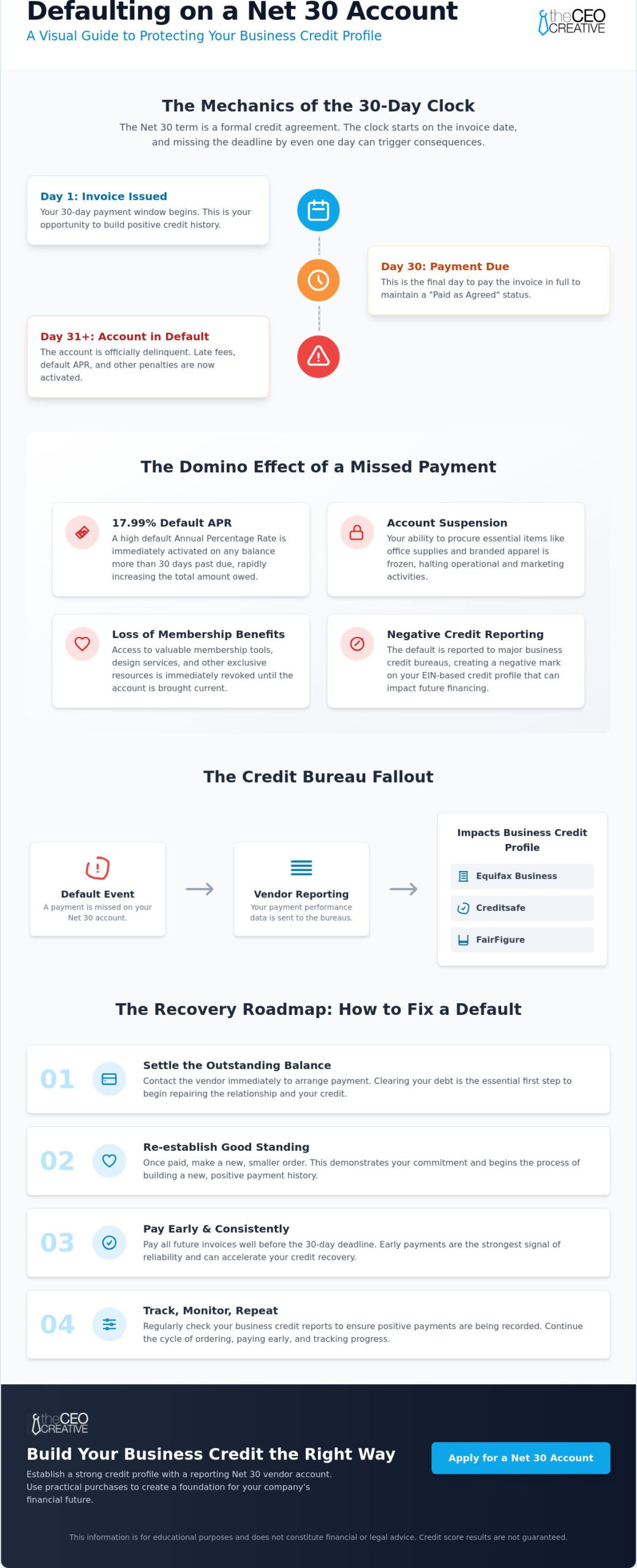
The “Net 30” term is a formal credit agreement, not a casual payment preference. It means the full invoice amount is due within 30 days. Usually, this clock starts on the invoice date, which might differ from the day your items arrive. Maintaining a “Paid as Agreed” status is the gold standard for positive reporting. If you’ve ever wondered what happens if you default on a net 30 account, the process typically starts when that 30-day window closes without a payment. Missing this deadline signals a break in the agreement, which can trigger late fees and negative marks on your credit file.
Immediate Consequences: What Happens the Moment You Default
The transition from an active account to a delinquent one happens the moment the 30-day window closes. It isn’t a slow process. Understanding what happens if you default on a net 30 account requires looking at the immediate operational freeze that occurs. Your business relies on these terms for liquidity. When you miss that deadline, the partnership is paused. This shift impacts your ability to operate and signals a change in your risk profile to the vendor.
A default triggers several immediate actions designed to protect the vendor’s interests:
- Immediate application of late fees to the outstanding balance.
- Activation of a 17.99% Default APR on any balance past 30 days.
- Suspension of procurement for essential office supplies.
- Loss of access to membership branding tools and design services.
- Potential for automatic credit card charges for invoices more than 15 days past due.
There is a common myth that a “grace period” exists beyond the 30 days. In the professional world of trade credit, 31 days is officially a default. While some vendors might offer a few days of leeway before reporting to bureaus, the internal penalties often start the very next day. Your “Paid as Agreed” status is at risk the second the clock runs out. Consistency is the only way to ensure your profile remains healthy.
Late Fees and Financial Penalties
Late penalties are structured to encourage prompt behavior. At The CEO Creative, any outstanding balance past 30 days is subject to a 17.99% Default APR. This rate reflects the increased risk the vendor takes on. If an invoice reaches 15 days past due, the system may automatically charge the credit card on file to settle the balance. These financial safeguards are standard in trade credit to maintain the flow of goods and services. Silence is your worst enemy here. If you anticipate a cash flow gap, reaching out to the vendor before the deadline is always more productive than waiting for the default to trigger; you can also learn more about QuickCashDirect to explore short-term funding options that can help bridge temporary liquidity issues and protect your credit standing.
Suspension of Membership and Services
An account lock does more than stop new orders. It cuts off access to logo design tools and custom branding services. If you rely on these for client deliverables or internal uniforms, your operations could stall. This suspension breaks the momentum of your credit-building journey. It effectively halts the “Apply, Order, Pay, Track, Repeat” cycle that builds your score. To keep your brand moving forward, it’s vital to manage your net 30 credit terms for business with the same precision you use for your high-level executive decisions. Maintaining your membership ensures you have the tools you need to grow without interruption.
The Credit Bureau Fallout: Equifax, Creditsafe, and FairFigure
Many entrepreneurs assume that small vendor accounts are “off the grid.” They believe that missing a payment with a specialized supplier won’t impact their broader financial standing. This is a dangerous misconception. Vendors report data precisely because it maintains the integrity of the business credit ecosystem. When you ask what happens if you default on a net 30 account, the answer lies in the detailed reporting sent to Equifax Business, Creditsafe, and FairFigure. These bureaus don’t just track if you paid; they track exactly how long it took you to do it.
This data creates a “Permanent Record” for your EIN. Unlike personal credit, where some minor issues might be overlooked, business credit is highly sensitive to payment timing. A single default can remain visible on your corporate profile for years, acting as a red flag for any future partner or lender. Modern reporting systems are designed to provide a transparent view of your brand’s reliability to the entire market.
Understanding DBT (Days Beyond Terms)
Bureaus use a metric called “Days Beyond Terms” (DBT) to quantify your organization’s risk. If your invoice is due on day 30 and you pay on day 45, you have a 15 DBT rating. Lenders categorize these behaviors into two main groups:
- Slow Pay: Paying consistently late (e.g., 15 to 30 DBT) signals cash flow struggles.
- No Pay: A complete default is the ultimate risk signal that can tank your score.
Lenders often view one 90-day default as more significant than a dozen on-time payments. It suggests that when things get difficult, your business prioritizes other obligations over its credit agreements. FairFigure monitors these tradelines in real-time, providing modern entrepreneurs with a clear view of how their DBT affects their overall score and fundability.
Impact on Future Credit Access
Defaulting on a Tier 1 account creates a ceiling for your brand’s growth. Business credit is a ladder. To reach Tier 2 store cards or Tier 3 bank and fleet cards, you must prove you can handle basic vendor terms. A default here halts that progression immediately. The ripple effect is also real. Other vendors who share data through Creditsafe may see your delinquency and decide to lower your existing credit limits to protect themselves. Professional branding and creditworthiness are inextricably linked; you can’t have a sustainable, high-level brand if your underlying financial systems are unreliable. Understanding what happens if you default on a net 30 account is the first step in ensuring your organization remains eligible for the capital it needs to scale.
The Recovery Roadmap: How to Fix a Defaulted Account
If your organization has already experienced what happens if you default on a net 30 account, your priority must shift to damage control. A default is a setback, but it isn’t a permanent barrier to your brand’s growth. Recovery is a logistical process that requires discipline and a commitment to showing bureaus that your brand is reliable. By following a structured roadmap, you can begin to overwrite negative data with fresh, positive reporting.
The foundation of this recovery is our standard credit-building checklist. Follow these steps precisely to restart your momentum:
- Apply: Ensure your business information (Name, EIN, Address) is identical to your Secretary of State filings.
- Order: Make small, manageable purchases to keep your account active.
- Pay: Settle your invoices at least 10 days before the due date.
- Track: Use tools like FairFigure to verify that your payments are being reported correctly.
- Repeat: Consistency over six months is the key to rebuilding trust with bureaus.
Remediation Steps for Late Payments
Don’t wait for a collection notice. Contact support the moment you realize a payment will be late. Transparency often leads to better outcomes, such as a payment plan that prevents a full default from being reported. If this is a first-time mistake for your organization, you can request a “goodwill adjustment.” This is a formal request for the vendor to update the reporting to the bureaus. Even if you can’t get the late mark removed, paying the balance in full is essential. Moving your status from “Default” to “Paid (Late)” is a significant improvement in the eyes of a future lender.
Strategic Rebuilding After a Default
Once you’ve settled the outstanding debt, you need to prove your reliability again. Start small. Using low-cost items like custom notebooks or basic stationery allows you to restart the reporting cycle without straining your cash flow. To offset previous Days Beyond Terms (DBT), aim to pay every new invoice 10 days early. This aggressive payment schedule helps pull your average DBT back into a healthy range. Monitor your FairFigure dashboard weekly to track how these new data points influence your score recovery. If you’re ready to start fresh, you can apply for a net 30 account to begin rebuilding your corporate profile today.
Common Mistakes to Avoid
Avoid these pitfalls to ensure your recovery stays on track:
- Using a residential address when your business is registered to a commercial one.
- Ignoring small late fees that continue to compound and trigger new default alerts.
- Paying exactly on day 30, which leaves no room for processing delays.
- Applying for high-tier bank cards before your vendor tradelines have recovered.
- Failing to update your business phone number across all credit profiles.
- Closing a tradeline immediately after paying a default instead of using it to rebuild.
Strategic Credit Management with The CEO Creative
Managing a business requires more than just a great product; it demands a solid financial foundation. While it’s vital to understand what happens if you default on a net 30 account, the true goal is to build a system where defaults never occur. The CEO Creative membership provides the structure your organization needs to maintain discipline. By integrating routine purchases into your credit-building strategy, you turn essential operational costs into proof of your brand’s reliability. Professionalism isn’t just about the logo on your shirt; it’s about the financial integrity behind it.
Strategic credit management involves using your accounts consistently. When you purchase items like mugs, apparel, or office supplies, you’re doing more than stocking your shelves. You’re keeping your tradelines active and ensuring a steady stream of positive data reaches the bureaus. This consistent activity is what eventually opens the door to higher credit limits and more favorable bank terms. For a deeper look at how to scale your profile, check out our Net 30 Vendors 2026: The Ultimate Guide.
The CEO Creative Membership Advantage
Our membership model is designed to support your startup journey from day one. You gain immediate access to high-quality custom apparel and promotional gear that elevates your brand’s aesthetic. More importantly, we provide automatic reporting to major bureaus like Equifax Business and Creditsafe. This automation removes the guesswork from credit building. It ensures that every time you invest in your brand’s visibility, you’re also investing in its creditworthiness. We act as a creative partner that understands the specific logistical hurdles modern entrepreneurs face.
Next Steps for Your Business
Ready to take control of your organization’s financial future? Your first move is to apply for a Business Net 30 Account. Once approved, choose a branding package that fits your current needs, whether that’s uniforms for your team or promotional items for a launch. To avoid the risks of what happens if you default on a net 30 account, set up calendar alerts or autopay immediately. Establishing a “Paid as Agreed” status from your very first invoice sets the tone for your entire corporate history.
In summary, your business credit profile is a reflection of your organizational discipline. On-time payments are the primary foundation of corporate credibility and the most effective way to protect your EIN-based identity. By treating every invoice as a strategic move, you ensure your brand remains fundable and sustainable for the long term.
Securing Your Brand’s Financial Future
Your organization’s credit profile acts as a living document of its reliability. Understanding what happens if you default on a net 30 account is the first step toward building a sustainable financial legacy. Missed payments trigger immediate penalties and long-term bureau reporting, but your focus should always remain on the growth ahead. By maintaining a “Paid as Agreed” status, you protect your EIN identity and ensure your brand remains fundable for high-level expansion.
The CEO Creative is here to act as your foundational support system. We offer a decision within one business day for essential branding and office supply tradelines with no personal guarantee required for EIN-based approval. Our system reports your positive performance directly to Equifax Business, Creditsafe, and FairFigure. This helps you climb the credit ladder with confidence. Don’t let cash flow gaps define your brand’s story. Instead, use disciplined credit management to turn routine expenses into corporate assets. Take the next step in your entrepreneurial journey and Apply for a CEO Creative Business Net 30 Account Today. We’re excited to partner with you as you build a brand that lasts.
Frequently Asked Questions
Do Net 30 vendors require a personal guarantee?
No, many Net 30 vendors, including The CEO Creative, don’t require a personal guarantee for approval. This allows you to separate your personal assets from your business liabilities entirely. By using your EIN for approval, you build credit strictly for your LLC or corporation. It’s a strategic way to protect your personal financial standing while your organization grows and scales in a competitive market.
How long does it take for a late payment to show up on my business credit report?
Late payments typically appear on your business credit report during the next monthly reporting cycle after the delinquency occurs. Most vendors report to bureaus like Equifax and Creditsafe on a consistent 30-day schedule. If you’re wondering what happens if you default on a net 30 account, the negative mark usually surfaces within 30 to 60 days of the missed deadline. Monitoring your dashboard regularly helps you catch these issues early.
Can I fix my business credit score after defaulting on a Net 30 account?
Yes, you can fix your business credit score by settling the outstanding debt and establishing a new history of on-time payments. Start by paying the defaulted balance in full to update the status to “Paid” on your file. Then, use small, routine purchases to generate fresh, positive data points. Consistency over the following six to twelve months will help dilute the impact of the previous default and rebuild your corporate credibility.
Will a default on my EIN affect my personal credit score?
A default on your EIN won’t affect your personal credit score if the account was opened without a personal guarantee. Because business credit bureaus like Creditsafe and Equifax Business track EIN-based data separately from consumer bureaus, the delinquency remains on the corporate file. If you personally guaranteed the debt, however, the creditor may report the default to your personal credit profile; potentially impacting your personal financial standing and future personal loan approvals.
Which credit bureaus does The CEO Creative report to?
The CEO Creative reports your payment performance to Equifax Business, Creditsafe, and FairFigure. This multi-bureau reporting ensures that your organization’s reliability is visible to a wide range of potential lenders and partners. By maintaining a clean record with us, you’re building a verifiable history of corporate credibility across the most influential business credit platforms. This transparency is a vital tool for any brand looking to secure higher-tier financing for long-term growth.
Does paying a Net 30 invoice early help my credit score more than paying on time?
Yes, paying early adds to your business payment history, which bureaus measure with a “Days Beyond Terms” (DBT) rating. While “on time” is the minimum requirement for a positive status, paying 10 to 15 days early signals exceptional financial health to bureaus. Lenders use these specific metrics to determine your organization’s risk level. They often reward early payers with higher credit limits and more favorable terms on future accounts because they demonstrate superior cash flow management.
What is the difference between a “slow pay” and a “default”?
A “slow pay” occurs when you pay after the 30-day window but before the account is formally charged off. A “default” happens when the vendor determines the debt is unlikely to be paid and closes the account entirely. Understanding what happens if you default on a net 30 account is crucial because a default is a much more severe indicator of risk than a simple late payment; it can stay on your profile for years and halt your progress.
What happens if I dispute a charge on a Net 30 account?
Disputing a charge usually pauses the standard collection process while the vendor investigates the claim. It’s important to communicate the dispute in writing immediately to prevent the invoice from being marked as delinquent. While the investigation is ongoing, the vendor may temporarily lock your account to prevent further procurement until the issue is resolved. This ensures that both parties have a clear path to a fair and professional resolution without damaging your credit profile prematurely.
Building business credit? Open a Net 30 Account — EIN only, no personal guarantee, $60 minimum order, credit lines up to $5,500, a decision in one business day, and every on-time payment reported monthly to Equifax Business, Creditsafe and FairFigure.