

Table of Contents
- What is a Vendor Credit Line Net 30? Definitions and Core Benefits
- How Net 30 Vendor Tradelines Impact Your Corporate Credit Profile
- The Step-by-Step Checklist for Managing Your Net 30 Account
- 5 Common Mistakes That Derail Business Credit Building
- Establishing Your Brand and Credit with The CEO Creative
- Frequently Asked Questions
What if you could scale your company’s purchasing power and build a fortress of corporate credit without ever putting your personal assets on the line? Most founders face a frustrating “chicken and egg” problem where you need credit to grow, but banks won’t talk to you until you’ve already grown. If you’re tired of being rejected due to a lack of history or feeling confused by which bureaus actually track your progress, you’re in the right place. Securing a vendor credit line net 30 is the most effective way to bridge this gap and establish your professional footprint.
You’ll learn exactly how to use these accounts to establish a robust corporate profile while keeping your startup cash flow steady. We’ll walk through the clear path to Tier 1 business credit, focusing on vendors that report to Equifax and Creditsafe so every dollar you spend on quality products works double duty. From avoiding common reporting mistakes to following a proven five-step checklist, this article provides the blueprint for your company’s financial independence. Please remember that this content is for educational purposes and is not intended as formal financial or legal advice.
Key Takeaways
- Understand how a vendor credit line net 30 provides interest-free terms while building a professional credit profile through consistent payment reporting.
- Discover the specific roles of bureaus like Equifax, Creditsafe, and FairFigure in tracking your corporate financial reliability and score growth.
- Learn to identify and avoid the five most common mistakes, such as mismatched business data, that prevent tradelines from appearing on your reports.
- Master the five-step credit-building cycle to ensure every purchase of office supplies or custom branding products strengthens your corporate identity.
- See how partnering with The CEO Creative allows you to establish Tier 1 credit without the need for personal guarantees or complex bank loans.
What is a Vendor Credit Line Net 30? Definitions and Core Benefits
Scaling a business requires more than just a great idea; it needs a sustainable financial foundation. For many founders, a vendor credit line net 30 serves as that first critical brick. This arrangement allows your company to purchase essential supplies today and defer the payment for 30 days. It’s an interest-free way to manage operations without dipping into your personal savings or relying on high-interest personal credit cards. By leveraging the fundamental principles of What is Trade Credit?, you essentially use your supplier as a short-term lender to fuel your daily growth.
For new LLCs and startups, these accounts are often classified as Tier 1 net 30 vendors. They’re accessible because they typically don’t require a long business history or a personal guarantee. The CEO Creative is a prime example of a reporting vendor that allows you to build business credit through real business purchases. As you pay these invoices, you’re not just clearing debt. You’re building a reputation that eventually unlocks higher-tier trade credit and larger bank loans.
Key Terms: Tradelines and Payment Reporting
A vendor tradeline is simply the record of your credit account as it appears on your business credit report. Think of it as a professional grade for your company’s financial behavior. However, not all vendors are created equal. If a supplier doesn’t practice payment reporting, your on-time payments stay invisible to the major bureaus. To build a profile that banks respect, you must partner with vendors that actively report to agencies like Equifax, Creditsafe, and FairFigure. This is where many entrepreneurs stumble. They spend thousands with non-reporting suppliers and wonder why their business credit score hasn’t budged.
Why Net 30 Terms Matter for Cash Flow
Cash flow is the lifeblood of any growing organization. With roughly 5.8 million new business applications projected for 2026, competition for resources is high. Choosing the right vendor credit line net 30 ensures you aren’t just buying products, but investing in your company’s future. This 30-day window acts as a buffer. It allows an ecommerce brand to sell inventory before the bill is due or a service-based agency to collect from clients before paying for their own office supplies. By maintaining liquidity, you protect your business from the tight cycles that often sink early-stage ventures. It’s a strategic move that turns routine operational costs into a credit-building asset.
Beyond daily operations, successful founders often look at how to structure their growth for the long term. You can read more about how RL Private Holding supports business expansion through diversified investment strategies.
How Net 30 Vendor Tradelines Impact Your Corporate Credit Profile
The core value of these accounts lies in how they communicate with financial institutions. High-quality vendors report your activity to specialized bureaus. This is a strategic advantage because it proves your company can handle debt responsibly. Beyond just scores, there are tangible Benefits of Net 30 Accounts that include building trust with future lenders. If you’re ready to start this journey, you can apply for a business account today to begin establishing your history.
The Reporting Process: From Payment to Profile
Understanding the timeline is crucial for managing expectations. Typically, it takes a window of 30 to 60 days for a new tradeline to appear on your business credit report after your first payment. Bureaus don’t just see that you paid; they see the “original credit limit,” which signals your company’s capacity for larger transactions. They also track the specific payment date, the total amount spent, and the agreed-upon terms. This data creates a comprehensive picture of your operational discipline. Consistency is the key here. One-off purchases won’t move the needle as much as a pattern of regular, on-time payments.
Equifax, Creditsafe, and FairFigure: Why They Matter
Relying on just one bureau is a risky strategy. Different lenders and suppliers use different agencies to check your creditworthiness. This is why diversifying your reporting is essential for long-term safety. Equifax and Creditsafe are major players in the commercial world, while FairFigure provides modern insights into your financial health. The CEO Creative acts as a strategic partner by reporting to these specific entities. When your vendor credit line net 30 activity is visible across multiple bureaus, it creates a “thick file” that makes your business look established and reliable. This multi-bureau approach ensures that no matter which agency a lender checks, they see a company that honors its commitments.
The Step-by-Step Checklist for Managing Your Net 30 Account
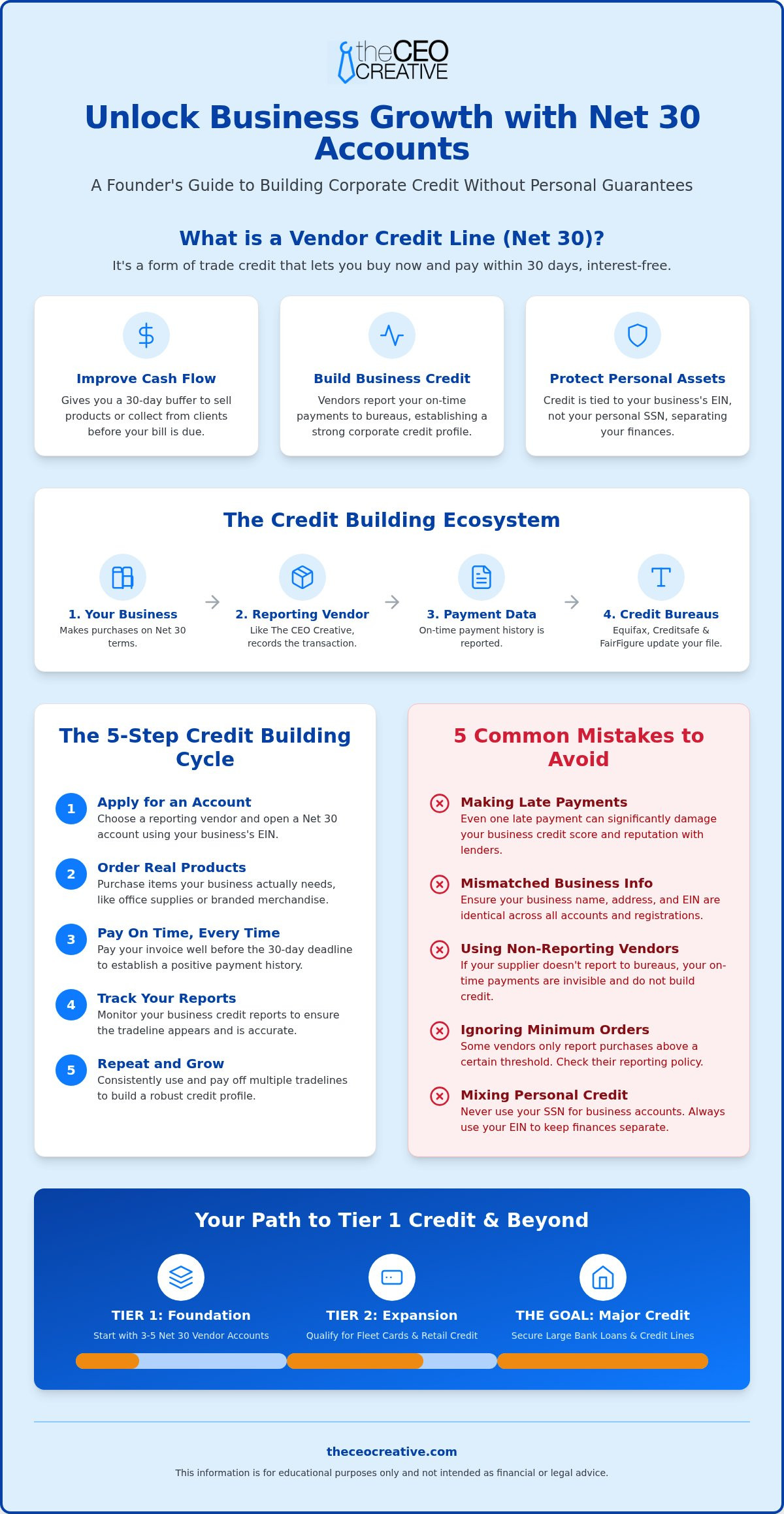
Managing a vendor credit line net 30 is a strategic exercise in data management. It’s not just about acquiring supplies; it’s about proving your company’s reliability to the financial world. To succeed, you must treat every transaction as a professional milestone. This starts with ensuring your business is properly registered. Always use your legal business name and Employer Identification Number (EIN) for every application. This separates your personal identity from your corporate entity, ensuring the credit bureaus attribute your positive behavior to the right file. For a deeper look at the landscape, check out our Net 30 Vendors 2026: The Ultimate Guide.
The Apply, Order, Pay, Track, Repeat Method
Success in credit building comes from a consistent, four-stage cycle. Follow these steps to ensure your activity actually moves the needle:
- Step 1: Apply. Register for an account using your EIN. Avoid using your Social Security Number to keep your personal and business files distinct.
- Step 2: Order. Place a qualifying purchase. Focus on items your business actually needs, such as custom apparel or essential office supplies. This proves you are a functioning, active brand.
- Step 3: Pay. Clear your invoice early. Aim to submit payment at least 5 to 10 days before the 30-day deadline.
- Step 4: Track. Monitor your business credit reports. Ensure the tradeline appears correctly on Equifax, Creditsafe, or FairFigure.
Once the first cycle is complete, repeat the process. Frequency and consistency are what build a “thick” credit file that lenders find attractive.
Best Practices for Early Repayment
While “Net 30” gives you a full month, paying on “Net 15” or “Net 20” terms can be a major advantage. Some scoring models reward businesses that pay well ahead of the due date. This proactive approach signals high liquidity and low risk. Beyond timing, accuracy is your best friend. Ensure your business address, phone number, and name match exactly across all your accounts. Mismatched data can lead to “fragmented” files where your vendor credit line net 30 activity doesn’t show up on your main report. To stay on top of this, set up calendar alerts or use autopay features. Missing a single deadline is the fastest way to damage a new credit profile, so build systems that make punctuality automatic—often, professional support from On the Hook Bookkeeping can provide the oversight needed to keep your financial records and payments flawlessly organized.
5 Common Mistakes That Derail Business Credit Building
Building credit is a marathon, not a sprint. While a vendor credit line net 30 provides the necessary momentum, simple errors can halt your progress. The most catastrophic mistake for any new LLC is a late payment. Business credit bureaus prioritize payment history above almost all other factors. A single missed deadline can stay on your report for years, signaling to lenders that your company is a high-risk partner. Always prioritize your trade invoices to keep your profile pristine.
Another common pitfall is “ghosting” your accounts. Opening a tradeline is only the first step; you must actually use it. Bureaus want to see active trade data. If you open a line and never place an order, the account remains “stale” and adds no value to your score. Similarly, spending your entire budget with non-reporting vendors is a missed opportunity. If the supplier doesn’t share data with Equifax or Creditsafe, your financial discipline remains invisible. To avoid these traps, apply for a reporting business account that ensures your activity is counted toward your corporate growth.
The Danger of Mismatched Data
Inconsistency is a red flag for credit algorithms. If your application uses “Suite 100” but your utility bill says “Unit 100,” bureaus may create “split files.” This means your hard-earned credit history is divided between two different profiles, making your business look less established than it is. We recommend keeping a “Business Identity” master sheet. Use this document to copy and paste your exact legal name, address, and phone number into every application. Ensuring these details are perfect is a prerequisite to learning how to get a D-U-N-S Number quickly and maintaining a clean file.
Why “Low-Quality” Vendors Can Hurt Your Profile
Not all tradelines carry the same weight. Bureaus look for “organic” business growth. They are increasingly wary of “shelf corporations” or accounts that appear to be empty shells with no real operations. This is why purchasing tangible, high-quality goods matters. When you buy office supplies or branded merchandise, you show that your company is a legitimate, functioning entity. Avoid vendors that offer “digital downloads” or “membership only” tradelines without physical products. These are often viewed as low-quality indicators by sophisticated lenders. Finally, never over-extend your vendor credit line net 30 before your revenue is stable. Building a profile is important, but maintaining your liquidity is essential for long-term survival.
Establishing Your Brand and Credit with The CEO Creative
Custom Merchandise as a Strategic Business Move
First impressions are a form of business currency. When you invest in custom apparel or branded stationery, you aren’t just buying products; you’re creating a professional identity. These items act as the “fuel” for your credit tradeline. Every order placed through your account reinforces your brand’s presence in the market while simultaneously building your corporate credit file. For businesses in the earliest stages, we even offer logo design services to ensure your visual identity matches your professional aspirations. This synergy ensures that your vendor credit line net 30 serves a practical purpose beyond just a score on a report.
Working with a dedicated studio like Mark Finzel Art and Design can help you refine this visual identity, ensuring your brand makes a lasting impression as you scale your operations.
What Happens After You Apply?
We designed our process to mirror the fast-paced nature of the modern professional world. Efficiency is our priority. Once you submit your application using your EIN, the path to building your profile is clear and immediate. Here is what you can expect:
- Decision Within 1 Business Day: You will receive a notification of the decision, and once approved you get access to your account dashboard, with no personal guarantee required.
- Catalog Access: Browse our extensive selection of essential branding gear and office supplies to find what your business needs to operate.
- Initiate Reporting: Your very first purchase triggers the reporting process. We share your payment data with major bureaus like Equifax, Creditsafe, and FairFigure to begin establishing your history.
Your journey toward financial independence starts with a single strategic choice. By choosing a partner that understands the logistical hurdles of management, you simplify your path to Tier 1 credit. Don’t let a lack of history hold your vision back. Establish your professional footprint and apply for a Net 30 account today to begin scaling your brand with confidence.
Take the First Step Toward Financial Independence
Frequently Asked Questions
Do I need a personal guarantee for a vendor credit line net 30?
No, you don’t need a personal guarantee for a vendor credit line net 30 with The CEO Creative. This allows you to build credit under your EIN alone, protecting your personal assets from business liabilities. It’s a key advantage for new founders who want to separate their personal and professional financial profiles from day one. By removing the personal link, you focus entirely on your corporate entity’s growth.
Which business credit bureaus does The CEO Creative report to?
The CEO Creative reports your payment activity to Equifax, Creditsafe, and FairFigure. By sharing data with multiple bureaus, we help you build a more comprehensive and thick credit file. This multi-bureau approach is essential because different lenders and suppliers may check different agencies when evaluating your company’s creditworthiness. Diversified reporting ensures that your hard work is visible no matter which agency a future partner chooses to review.
How long does it take for a net 30 tradeline to show up on my report?
It typically takes between 30 and 60 days for a new tradeline to appear on your business credit report. This timeline depends on the reporting schedule of the vendor and the processing speed of the bureaus. Consistency is vital; making regular purchases and paying early ensures that your positive history is updated accurately during each reporting cycle. Tracking your report regularly helps you confirm that your activity is being documented as expected.
Can a new LLC with no credit history get approved for a net 30 account?
Yes, a new LLC can absolutely get approved for a net 30 account even with zero established credit history. The CEO Creative is a reporting NET 30 vendor that helps build business credit through real business purchases, with a decision within 1 business day to help startups bridge the credit gap. This provides a foundational step for businesses to begin building their professional reputation through tangible goods rather than just loans. It’s the most accessible way to start your journey toward Tier 1 business credit.
What happens if I pay my net 30 invoice late?
Paying a vendor credit line net 30 invoice late is the most common way to damage a developing credit profile. Late payments are reported to the bureaus and can significantly lower your business credit score. To avoid this, we recommend setting up calendar alerts or using autopay features to ensure your invoices are cleared at least five days before the deadline. Protecting your payment history is the most important part of your credit strategy.
Is there a minimum purchase amount required for reporting?
While specific requirements can vary, most reporting vendors require a qualifying purchase to initiate the data sharing process. At The CEO Creative, your first order of office supplies or branded gear starts the reporting cycle to major bureaus. It’s important to place an actual order rather than just opening an account. Ghost accounts don’t provide the data bureaus need to see that your business is active and reliable.
Do I need a D-U-N-S number before applying for a net 30 account?
You don’t necessarily need a D-U-N-S number before applying, but having one helps ensure your data is mapped correctly. Most vendors primarily require your Employer Identification Number (EIN) and legal business name. However, obtaining a D-U-N-S number is a standard best practice for any company looking to maximize their visibility across all major business credit bureaus. It acts as a universal identifier that makes your company’s credit profile much easier to find.
Can I use a net 30 account to buy custom branded apparel?
Yes, you can use your net 30 account to purchase custom branded apparel such as t-shirts, hoodies, and hats. This allows you to invest in your brand’s visual identity while building your credit tradeline at the same time. It’s a strategic move that turns necessary marketing and team gear into a long-term financial asset for your company. Building your brand and your credit simultaneously creates a more sustainable foundation for growth—and for brands seeking inspiration in bold and creative graphic apparel, Rebelo Art Work Designs offers excellent examples of professional design. Please note that this content is for educational purposes and is not intended as financial or legal advice.