

Trust and Compliance Note: This content is for educational purposes only and does not constitute financial or legal advice.
Table of Contents
- What is a Net 30 Business Credit Vendor?
- How Net 30 Accounts Build Your Corporate Credit Profile
- Step-by-Step: How to Establish and Manage Net 30 Tradelines
- 5 Critical Mistakes to Avoid When Building Vendor Credit
- Why The CEO Creative is a Strategic Net 30 Partner
- Frequently Asked Questions
Before we dive into the strategy, it’s essential to understand two core terms. A vendor tradeline is a credit account established with a supplier that reports your payment history to credit bureaus. Payment reporting is the process where that vendor shares your data with bureaus like Equifax, Creditsafe, and FairFigure. In this guide, we define how The CEO Creative acts as a reporting net 30 vendor that helps build business credit through real business purchases. We’ll provide a step-by-step checklist to help you apply, order, and track your progress toward a robust corporate credit profile.
Key Takeaways
- Establish a professional credit profile using your EIN to separate your personal financial history from your company’s growth.
- Understand the strategic value of choosing a net 30 business credit vendor that reports directly to essential bureaus like Equifax, Creditsafe, and FairFigure.
- Follow a disciplined five-step workflow—apply, order, pay, track, and repeat—to ensure your tradelines are consistently reflected on your reports.
- Identify and avoid critical mistakes, such as mismatched business information or late payments, that can stall your progress toward higher credit lines.
- Leverage routine purchases of branding materials and office essentials to professionalize your brand while simultaneously building a robust credit foundation.
What is a Net 30 Business Credit Vendor?
Stop leaning on your personal credit cards to fund your company’s growth. It’s a common mistake that limits your personal borrowing power and puts your private assets at unnecessary risk. You have the power to establish a professional credit file using only your Employer Identification Number (EIN). A net 30 business credit vendor is a company that allows you to purchase essential products now and pay the full invoice balance within a 30-day window. To understand the fundamental mechanics of this arrangement, it helps to ask: What is Trade Credit? Essentially, the vendor acts as a short-term lender, providing you with the goods you need while giving your cash flow room to breathe.
Mastering this strategy requires a clear understanding of specific industry terminology. Here are the core concepts you need to know:
- Vendor Tradeline: This is a credit account established with a supplier. When the supplier reports your account activity to a bureau, it appears as a “tradeline” on your business credit report.
- Payment Reporting: This is the critical process where the vendor shares your transaction history, including how quickly you pay, with major credit bureaus.
- EIN-Only Approval: This refers to accounts that don’t require a personal guarantee or a Social Security Number. The vendor approves the line based solely on your business entity’s data.
The Difference Between Vendor Credit and Traditional Loans
Traditional bank loans often demand years of profitable tax returns and high personal credit scores. If past tax issues are hindering your ability to secure traditional financing, working with US Tax Advocate Services LLC can help you resolve IRS problems and improve your financial standing. Vendor credit, however, is different. It serves as the most accessible “Tier 1” entry point for new LLCs and startups. You can establish credibility without a personal guarantee, which ensures your personal finances remain separate from your business liabilities. Beyond the credit benefits, these terms significantly improve your daily operational cash flow. You can acquire inventory or branding materials today and use the revenue generated from those items to pay the invoice later.
Why Tradeline Reporting Matters for Your EIN
Your business credit score is a direct reflection of your reliability as a partner. There is a strict connection between consistent, on-time payments and a high credit rating. If a supplier doesn’t report your activity, your perfect payment history remains invisible to the rest of the financial world. A single reporting net 30 business credit vendor can trigger the creation of a credit file for a new business that previously had no record. This visibility is what eventually allows you to qualify for high-limit credit cards and commercial leases.
How Net 30 Accounts Build Your Corporate Credit Profile
Building a corporate credit profile isn’t an overnight event. It follows a specific reporting cycle that begins the moment you place an order. When you work with a net 30 business credit vendor, you’re essentially creating a data trail for future lenders. Once you pay your invoice, the vendor transmits that data to the bureaus, usually on a monthly or quarterly basis. This process serves as a vital strategy to get credit and conserve cash flow, allowing your business to prove its reliability without draining its bank account.
Think of these initial accounts as the foundation of the “Tier System.” Most high-limit lenders require a history of successfully managed trade credit before they’ll approve significant funding. By starting with Tier 1 vendors, you provide the “proof of concept” that your business is a safe bet for commercial loans. This foundational step is what separates established brands from startups that remain stuck using personal funds.
Targeting the Right Credit Bureaus
While Dun & Bradstreet is often the first name entrepreneurs mention, modern lending in 2026 relies on a broader data set. Equifax Business remains a staple for traditional bank lending and lease approvals. Meanwhile, Creditsafe has become a preferred choice for global and modern vendors because of its real-time data accuracy. Finally, FairFigure provides a holistic view, helping you monitor how your score fluctuates across multiple data points. The CEO Creative is a reporting net 30 vendor that helps build business credit through real business purchases, sharing your payment history with these specific entities. You might wonder: are business credit monitoring services actually worth it? For most growing brands, the answer is yes. It prevents surprises when you apply for larger lines. You can start building this history today by opening a business net 30 account that reports to these bureaus.
The Impact of “Days Beyond Terms” (DBT)
In business credit, timing is everything. A score isn’t just about paying; it’s about when you pay. “Days Beyond Terms” (DBT) is a metric that tracks how many days past the due date an invoice is settled. While paying on day 29 of a 30-day term is technically on time, paying on day 15 is often viewed more favorably by scoring models. Early payments signal high liquidity and financial stability. Conversely, late payments are weighted much more heavily in business credit than in personal credit. Even a single day past the deadline can cause a noticeable dip in your score. Consistency with your net 30 business credit vendor ensures your DBT stays at zero or even enters the negative, which is the gold standard for corporate creditworthiness.
Step-by-Step: How to Establish and Manage Net 30 Tradelines
Establishing a corporate credit file requires a disciplined workflow. It isn’t enough to simply open an account; you must follow a specific sequence to ensure your activity is captured by the bureaus. The right net 30 business credit vendor provides the mechanism for growth, but your execution determines the final score. This process turns routine business expenses into a powerful financial asset that eventually unlocks five and six-figure credit lines.
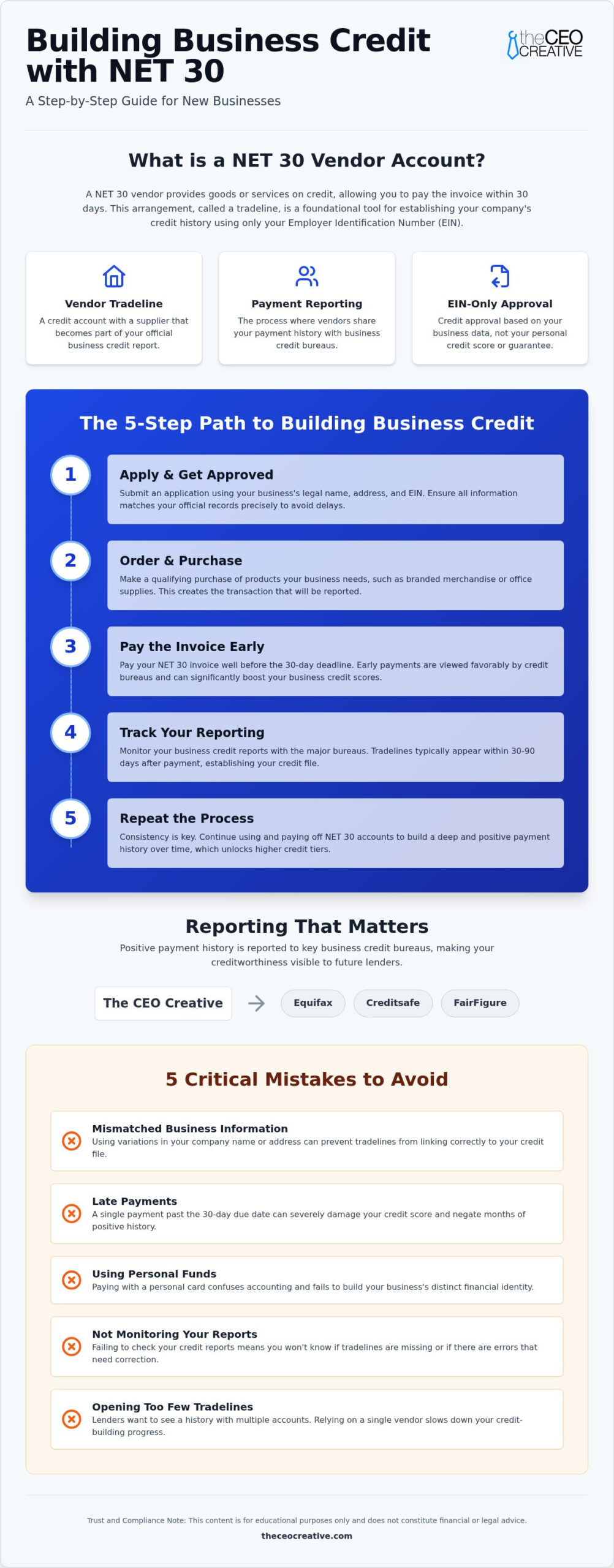
Use this step-by-step checklist to manage your vendor tradelines effectively:
- Apply: Submit your business details with 100% accuracy to match public records.
- Order: Purchase physical goods or branding services that meet the vendor’s reporting threshold.
- Pay: Settle the invoice at least 10 to 15 days before the due date to maximize your score.
- Track: Monitor your Equifax, Creditsafe, and FairFigure reports to verify the tradeline appears.
- Repeat: Maintain activity monthly or quarterly to demonstrate ongoing financial stability.
What a complete application looks like
Consistency is the foundation of a successful application. Automated underwriting systems cross-reference your data with Secretary of State filings and EIN records in seconds. Even a missing “LLC” or a mismatched suite number can trigger a manual review or an immediate rejection. You’ll also need a professional business email and a functional website to signal that you’re an operational brand. If you haven’t already secured your unique identifier, follow our guide on how to get a D-U-N-S number quickly to complete your profile before applying for credit.
Making Your First Strategic Purchase
Once approved, make a strategic purchase. Don’t buy for the sake of credit alone; buy “merch with a purpose.” Choosing items like custom apparel or branding materials allows you to professionalize your team while simultaneously building your score. Most vendors require a minimum spend to trigger bureau reporting, often around $100. For a curated list of reliable entry points that cater to new businesses, see The Best Tier 1 Net 30 Vendors for Building Credit.
The final phases of the workflow turn a single transaction into a long-standing asset. After 30 to 60 days, verify the tradeline on your file. If it doesn’t show up, contact the vendor’s billing department to confirm your data was transmitted. Repeating this cycle with your net 30 business credit vendor keeps your file active and signals to high-limit lenders that your business is a reliable partner for future funding.
5 Critical Mistakes to Avoid When Building Vendor Credit
Most entrepreneurs don’t fail at building business credit because they lack discipline. They fail because of small, preventable errors that silently derail their progress. Knowing what to avoid is just as valuable as knowing what to do. Here are the five mistakes that consistently stall credit growth before it ever gains momentum.
- Mismatched business information. Your legal business name, address, and phone number must be identical across every platform: your Secretary of State filing, your EIN record, your website, and your vendor application. A missing “LLC,” an abbreviated street name, or a suite number formatted differently can cause an underwriting system to treat your application as a separate, unverifiable entity. Automated systems don’t give the benefit of the doubt. They reject inconsistencies.
- Late payments, even by one day. Business credit scoring penalizes tardiness far more aggressively than personal credit models do. A single late payment can spike your Days Beyond Terms (DBT) metric and signal financial instability to future lenders. Set a calendar reminder to pay 10 to 15 days before the deadline, not the day of.
- Choosing a vendor that doesn’t report. This is the most costly mistake a startup can make. Paying perfectly on an account that never transmits data to Equifax, Creditsafe, or FairFigure produces zero credit benefit. Always confirm a vendor’s reporting policy before your first purchase. Working with a verified reporting net 30 business credit vendor is the only way to ensure your on-time payments actually count.
- Closing accounts too quickly. Account age matters. Closing a tradeline after a single purchase eliminates the history attached to it. Keep accounts open and active, even with minimal orders, to demonstrate a long-standing, stable relationship with suppliers.
- Overextending cash flow too early. Net 30 terms are a tool, not a license to overspend. Taking on more vendor obligations than your current revenue can cover within 30 days defeats the purpose entirely. Build slowly. Let your credit file grow before your obligations do.
The “Ghost Tradeline” Problem
You paid on time. You did everything right. But 60 days later, the tradeline still isn’t showing up on your report. This “ghost tradeline” issue is more common than most guides acknowledge. The most frequent cause is that your business isn’t searchable in public directories. Verify that your business phone number is listed in 411 directories and that your address matches public records exactly. If a bureau can’t confirm your entity exists, it may reject the data submission entirely. If your tradeline is missing, contact the vendor’s billing department directly and request confirmation that your data was transmitted. Most reporting delays resolve within one to two billing cycles.
Managing Your Credit-to-Debt Ratio
Small, frequent purchases consistently outperform single large orders for credit-building purposes. A pattern of regular activity signals an ongoing, operational relationship rather than a one-time transaction. Use your net 30 business credit vendor account to purchase office supplies or branded apparel on a predictable schedule. Keep your utilization well below your credit limit to maintain a healthy ratio. Treat every order as a deliberate credit-building move, not just a procurement decision.
Avoiding these five mistakes puts you firmly ahead of the majority of startups that wonder why their score isn’t moving. Open a business net 30 account today and start building a verifiable, bureau-reported credit history with every purchase you make.
Why The CEO Creative is a Strategic Net 30 Partner
The CEO Creative serves as a foundational partner for new LLCs and startups that want to professionalize while they scale. Unlike a generic net 30 business credit vendor that only offers basic staples, this platform integrates high-level branding services with credit building. You gain direct reporting to Equifax, Creditsafe, and FairFigure, ensuring your payment history is visible to modern lenders. By purchasing high-utility office supplies or customizable products, you solve two operational hurdles at once: procurement and credit establishment.
Professional logo design is another key offering that builds corporate credibility. When a lender reviews your business, they look for signs of a stable, established brand. A cohesive visual identity suggests that your business is a long-term venture rather than a temporary project. The CEO Creative Membership provides a structured path to corporate credit, moving beyond simple transactions to a partnership model that supports your long-term growth.
Building Your Brand While You Build Your Credit
Using Net 30 terms for custom apparel and branded gear is a strategic move. It allows you to outfit your team and market your services without an immediate cash drain. This professional branding increases your perceived creditworthiness to lenders who often search for your business online during the manual review process. Seeing a polished, branded presence can influence their decision to approve larger credit lines. You can learn more about how this works in our detailed look at the CEO Creative Membership: Build Business Credit and Brand Identity.
What Happens After You Apply?
The process is designed for speed and clarity. Once your account is approved you get access to the full product catalogue. Once you make a purchase, the monthly reporting cycles ensure your credit file stays active and continues to grow. Members also receive access to exclusive tools for tracking business growth and monitoring their progress. This transparency helps you stay on track toward higher-tier credit accounts without the guesswork. Choosing the right net 30 business credit vendor means finding a partner that understands the logistical hurdles of management. The CEO Creative simplifies these systems, allowing you to focus on your vision while your credit foundation builds itself through regular business purchases.
What happens next:
- Receive a decision within 1 business day, using only your EIN.
- Browse our catalog of office essentials and customizable branding products.
- Place your first order to trigger the bureau reporting process.
Scale Your Business with Strategic Credit Building
Mastering your company’s financial future starts with a single, deliberate step. By leveraging a net 30 business credit vendor, you’ve learned how to establish a professional file without risking your personal assets. You now understand that maintaining a low “Days Beyond Terms” metric and ensuring your data reaches bureaus like Equifax is the key to unlocking high-limit funding. Success isn’t about avoiding debt; it’s about managing trade credit with precision and consistency. Every on-time payment is a building block for your corporate reputation.
The CEO Creative is ready to act as your foundational partner. We provide the essential tools and branding materials you need to grow while reporting your progress to major bureaus. You can apply with your EIN only and get a decision within 1 business day, with no personal guarantee required. Don’t let a lack of credit history hold your vision back. It’s time to professionalize your brand and build a sustainable financial legacy that stands on its own.
Apply for a Net 30 Account with The CEO Creative and Start Building Credit Today! Our systems report directly to Equifax, Creditsafe, and FairFigure to ensure your growth is visible to the lenders that matter most. Take control of your business credit journey today and start scaling with confidence.
Frequently Asked Questions
Does The CEO Creative require a personal guarantee for Net 30 accounts?
No, The CEO Creative does not require a personal guarantee for its Net 30 accounts. We assess the business on your EIN and your current business standing, and you get a decision within 1 business day. Approval is not guaranteed. This structure allows you to establish a corporate credit profile without putting your personal assets or private credit score at risk. It’s an ideal solution for entrepreneurs who want to keep their private and professional finances completely separate.
Which credit bureaus does The CEO Creative report to?
The CEO Creative reports your payment activity to Equifax Business, Creditsafe, and FairFigure. These bureaus are essential for modern lending decisions and traditional bank reviews. As a reporting net 30 business credit vendor, we ensure your on-time payments are visible to the institutions that matter most. This broad reporting helps you build a more comprehensive credit file than vendors who only report to a single, traditional bureau.
Can a new LLC with no credit history get approved for a Net 30 account?
Yes, new LLCs and startups with no existing credit history can get approved for an account. We specifically design our services to act as a foundational partner for developing companies. Instead of relying on past credit data, we look at your current business formation and Employer Identification Number. This allows you to start building a high-quality credit file from the very first day your business is operational.
How long does it take for a Net 30 tradeline to appear on my business credit report?
Tradelines typically appear on your business credit report within 30 to 60 days after your first invoice is paid. This timeline depends on the specific reporting cycle of the credit bureaus and when the vendor transmits the monthly data batch. Consistency is key during this period. We recommend making your first purchase immediately after approval to trigger the initial reporting process as quickly as possible.
What happens if my tradeline does not show up after 60 days?
If your tradeline isn’t visible after 60 days, first verify that your business information matches your bureau records exactly. Mismatched addresses or names are the most common cause of reporting delays. If all information is correct, contact our billing department to confirm that your data was transmitted in the latest batch. We can help troubleshoot any technical issues that might prevent the bureaus from linking the data correctly.
Are there any membership fees associated with Net 30 vendor accounts?
Yes, The CEO Creative offers a structured membership model that provides access to Net 30 terms and exclusive branding services. This membership includes benefits like direct bureau reporting and access to our full catalog of office supplies and customizable products. By choosing a membership-based net 30 business credit vendor, you gain a dedicated partner committed to your long-term financial growth and the development of your professional brand identity.
What is the minimum purchase required for reporting?
While we don’t enforce an overly restrictive minimum, we recommend making meaningful purchases to ensure your tradeline reflects active business usage. Lenders prefer to see a history of regular transactions rather than a single, symbolic order. Purchasing items like custom apparel or essential office supplies on a monthly basis demonstrates that your business has consistent operational needs and the cash flow required to manage them responsibly.
Can I build business credit using only my EIN?
You can absolutely build business credit using only your Employer Identification Number. Our approval process focuses on your business entity rather than your personal Social Security Number. By making purchases and paying invoices on time, you establish a credit history that belongs solely to your company. This is the most effective way to professionalize your brand and eventually qualify for high-limit commercial funding without personal liability.