

Rather apply than read? The CEO Creative offers open a net 30 account — EIN only, no personal guarantee, credit lines up to $5,500.
Longer terms: Net 60 and Net 90 Vendors — who grants extended terms, what they ask for first, and the realistic path from a starter net 30 tradeline.
What if the extra 30 days you get to pay an invoice is actually slowing down your company’s financial growth? It’s easy to see why longer terms like net 60 are attractive for cash flow, especially when you’re managing tight margins as a new startup. However, when you look at the data, does net 60 build credit faster than net 30? The answer often surprises entrepreneurs who are eager to establish a robust credit file and win higher credit limits.
We understand the frustration of having no established credit history or being confused by how vendors report to bureaus like Equifax and Creditsafe. You’ll discover why reporting frequency matters more than term length and how to optimize your EIN credit building strategy. This article breaks down the reporting cycles of major bureaus, identifies common pitfalls, and provides a step-by-step checklist to help you establish a professional corporate profile. Please note that this content is for educational purposes and does not constitute financial or legal advice.
Key Takeaways
- Learn why reporting frequency is more critical than the length of your payment terms when establishing corporate credit.
- Understand the “Velocity Factor” and how net 30 accounts provide double the reporting opportunities compared to net 60 terms.
- Discover the data-driven answer to does net 60 build credit faster than net 30 and how payment cycles impact your bureau scores.
- Identify the common mistakes in business info consistency that can prevent your tradelines from appearing on your credit file.
- Master a simple five-step checklist to apply, order, and track your way to a robust credit profile with reporting vendors.
Understanding Net Terms: Net 30 vs. Net 60 Basics
Net terms are the foundation of modern B2B relationships. They allow your business to buy what it needs today and pay for it later. This system, often referred to as Trade Credit, helps you manage cash flow while creating a paper trail for your financial reliability. For most new LLCs and startups, choosing between these terms is the first strategic step toward a strong credit profile.
You might assume that a longer window like Net 60 is better because it offers more time to manage your budget. However, when you ask, does net 60 build credit faster than net 30, the answer depends on the frequency of data reaching the bureaus. Building a robust profile requires a consistent, reported payment history that shows lenders you can handle debt responsibly over multiple cycles. We’ll show you exactly how to leverage these terms to win higher credit limits and establish your EIN credit file.
Trust Note: This content is for educational purposes and is not financial or legal advice. We make no guarantees regarding specific credit score increases.
To help you get started, The CEO Creative acts as a reporting Net 30 vendor that understands the hurdles of early-stage management. Our Net 30 account program is designed to simplify the credit building process by reporting your activity to major bureaus. By providing essential supplies and reporting your payments, we help you turn routine operational costs into strategic credit-building moves.
What is a Net 30 Account?
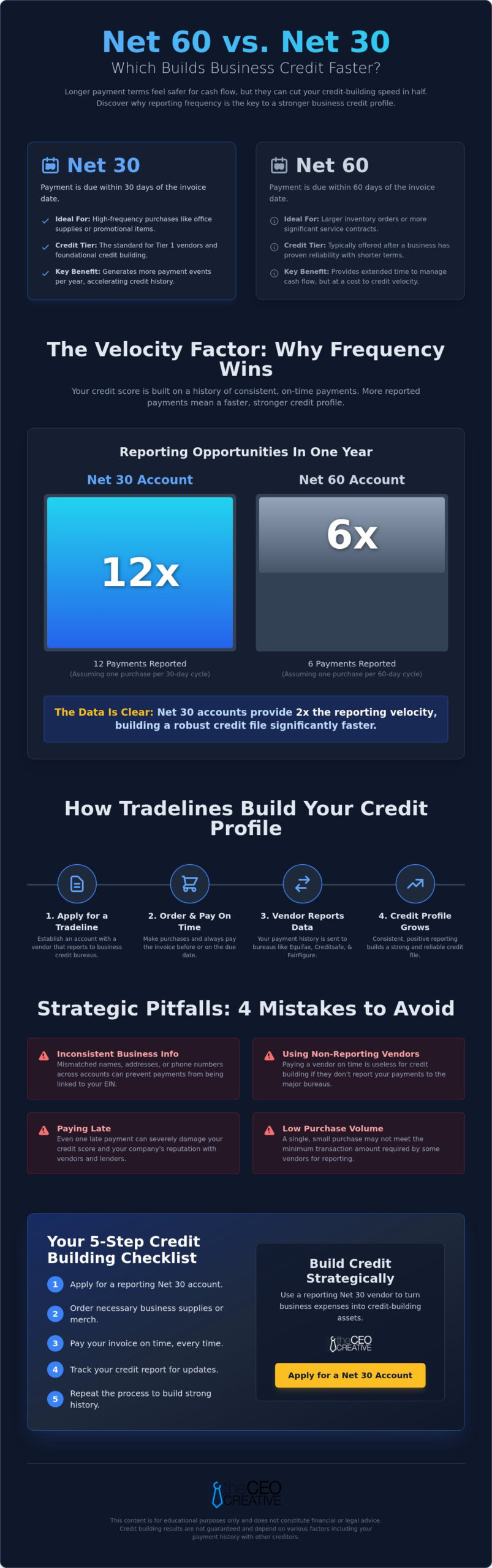
A Net 30 account means your payment is due exactly 30 days after the invoice date. These accounts are the standard entry point for Tier 1 business credit building. They’re ideal for high-frequency, low-cost purchases like office supplies or promotional items. Because the cycle is shorter, you can generate more reporting events in a single year, which is vital for new businesses with no existing credit file.
What is a Net 60 Account?
With a Net 60 account, you have 60 days from the invoice date to settle the balance. Suppliers typically reserve these terms for larger inventory orders or service contracts. While the extra 30 days helps with cash flow, many entrepreneurs still wonder: does net 60 build credit faster than net 30? Usually, the answer is no because fewer invoices are generated and reported over the course of a year. Most vendors won’t offer Net 60 terms until you’ve proven your reliability through shorter Net 30 or Net 15 cycles first.
The Credit Building Mechanics: How Tradelines Actually Report
Your business credit score doesn’t exist in a vacuum. It relies on a vendor tradeline, which is simply a credit account you establish with a supplier. When you use this account, the supplier records your behavior. Then, through a process called payment reporting, they send that data to specialized business credit bureaus. This transmission of data is what builds your score over time. Without this reporting, your on-time payments won’t help you secure larger loans or better insurance rates.
Most vendors follow a specific reporting schedule, usually sending updates on a monthly or quarterly basis. This timing is why the question of does net 60 build credit faster than net 30 is so important for growth-minded CEOs. If a vendor reports monthly, a Net 30 account provides 12 distinct payment experiences in a single year. A Net 60 account might only provide six. Lenders want to see a high volume of positive experiences in your business credit report to justify higher credit limits and lower interest rates.
Establishing these lines early is the best way to avoid the “no credit file” trap that stalls many startups. You can start this journey today by opening a Net 30 account to ensure your operational spending actually counts toward your future financial power. It’s a simple way to turn your routine purchases into a strategic asset.
The Role of Equifax and Creditsafe
Equifax Business is a major player that tracks how you manage your payment obligations and credit utilization. They want to see that you don’t just have credit, but that you use it responsibly. Creditsafe operates on a global scale, focusing heavily on B2B trade data. For a new LLC, having your activity reported to these entities is vital. It proves you’re a legitimate entity capable of honoring professional contracts and managing cash flow efficiently.
Understanding the FairFigure Reporting Ecosystem
FairFigure acts as a powerful aggregator in the business credit world. It pulls data from various sources to give you a clear view of your standing through the FairFigure PowerScore. When you use Net 30 accounts, they feed consistent data into this ecosystem, adding to your business payment history more often than longer terms might. FairFigure monitors your credit velocity, which is the speed and frequency at which new positive data points are added to your profile.
Net 60 vs. Net 30: Which Builds Credit Faster?
Many entrepreneurs assume that longer payment terms are a sign of a more “mature” credit profile. While a 60-day window is excellent for keeping cash in your pocket, it’s actually a slower route for your credit score. If you’re asking, does net 60 build credit faster than net 30, you have to look at the math of reporting. Credit bureaus like Equifax and Creditsafe thrive on data density. They want to see that you can borrow, pay, and repeat that cycle as often as possible.
We call this the “Velocity Factor.” Think of your credit report as a resume. A Net 30 account allows you to add 12 positive entries to that resume every single year. If you only place orders when your previous invoice is due, a Net 60 account only provides six entries in the same timeframe. This frequency is a cornerstone of how to build business credit because it proves your reliability across more cycles. Bureaus favor this consistency over the long duration of a single debt.
Why Net 30 is the “Speed Demon” of Credit Building
Net 30 accounts are designed for speed. Because the cycle resets every month, you can generate a Paydex score or a high FairFigure PowerScore much faster than with longer terms. It’s also much easier to manage small, frequent purchases to keep the tradeline active. You don’t need to make massive investments to see progress. Routine items like office supplies or branding materials are perfect for this. You can apply for a business net 30 account today to start stacking these monthly wins immediately.
When Net 60 Makes Strategic Sense
Building a robust credit profile is a discipline, not a one-time event. It requires a repeatable system that prioritizes accuracy and speed. If you are still weighing whether does net 60 build credit faster than net 30, remember that momentum comes from the reporting cycle. You need to be precise with your data and your timing. Many CEOs fail because they treat credit building as a random task rather than a monthly ritual. Frequency and consistency are your best friends when you’re starting from scratch.
Business info consistency is non-negotiable. Your business name, address, and phone number must match your Secretary of State filing exactly. Even a small discrepancy, like using “St.” on one application and “Street” on another, can confuse bureau algorithms. This often leads to “unverified” data that never actually hits your profile. You want every dollar spent to count toward your future financial power.
The Beginner Checklist for EIN Credit
- Apply: Choose a vendor that reports to major bureaus like Creditsafe or Equifax without requiring a personal guarantee (PG).
- Order: Stick to necessities. Purchase practical items like office supplies or branding materials that your business already needs to function.
- Pay: Don’t wait for the deadline. Settle the invoice at least 10 days early for maximum impact. Early payments are often the secret to earning an 80+ Paydex score.
- Track: Monitor your reports regularly to ensure the tradeline is appearing correctly.
- Repeat: Keep the account active. Consistency is the only way to earn higher credit limits and prove you are a reliable partner.
Common Pitfalls to Avoid
- Using different addresses or phone numbers across different vendor applications, which creates fragmented credit files.
- Ordering once and never using the account again. Dormant tradelines don’t provide the ongoing data bureaus need to calculate a score.
- Paying exactly on the due date. While this isn’t “late,” it misses the opportunity to show the exceptional liquidity that early payments demonstrate.
- Failing to monitor your Creditsafe or Equifax files for reporting errors that could be dragging your score down.
- Overextending your cash flow just to “buy” credit history. Only purchase what your business can comfortably afford to pay back immediately.
- Forgetting to update your business registration details with the bureaus after a move or a change in ownership.
Ready to start your journey? Apply for a Net 30 account today to begin building a professional credit profile with a partner that understands your developmental stage.
Build Your Business Credit with The CEO Creative
The CEO Creative serves as a foundational partner for new LLCs and startups. We understand that your goals are ambitious and your time is valuable. While you might still ask, does net 60 build credit faster than net 30, the answer remains rooted in reporting frequency. Monthly updates through a Net 30 account provide the density of data that lenders look for when evaluating your business. Our membership program is designed to facilitate this consistency, turning your routine operational needs into a powerful credit-building engine. You can explore our comprehensive strategy in our guide on how to build business credit without a loan.
We focus on practical business utility. Instead of spending on items you don’t need, you can invest in onboarding kits, uniforms, and promotional materials that grow your brand. This approach ensures your spending stays professional and purposeful. By reporting these payments to major bureaus, we help you bridge the gap between a new entity and an established corporate profile. It’s about making every dollar work double duty for your organization’s long-term success.
High-Quality Products that Build Your Brand
Maintaining a professional image is vital for corporate credibility. Use our customizable apparel to create polished team uniforms that inspire confidence. Investing in net 30 apparel allows you to equip your staff while simultaneously building your credit history. These purchases are strategic moves. They prove to both your clients and the credit bureaus that your business is active, organized, and growing. When you choose quality branded gear, you’re signaling that your company is built to last.
Membership Benefits and Next Steps
Our membership model offers fast-decision options to get your first tradeline reported quickly. This is essential for businesses that currently lack an established credit file. Beyond tradelines, you gain access to professional logo design services to unify your brand identity. This helps you present a cohesive image to the world while you work on the underlying systems of your business. The path to a robust EIN-only credit profile is clear: apply for an account, make consistent purchases, and pay early. Start today and watch your corporate financial power expand with every reported invoice. We’re here to act as the foundational support system for your entrepreneurial journey.
Scale Your Corporate Financial Power
Building a robust business credit profile requires a shift from passive spending to strategic management. The most important takeaway is that reporting frequency drives your score higher than the length of your payment terms. While Net 60 offers liquidity, it lacks the reporting velocity needed for rapid growth. When you consider does net 60 build credit faster than net 30, the answer is clear: the monthly cycle of a Net 30 account establishes a denser, more reliable history with bureaus like Equifax and Creditsafe.
Consistency in your business data and the habit of paying invoices early will set you apart from the competition. You’re ready to take control of your organization’s financial future. Apply for a CEO Creative Net 30 Account Today to benefit from a decision within one business day for new LLCs and reporting to Equifax, Creditsafe, and FairFigure. Best of all, there’s no personal guarantee required. Start building the professional foundation your brand deserves. You’ve got the vision; now it’s time to build the systems that make it sustainable.
Frequently Asked Questions
Do Net 60 terms report to credit bureaus differently than Net 30?
Net 60 and Net 30 accounts use the same transmission methods to reach bureaus, but the frequency of those transmissions varies. While the data format is similar, the primary question for many is does net 60 build credit faster than net 30, and the answer is no because it offers fewer reporting cycles. Shorter terms allow for more frequent data updates, which helps bureaus calculate your score with more precision.
Is a personal guarantee required for Net 30 vendor accounts?
You don’t need a personal guarantee (PG) to open a Net 30 account with Tier 1 vendors like The CEO Creative. These accounts are specifically designed to help you build credit using only your Employer Identification Number (EIN). This protects your personal credit score from business-related fluctuations and establishes your company as a separate legal and financial entity.
How long does it take for a Net 30 account to show up on my credit report?
It typically takes between 30 and 90 days for a new tradeline to appear on your business credit report. This duration depends on when the vendor submits their monthly batch of data and how quickly the bureaus process that information. Consistently using your account and paying early ensures that once the reporting cycle begins, your profile shows a steady stream of positive activity.
Does paying a Net 60 invoice early build credit faster?
Paying early strengthens your business payment history, but it doesn’t change the number of times a vendor reports to the bureaus. If you’re wondering if does net 60 build credit faster than net 30 simply by paying ahead of time, the frequency remains limited by the invoice cycle. To maximize speed, combine early payments with the higher reporting volume of 30-day terms.
Which business credit bureaus does The CEO Creative report to?
The CEO Creative reports your payment data to Equifax Business, Creditsafe, and FairFigure. We choose these bureaus because they are widely used by lenders and other suppliers to assess your business’s creditworthiness. Having your tradelines visible across multiple major platforms ensures that your positive payment history is recognized throughout the B2B marketplace.
Can I build business credit using only my EIN?
You can build a robust credit profile using only your EIN by working with reporting vendors that don’t require a personal guarantee. By applying with your EIN and ensuring your business information is consistent across all filings, you establish a corporate credit file independent of your personal history. This is the standard path for LLCs and startups looking to scale their financial power.
What happens if I miss a payment on a Net 30 account?
Missing a payment on a Net 30 account can lead to immediate late fees and negative marks on your business credit report. Bureaus track “Days Beyond Terms” (DBT), so even a payment that’s a few days late can lower your score and signal risk to future lenders. Always prioritize your vendor payments to maintain the integrity of your corporate credit file.
Do I need a high revenue to qualify for a Net 30 account?
No, you don’t need high annual revenue to qualify for a Net 30 account with Tier 1 vendors. These accounts are designed to support businesses at various stages, including new startups and small agencies. Most applications focus on your legal business structure and EIN verification rather than your current bank balance or monthly sales volume.