


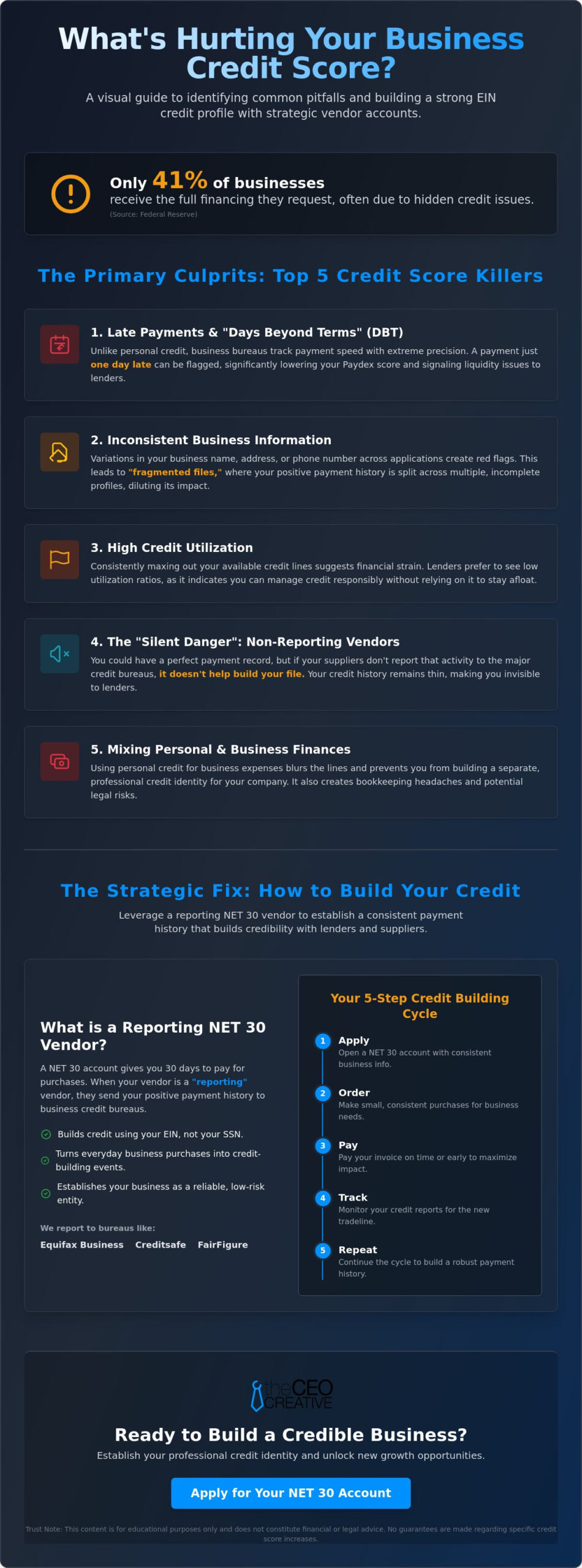
Did you know that according to the Federal Reserve, only 41% of businesses that apply for financing actually receive the full amount they requested? Many entrepreneurs are blindsided by low scores because they don’t realize which specific factors that hurt your business credit score are lurking in their reports. It’s frustrating to feel like your EIN profile is a mystery. This is especially true when you need credit to keep your operations running smoothly. At The CEO Creative, we act as a reporting NET 30 vendor to help you bridge this gap and establish a professional credit identity through consistent payment history.
We understand that the line between personal and business credit often feels blurred. This leads to confusion and missed opportunities for growth. You’ve built your business with passion, and you shouldn’t be held back by a lack of transparency in bureau reporting. This article provides a clear list of behaviors to avoid and a roadmap to repair your standing through strategic vendor accounts. We’ll explore how reporting schedules work with agencies like Equifax, Creditsafe, and FairFigure, giving you the tools to build a credible, sustainable foundation for your company’s future.
Key Takeaways
- Identify the specific factors that hurt your business credit score, from high credit utilization to missed reporting windows, so you can take proactive control of your EIN profile.
- Understand the impact of “Days Beyond Terms” (DBT) and why even a single day’s delay in payment can significantly lower your Paydex score.
- Learn how to leverage a reporting NET 30 vendor to establish a consistent payment history that builds credibility with lenders and suppliers.
- Discover the importance of keeping business and personal finances separate to ensure your credit file remains accurate and professional.
- Master the reporting cycles of major bureaus like Equifax, Creditsafe, and FairFigure to time your purchases and payments for maximum score impact.
Understanding Business Credit and Net 30 Mechanics
The CEO Creative operates as a reporting Net 30 vendor, which means we provide the tools you need to establish a credit history using only your EIN. A Net 30 arrangement is a simple but powerful credit term. It provides a 30-day window between the time you receive an invoice and the date the payment is due. By using a vendor tradeline, your everyday business purchases become tangible evidence of your creditworthiness. Small, consistent orders for supplies show lenders you can manage debt responsibly. Understanding the specific factors that hurt your business credit score is the first step toward long-term financial health.
Many owners don’t realize their credit is at risk until they’re denied an essential line of credit. We’re here to change that. We’ll identify the critical pitfalls that damage your profile and provide a clear roadmap to fix them today. By mastering these mechanics, you transition from a high-risk startup to a credible, established brand in the eyes of major credit bureaus.
Key Definitions for New LLCs
Payment reporting is the primary mechanism used to build business credit reports. It differs from personal credit because most vendors report to bureaus like Equifax or Creditsafe voluntarily. Your Employer Identification Number (EIN) acts as the social security number for your business credit profile. It’s the unique identifier linking your history to your legal entity. Without a clean EIN profile, your business remains invisible to traditional lenders. Trust Note: This content is for educational purposes and is not financial or legal advice.
The Impact of Business Information Consistency
Inconsistency is one of the most overlooked factors that hurt your business credit score. If your business address or phone number varies across different applications, it triggers immediate red flags. Lenders look for stability. They expect your credit applications to match your Secretary of State filing exactly. When vendors report inconsistent data, it leads to “fragmented files.” This means your positive payment history is split across multiple incomplete profiles. Setting up a business net 30 account with accurate details ensures your reporting is consolidated and effective.
The Primary Culprits: Late Payments and Reporting Delays
Missing a payment deadline by just 24 hours can trigger a cascade of negative effects. While personal credit bureaus often wait 30 days to report a delinquency, business bureaus operate on a much tighter schedule. In the commercial world, “on time” is the bare minimum, and even a single day’s delay can be flagged. This immediacy is one of the primary factors that hurt your business credit score because it suggests your company may be struggling with liquidity. To bolster your cash reserves and ensure timely payments, exploring capital recovery options like Trump Tariff Relief can be a strategic move for businesses impacted by import duties.
This is where the concept of “Days Beyond Terms” (DBT) becomes critical. DBT is a core metric used to calculate your risk level. Major bureaus like Equifax, Creditsafe, and FairFigure interpret your payment speed as a direct reflection of your operational health. If you are consistently late, these Actions That Hurt Business Credit Scores linger on your profile, signaling to future partners that you are a high-risk entity. Creditsafe, for example, uses this data to predict the likelihood of a business becoming insolvent, making every day count toward your credibility.
There’s also a “silent” danger to consider: vendors who don’t report at all. You might maintain a perfect payment history with a supplier for years, but if they don’t share that data with the bureaus, your credit file remains thin. It’s essential to partner with a net 30 vendor that prioritizes reporting to ensure your hard work is actually reflected in your score.
How DBT (Days Beyond Terms) Calculates Your Risk
Most business credit scores operate on a 1-100 scale. A score of 80 is often considered the “passing grade,” but that’s typically what you receive for paying exactly on day 30. To reach a perfect 100/100 rating, you have to pay early. Lenders often look for scores above 90 when evaluating applications for high-limit financing. Aiming to settle your invoices by day 20 or 25 isn’t just about being organized; it’s a strategic move to prove your business is thriving and deserves the best possible terms.
Bureau Reporting Schedules and Timelines
Don’t panic if your score doesn’t jump the moment you settle an invoice. Most Net 30 vendors follow a monthly reporting cycle rather than updating in real-time. This means there’s usually a 30-60 day lag between your payment and the bureau update. Understanding this rhythm helps you plan your credit-building activities more effectively. For a deeper dive into choosing the right partners for this journey, see our guide on Net 30 Vendors 2026: The Ultimate Guide to Building Business Credit.
Credit Utilization and Excessive Inquiries
While payment history is the foundation of your profile, credit utilization is a silent heavy hitter among the factors that hurt your business credit score. Utilization is the percentage of your available credit that you’re currently using. If you have a $1,000 limit and carry a $900 balance, you’re at 90% utilization. This signals to bureaus like Equifax and Creditsafe that your business might be relying too heavily on credit to survive. Even if you pay on time, high balances suggest cash flow distress, which can suppress your score growth and make lenders hesitant to increase your limits.
Inquiries also play a unique role in the commercial space. You’ve likely heard about the “Hard Inquiry” myth, where owners fear that checking their score will cause it to drop. In business credit, many vendor applications don’t trigger a hard pull on your personal report, but “shotgunning” applications to dozens of vendors simultaneously is still risky. It creates a profile that looks desperate for capital. Instead of applying everywhere at once, focus on high-quality reporting vendors that offer the specific supplies your business needs to operate professionally.
The Utilization Trap for Small Tradelines
Keeping your balance below 30% is a standard rule of thumb for maintaining a healthy profile. On a small $500 tradeline, this means your balance shouldn’t exceed $150. If you buy $400 worth of office supplies on that same line, your utilization jumps to 80%. This is one of the most common ways business owners accidentally damage your business or personal credit score. For those just starting out, it’s often more effective to build business credit without a loan by managing small vendor accounts with precision and keeping balances low.
Managing Your Credit Mix
Your credit mix refers to the different types of accounts present in your file. A healthy profile includes a combination of Net 30 vendor accounts and revolving business credit cards. If you only have one type of tradeline, such as only buying custom apparel, your score growth may eventually plateau. Diversifying your accounts proves to the bureaus that your business can handle various types of financial obligations. This variety builds a robust profile that lenders find attractive when you eventually apply for larger commercial loans or high-limit credit lines.
5–8 Common Mistakes When Building Business Credit
Building a robust credit profile requires more than just paying your bills. Startups often fall into traps that stall their progress before they even get off the ground. Understanding the factors that hurt your business credit score is essential, but avoiding these common operational mistakes is what keeps your score rising. One of the most frequent errors is co-mingling funds. When you use personal bank accounts for business expenses, you fail to establish a separate financial identity for your EIN. This makes it difficult for bureaus to verify your company’s independent spending power.
Avoid these common pitfalls to protect your credibility:
- Ignoring your credit report: Failing to check your reports from Equifax or Creditsafe for more than 90 days allows errors to go unnoticed.
- Closing old vendor accounts: Age of credit is a major factor. Even if you don’t use a specific vendor often, keeping an old account with a positive history active helps your average account age.
- Lacking LLC compliance: Applying for credit before setting up a professional business address, dedicated phone line, and website can lead to immediate denials. For entrepreneurs who need a robust digital presence, Devco Solution provides custom software development to help you meet these critical professional standards.
- Failing to update bureaus after a move: Inconsistent address data across different vendors creates fragmented files, which suppresses your overall score.
- One-and-done ordering: Ordering once and letting a tradeline go “cold” doesn’t provide the consistent data bureaus need to see. Maintain a regular purchase cycle.
Ready to start building a compliant profile with a partner that understands these nuances? Apply for your business net 30 account today to begin your journey with a reporting vendor.
The Step-by-Step Credit Building Checklist
If your score has taken a hit, follow this structured roadmap to rehabilitate your profile and establish new, positive history.
- 1. Apply: Secure a business Net 30 account with an EIN-only vendor to ensure your activity is tracked.
- 2. Order: Purchase essential office supplies or branding gear that your business actually needs for daily operations.
- 3. Pay: Settle the invoice at least 5-10 days before the 30-day deadline to maximize your Paydex or payment speed score.
- 4. Track: Monitor your reporting on FairFigure or Creditsafe to ensure the vendor is reporting your on-time payments accurately.
- 5. Repeat: Maintain a monthly or quarterly order cycle to keep the tradeline active and prove long-term reliability.
Strategic Credit Repair with The CEO Creative Membership
Repairing a damaged profile requires a shift from defensive management to proactive growth. We’ve explored the various factors that hurt your business credit score, such as thin files and reporting delays. Now, it’s time to focus on the solution. The CEO Creative Membership acts as a cornerstone for your credit rehabilitation strategy. It provides a consistent, high-limit reporting tradeline that helps dilute the impact of past mistakes. By feeding positive data to bureaus like Equifax, you demonstrate that your company is currently reliable and creditworthy.
One of the most effective ways to utilize this membership is through the “Onboarding Kit” strategy. Instead of making random purchases, focus on items that build your brand’s physical presence. Ordering professional stationery and apparel creates a unified look for your team while triggering a reporting event on your EIN. This dual-purpose spending ensures your capital works twice as hard. You’re simultaneously building your professional identity and your financial credibility.
Leveraging Custom Products for Corporate Growth
Investing in Net 30 apparel is a strategic move for any growing organization. Branded uniforms and gear aren’t just operational costs; they are marketing assets. By utilizing customizable products, you turn routine procurement into a powerful credit-building exercise. There’s a distinct psychological benefit to seeing your logo on high-quality gear. It reinforces your brand’s legitimacy to your clients and team while your business credit profile matures in the background.
What Happens After You Join
The transition from application to reporting is designed to be seamless. Once you’re a member, you gain instant access to a curated catalog of business essentials. Your payment activity is automatically shared with major bureaus, ensuring your on-time history is documented. These structured payment terms make cash flow management predictable and easy to track. You won’t have to wonder if your efforts are being noticed. The systematic reporting cycle ensures your positive behavior is reflected in your score month after month. Apply today, select your branding essentials, and watch your new reporting cycle begin.
Secure Your Company’s Financial Future
Success in business credit is a journey of active, consistent interaction with your vendors. We’ve discussed how late payments, high utilization, and inconsistent data are primary factors that hurt your business credit score. By focusing on early payments and maintaining a healthy mix of tradelines, you protect your credibility and unlock essential financing opportunities. Your credit score isn’t just a number. It’s a foundational support system for your long-term success and sustainability.
Ready to establish a professional identity that lenders trust? Apply for a CEO Creative Net 30 Account and Start Building Credit Today. We offer a decision within one business day for new LLCs with no personal guarantee required. Your on-time payments are reported directly to Equifax, Creditsafe, and FairFigure to maximize your profile’s growth. Take this strategic step now and build the credible foundation your business deserves.
Frequently Asked Questions
Do I need a personal guarantee to open a Net 30 account with The CEO Creative?
No personal guarantee is required to open a Net 30 account with The CEO Creative. We focus on empowering new LLCs by providing credit lines based on your business entity rather than your personal assets. This allows you to scale your operations without putting your personal financial standing at risk. It’s a foundational step for any startup looking to separate its corporate and personal liabilities.
Which credit bureaus does The CEO Creative report to?
The CEO Creative reports your payment history to Equifax, Creditsafe, and FairFigure. These are major bureaus used by lenders to assess the health of your EIN profile. By reporting to multiple agencies, we ensure your consistent payment behavior is visible across the industry. This broad visibility helps you build a more robust and credible business credit file faster.
How long does it take for a Net 30 payment to show up on my business credit report?
It typically takes 30 to 60 days for a Net 30 payment to appear on your business credit report. Most vendors operate on a monthly reporting cycle rather than updating in real-time. This means your payment is batched with others and sent to the bureaus at the end of each reporting period. Consistency is key during this waiting period to maintain a healthy profile.
Will paying my Net 30 invoice early help my business credit score more than paying on time?
Paying your invoice early often helps your score more than paying exactly on the due date. Many business credit scoring models reward businesses that settle debts 5 to 10 days before the 30-day deadline. While paying on time maintains your score, early payments can push your rating toward a perfect 100/100 by significantly reducing your “Days Beyond Terms” metric.
Can a low personal credit score stop me from building business credit with an EIN?
A low personal credit score won’t stop you from building business credit with an EIN if you choose the right partners. The CEO Creative provides vendor accounts that don’t require a personal guarantee or a hard pull on your personal report. This structure allows you to build a completely independent corporate credit profile regardless of your past personal financial history or current FICO score.
What happens if I miss a payment on a Net 30 vendor account?
Missing a payment is one of the most critical factors that hurt your business credit score and can lead to immediate drops. Unlike personal credit, business bureaus may flag a delinquency just one day after the due date. This negative data stays on your report and signals high risk to other suppliers. It’s vital to communicate with your vendor if you anticipate any cash flow issues.
How many Net 30 accounts do I need to see a significant score increase?
Most industry experts recommend having at least 3 to 5 active Net 30 accounts to see a significant score increase. A single tradeline provides a starting point, but a diverse mix of accounts proves you can manage multiple obligations simultaneously. This variety builds a more comprehensive profile that traditional lenders look for when you eventually apply for larger commercial loans.
Does buying office supplies really help my corporate credit profile?
Buying office supplies is a highly effective way to build your corporate credit profile because it creates a consistent tradeline. Every purchase you make and pay off on time acts as a data point for the bureaus. Using these supplies for daily operations keeps your business professional while ensuring your EIN profile remains active and healthy through regular, predictable spending cycles.
What is the difference between a hard pull and a soft pull for business credit?
A hard pull is a detailed inquiry that can lower your personal credit score, while a soft pull or no pull doesn’t affect it. Many traditional business credit cards require a hard pull because they ask for a personal guarantee. In contrast, EIN-only vendor accounts often skip this step entirely. This protects your personal standing while you focus on developing your company’s independent financial identity.
How do I fix an error on my business credit report from a vendor?
To fix an error on your business credit report, you must file a formal dispute with the specific bureau reporting the mistake. You should also contact the vendor directly to provide proof of payment or documentation of the error. Keeping detailed records of every transaction is essential for resolving these discrepancies quickly. Regular monitoring ensures you catch these issues before they impact your ability to secure financing.
Building business credit? Net 30 Promotional Products Vendor — EIN only, no personal guarantee, $60 minimum order, credit lines up to $5,500, a decision in one business day, and every on-time payment reported monthly to Equifax Business, Creditsafe and FairFigure.