

Did you know that only 21% of high-credit-risk businesses actually secure the funding they need? When your score drops, you aren’t just losing a digital number; you’re losing the ability to scale and survive. It’s frustrating to watch your growth stall because of loan denials or high insurance premiums, especially with the 2026 prime rate sitting at 6.75%. If you’re wondering how to improve a low business credit score to combat these hurdles, you’re in the right place. We understand the pressure of limited cash flow and the urgent need for more favorable terms.
Your current score isn’t a permanent sentence. We’ll show you exactly how to repair your standing by using strategic Net 30 vendor accounts and consistent payment reporting. You’ll learn the specific steps to rebuild your history and finally separate your personal and business finances. We’ll define how The CEO Creative serves as a reporting Net 30 vendor to help you establish a professional profile. This guide covers everything from choosing tradelines to tracking your progress with bureaus like Equifax, Creditsafe, and FairFigure. Let’s build a foundation that transforms your business into a fundable entity.
Key Takeaways
- Discover how to improve a low business credit score by leveraging reporting Net 30 vendor accounts to establish a positive payment history.
- Understand the specific reporting mechanics used by bureaus like Equifax and Creditsafe to ensure your “Paid as Agreed” status is accurately reflected.
- Learn why paying invoices just a few days early is significantly more effective for your score than waiting until the actual due date.
- Identify professional ways to build credit through practical purchases like onboarding kits and uniforms that serve as strategic business investments.
- Master the five-step cycle—apply, order, pay, track, and repeat—to maintain a consistent and fundable business credit profile over 90 days.
Understanding Business Credit and The CEO Creative Advantage
Business credit is a financial reputation score assigned specifically to your Employer Identification Number (EIN). Unlike your personal credit, which tracks your individual habits, this score is based on how your business handles its obligations with lenders and suppliers. These activities are compiled into Business credit reports that banks and insurance companies review before deciding your terms. Many entrepreneurs find themselves stuck with limited options and often search for how to improve a low business credit score to find a path back to financial stability.
Before we dive into the strategy, please keep in mind that this content is for educational purposes only. It isn’t financial or legal advice, and we don’t guarantee specific score increases. A low score usually happens because of a lack of data, late payments, or high credit utilization on existing lines. Understanding these mechanics is the first step in learning how to improve a low business credit score through active management.
The CEO Creative acts as a strategic partner by serving as a reporting net 30 vendor. We provide high-quality branding products and business credit tradelines that help you build a verifiable history. By purchasing items your business already needs, you create the data points that credit bureaus require to generate a positive score.
Key Definitions: Net 30 and Tradelines
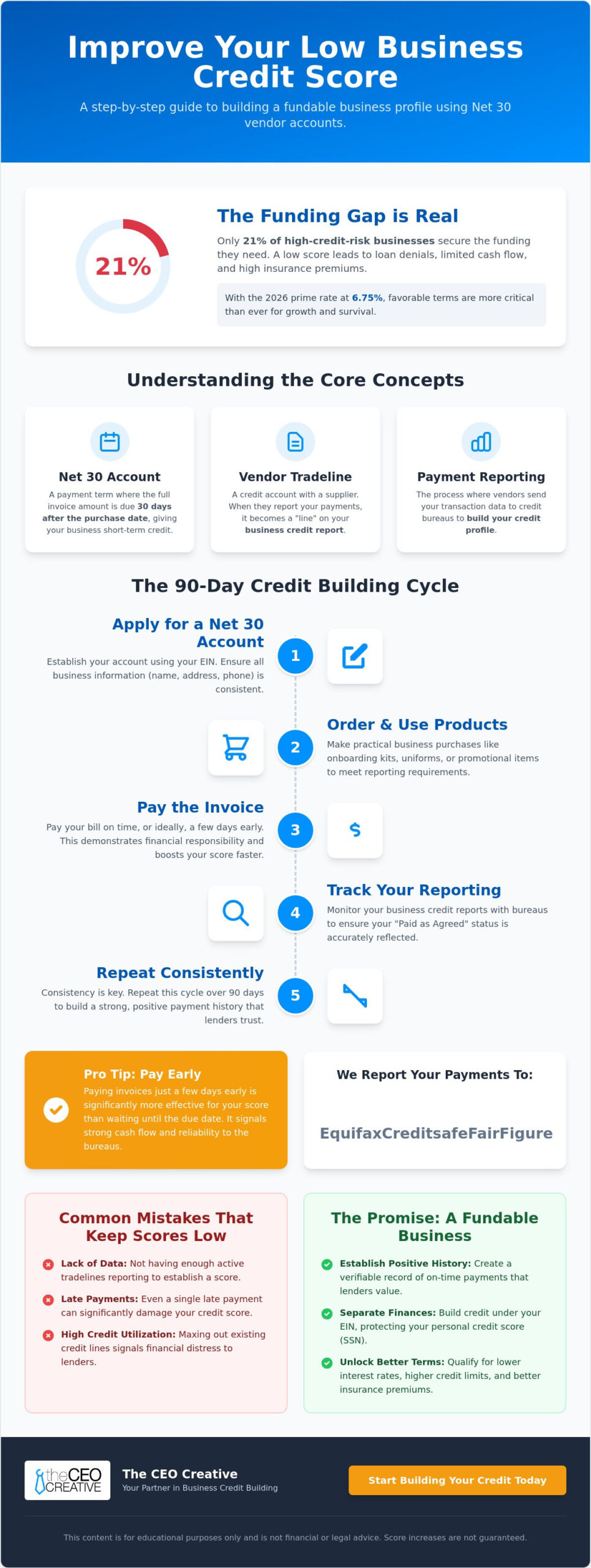
- Net 30: This is a specific payment term where the full amount of your invoice is due exactly 30 days after the purchase date.
- Vendor Tradeline: This is a credit account established with a supplier. When they report your payment behavior to bureaus, it becomes a “line” on your credit report.
- Payment Reporting: This is the technical process where a vendor sends your transaction data to agencies like Equifax or Creditsafe to build your profile.
The ‘Hook and Promise’ of Credit Repair
The ultimate outcome of this process is a professional credit profile that attracts favorable interest rates and higher credit limits. You’re moving from a “no-file” or “low-score” status to a robust, fundable history through consistent activity. Net 30 accounts are the fastest starting point because they’re accessible even to businesses with poor existing credit. By establishing these accounts, you prove you can manage debt responsibly, which is exactly what lenders want to see before they approve a major loan or line of credit.
The Mechanics of Business Credit Bureau Reporting
Business credit scores operate on a completely different scale than the personal FICO scores you’re likely used to. While personal scores range from 300 to 850, most business bureaus use a scale of 0 to 100. Your Employer Identification Number (EIN) acts as the anchor for this entire file. It’s the primary identifier that lenders use to Establish business credit history separate from your social security number. If you’re researching how to improve a low business credit score, understanding this structural distinction is your first step toward success.
Consistency serves as the foundation of a high score. Bureaus don’t just look for payment; they look for a pattern of “Paid as Agreed” or, ideally, “Paid Early” status. In 2026, reporting frequency has become a major factor in rapid score improvement. Monthly reporting from your vendors ensures that your positive behavior is reflected in real-time. This allows you to recover from a low score much faster than relying on vendors who only provide quarterly updates. Every on-time transaction is a vote of confidence in your company’s reliability.
Reporting to Equifax, Creditsafe, and FairFigure
Each bureau provides a different perspective on your business’s financial health. Equifax Business is a primary bureau that many traditional lenders use to assess overall risk. Creditsafe offers a global perspective, tracking stability and payment trends across various markets. FairFigure acts as a modern dashboard, helping you monitor multiple scores simultaneously so you can track your growth. You can see exactly how to improve a low business credit score by watching how these different scores react to your activity. Getting started with a net 30 account that reports to these agencies is a strategic move to ensure your data reaches the right places.
Maintaining Data Consistency
Lenders use a “Lender Match” rule to verify your identity. This means your business name, address, and phone number must match exactly across all your credit files and legal documents. Even a small discrepancy, like using “St.” instead of “Street” in your LLC filing, can create fragmented reports that hide your positive history. To maintain credibility, always use a professional business email and a functional website. These small details signal to bureaus and lenders that your organization is established and reliable. Disorganized data is one of the most common reasons scores remain low despite on-time payments. Fix these details to ensure your reporting counts.
Common Mistakes That Keep Business Scores Low
Building a fundable profile requires more than just paying your bills. Many entrepreneurs spend thousands of dollars with suppliers only to find their scores haven’t moved an inch. If you are struggling with how to improve a low business credit score, you might be falling into a few common traps that keep your data invisible to lenders. Avoiding these mistakes is just as important as opening new accounts.
- Ignoring the reporting status: Using vendors that don’t report to major bureaus like Equifax or Creditsafe is the most common error. Your payment history remains a secret from the rest of the financial world.
- The “Day 30” Trap: Paying exactly on the due date is acceptable for personal credit, but it’s a missed opportunity for business credit. Paying 1 to 5 days early, such as on Day 25, often triggers a higher score than waiting until the last minute.
- Neglecting report accuracy: Fraudulent activity or simple data entry errors can tank your score. You must monitor your files regularly to ensure your business info matches across all platforms.
- Skipping the foundation: Applying for high-tier bank loans or credit cards before establishing Tier 1 foundations leads to instant denials. These hard inquiries can further damage an already low score.
- Closing old accounts: Even if you no longer use a specific vendor, closing the account reduces the average age of your credit history. Keep those lines open to show long term stability.
The Trap of Non-Reporting Vendors
Big-box retailers and local hardware stores are convenient, but they rarely help your score repair journey. Most of these companies don’t provide a “tradeline” that appears on your corporate credit file. Before you make a purchase, verify if the supplier reports to the bureaus. A “hidden” trade line might give you credit terms, but a public reporting one is what actually builds your reputation. Always prioritize vendors that explicitly state they send data to agencies like Equifax to ensure your spending counts toward your goals.
Financial Missteps and Personal Guarantees
Relying on personal credit cards for business expenses is a major hurdle. This behavior increases your personal debt to income ratio and keeps your business and personal finances dangerously intertwined. When you use your Social Security number for business applications, you risk “hard pulls” that lower your personal score. This is why “no personal guarantee” (No PG) accounts are a safer path. These accounts rely strictly on your EIN, allowing you to learn how to improve a low business credit score without risking your personal financial health. By focusing on EIN only credit, you protect your individual assets while building a professional entity that stands on its own.
Step-by-Step Checklist to Improve Your Score
Repairing your financial profile requires a disciplined approach rather than a series of random actions. If you’re focusing on how to improve a low business credit score, you need to commit to a 90 day consistency window. This duration allows enough time for vendors to report your activity and for bureaus to update your data. By following a structured cycle, you can move from a stagnant file to a fundable one without taking on unnecessary debt. Learn more about this approach in our guide on how to build business credit without a loan.
The goal is to create a “paper trail” of reliability that lenders can verify. We recommend using the “Apply, Order, Pay, Track, Repeat” framework for all your Tier 1 accounts. This repetitive cycle is the most effective way to demonstrate that your business is a low risk partner. When you stick to this plan, you’re not just guessing how to improve a low business credit score; you’re actively engineering a better one.
The 5-Step Net 30 Cycle
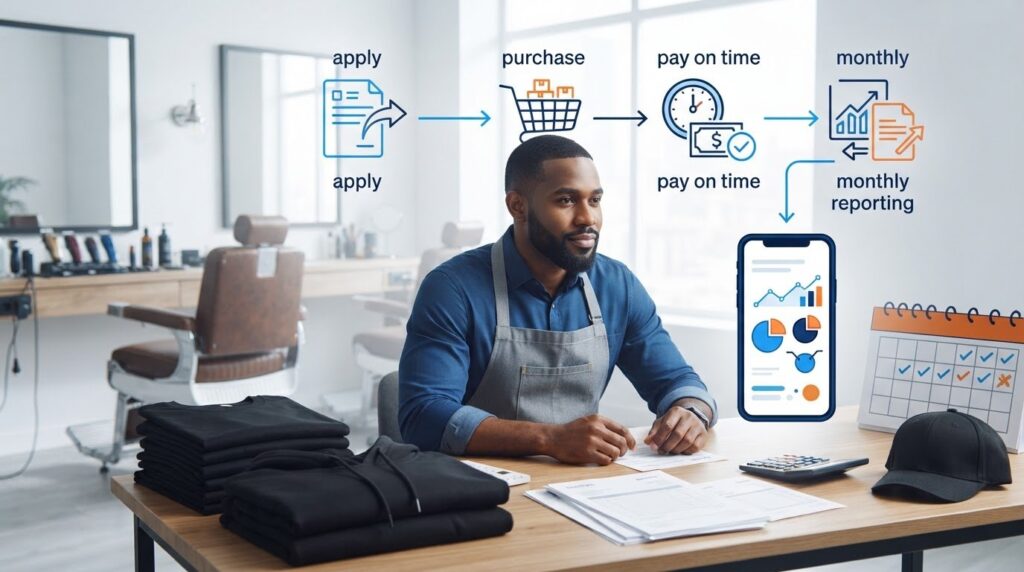
- 1. Apply: Your journey starts by securing a Business Net 30 Account using your EIN. This establishes the initial link between your business identity and the credit bureaus.
- 2. Order: Purchase items that help your operations grow. Focus on essential office supplies or custom branding gear that your business already needs to stay professional.
- 3. Pay: Don’t wait for the deadline. Settle the invoice early, ideally within 20 to 25 days, to signal extreme reliability to the reporting agencies.
- 4. Track: Monitor your progress through platforms like FairFigure. This confirms the tradeline is reporting correctly and helps you identify any data gaps.
- 5. Repeat: One purchase isn’t enough to build a score. Maintain a monthly purchase cycle to keep the tradeline active and the positive data flowing into your file.
Tiered Progression Strategy
Establishing 3 to 5 Tier 1 vendor accounts is necessary before you even think about moving to Tier 2 retail cards. Jumping ahead too quickly is a common reason for application denials. You should avoid applying for traditional bank loans until you have achieved a Paydex score of 80 or higher. This score indicates to lenders that you consistently pay your bills on or before the due date. Once you’ve hit this milestone, you can use your improved score to negotiate better terms or higher credit limits with your existing suppliers. This tiered approach ensures your growth is sustainable and backed by a solid financial reputation. Ready to start your first reporting cycle? Apply for your net 30 account today to begin establishing your history.
Building Credit Through Product-Focused Growth
Every dollar spent on your business should work twice. You receive a high-quality product for your operations, and your business credit file receives a positive data point. If you’re currently navigating how to improve a low business credit score, this dual-purpose spending is the most efficient strategy available. Instead of making random purchases, focus on essential items like Onboarding Kits and Uniforms. These items keep your spending professional and consistent, which is exactly what bureaus want to see.
The CEO Creative Membership serves as a foundational support system for this journey. It provides access to tools that streamline your spending and ensure your activity is reported to the right agencies. By integrating your branding needs with your credit building goals, you ensure that every invoice settled is a step toward a higher score. This approach eliminates the confusion over bureau reporting and puts you in control of your financial reputation.
Strategic Branding with Net 30 Terms
Brand identity is a powerful tool for any new LLC or service-based agency. Using customizable products like mugs and stationery allows you to solidify your image while establishing your history. Equipping your team with Net 30 apparel creates a professional look that builds trust with your clients. There is a distinct psychological benefit to seeing your brand grow physically as your credit score improves on paper. It elevates the act of purchasing basic essentials into a strategic move for your company’s long-term sustainability.
Membership and Long-term Scaling
Membership programs provide the ongoing reporting and exclusive options necessary for long-term scaling. As your business matures and your needs become more complex, you can move from basic supplies to high-level web packages. This natural progression ensures your credit file remains active and relevant as you target higher credit limits. For a complete overview of how to structure your accounts, consult our Net 30 Vendors Guide. This resource helps you identify the best partners for your specific stage of development.
Learning how to improve a low business credit score is a marathon of small, consistent, and reported actions. By choosing products that serve your operational needs while building your tradelines, you create a fundable entity that is ready for future opportunities. Focus on the long-term vision and let your everyday business expenses build the foundation you need. Consistent activity over the next 90 days will set the stage for the better terms and cash flow your business deserves.
Take Control of Your Financial Reputation Today
The CEO Creative is here to act as your foundational support system. Our accounts offer a decision within one business day for membership tiers and report directly to Equifax, Creditsafe, and FairFigure. You can build your history using your EIN only, as no personal guarantee is required for our standard business accounts. This allows you to protect your personal assets while your company stands on its own. Apply for a CEO Creative Net 30 Account and start building credit today! Your path to a stronger financial future starts with a single reported purchase. We look forward to being your partner in long term scaling and success.
Frequently Asked Questions
Do I need a personal guarantee to improve my business credit score?
No, you don’t need a personal guarantee to establish or improve your score. Many reporting vendors offer “No PG” accounts that rely strictly on your Employer Identification Number. This is a strategic way to separate your personal and business finances while protecting your individual assets. Focusing on these accounts is a key step in learning how to improve a low business credit score without risking your personal credit profile.
How long does it take for a Net 30 vendor to report to the bureaus?
Most Net 30 vendors report your activity on a monthly or quarterly schedule. You can generally expect to see a new tradeline appear on your report within 30 to 60 days after your invoice is settled. Consistency is vital because bureaus need several cycles of data to generate a reliable score. Checking your file regularly through platforms like FairFigure will help you confirm when the reporting has been successfully completed.
Will paying my invoice early help my business credit score more than paying on time?
Yes, paying early often provides a greater boost than simply paying on time. For example, the Dun & Bradstreet PAYDEX score specifically rewards businesses that settle invoices before the due date. Paying on Day 20 or Day 25 of a 30 day term signals to lenders that you have excellent cash flow management. This proactive behavior is one of the fastest ways to improve a low business credit score and secure better terms.
Can I build business credit with just an EIN and no personal credit history?
You can absolutely build business credit using only your EIN. By starting with Tier 1 vendors that don’t require a personal credit check, you establish a standalone corporate profile. This process allows your business to earn its own reputation based on its own payment history. It’s an ideal path for entrepreneurs who want to keep their personal and professional financial identities entirely separate from day one.
What is the difference between a Tier 1 and a Tier 2 vendor?
Tier 1 vendors are starter accounts that usually offer Net 30 terms with minimal requirements or personal guarantees. They are the foundation of your credit profile. Tier 2 vendors typically include retail store cards, like those from major gas stations or office supply chains, which often require at least three established tradelines. You must master Tier 1 before applying for Tier 2 to avoid unnecessary application denials.
How many tradelines do I need to see a significant score increase?
Most experts suggest establishing at least 3 to 5 active tradelines to generate a robust score. Bureaus need a variety of data points to assess your reliability across different types of spending. Having multiple reporting accounts shows that you can manage various obligations simultaneously. This diversity is essential for businesses looking to move beyond basic vendor terms and into high-level bank financing or large lines of credit.
Does The CEO Creative report to Equifax and Creditsafe?
Yes, The CEO Creative reports your payment activity to major bureaus including Equifax Business and Creditsafe. We also share data with FairFigure to provide you with a comprehensive view of your progress. By maintaining a membership and making consistent purchases, you ensure that your positive payment history is reflected across the agencies that lenders use most. This broad reporting is a cornerstone of our credit building membership model.
What happens if I miss a payment on a Net 30 account?
Missing a payment can lead to late fees and a significant drop in your business credit score. Because business scores are heavily weighted toward payment history, even one late report can signal high risk to future lenders. If you’re struggling with cash flow, it’s better to communicate with the vendor early. Maintaining a “Paid as Agreed” status is the single most important factor in protecting your hard-earned financial reputation.
Building business credit? Open a Net 30 Account — EIN only, no personal guarantee, $60 minimum order, credit lines up to $5,500, a decision in one business day, and every on-time payment reported monthly to Equifax Business, Creditsafe and FairFigure.
What should I do if my business credit score is low?
A low business credit score is fixable, and the first step is pulling your reports from the major bureaus and checking them for errors, since inaccurate information is a common and easy-to-fix drag on a score. From there, pay everything on time going forward and ask any supplier you work with whether they actually report payment activity to a bureau, because a payment that never gets reported can’t help your file. Bringing down how much of your available credit you’re using also tends to help.
How do I improve my business credit score?
Improving a business credit score comes down to a few repeatable habits: pay on time or early, keep credit utilization low, open tradelines with suppliers who report to a bureau, and correct any errors you find on your reports. None of these moves fast on their own, since a score reflects accumulated reported activity rather than a single good month. Consistency across several reporting cycles usually matters more than any one payment.
How long does it take to improve a business credit score?
There’s no fixed timeline, because how fast a score moves depends on how quickly new payment activity gets reported and how much history a bureau already has on file. Suppliers differ in how often they report, and more frequent reporting gets positive activity onto a file sooner. The CEO Creative, for instance, reports payment activity monthly to Equifax Business, Creditsafe, and FairFigure.
What hurts a business credit score the most?
Late payments and high credit utilization are generally the two biggest drags on a business credit score, since bureaus weight payment history heavily and a maxed-out credit line reads as risk to a lender. Having too few open tradelines, or none at all, can also hold a score down because there’s little payment history for a bureau to report. Errors on a credit report, like a payment marked late that wasn’t, can drag a score down too even though the fault isn’t the business owner’s.