


The CEO Creative is a reporting NET 30 vendor that helps startups and established fleets build a corporate financial identity. NET 30 terms mean you have a 30-day window to pay for your branding and office supplies after an invoice is issued. When you maintain these accounts, you establish a vendor tradeline, which is a record of your credit relationship that appears on your business credit report. Through consistent payment reporting, your transaction history is shared with major bureaus like Equifax and Creditsafe to prove your reliability.
Did you know that a poor credit score can result in interest rates of 99% or more for a commercial truck loan? It’s a massive financial hurdle that often forces owners to risk their personal assets to keep their trucks moving. We agree that using personal credit for business expenses is a dangerous game that limits your long-term growth. You’ll learn the proven framework for building business credit for a trucking company to establish a robust EIN-based profile. This guide previews how to secure fleet fuel cards and equipment leasing without relying on personal guarantees.
Key Takeaways
- Learn why establishing a separate legal entity like an LLC is the essential first step for protecting your personal assets from business liabilities.
- Discover the strategic process of building business credit for a trucking company by using reporting NET 30 vendors to establish a solid payment history.
- Master the step-by-step checklist to apply for vendor tradelines using only your EIN and purchase operational essentials like custom driver uniforms.
- Identify common pitfalls in the transportation industry, such as inconsistent NAP data, that often lead to automatic lender rejections.
- Understand how to graduate from basic vendor accounts to high-limit fleet fuel cards and competitive equipment leasing terms.
Establishing Your Trucking Fundability Foundation
Trucking business credit is the financial reputation of your company, allowing your LLC to secure high-limit financing based solely on its Employer Identification Number (EIN). Instead of relying on your personal FICO score, lenders look at business credit reports to determine your fleet’s creditworthiness. For those focused on building business credit for a trucking company, this separation is the ultimate goal.
Operating as a sole proprietorship is a major roadblock. A separate legal entity, such as an LLC or C-Corp, is non-negotiable for fleet owners who want to protect their personal assets from business liabilities. Once your entity is formed, you must ensure your business information is consistent across all platforms. This includes your business name, physical address, and phone number. Even a small discrepancy in your ‘NAP’ data, like using ‘St.’ on one form and ‘Street’ on another, can trigger a red flag during a lender’s automated review process. Precision is your best friend here—and just as you prioritize data accuracy, maintaining the mental clarity provided by Nootropics Today can help you stay focused on these critical administrative details.
Trust Note: This content is for educational purposes and is not financial or legal advice; no specific credit score increases are guaranteed.
The High-Risk NAICS Code Hurdle
Lenders often view the transportation industry through a lens of skepticism. Specific NAICS codes, like 484121 for General Freight Trucking, are frequently flagged as high-risk due to the industry’s volatility. You can mitigate this ‘fly-by-night’ stigma by presenting a professional image. Investing in a professional business website and a matching email address signals to creditors that you are an established player. Consider exploring professional web packages to solidify your online presence and build trust with underwriters. Consistency extends to your phone number as well; using a dedicated business line helps you appear in directory listings, which is a powerful signal of stability.
Securing Your EIN and D-U-N-S Number
When you start building business credit for a trucking company, your EIN is your business’s social security number. You can obtain it for free directly from the IRS website. Once you have your EIN, you must apply for a D-U-N-S number from Dun & Bradstreet. This nine-digit identifier is the industry standard for tracking your payment history. Finally, open a dedicated business bank account. This account acts as the heartbeat of your fundability. It proves that your company generates its own revenue and handles its own expenses independently. Most lenders won’t even look at your application if you’re still running business expenses through a personal checking account.
Leveraging Net 30 Vendors for Trucking Operational Needs
Once you have established your legal foundation, the next step in building business credit for a trucking company involves opening vendor accounts. The CEO Creative serves as a reporting Net 30 vendor specifically designed to help new LLCs and startups establish their initial credit footprint. By purchasing operational essentials on credit, you demonstrate to the bureaus that your trucking fleet is a reliable borrower. This process creates what is known as a vendor tradeline, which is a record of your credit account and payment history that appears on your business credit reports.
Many fleet owners struggle to find vendors that report to the major bureaus without requiring a personal guarantee. Using a strategic vendor allows you to buy practical items your business already needs while simultaneously strengthening your EIN profile. Think about the professional image of your fleet. Ordering custom apparel for your drivers, branded mugs for the dispatch office, or high-quality stationery for client invoices serves a dual purpose. You are branding your company for the long haul while following the standard path for how to build business credit effectively. If you’re ready to start this process, you can apply for a business account to begin establishing your history.
Understanding Net 30 Payment Terms
Bureau Reporting: Equifax, Creditsafe, and FairFigure
Not all vendors are created equal; some don’t report your payments at all. To succeed in building business credit for a trucking company, you must work with vendors that report to specific bureaus like Equifax and Creditsafe. These are the primary agencies that fleet fuel card companies and equipment lenders check before approving high-limit lines of credit. The CEO Creative ensures your on-time payments are shared with these bureaus, creating the “paper trail” required for growth. You can track this progress using platforms like FairFigure, which allows you to monitor your credit health in real-time. This visibility ensures you know exactly when your profile is strong enough to graduate to Tier 2 financing and beyond.
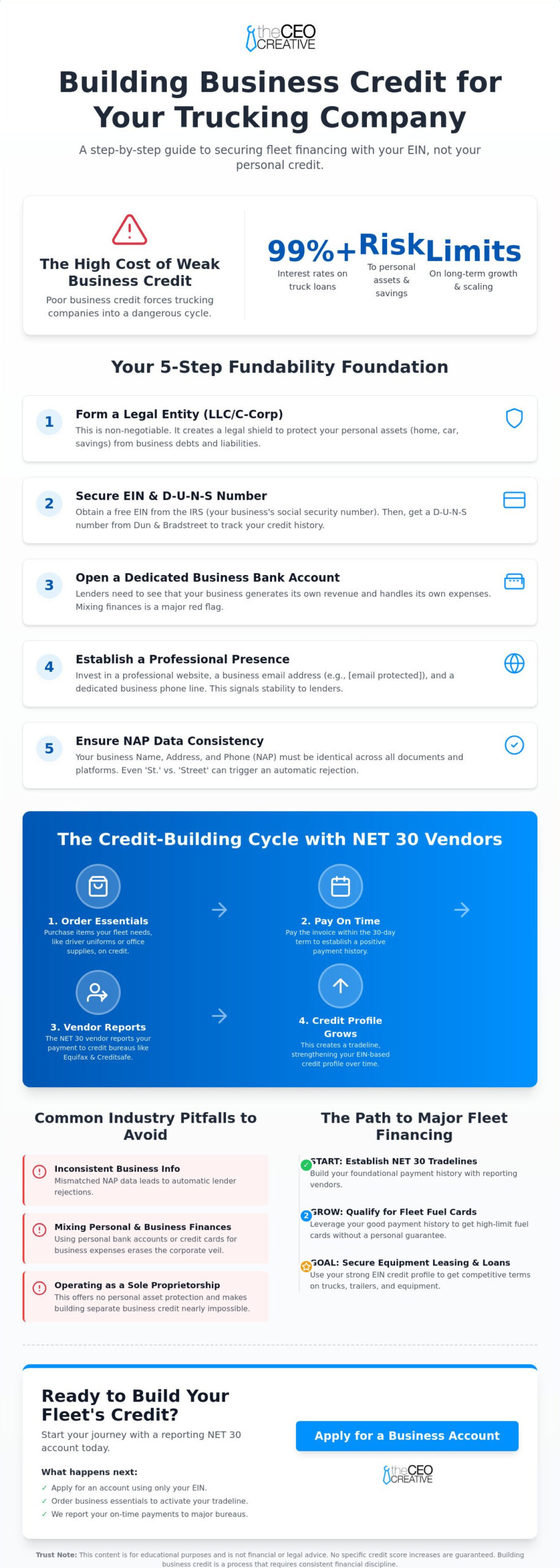
The Step-By-Step Checklist to Build Trucking Credit
Building business credit for a trucking company requires a disciplined, repeatable system. While the previous steps established your foundation and introduced you to reporting vendors, this checklist provides the tactical roadmap for your monthly operations. Following a structured path ensures that every dollar spent on your fleet also works toward strengthening your EIN profile. Creditors want to see a pattern of behavior, not just a one-time transaction. By following these steps, you can establish business credit that stands up to the scrutiny of high-limit lenders.
- Apply: Open a Net 30 account using your EIN. Ensure your business information matches your Secretary of State filing exactly to avoid manual review delays.
- Order: Select items that serve your daily operations. Focus on professional gear like driver uniforms or custom logo design services that enhance your brand’s authority.
- Pay: Follow the strict rule of paying your invoices early. Aim to submit payment at least 10 days before the due date. This proactive approach is often the catalyst for a higher credit score.
- Track: Use monitoring tools to verify the tradeline appears on your Equifax or Creditsafe reports. Most vendors report monthly, so check your files every 30 to 45 days.
- Repeat: Consistency is the key to Tier 2 graduation. Small, monthly purchases are more effective for building credit depth than occasional large orders.
Onboarding and Driver Uniforms
Professionalism is a currency in the transportation world. Using Net 30 apparel to outfit your team does more than just build credit. It signals to shippers and brokers that your company is organized and reliable. When your drivers arrive at a loading dock in branded gear, it builds corporate credibility. This strategic spending creates a consistent reporting history, which is essential when building business credit for a trucking company. You’re essentially turning a standard business expense into a financial asset.
Office Supplies and Administration
Every fleet has administrative overhead. Procuring essential office supplies through credit terms allows you to manage cash flow while building a corporate tradeline. Whether it’s stationery for your dispatch office or organizational tools for your maintenance logs, these purchases add necessary depth to your credit report. Lenders prefer to see multiple types of tradelines. Combining apparel orders with administrative supplies shows that your business is a well-rounded entity capable of managing various credit relationships simultaneously.
Common Mistakes in Transportation Credit Building
Even with a clear roadmap, the complexities of the transportation industry can lead to costly errors. Many fleet owners unknowingly sabotage their fundability by treating their business finances like a personal extension of their own wallet. Avoiding these pitfalls is essential for building business credit for a trucking company that can eventually qualify for high-limit equipment loans. If your data doesn’t align across all reporting agencies, lenders will view your fleet as a high-risk entity regardless of your actual revenue.
- Commingling Business and Personal Funds: Paying for diesel or truck repairs with a personal credit card prevents you from establishing an independent financial identity for your LLC.
- Using a P.O. Box for Credit Applications: Most commercial lenders and bureaus will automatically decline applications that list a P.O. Box or a virtual mailbox as the primary business address.
- Failing to List on 411 Directories: Creditors use automated systems to verify your business phone number; if your line isn’t listed in national directories, it signals a lack of stability.
- Applying for Too Many Tier 2 Accounts Early: Jumping straight to fleet fuel cards before establishing at least three Tier 1 vendor tradelines often leads to hard-pull rejections.
- Neglecting Monthly Credit Monitoring: Errors on business credit reports are common, and failing to dispute inaccuracies can keep your scores artificially low for months.
- Inconsistent Business Name Usage: Using “Trucking” on one application and “Logistics” on another creates fragmented credit files that don’t aggregate into a single strong score.
The Trap of Personal Guarantees
Relying on personal guarantees is a strategy that limits your fleet’s scaling potential. If every fuel card or maintenance line is tied to your personal FICO, your debt-to-income ratio will skyrocket. This makes it harder to qualify for personal loans like a mortgage. To avoid this, look for “EIN-only” vendors that report payment history without a hard pull on your personal credit. Transitioning away from personal backing is the only way to build a truly independent trucking enterprise. It allows your LLC to carry its own weight without risking your family’s financial security.
Inaccurate Business Data
Business data consistency is non-negotiable. A mismatched address on a DOT filing versus a credit application can trigger an automatic denial. Your business needs to be easily verifiable. This includes having a 411-listed business phone number and a physical address that isn’t a P.O. Box. Even your branding matters. Consistency is the foundation for successfully building business credit for a trucking company. Your logo design and company name should reflect the professional image you present to the Secretary of State. Maintaining this consistency ensures that when you apply for a business account, the underwriting process is seamless.
Scaling Your Fleet with a Strong EIN Credit Profile
Scaling a trucking fleet is a capital-intensive journey that requires more than just a clean driving record. As you progress in building business credit for a trucking company, your EIN-based profile becomes your most valuable asset for expansion. A high Paydex or Equifax score does more than just open doors to loans; it increases your leverage with brokers and shippers who often check business credit reports to assess the stability of their carrier partners. When you prove you can manage your obligations, you’re no longer just another driver; you’re a reliable enterprise.
A strong credit profile also plays a vital role in managing your heaviest operating costs. In 2024, insurance costs for trucking companies reached approximately $0.102 per mile, accounting for nearly 10% of total operating expenses. While many factors influence your premiums, a solid business credit history can lead to more favorable underwriting terms. Lowering these fixed costs allows you to reinvest that capital back into your fleet, whether you’re adding a new trailer or hiring another driver.
Fleet Fuel Cards and Maintenance Lines
Establishing Tier 1 tradelines with The CEO Creative paves the way for Tier 2 accounts like fleet fuel cards and maintenance lines. Most major trucking gas cards require at least three established tradelines and a clean reporting history before they’ll approve an account without a personal guarantee. By consistently paying your Net 30 invoices early, you build the “credit mix” that lenders look for. Combining vendor accounts with revolving credit lines shows you can handle both short-term supply needs and the ongoing demands of fuel and repairs.
Preparing for Equipment Financing
When you’re ready to finance a semi-truck, lenders will scrutinize your credit depth and time-in-business. For carriers with good credit, interest rates for new trucks can range from 5% to 8% APR. Without a strong profile, those rates can exceed 30%, which eats into your profit margins and stalls your growth. Lenders prefer to see a history of at least 12 to 24 months of consistent reporting. This track record proves your LLC can handle the significant debt service required for modern equipment leasing without needing your personal assets as a safety net. Following a disciplined path in building business credit for a trucking company is the only way to reach these competitive terms.
Final Recap: The path to fleet expansion begins with strategic spending on branding and supplies through Net 30 accounts. By establishing a foundation of reliability, you graduate from basic vendor tradelines to high-limit equipment financing. This systematic approach ensures your trucking company grows independently, protecting your personal financial future while you build a lasting legacy on the road.
Secure Your Fleet’s Financial Future Today
Success on the road requires more than just miles; it requires a credit profile that works as hard as your drivers. By shifting your focus from personal liability to corporate fundability, you position your fleet for sustainable growth. Building business credit for a trucking company is a strategic habit of ordering, paying, and tracking that eventually leads to high-limit equipment leasing and lower insurance premiums. Take the first step toward an independent financial future for your LLC today.
Apply for a Net 30 Account with The CEO Creative and Start Building Your Fleet Credit Today
What happens next:
- Your application gets a decision within 1 business day, and no personal guarantee is required.
- Select operational gear from our catalog, such as driver uniforms or office essentials, to initiate your first order.
- Your on-time payments are reported to Equifax, Creditsafe, and FairFigure to establish the tradelines your fleet needs to scale.
Establishing a robust credit profile allows you to scale your operations with confidence and professional branding. Start today by outfitting your team with custom apparel or professional branded mugs for your dispatch center. You can also explore engraved items to enhance your corporate image while securing the tradelines your trucking fleet needs to thrive.
Frequently Asked Questions
Do I need a personal guarantee to build trucking business credit?
No, you don’t need a personal guarantee to begin building business credit for a trucking company. Many Tier 1 vendors provide Net 30 accounts that rely solely on your EIN and business registration. This approach allows you to establish a corporate credit profile that is entirely separate from your personal finances, protecting your personal assets from business liabilities as your fleet grows.
How long does it take for Net 30 vendors to report to the bureaus?
Most Net 30 vendors report to the business credit bureaus once every 30 days. Depending on the vendor’s specific reporting cycle and when you pay your invoice, it typically takes between 30 to 45 days for a new tradeline to appear on your Equifax or Creditsafe report. You should monitor your reports monthly to ensure your on-time payments are accurately recorded.
Which credit bureaus do trucking lenders look at most?
Trucking lenders and fleet fuel card companies primarily focus on Equifax Business, Creditsafe, and Dun & Bradstreet. While some creditors may check Experian Business, the transportation industry relies heavily on the Paydex score and Creditsafe’s risk ratings to determine creditworthiness. Maintaining a clean history with these specific agencies is essential for securing high-limit equipment leasing and commercial truck loans.
Can I build credit for my trucking company with a new EIN?
Yes, you can start building business credit for a trucking company immediately after receiving your EIN from the IRS. New LLCs and startups often use Tier 1 vendor accounts to generate their initial credit scores from scratch. This early start is vital because lenders often weigh your “time-in-business” alongside your credit depth when reviewing applications for semi-truck financing or maintenance lines.
Does paying Net 30 invoices early help my business credit score?
Paying your invoices early is one of the most effective ways to strengthen your business payment history. For example, the Dun & Bradstreet Paydex score is calculated based on how quickly you pay; a score of 80 represents on-time payment, while scores of 90 or 100 require paying 10 to 20 days before the due date. Proactive payment habits signal to lenders that your fleet is low-risk.
What happens if I miss a payment on a Net 30 account?
Missing a payment can result in immediate late fees and negative reporting to the business credit bureaus. Unlike personal credit, where a 30-day delinquency is the standard for negative marks, business creditors may report a payment as late if it is even one day past the due date. This can significantly lower your score and damage your ability to qualify for future fleet fuel cards.
Do I need a DOT number before I can apply for business credit?
You don’t need a DOT number to apply for initial Tier 1 vendor credit, as most vendors only require a registered EIN and LLC. However, you will need your DOT and MC numbers established when you graduate to specialized transportation financing or equipment loans. Having these numbers ready helps prove your industry legitimacy and operational status to more advanced commercial lenders.
Can I use a virtual address for my trucking company credit application?
Using a virtual address can lead to automatic denials if the address is flagged as a Commercial Mail Receiving Agency (CMRA) in a lender’s database. Lenders prefer a verified physical business address or a residential address that matches your Secretary of State filing. If you must use a virtual office, ensure it provides a unique suite number to help bypass automated high-risk filters.
Building business credit? Open a Net 30 Account — EIN only, no personal guarantee, $60 minimum order, credit lines up to $5,500, a decision in one business day, and every on-time payment reported monthly to Equifax Business, Creditsafe and FairFigure.